


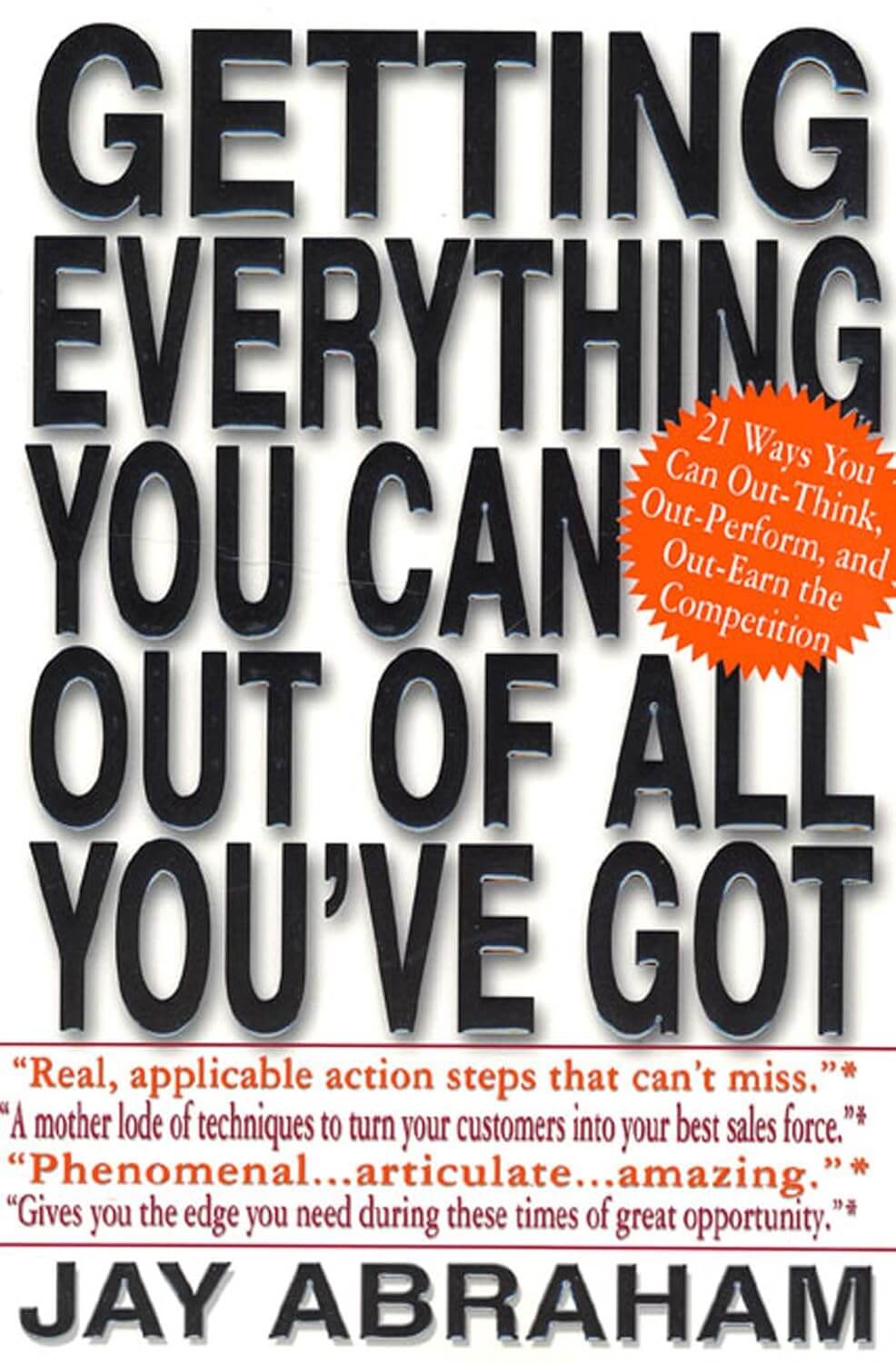
Prefer the print book? Buy on Amazon
As an Amazon Associate, Sumizeit earns from qualifying purchases.
Getting Everything You Can Out of All You’ve Got Book Summary
This Getting Everything You Can Out of All You’ve Got Book Summary covers the key ideas, lessons, and takeaways in about 20 minutes.
Short Description:
Abraham shows growth comes from leveraging existing resources strategically.
You don’t need more money, more staff, or more time to grow — you need clearer thinking about what you already possess. By evaluating your current performance, refining your offerings, identifying profitable customers, mastering multi-channel marketing, building trust, increasing transaction value, and leveraging partnerships, you unlock massive improvements in revenue and customer loyalty.
Growth happens when you stop operating on autopilot and begin using every asset — tangible or intangible — to its fullest strategic potential. Abraham shows that the most profitable opportunities are rarely external; they are already in your hands.
Helps with these goals
Preview the Getting Everything You Can Out of All You’ve Got book summary
Below is a preview of Sumizeit’s comprehensive human-written summary of Getting Everything You Can Out of All You’ve Got by Jay Abraham. The full summary is 15-20 minutes long and covers the book’s key ideas in text, audio, visual, and video formats. Unlock the full 20 Minute Summary
Jay Abraham’s central message is deceptively simple: most businesses dramatically underuse the assets already at their disposal. Instead of hunting for brand-new opportunities, Abraham argues that companies can achieve explosive gains by uncovering overlooked strengths, underutilized resources, and unused market advantages that already exist inside the business. His book is a blueprint for expanding profits, increasing customer loyalty, and multiplying growth by better leveraging what you already have.
Abraham’s framework covers five major areas: evaluating your current performance, defining your offering, attracting and engaging customers, converting interest into profitable sales, and scaling beyond your current limits. Underneath every tactic is the recurring belief that businesses succeed not by chance but by intentional design — and that design begins with understanding exactly where you stand and where you can realistically grow.
Part 1: Understanding Your Current Position and Setting a Direction
Abraham begins by insisting that businesses must take an unflinching look at their strengths, weaknesses, competitive landscape, and current market position before attempting any form of growth. Many business owners, he suggests, operate based on assumptions that haven’t been tested in years. By auditing your business model with clarity and honesty, you identify what is working, what isn’t, and what opportunities lie hidden beneath operations that have become routine.
This kind of assessment doesn’t just reveal operational flaws — it clarifies your priorities. Without this grounding, businesses waste time chasing new ideas that don’t create meaningful profit.
Abraham recommends building a clear overview of three core elements:
What you sell
Who you sell it to
How you deliver it
This deceptively basic map uncovers layers of insight. Businesses often believe they understand their customers, but the moment they articulate these components, they discover uncertainties or outdated assumptions. Clarifying the structure of your current model makes it easier to identify the exact mechanisms generating revenue — and the ones failing to contribute.
When analyzing these parts of your model, it’s important to treat different customer groups as separate segments. Even if you sell one product, different buyer categories may purchase for entirely different reasons, use the product differently, or respond to different forms of messaging.
Abraham emphasizes that you cannot evaluate your own strengths without studying the companies competing for your customers’ attention. By examining competitors, you uncover:
What they do better than you
Where they fail to deliver
Why customers may choose them instead
What differentiators make customers choose you
Through this kind of analysis, companies discover what prevents them from dominating their markets. Sometimes the issue is product quality, sometimes convenience, sometimes pricing structure, and sometimes messaging. Whatever the reason, understanding your position relative to competitors gives you a roadmap for improvement.
Generating Innovative Business Ideas by Breaking Conventional Thinking
Once you understand your current state, Abraham encourages a radical shift in creativity: break away from familiar industry wisdom and draw inspiration from other fields entirely. Businesses often remain stuck because they only study companies similar to their own — limiting the potential for innovation.
By examining strategies from…
Want the complete 20-minute summary?
- Full structured summary
- Video Summary
- Podcast Summary
- Audio summary
- Key takeaways
- Exercises
- Quiz
- Highlights and notes
- Ask the book with AI
Who should read Getting Everything You Can Out of All You’ve Got?
Getting Everything You Can Out of All You've Got is ideal for business owners, entrepreneurs, and managers who feel stuck in their growth trajectory. If you're looking to increase revenue without necessarily spending more money, or if you suspect your business has untapped potential, this book provides a systematic approach to unlocking hidden value. It's particularly valuable for those who want to work smarter rather than harder.
Why does Getting Everything You Can Out of All You’ve Got matter?
In today's competitive business environment, the ability to extract maximum value from existing resources is a critical competitive advantage. Jay Abraham's framework shows that explosive growth rarely requires external capital or entirely new strategies—it emerges from clarity about what you already have. This mindset shift is especially relevant for businesses facing economic uncertainty, where optimization and efficiency directly impact survival and profitability.
What are the key themes in Getting Everything You Can Out of All You’ve Got?
- Maximize existing resources instead of chasing new opportunities
- Know your current position before attempting growth
- Understand customer psychology and hidden motivations
- Build trust before converting sales
- Strategic partnerships amplify growth
- Operational efficiency enables scaling
- Multi-channel marketing creates consistent visibility
How can you apply ideas from Getting Everything You Can Out of All You’ve Got?
- Conduct an honest audit of your business identifying what's working, what isn't, and what opportunities are hidden in current operations
- Develop detailed customer profiles of your highest-value buyers and study their behavioral patterns, motivations, and usage habits
- Create a formal referral system with clear incentives and simple mechanisms that encourage happy customers to share your business
- Map your competitors' strengths and weaknesses to clarify your true competitive advantages and areas for improvement
- Design and test strategic partnerships with non-competing businesses serving the same audience to expand reach without additional spending
- Implement a systematic approach to collecting and acting on customer feedback and complaints as product development direction
- Build trust-building elements into your sales process including guarantees, transparent communication, and generous trials before customers commit
What common mistakes do readers make with Getting Everything You Can Out of All You’ve Got?
- Operating on autopilot based on untested assumptions rather than regularly auditing actual business performance and customer behavior
- Chasing new opportunities instead of first maximizing value from existing resources, customers, and market position
- Trying to serve all customers equally instead of identifying and focusing on the highest-lifetime-value segments
- Spending aggressively on marketing without first understanding customer acquisition costs relative to lifetime customer value
- Dismissing customer complaints or hesitation as unfounded rather than treating them as honest data pointing to real obstacles
Sumizeit Exercises Apply what you've learned
Turn ideas from Getting Everything You Can Out of All You’ve Got into action with a short guided reflection: identify the biggest takeaway, connect it to your life, and commit to one step you can take in the next 24 hours.
What is the expert analysis of Getting Everything You Can Out of All You’ve Got?
Overview
Getting Everything You Can Out of All You’ve Got is a seminal work by Jay Abraham, a renowned business strategist celebrated for his innovative approaches to marketing and growth optimization. The book’s significance lies in its contrarian yet practical philosophy: rather than seeking new external opportunities, businesses should first exhaust the potential within their existing resources, customers, and market positioning. Abraham’s extensive consulting background across diverse industries lends credibility and depth to his insights, making this a foundational text for entrepreneurs and executives aiming to unlock hidden value and drive exponential growth.
Core Thesis
At its core, Abraham’s argument is elegantly straightforward yet profound: most businesses underutilize the assets already at their disposal. By rigorously auditing current operations, understanding customer behavior, refining offerings, and leveraging multi-channel marketing alongside strategic partnerships, companies can achieve significant growth without the need for additional capital or resources. This thesis challenges the conventional growth paradigm that emphasizes external expansion and innovation, advocating instead for a disciplined, introspective approach that maximizes existing strengths through intentional design and strategic clarity.
Strengths
- Comprehensive Framework: Abraham’s five-part structure—from assessing current position to scaling the business—provides a holistic roadmap that covers both strategic thinking and tactical execution.
- Pragmatic Emphasis on Underused Assets: The focus on leveraging what is already owned or controlled encourages resourcefulness and cost-effective growth, a valuable perspective especially for small to medium enterprises.
- Customer-Centric Insights: The detailed exploration of customer segmentation, lifetime value, and behavioral motivations grounds the book in real-world market dynamics rather than abstract theory.
- Innovative Idea Generation: Encouraging cross-industry learning and challenging self-imposed constraints fosters creativity beyond conventional business silos.
- Actionable Tools: Practical advice on goal-setting, referral systems, trust-building, and operational efficiency equips readers with concrete mechanisms to implement change.
Critiques & Counterarguments
- Potential Oversimplification: While the premise of maximizing existing assets is compelling, the book may understate the complexity and risk involved in deeply entrenched organizational inertia or market disruption that requires genuinely new innovations rather than optimization.
- Limited Engagement with Technological Disruption: Although Abraham advocates for automation and outsourcing, the examples and framework feel somewhat dated in the context of rapidly evolving digital ecosystems and AI-driven market shifts that demand more radical adaptation.
- Assumption of Rational Customer Behavior: The emphasis on customer lifetime value and behavioral analysis presumes a level of predictability that behavioral economics and recent psychological research often challenge, highlighting irrational, emotional, or context-dependent purchasing decisions.
- Competing Schools of Thought: Growth hacking and lean startup methodologies prioritize rapid experimentation and pivoting, sometimes at odds with Abraham’s more deliberate, resource-focused approach. These contrasting paradigms suggest that in highly dynamic markets, external innovation may be as critical as internal optimization.
- Evidence and Case Studies: The summary does not detail empirical data or rigorous case studies supporting the universal applicability of Abraham’s methods, which may leave skeptical readers desiring more robust validation.
Who Should Read This
This book is ideally suited for business owners, marketing professionals, and executives who feel constrained by limited resources and seek a disciplined, strategic approach to growth. It is particularly valuable for those in established companies aiming to revitalize performance without large-scale reinvestment or disruption. Additionally, entrepreneurs interested in foundational business principles and sustainable scaling will find Abraham’s insights both inspiring and practical. However, readers operating in highly volatile, tech-driven sectors may need to supplement this work with more agile and innovation-centric frameworks.
Frequently asked questions about the Getting Everything You Can Out of All You’ve Got book summary
What is Getting Everything You Can Out of All You've Got about?
Getting Everything You Can Out of All You've Got by Jay Abraham is a comprehensive business strategy guide that teaches entrepreneurs and business owners how to unlock hidden growth potential from existing resources, customers, and capabilities. Rather than pursuing expensive new initiatives, Abraham's framework shows how clarity and intentional design of current assets can generate explosive improvements in revenue and customer loyalty. The book covers five major areas: evaluating your current position, defining your offering, reaching customers, converting sales, and scaling operations through strategic partnerships.
Who should read Getting Everything You Can Out of All You've Got?
This book is ideal for business owners, entrepreneurs, managers, and anyone leading a business that feels stuck in growth. It's particularly valuable if you suspect untapped potential exists in your current operations but you're unsure where to look or how to extract it. The framework applies across industries and business sizes, making it useful for startups trying to grow efficiently and established companies seeking to optimize existing operations without major capital investment.
What are the main takeaways from Getting Everything You Can Out of All You've Got?
The core insight is that most businesses dramatically underuse their existing assets and don't need more money, staff, or time to grow—they need clearer thinking about what they already possess. Key takeaways include: audit your current position honestly, understand your customers' true motivations, identify your genuine competitive advantages, build trust before selling, increase transaction value through strategic offers, and use partnerships to accelerate growth. Abraham emphasizes that extraordinary profit potential hides within resources you already have; growth emerges from intentional design and systematic leverage of what's already in your hands.
How does Jay Abraham define customer lifetime value and why does it matter?
Customer lifetime value is the total profit generated by a customer over the entire duration of your relationship with them. Abraham stresses this is critical because it determines how aggressively you can pursue new customers, which acquisition channels are profitable, how much to invest in retention, and what incentives you can sustainably offer. Without understanding this metric, businesses waste money on marketing without knowing whether the investment is justified.
What role do strategic partnerships play in Abraham's growth framework?
Partnerships are highlighted as one of the fastest ways to grow because they allow you to tap into existing distribution, resources, or customer bases without building everything internally. Abraham outlines three powerful models: customer-sharing partnerships with non-competing businesses serving the same audience, resource-exchange partnerships that barter assets to reduce costs, and supplier partnerships that secure better terms and preferential service. Partnerships amplify growth by merging complementary strengths that neither party could achieve alone.
How should businesses handle customer complaints according to Getting Everything You Can Out of All You've Got?
Abraham urges businesses to treat complaints as gold—not as frustrations to dismiss. Complaints are honest data that point directly to what customers want and what obstacles prevent them from buying more. By listening to and acting on complaints systematically, you gain actionable product development direction and opportunities to increase customer satisfaction and loyalty that competitors may be ignoring.
What is Abraham's approach to building customer trust before selling?
Abraham argues that businesses often try to close sales too quickly before establishing sufficient trust. Customers hesitate due to fear of wasting money or choosing wrong. His approach includes using guarantees, transparent communication, generous trials, strong endorsements, and exceptional customer service to reduce perceived risk. Once customers feel protected and confident the business will deliver on promises, they shift their focus from fear of loss to potential gain, making them far more willing to purchase and spend more.
About Sumizeit
Sumizeit is a profitable Scomy LLC company based in Miami, Florida. Our founders, Clemens Raemy and Weina Scott, are successful entrepreneurs with several exits. Sumizeit is a popular book summary app / micro learning app used by busy professionals and entrepreneurs with over 2,500 non-fiction book summaries and 10,000 podcast summaries in text, audio, visual, podcast, and video format. We also have stellar retention tools to make ideas stick - such as flashcards with spaced repetition, quizzes, streaks, highlighting and notes, daily challenges, riddles, mini-courses, meditation, and more. You won't only learn the idea, but also remember it. Over 90% of our users change their habits with Sumizeit.
Upgrade Now
Here's why readers love Sumizeit
Join thousands of learners getting smarter every day
"Great experience. Detailed summaries. Loved the gamification feature. Makes learning fun. Good customer service. I recommend Sumizeit to anyone. You'll learn a lot."
"I always felt busy but still wanting to keep up with the book discussion in my friend group. This was a great supplement to help me keep reading the books I find fun while keeping up with important books."
"I love this website. Instead of scrolling social media, I find myself learning a lot. I use it everyday. I recommend this app for anyone who is too busy and wants to get up to speed with their favorite books."
Getting Everything You Can Out of All You’ve Got Book Summary PDF
Looking for a Getting Everything You Can Out of All You’ve Got Book Summary PDF you can save and revisit offline? Our Getting Everything You Can Out of All You’ve Got Book Summary PDF captures the book’s core ideas in a clean, printable format — the key frameworks, takeaways, and structure without the fluff. Download the Getting Everything You Can Out of All You’ve Got Book Summary PDF when you want a reference you can annotate, share with your team, or review on the go. Get your Getting Everything You Can Out of All You’ve Got Book Summary PDF from the download page below.
Download Getting Everything You Can Out of All You’ve Got Book Summary PDFPeople also liked these summaries
Readers who explored Getting Everything You Can Out of All You’ve Got often enjoyed these titles next.



Ready to read the whole thing?
- Full structured summary
- Video Summary
- Podcast Summary
- Audio summary
- Key takeaways
- Exercises
- Quiz
- Highlights and notes
- Ask the book with AI
Featured Book Titles
Popular Book Summaries at sumizeit, leading book summary app