


As an Amazon Associate, Sumizeit earns from qualifying purchases.
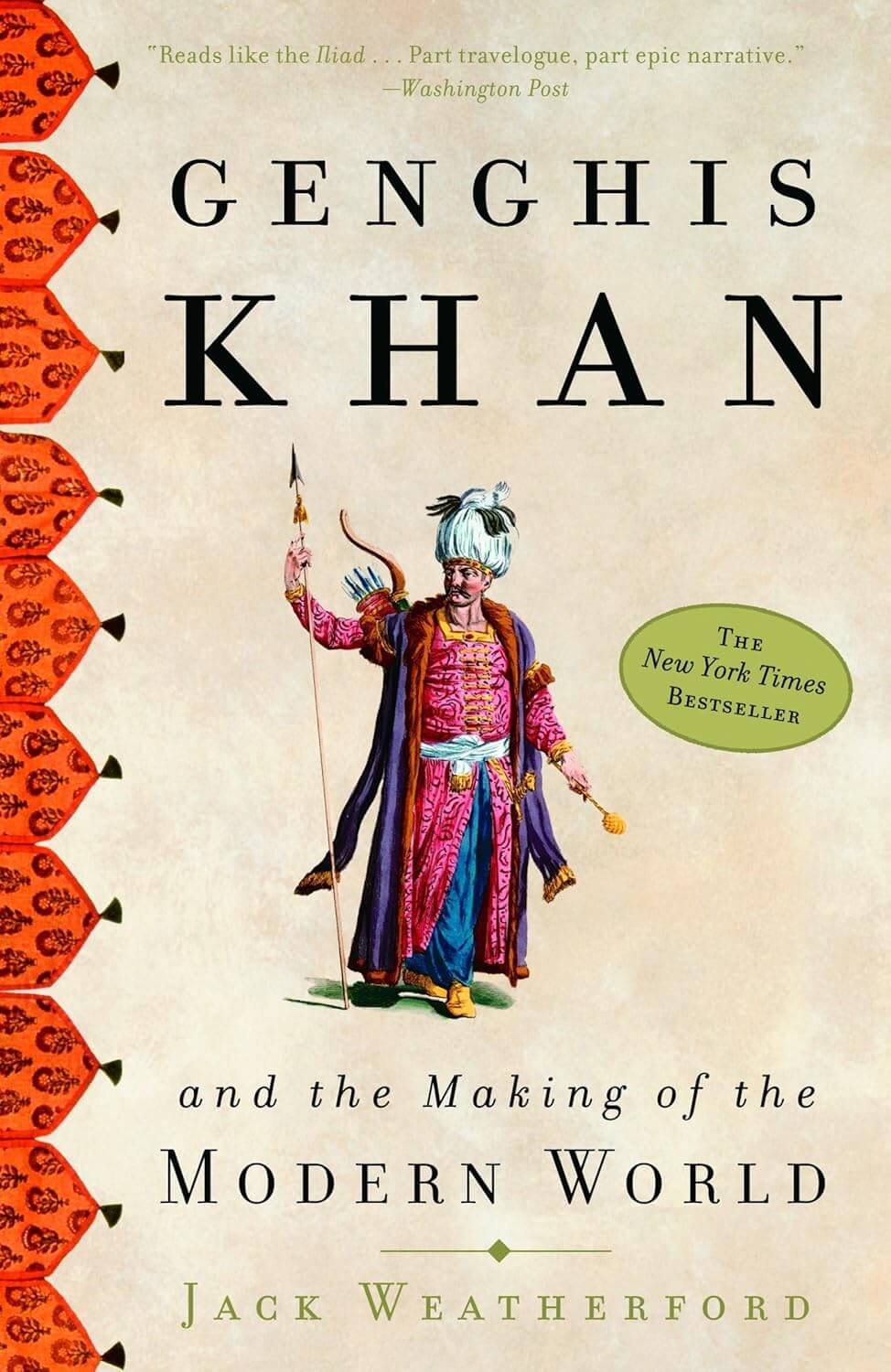
Genghis Khan and the Making of the Modern World Book Summary
This Genghis Khan and the Making of the Modern World Book Summary covers the key ideas, lessons, and takeaways in about 20 minutes.
Helps with these goals
Want the complete 20-minute summary?
- Full structured summary
- Video Summary
- Podcast Summary
- Audio summary
- Key takeaways
- Exercises
- Quiz
- Highlights and notes
- Ask the book with AI
What is in the Genghis Khan and the Making of the Modern World book summary?
Below is a preview of Sumizeit’s expert-written summary of Genghis Khan and the Making of the Modern World by Jack Weatherford. The full summary covers the book’s key ideas in text, audio, and video.
Genghis Khan, originally named Temujin, entered the world amid turmoil on the harsh Mongolian grasslands. From birth, his life was immersed in violence, scarcity, and unpredictable tribal conflict. His mother, Hoelun, had already endured abduction from her first husband, and the family lived under constant threat. Temujin’s earliest experiences were steeped in abandonment and betrayal—elements that fundamentally shaped how he viewed power, loyalty, and survival.
When Temujin was still a boy, his father, Yesugei, was poisoned by rivals, leaving the family stranded without allies. Their clan quickly expelled Hoelun and her children, condemning them to an existence on the edge of starvation. Instead of receiving help from their kin, they were pushed into a life of scavenging and isolation. This episode instilled in Temujin a deep mistrust of traditional clan loyalty, which he would later reject in favor of allegiance built on personal choice and merit.
One of the most defining early events occurred when Temujin, still a youth, killed his older half-brother Begter. The act—motivated by a dispute over food—symbolized his fierce will to assert authority in a world where power and survival were inseparable. Later, he was captured and enslaved by the Tayichiud, forced into servitude until he escaped with unexpected assistance from a sympathetic guard. Every step of his early life taught him that survival required vigilance, decisive action, and the ability to inspire loyalty outside one’s own family.
These formative experiences forged his worldview: leadership would not be determined by birthright, but by strength, competence, and an unwavering commitment to those who followed him. The traumas of youth did not crush him; instead, they fueled a relentless determination to rise above the fate imposed upon him by clan politics and circumstance.
Building Bonds Beyond Blood: Loyalty as a Foundation for Power
Temujin’s philosophy of leadership emerged from a childhood that had shown him the fragility of kinship ties. The betrayal by his own clan convinced him that true allegiance had to be earned rather than inherited. As he grew older, he deliberately sought relationships outside his family’s network, forging alliances built on loyalty rather than lineage.
One of the most significant relationships of his life was with Jamuka, his childhood friend and sworn blood brother, or anda. The bond of anda was considered sacred—stronger than blood, voluntary, and sealed through shared experiences and ritual. Temujin and Jamuka reaffirmed this bond multiple times, yet their visions for the future diverged dramatically. Jamuka believed in the long-standing aristocratic hierarchy of the steppe; he saw leadership as the exclusive domain of noble lineages. Temujin, in contrast, envisioned a society in which leadership was earned through talent and dedication.
This ideological divide would eventually spark a long and bitter rivalry. Their conflict was more than a personal dispute; it marked a crossroads between two competing systems of rule. Temujin’s victory over Jamuka symbolized the triumph of a new model of governance—one in which individuals rose through the ranks based on their contributions rather than their ancestry.
Temujin reorganized his…
Want the complete 20-minute summary?
- Full structured summary
- Video Summary
- Podcast Summary
- Audio summary
- Key takeaways
- Exercises
- Quiz
- Highlights and notes
- Ask the book with AI
Who should read Genghis Khan and the Making of the Modern World ?
This book is essential for history enthusiasts, students of global affairs, and anyone curious about how one leader reshaped civilization. If you want to understand the foundations of the modern world—from international trade to multicultural governance—Genghis Khan and the Making of the Modern World offers surprising insights that challenge conventional narratives about conquest and leadership.
Why does Genghis Khan and the Making of the Modern World matter?
In an age of globalization and interconnected systems, understanding how the first truly global network was built is remarkably relevant. Jack Weatherford's reinterpretation shows that Genghis Khan was far more than a brutal conqueror; he was an innovator who established legal systems, merit-based governance, and trade infrastructure that echo in our world today. This book dismantles harmful stereotypes while revealing how medieval Mongol practices prefigured modern institutions.
What are the key themes in Genghis Khan and the Making of the Modern World ?
- Leadership through merit rather than birthright
- Military innovation and adaptability in warfare
- Creating global networks of trade and communication
- Religious tolerance and multicultural governance
- The tension between destruction and creation in empire-building
- How trauma shapes visionary leadership
- Legal standardization across diverse populations
What are the key lessons from the Genghis Khan and the Making of the Modern World book summary?
Reject inherited hierarchies in favor of earned authority
Genghis Khan built an organization where talent and loyalty determined advancement, not family lineage. This meritocratic approach unified fractious groups and created institutional stability that outlasted individual leaders.
Speed and mobility defeat traditional power structures
The Mongols revolutionized warfare by prioritizing mounted mobility and rapid deployment over static fortifications. This mobility advantage allowed them to conquer territory faster than any previous empire.
Psychological warfare can achieve results without total combat
The Mongols strategically spread stories of their destructiveness to induce surrender before battle. Managing perception and fear proved as effective as military force itself.
Loyalty built on choice outperforms loyalty based on blood
By deliberately mixing clans and building units around personal allegiance rather than kinship, Genghis Khan created a cohesive force where soldiers felt chosen rather than obligated.
Standardization enables large-scale commerce and communication
The Mongols unified weights, measures, currency, and passports across vast territories, allowing merchants to operate confidently across borders and accelerating economic growth.
Embrace foreign expertise and adapt technologies from conquered peoples
Rather than dismissing rival technologies, Genghis Khan hired Chinese engineers, Persian chemists, and Muslim mathematicians to strengthen his military and administration.
Enforce uniform law codes to prevent endless cycles of revenge
The Yassa legal code applied to all subjects equally and forbade feuding, replacing tribal vengeance with state-administered justice and creating predictability in governance.
Religious tolerance strengthens multicultural empires
By offering tax exemptions and protection to monks, priests, and scholars from all faiths, Genghis Khan reduced religious conflict and gained legitimacy across diverse populations.
Create infrastructure that enables rather than controls movement
The yam relay system and secure trade routes gave the empire economic dynamism and information flow that centralized control could not replicate.
Early trauma can fuel vision for systemic change
Genghis Khan's childhood abandonment and betrayal by his clan motivated him to build a society fundamentally different from the clan-based hierarchies that had failed him.
Discipline at scale requires clear unit structures and mutual accountability
Mongol soldiers were organized into units of ten where each member was responsible for the others' conduct and survival, creating cohesion without constant supervision.
Complete conquest prevents the rebellions that partial submission invites
By demanding total surrender rather than accepting tribute, Genghis Khan reduced subsequent revolts and established clear chains of command across territories.
Cultural legitimacy is essential for ruling foreign populations
Khubilai Khan's adoption of Chinese customs, ceremonial practices, and dynastic rituals convinced Chinese subjects of his commitment to their civilization, not just its conquest.
Connected trade networks accelerate technological and cultural exchange
The Pax Mongolica enabled unprecedented mobility for merchants, scholars, and ideas, creating a global workshop where innovations from one region enriched all others.
Systems designed for one purpose often create unintended consequences elsewhere
The same trade routes that spread ideas and prosperity across the Mongol Empire became highways for plague transmission, ultimately contributing to the empire's fragmentation.
Historical narratives are shaped by the political interests of those who write them
European Enlightenment thinkers portrayed Genghis Khan as barbaric to justify their own colonialism, while modern Asia reimagined him as a nationalist hero—both distortions of a more complex reality.
Violence and institution-building can coexist in the same regime
The Mongol Empire was simultaneously brutal in conquest and progressive in its internal governance, proving that destructive military power and constructive legal systems need not be contradictory.
Adaptability in strategy beats rigid adherence to tradition
Genghis Khan abandoned nomadic hunting tactics when necessary, incorporated siege technology, and reshaped governance to suit different regions rather than imposing uniform methods.
Information networks are as valuable as military might
The yam relay system gave the Mongol leadership advantages in communication speed that translated directly to military and administrative superiority.
Legacy is contested and reinterpreted by each generation
Genghis Khan's memory shifted from barbaric conqueror to nationalist symbol to architect of globalization, reflecting the values and agendas of those interpreting his story.
Want the complete 20-minute summary?
- Full structured summary
- Video Summary
- Podcast Summary
- Audio summary
- Key takeaways
- Exercises
- Quiz
- Highlights and notes
- Ask the book with AI
How can you apply ideas from Genghis Khan and the Making of the Modern World ?
- Restructure organizations to promote talent-based advancement over seniority or family connections
- Standardize communication protocols, metrics, and tools across departments to enable seamless collaboration
- Create cross-functional teams by intentionally mixing different groups to build loyalty to shared goals rather than silos
- Develop clear legal frameworks and transparent governance rules that apply equally to all levels of an organization
- Invest in acquiring and integrating expertise from external sources and competing organizations
- Use strategic communication and narrative to shape perceptions and achieve goals beyond direct confrontation
- Build relay systems or infrastructure that enable rapid information flow and resource movement across the organization
What common mistakes do readers make with Genghis Khan and the Making of the Modern World ?
- Assuming that harsh early conditions necessarily create weak or broken leaders, rather than considering how adversity can fuel transformative vision
- Viewing empires primarily through a lens of destruction and violence while overlooking their administrative, legal, and cultural innovations
- Treating historical narratives as objective fact rather than recognizing how they reflect the biases and agendas of those writing them
- Believing that global connectivity and trade are entirely modern phenomena, when similar dynamics were already operating under Mongol rule
Sumizeit Exercises Apply what you've learned
Turn ideas from Genghis Khan and the Making of the Modern World into action with a short guided reflection: identify the biggest takeaway, connect it to your life, and commit to one step you can take in the next 24 hours.
What is the expert analysis of Genghis Khan and the Making of the Modern World ?
Overview
Genghis Khan and the Making of the Modern World is a seminal work by Jack Weatherford, an accomplished anthropologist and historian renowned for his expertise in Mongolian culture and nomadic civilizations. This book stands out for its comprehensive reevaluation of Genghis Khan, moving beyond the conventional portrayal of the Mongol leader as a ruthless conqueror to reveal his profound influence on social reform, military innovation, and the genesis of global interconnectedness. Weatherford’s scholarship, grounded in extensive fieldwork and a nuanced reading of primary sources like The Secret History of the Mongols, offers a fresh lens through which to understand the Mongol Empire’s enduring legacy in shaping the modern world.
Core Thesis
Weatherford’s central argument posits that Genghis Khan was not merely a destructive warlord but a visionary architect of a new social and political order. He transformed the fragmented Mongol tribes into a meritocratic, disciplined society that revolutionized warfare, governance, and international commerce. The Mongol Empire, under Genghis Khan’s leadership, established the first extensive Eurasian network facilitating trade, communication, and cultural exchange, thereby laying foundational elements of the modern global system. This thesis challenges entrenched stereotypes by highlighting the empire’s contributions to legal equality, religious tolerance, and technological diffusion.
Strengths
- Reinterpretation of a Historical Figure: Weatherford’s work masterfully dismantles the simplistic barbarian narrative, presenting Genghis Khan as a complex leader whose innovations had lasting global impact.
- Interdisciplinary Approach: Combining anthropology, history, and archaeology, the author provides a richly textured account that integrates cultural, military, and political dimensions.
- Detailed Military Analysis: The book offers an insightful examination of Mongol military tactics, emphasizing mobility, psychological warfare, and technological adaptation.
- Global Contextualization: By situating the Mongol Empire within broader Eurasian developments, Weatherford elucidates how Mongol rule catalyzed cross-cultural exchanges and economic integration.
- Engaging Narrative Style: The vivid storytelling, especially regarding Temujin’s formative years and personal relationships, humanizes a figure often shrouded in myth.
Critiques & Counterarguments
- Romanticization of Mongol Rule: Some critics argue that Weatherford’s portrayal occasionally glosses over the brutal realities of Mongol conquests, underemphasizing the scale of violence and destruction inflicted upon civilian populations.
- Selective Use of Sources: While drawing heavily on Mongol and Chinese chronicles, the book may insufficiently engage with Persian and Islamic perspectives that highlight the empire’s devastation and cultural disruption.
- Oversimplification of Meritocracy: The depiction of the Mongol social system as purely meritocratic can be contested, given evidence of persistent clan loyalties and aristocratic privileges within the empire’s elite strata.
- Competing Historical Interpretations: Alternative scholarship emphasizes the Mongol Empire’s role in facilitating the spread of the Black Death, which had catastrophic demographic and economic consequences, complicating the narrative of unmitigated progress.
- Modern Political Appropriations: The book’s framing of Genghis Khan as a unifying global figure may inadvertently echo nationalist or revisionist agendas in contemporary Mongolia and beyond, which seek to rehabilitate his image for political ends.
Who Should Read This
This book is essential reading for historians, anthropologists, and scholars of political science interested in empire-building, leadership, and cross-cultural interactions. It also appeals to readers of military history and global economic history, offering a compelling case study of how nomadic societies shaped world affairs. Furthermore, those intrigued by the dynamics of social reform and legal innovation in pre-modern contexts will find Weatherford’s analysis illuminating. Finally, the book serves as a valuable corrective for general audiences seeking a more balanced and sophisticated understanding of Genghis Khan’s legacy beyond the myths of barbarism.
Frequently asked questions about the Genghis Khan and the Making of the Modern World book summary
What is Genghis Khan and the Making of the Modern World about?
Jack Weatherford's Genghis Khan and the Making of the Modern World reinterprets the legacy of Mongol conqueror Temujin (Genghis Khan) as more than a brutal military leader. The book argues that Genghis Khan was a visionary who revolutionized warfare, governance, and global trade, establishing merit-based systems, religious tolerance, and interconnected networks that prefigured the modern world. Rather than viewing the Mongol Empire as merely destructive, Weatherford reveals how it laid the institutional and logistical foundations for globalization.
Who should read Genghis Khan and the Making of the Modern World?
This book is ideal for history enthusiasts, students of global affairs, business leaders interested in organizational systems, and anyone curious about the origins of modern institutions. It appeals to readers who want to challenge conventional narratives about conquest and leadership, and to those seeking to understand how medieval empires shaped contemporary global structures. Whether you're interested in military history, governance, trade networks, or cultural exchange, Weatherford's work offers compelling insights.
What are the main takeaways from Genghis Khan and the Making of the Modern World?
The central takeaways are that Genghis Khan was an innovator whose systems prioritized merit over birthright, established unprecedented legal equality, fostered religious tolerance, and created the first truly global trade and communication networks. His military innovations transformed warfare through mobility and discipline, while his administrative reforms proved that vast multicultural empires could function cohesively. Ultimately, Weatherford argues that the interconnected, trade-driven world we inhabit today owes a profound debt to structures first established under Mongol rule.
How did Genghis Khan transform military warfare?
Genghis Khan revolutionized warfare by building entirely mobile mounted forces armed with composite bows and organized with unprecedented discipline. Drawing from nomadic hunting traditions, he used sweeping encirclement tactics to overwhelm enemies while minimizing Mongol casualties. He also mastered psychological warfare—spreading exaggerated stories of destruction to induce surrender before battle—and eagerly adopted siege technology and gunpowder weapons from conquered peoples. This combination of speed, coordination, terror, and adaptability allowed the Mongols to conquer more territory faster than any previous empire.
What was the Pax Mongolica and why was it important?
The Pax Mongolica was a period of unprecedented peace and stability under Mongol rule that transformed Eurasia into a single, interconnected world. The Mongols created secure trade routes, established a sophisticated postal relay system called the yam, and standardized weights, measures, and currency across vast territories. This stability enabled merchants, scholars, and ideas to flow freely from the Pacific to the Mediterranean, facilitating the first major wave of global technological and cultural exchange. The resulting network of commerce and communication became a prototype for modern international systems.
How did Genghis Khan's early life shape his leadership philosophy?
Genghis Khan's childhood was marked by violence, abandonment, and betrayal by his own clan, experiences that taught him to distrust inheritance-based loyalty. These traumas motivated him to build a radically different society based on merit, personal choice, and earned allegiance rather than bloodline. His early struggles instilled in him an uncompromising determination to create systems where talent and dedication determined advancement, and where individuals chosen for their abilities proved more loyal than those bound by kinship.
What role did the plague play in the collapse of the Mongol Empire?
The bubonic plague spread rapidly along the same trade routes that had enabled the Mongol Empire's prosperity and communication. The pandemic decimated populations across China, Central Asia, the Middle East, and Europe, causing trade to stagnate and populations to collapse. This demographic catastrophe weakened the economic and political foundations of the empire, and competing branches of Genghis Khan's descendants lost the capacity to support one another. Without trade revenue and stable population centers, the once-unified system fractured into independent khanates and gradually dissolved.
How did Khubilai Khan adapt Mongol rule to govern China?
Khubilai Khan understood that ruling China required cultural legitimacy beyond military dominance, so he adopted Chinese customs, administrative structures, and ceremonial practices. He established his capital at Dadu (Beijing) and commissioned Chinese-style portraits and ancestral temples to present himself as a rightful emperor rather than a foreign conqueror. While maintaining Mongol principles like merit-based staffing and reduced torture in law, he also became a patron of culture and promoted printing, drama, and scholarship, making his court a hub of creativity that attracted scholars from across Eurasia.
About Sumizeit
Sumizeit is a profitable Scomy LLC company based in Miami, Florida. It has been helping readers learn from nonfiction books for 7 years with expert-written summaries in text, audio, podcast, and video.
Want the complete 20-minute summary?
- Full structured summary
- Video Summary
- Podcast Summary
- Audio summary
- Key takeaways
- Exercises
- Quiz
- Highlights and notes
- Ask the book with AI
Here's why readers love Sumizeit
Join thousands of learners getting smarter every day
"Great experience. Detailed summaries. Loved the gamification feature. Makes learning fun. Good customer service. I recommend Sumizeit to anyone. You'll learn a lot."
"I always felt busy but still wanting to keep up with the book discussion in my friend group. This was a great supplement to help me keep reading the books I find fun while keeping up with important books."
"I love this website. Instead of scrolling social media, I find myself learning a lot. I use it everyday. I recommend this app for anyone who is too busy and wants to get up to speed with their favorite books."
Genghis Khan and the Making of the Modern World Book Summary PDF
Looking for a Genghis Khan and the Making of the Modern World Book Summary PDF you can save and revisit offline? Our Genghis Khan and the Making of the Modern World Book Summary PDF captures the book’s core ideas in a clean, printable format — the key frameworks, takeaways, and structure without the fluff. Download the Genghis Khan and the Making of the Modern World Book Summary PDF when you want a reference you can annotate, share with your team, or review on the go. Get your Genghis Khan and the Making of the Modern World Book Summary PDF from the download page below.
Download Genghis Khan and the Making of the Modern World Book Summary PDFPeople also liked these summaries
Readers who explored Genghis Khan and the Making of the Modern World often enjoyed these titles next.





Want the complete 20-minute summary?
- Full structured summary
- Video Summary
- Podcast Summary
- Audio summary
- Key takeaways
- Exercises
- Quiz
- Highlights and notes
- Ask the book with AI
Featured Book Titles
Popular Book Summaries at sumizeit, leading book summary app