
Question 1 of 10


Prefer the print book? Buy on Amazon
As an Amazon Associate, Sumizeit earns from qualifying purchases.
Book Summary
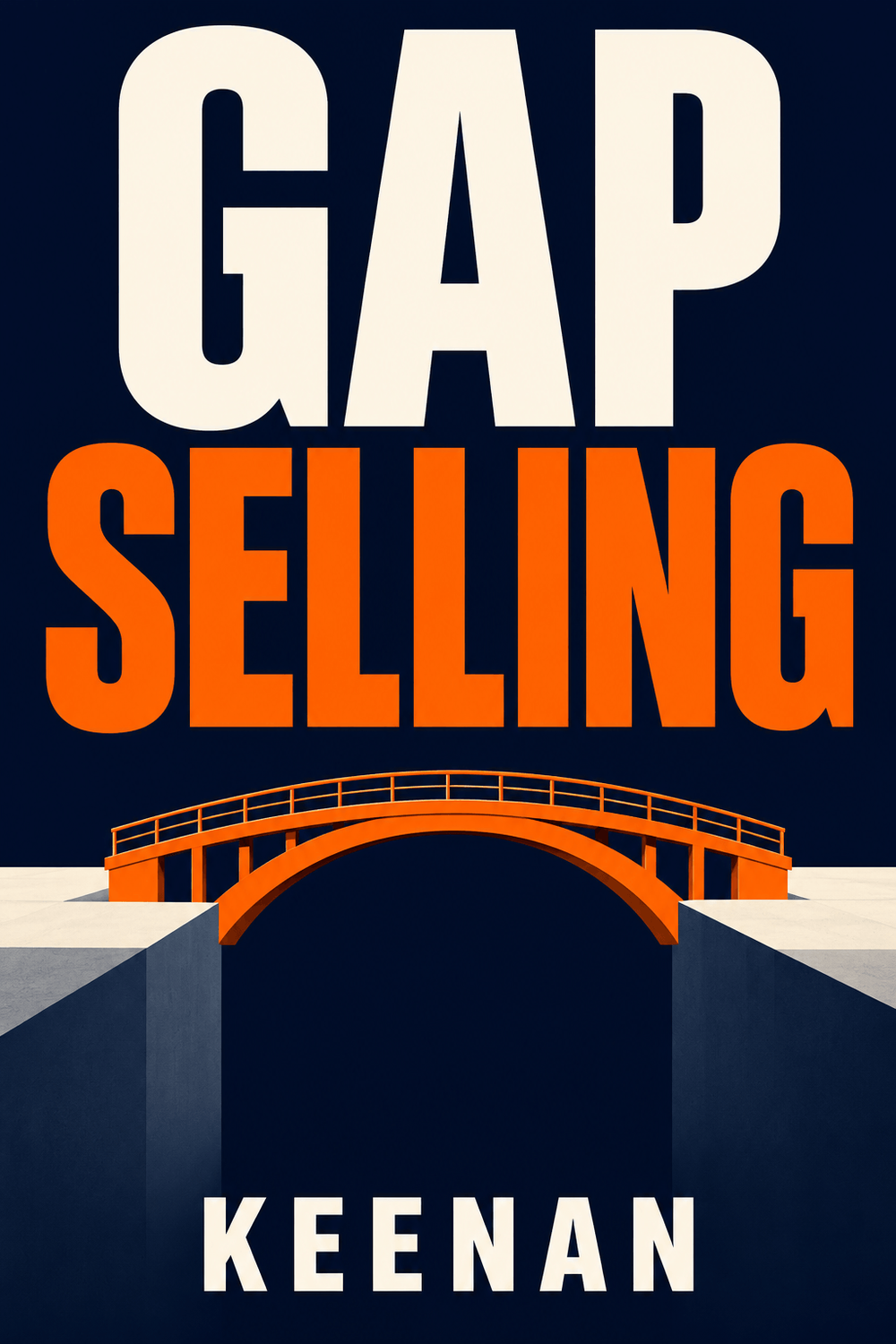
Gap Selling Book Summary
This Gap Selling Book Summary covers the key ideas, lessons, and takeaways in about 20 minutes.
Short Description:
Closing deals by solving the customer’s real problem
Selling works when you stop talking about your product and start learning about your customer's problem. Find out where they are today, where they want to be, and what is keeping them from getting there. Measure what closing that gap is worth, weigh it against what it costs them, and then show them the math in terms that matter to their business. Move the deal forward one small yes at a time, bring real expertise, and hold your ground when the customer wavers. If you manage a team, ask the questions that prove your reps understand each gap, and build forecasts on honest reports and hard data. Customers buy when they see that the change is worth more than staying put.
Helps with these goals
Preview the Gap Selling book summary
Below is a preview of Sumizeit’s comprehensive human-written summary of Gap Selling by Keenan. The full summary is 15-20 minutes long and covers the book’s key ideas in text, audio, visual, and video formats. Unlock the full 20 Minute Summary
Most salespeople lead with what they sell. They walk in with features, pricing, and a polished demo, then wonder why the deal stalls. Keenan says the product is the wrong place to start. Customers don't care about your product. They care about their own problems, and they will pay you when they believe you can make those problems go away.
That idea runs through the whole book. Your job is to understand the customer's situation better than anyone else in the room, sometimes better than the customer does. You ask a lot of questions. You dig until you hit the real cause of the trouble. Then you show, with numbers, what fixing it is worth. Do that and you win more deals, and the customer gets a real fix instead of a patch.
The book moves through three subjects. First, why customers buy at all. Second, how to run a sale from the first conversation to the close. Third, how to lead a team of reps who sell this way.
Why Customers Buy
Keenan gives two reasons, and you need both.
The first is a problem. Every sale starts with one. A customer who is happy with how things are has no reason to look for anything new, and no pitch will move them. A customer who is struggling with something is already looking for a way out. That is your opening.
The second is a solution. A problem starts the search, but it doesn't finish the purchase. The customer buys only when you put a believable fix in front of them.
The Gap
Here Keenan introduces the idea that gives the book its name. Picture two points. One is where the customer stands today, with the problem still in place. The other is where they want to be, with the problem gone and their business goals back within reach. The distance between those two points is the gap.
Customers buy when your solution closes that gap and carries them to the future they want. The bigger the gap, the more your solution is worth.
Take a small online store with a slow website. Pages take so long to load that shoppers quit before they pay. Today the store has annoyed customers and lost revenue. The future it wants has smooth checkouts and rising sales. A faster site that can handle heavy traffic closes the gap, and the store will pay for it.
Discovery Comes First
You can't close a gap you don't understand, so Keenan calls discovery the most important part of selling. Discovery means asking questions to learn about the customer's gap. He doesn't treat it as one meeting you check off and leave behind. It keeps going for as long as you are talking to the customer. Every conversation is a chance to learn more.
He sets three goals for discovery.
The first is to become an expert in the customer's business. Keep asking why, and keep following up.
Want the complete 20-minute summary?
- Full structured summary
- Video Summary
- Podcast Summary
- Audio summary
- Key takeaways
- Exercises
- Quiz
- Highlights and notes
- Ask the book with AI
Who should read Gap Selling?
Gap Selling is essential for sales professionals, sales managers, and business leaders who want to move beyond product-focused pitches. If you're tired of deals stalling and want to understand what actually drives customer decisions, this book will reshape how you sell.
Why does Gap Selling matter?
Most salespeople still lead with features and pricing, missing the real reason customers buy: they want their problems solved and their gaps closed. In today's competitive market, the ability to uncover customer pain, quantify its impact, and present a credible solution is what separates top performers from the rest. Gap Selling by Keenan gives you a proven framework to do exactly that.
What are the key themes in Gap Selling?
- The gap between a customer's current state and desired future state is the foundation of every sale
- Discovery is not a one-time meeting but an ongoing process that reveals true customer goals and root causes
- Quantifying value with concrete numbers and metrics makes your solution irresistible
- Authority and expertise matter far more than likability in closing deals
- Every sale is a series of small commitments, not a single large ask
- Honest pipeline reporting and data-driven forecasting replace gut feeling in sales management
How can you apply ideas from Gap Selling?
- Rewrite your sales discovery questions to focus on the customer's current state, desired future state, root causes, and long-term business goals instead of their interest in your product
- Create a value-calculation template that quantifies benefits, costs, and net value for each customer before you pitch, so you lead with numbers that matter to them
- Train your team to ask follow-up questions until they uncover the real goal beneath the stated goal, then verify their understanding before moving to the next stage
- Build a small-yes framework for your sales process, breaking your typical deal cycle into smaller checkpoints and tracking which rep secured each one
- Develop a pipeline-coaching routine where you ask each rep three questions: What is the gap? What are the root causes? What is the next commitment from the customer?
- Implement a forecast system based on historical close rates and pipeline data rather than rep confidence, so your revenue predictions become more reliable
- Establish a no-penalty reporting culture by responding to missed forecasts with coaching and strategy, not punishment, so reps surface problems early
What common mistakes do readers make with Gap Selling?
- Leading with product features and pricing instead of first understanding the customer's specific problem and desired future state
- Treating discovery as a single meeting to check off rather than an ongoing process woven through every customer conversation
- Accepting the customer's surface-level explanation of their problem without asking deeper questions to find root causes
- Presenting value in general terms or by industry benchmarks instead of showing concrete, quantified impact specific to that customer's situation
- Trying to be liked instead of building authority and expertise, missing the opportunity to position yourself as a trusted advisor who brings real value
Sumizeit Exercises Apply what you've learned
Turn ideas from Gap Selling into action with a short guided reflection: identify the biggest takeaway, connect it to your life, and commit to one step you can take in the next 24 hours.
What is the expert analysis of Gap Selling?
Overview
Gap Selling is a contemporary sales methodology book authored by Keenan, a seasoned B2B sales expert and CEO of A Sales Guy Inc. The book distinguishes itself by shifting the sales focus from product features to a deep understanding of the customer’s problems and the value of solving them. Keenan’s approach is rooted in real-world experience and targets sales professionals and managers seeking to elevate their effectiveness by adopting a problem-centric mindset rather than traditional product pitching.
Core Thesis
Keenan’s central argument is that successful selling hinges on identifying and quantifying the “gap” between a customer’s current problematic state and their desired future state. Rather than leading with product features, salespeople must first uncover the customer’s underlying issues through rigorous discovery, understand the true business impact of those issues, and then demonstrate how their solution closes that gap with measurable value. This approach reframes sales as a consultative, value-driven process that prioritizes the customer’s goals and challenges over the product itself.
Strengths
- Customer-Centric Focus: The book excels at reorienting sales strategies around the customer’s real needs and business outcomes, which aligns with modern consultative selling philosophies.
- Practical Framework: Keenan provides a clear, actionable framework—discovery, value quantification, and incremental commitments—that salespeople can implement immediately to improve their results.
- Emphasis on Discovery: The insistence on continuous questioning and deep understanding avoids superficial sales conversations and encourages genuine expertise.
- Integration of Sales Management: The book addresses leadership by advocating for accountability, data-driven forecasting, and coaching through targeted questioning, which supports sustainable team performance.
- Realistic View of Sales Dynamics: By acknowledging customer resistance to change and promoting the idea of “small yeses,” Keenan offers a nuanced approach to managing the sales cycle.
Critiques & Counterarguments
- Potential Oversimplification of Complex Sales: While the gap concept is compelling, some sales situations—especially in highly technical or regulated industries—may require deeper product education before value can be fully appreciated.
- Reliance on Customer Self-Disclosure: The model assumes customers will truthfully and fully reveal their problems and goals, which may not always be the case due to internal politics or lack of clarity.
- Competing Sales Philosophies: Alternative approaches like Challenger Sale emphasize teaching and tailoring over discovery alone, suggesting that sometimes salespeople must lead with insight rather than just uncovering existing gaps.
- Evidence and Examples: The book’s examples, while illustrative, occasionally lack empirical backing or broader case studies that would strengthen the argument’s generalizability.
- Change Resistance Complexity: Keenan highlights resistance to change but may understate the psychological and organizational inertia factors that require more than just demonstrating economic value to overcome.
Who Should Read This
Gap Selling is ideal for sales professionals, managers, and business leaders who are frustrated with traditional feature-driven selling and seek a more strategic, customer-focused approach. It is particularly valuable for those involved in complex B2B sales where understanding nuanced business problems and quantifying value are critical. Additionally, sales leaders looking to build disciplined, data-driven teams with strong coaching cultures will find practical guidance here. However, readers should be prepared to adapt the framework to their specific industry contexts and complement it with additional insights on customer psychology and change management.
Discussion questions for Gap Selling Short questions you can actually use in a conversation
Frequently asked questions about the Gap Selling book summary
What is Gap Selling about?
Gap Selling by Keenan is about a fundamentally different approach to sales: instead of pitching your product, you uncover the gap between where your customer is today (with their problem) and where they want to be (with the problem solved). You become an expert in their business, quantify what closing that gap is worth, and show them the math. The book covers how customers actually buy, how to run a sale from discovery through close, and how to lead a team selling this way.
Who should read Gap Selling?
Gap Selling is essential for B2B sales professionals, sales managers, and business leaders who want to move beyond product-focused selling. If your deals are stalling, your pitches feel generic, or you're not hitting your numbers, this book offers a proven framework. It's also valuable for anyone managing a sales team and struggling to forecast revenue or coach reps effectively.
What are the main takeaways from Gap Selling?
The main takeaways are: stop leading with your product and start understanding your customer's problem and goals; identify and quantify the gap between their current state and desired future state; discovery is ongoing, not a one-time meeting; every sale is a chain of small commitments, not a single ask; bring real expertise and authority to every conversation; and as a manager, build forecasts on honest data and coach reps on whether they truly understand each customer's gap.
What is a sales gap and why does it matter?
A sales gap is the distance between where a customer is today (dealing with a problem) and where they want to be in the future (problem solved, goals reached). The gap matters because customers buy specifically to close it. The bigger the gap you identify and quantify, the more valuable your solution appears and the easier it is to justify a higher price. Understanding the gap lets you show the customer exactly what closing it is worth.
How do I discover a customer's real gap?
Start with open-ended questions about their current situation, their business goals, and what's holding them back. Then dig deeper by asking why their stated goal matters and how it fits their larger strategy. Look past their surface explanation of the problem to find root causes. This process isn't a single meeting; it's ongoing. Your job is to become an expert in their business so you see the gap clearly, sometimes better than the customer does.
How do I quantify the value of my solution?
Calculate three things: the benefits (measurable gains like time saved, revenue increased, or efficiency improved), the costs (not just your price, but also setup, training, disruption, and opportunity costs), and the net value (benefits minus costs). Present this calculation to the customer using their own metrics and priorities. When the net value is clearly positive, you have a compelling case.
How should I structure my sales pitch using Gap Selling?
Start with the specific, quantified value for this customer, not generic features. Lead with concrete, measurable improvements tied directly to the goals and priorities they shared during discovery. Show the gap, the solution, and the math proving the change is worth it. Remember that most people resist change, so your job is to make the value so obvious that staying put seems riskier than moving forward.
What does it mean to treat every sale as a chain of small yeses?
Instead of fixating on the final signature, focus on the next small commitment. First you sell the customer on meeting with you, then on answering your discovery questions, then on sharing data, then on hearing your pitch, and finally on the deal itself. Each small yes moves momentum forward and reduces the risk that the deal stalls. As a manager, hold each rep accountable for naming what the next customer commitment should be.
About Sumizeit
Sumizeit is a profitable Scomy LLC company based in Miami, Florida. Our founders, Clemens Raemy and Weina Scott, are successful entrepreneurs with several exits. Sumizeit is a popular book summary app / micro learning app used by busy professionals and entrepreneurs with over 2,500 non-fiction book summaries and 10,000 podcast summaries in text, audio, visual, podcast, and video format. We also have stellar retention tools to make ideas stick - such as flashcards with spaced repetition, quizzes, streaks, highlighting and notes, daily challenges, riddles, mini-courses, meditation, and more. You won't only learn the idea, but also remember it. Over 90% of our users change their habits with Sumizeit.
Upgrade Now
Here's why readers love Sumizeit
Join thousands of learners getting smarter every day
"Great experience. Detailed summaries. Loved the gamification feature. Makes learning fun. Good customer service. I recommend Sumizeit to anyone. You'll learn a lot."
"I always felt busy but still wanting to keep up with the book discussion in my friend group. This was a great supplement to help me keep reading the books I find fun while keeping up with important books."
"I love this website. Instead of scrolling social media, I find myself learning a lot. I use it everyday. I recommend this app for anyone who is too busy and wants to get up to speed with their favorite books."
Gap Selling Book Summary PDF
Looking for a Gap Selling Book Summary PDF you can save and revisit offline? Our Gap Selling Book Summary PDF captures the book’s core ideas in a clean, printable format — the key frameworks, takeaways, and structure without the fluff. Download the Gap Selling Book Summary PDF when you want a reference you can annotate, share with your team, or review on the go. Get your Gap Selling Book Summary PDF from the download page below.
Download Gap Selling Book Summary PDFPeople also liked these summaries
Readers who explored Gap Selling often enjoyed these titles next.

Ready to read the whole thing?
- Full structured summary
- Video Summary
- Podcast Summary
- Audio summary
- Key takeaways
- Exercises
- Quiz
- Highlights and notes
- Ask the book with AI
Featured Book Titles
Popular Book Summaries at sumizeit, leading book summary app
Atomic Habits Book Summary Rich Dad Poor Dad Book Summary The Four Agreements Book Summary The 48 Laws of Power Book Summary When Breath Becomes Air Book Summary Think and Grow Rich Book Summary