


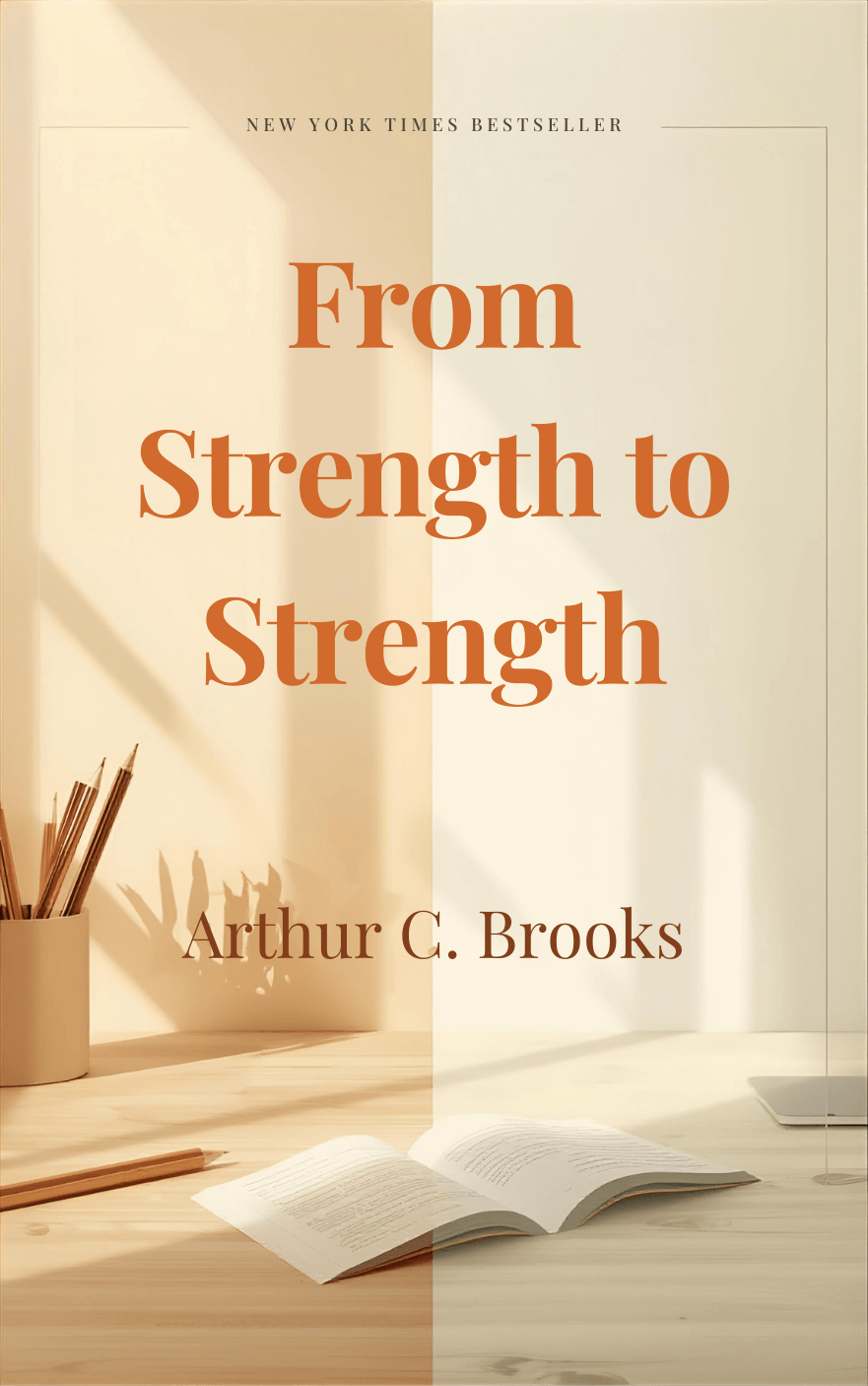
Prefer the print book? Buy on Amazon
As an Amazon Associate, Sumizeit earns from qualifying purchases.
From Strength to Strength Book Summary
This From Strength to Strength Book Summary covers the key ideas, lessons, and takeaways in about 20 minutes.
Short Description:
How to find happiness and purpose as your career skills begin to change
True fulfillment comes from redefining success. Careers matter, but they cannot be the foundation of identity forever. Lasting happiness grows from relationships, contribution, values, and belief in something larger than oneself. When people align their lives with these deeper priorities, aging transforms from loss into liberation.
Helps with these goals
Preview the From Strength to Strength book summary
Below is a preview of Sumizeit’s comprehensive human-written summary of From Strength to Strength by Arthur C. Brooks. The full summary is 15-20 minutes long and covers the book’s key ideas in text, audio, visual, and video formats. Unlock the full 20 Minute Summary
Arthur C. Brooks opens From Strength to Strength with a message that feels unsettling at first but ultimately becomes liberating: most people will not keep improving at the same kind of work forever. For decades, society has told us a simple story—work hard, build expertise, climb higher, and life will keep getting better. Yet many people in midlife quietly discover that something has shifted. Tasks that once felt effortless now require more energy. Recognition comes less often. Younger colleagues move faster. Instead of excitement, work begins to produce anxiety, defensiveness, or fear.
Brooks does not frame this experience as failure. Instead, he argues that it is a natural and predictable stage of life. The problem is not that decline exists—the problem is that no one prepares us for it. We build our identities around performance, status, and achievement, then feel lost when those pillars weaken. The central promise of the book is that the second half of life can be not only meaningful, but deeply joyful—if we are willing to change what we value and how we define success.
Rather than clinging to a fading version of ourselves, Brooks encourages readers to treat aging as a transition, not a tragedy. The skills that diminish make room for new strengths. The hunger for achievement can evolve into a desire for purpose. What looks like loss can become transformation.
The Hidden Curve Behind Every Career
One of Brooks’s most important contributions is his explanation that nearly all high-skill careers follow a rise-and-fall pattern. Whether someone works in science, business, athletics, medicine, art, or leadership, performance typically increases early in adulthood, plateaus, and eventually declines.
This curve often arrives sooner than people expect. Many assume decline begins in old age, but Brooks presents evidence that it often starts between the late 30s and early 50s. That timing makes it particularly painful because it collides with peak responsibility—mortgages, families, leadership roles, and social expectations all intensify just as cognitive sharpness begins to change.
He uses examples across professions. Scientists and inventors tend to produce their most groundbreaking ideas early in life. Breakthrough discoveries after age 70 are extraordinarily rare. Artists and writers often last longer, but even they tend to receive major awards earlier rather than later. Athletes experience this reality most visibly, but intellectual professionals encounter it more quietly—and often more painfully.
Because modern society worships productivity and youth, people interpret decline as personal inadequacy instead of biological reality. Brooks emphasizes that this misunderstanding fuels midlife despair. People don’t just lose skills—they lose identity.
What Actually Changes in the Aging Mind
Brooks explains that aging does not mean becoming unintelligent. Instead, intelligence changes shape.
The brain’s prefrontal cortex—the area responsible for fast reasoning, innovation, and novel problem-solving—gradually shrinks with age. This shift is unavoidable. No amount of discipline, vitamins, or hustle can permanently stop it. As a result, quick mental leaps, rapid pattern recognition, and intense creative output become harder over time.
This biological shift explains why people who once thrived on speed…
Want the complete 20-minute summary?
- Full structured summary
- Video Summary
- Podcast Summary
- Audio summary
- Key takeaways
- Exercises
- Quiz
- Highlights and notes
- Ask the book with AI
Who should read From Strength to Strength?
From Strength to Strength is essential for anyone entering midlife or later career stages who feels their professional edge dulling. It's particularly valuable for high achievers whose identities are tied to performance, success-driven professionals worried about staying relevant, and anyone seeking meaning beyond their career accomplishments.
Why does From Strength to Strength matter?
In a culture obsessed with youth, speed, and constant productivity, this book offers a liberating reframe: decline is not failure, it's a predictable life stage requiring intentional adaptation. As cognitive abilities shift with age, understanding how to leverage your evolving strengths rather than fight biological reality becomes crucial to avoiding burnout and finding lasting fulfillment.
What are the key themes in From Strength to Strength?
- The inevitable cognitive shift from fluid to crystallized intelligence across the lifespan
- Moving from resume values (status, recognition, wealth) to eulogy values (kindness, love, generosity)
- Redefining success and winning as inner peace rather than outperformance
- The critical role of relationships and community in sustained happiness
- Acceptance and self-compassion as gateways to reinvention
- Transitioning from achievement-driven careers to wisdom-based contribution
How can you apply ideas from From Strength to Strength?
- Audit your work to identify whether you're relying on speed and competition or wisdom and guidance, then intentionally shift responsibilities toward mentoring, teaching, or advising roles
- Track where your attention goes daily and consciously redirect focus from status anxiety, comparison, and resentments toward relationships, beauty, and gratitude
- Establish regular community involvement through volunteering, clubs, or faith communities to deepen relationships and combat isolation
- Replace resume-focused goals with eulogy-value goals: write your own eulogy and align weekly actions with the qualities you want to be remembered for
- Develop a personal philosophy or belief system through reading, reflection, or spiritual practice to anchor meaning beyond professional achievement
- Schedule consistent time for important relationships rather than waiting for spontaneous connection to occur
- Practice self-compassion when facing cognitive or professional limitations by observing emotions with curiosity rather than judgment
What common mistakes do readers make with From Strength to Strength?
- Doubling down on overwork and long hours when performance declines, accelerating burnout without restoring earlier ability
- Maintaining a career identity based entirely on speed and innovation, creating terror as mental processing naturally slows
- Allowing loneliness to grow by treating relationships as secondary priorities compared to professional achievement
- Continuing to measure success by comparison with younger colleagues and external metrics rather than internal values and contribution
Sumizeit Exercises Apply what you've learned
Turn ideas from From Strength to Strength into action with a short guided reflection: identify the biggest takeaway, connect it to your life, and commit to one step you can take in the next 24 hours.
What is the expert analysis of From Strength to Strength?
Overview
From Strength to Strength by Arthur C. Brooks emerges as a compelling meditation on the inevitable cognitive and emotional transitions that accompany aging, particularly within the context of professional life. Brooks, a distinguished Harvard professor and public intellectual, synthesizes psychological research, philosophical wisdom, and practical insight to challenge prevailing cultural narratives around success, productivity, and identity. This book stands out for addressing a universal yet often unspoken experience: the midlife realization that the metrics by which we have measured achievement and self-worth may no longer serve us—and that embracing this shift can lead to a more profound form of fulfillment.
Core Thesis
Brooks’s central argument is that human cognitive abilities follow a predictable arc, with fluid intelligence (speed, creativity, rapid problem-solving) peaking early and declining in midlife, while crystallized intelligence (wisdom, judgment, accumulated knowledge) grows stronger over time. The cultural failure lies in society’s insistence on valuing only the former, leading to identity crises and despair as individuals age. Instead of resisting decline, Brooks advocates for a conscious realignment of values—from résumé-driven achievements to eulogy values such as kindness, generosity, and connection. This reorientation transforms aging from a period of loss into one of liberation and meaningful contribution.
Strengths
- Interdisciplinary Integration: Brooks adeptly weaves together neuroscience, psychology, philosophy, and cultural critique, providing a rich, multidimensional understanding of aging that transcends simplistic self-help tropes.
- Practical Wisdom: The book offers actionable guidance on how to redesign careers and lives to align with evolving cognitive strengths, emphasizing mentorship, emotional intelligence, and service.
- Emotional Resonance: By framing decline as a natural and even necessary transition rather than failure, Brooks provides solace and hope to readers confronting midlife challenges.
- Reframing Success: The distinction between résumé and eulogy values is a powerful conceptual tool that encourages a deeper reflection on what truly matters in life.
- Accessible Scholarship: Brooks’s ability to translate complex academic research into engaging prose makes the book approachable without sacrificing intellectual rigor.
Critiques & Counterarguments
- Overgeneralization of Cognitive Decline: While Brooks emphasizes the decline of fluid intelligence, recent cognitive neuroscience suggests considerable individual variability and the potential for neuroplasticity well into later life, challenging the inevitability implied.
- Potential Underestimation of Late Creativity: Though groundbreaking discoveries may be rarer in later life, notable exceptions exist across disciplines—artists, writers, and scientists who defy the typical curve—suggesting that the “hidden curve” is not a strict rule but a statistical tendency.
- Cultural Bias: The book’s framework is largely grounded in Western, individualistic conceptions of success and aging; collectivist cultures may experience and interpret these transitions differently, which Brooks’s analysis does not fully address.
- Philosophical Alternatives: Competing schools of thought, such as existentialism or certain Eastern philosophies, might argue that meaning arises not from shifting values with age but from embracing life’s inherent absurdity or impermanence, offering a more radical acceptance than Brooks’s pragmatic approach.
- Economic and Structural Constraints: Brooks’s recommendations presume a degree of agency and resource availability that may not be accessible to all, particularly those in precarious economic situations or marginalized communities, where aging can compound systemic disadvantage rather than offer opportunities for reinvention.
Who Should Read This
From Strength to Strength is ideal for midlife professionals, leaders, and creatives grappling with the dissonance between their past achievements and present realities. It offers a roadmap for those seeking to redefine success and cultivate lasting fulfillment beyond career milestones. Additionally, scholars and practitioners in psychology, leadership development, and gerontology will find Brooks’s synthesis valuable for its nuanced understanding of aging and performance. Finally, readers interested in philosophical reflections on purpose and happiness will appreciate the book’s integration of ancient wisdom with contemporary science, making it a thoughtful companion for anyone contemplating life’s transitions.
Frequently asked questions about the From Strength to Strength book summary
What is From Strength to Strength about?
From Strength to Strength by Arthur C. Brooks argues that professional decline is an inevitable life stage, not personal failure, and shows how redefining success around wisdom, relationships, and values creates deep fulfillment in the second half of life. The book reframes aging from a threatening loss into a natural transition where different—and potentially more meaningful—strengths emerge.
Who should read From Strength to Strength?
Anyone navigating midlife transitions, high achievers whose identities are tied to professional performance, people worried about staying relevant as they age, and those seeking meaning beyond career accomplishments should read this book. It's particularly valuable for leaders, high-performers, and ambitious professionals who sense their competitive edge fading and need a framework for the next chapter.
What are the main takeaways from From Strength to Strength?
The main takeaways are: cognitive abilities naturally shift from speed-based fluid intelligence to wisdom-based crystallized intelligence; clinging to outdated definitions of success creates misery while acceptance opens possibility; fulfillment comes from eulogy values (kindness, love, generosity) rather than resume values (status, wealth, recognition); and relationships, meaning, and contribution—not achievement—create lasting happiness. Decline is not the enemy; denial is.
What does Arthur C. Brooks mean by resume values versus eulogy values?
Resume values are external measures like titles, income, and prestige that require constant winning and comparison to maintain satisfaction. Eulogy values are internal qualities like kindness, loyalty, and love that people mention at the end of a life, which deepen with age and create stable happiness independent of professional standing.
How can I transition my career for the second half of life?
Brooks recommends moving from roles centered on constant innovation and competition toward roles centered on guidance, mentoring, teaching, and advising—work that leverages wisdom and emotional intelligence. This shift doesn't mean stepping down; it means stepping into a different kind of excellence where your impact multiplies through others rather than through personal output.
Does From Strength to Strength address religion or faith?
Yes, Brooks discusses how religious faith and philosophical belief systems provide structure, purpose, and community that become increasingly important as professional identity fades. However, he emphasizes that meaning doesn't require religion—philosophical traditions and any belief in something larger than personal success serves the same purpose.
Is From Strength to Strength depressing or hopeful?
The book is ultimately hopeful, though it begins with an uncomfortable truth about cognitive decline. Brooks shows through research and examples that older adults often report greater happiness than younger ones when they've reoriented around meaningful values, relationships, and contribution rather than competition and status.
About Sumizeit
Sumizeit is a profitable Scomy LLC company based in Miami, Florida. Our founders, Clemens Raemy and Weina Scott, are successful entrepreneurs with several exits. Sumizeit is a popular book summary app / micro learning app used by busy professionals and entrepreneurs with over 2,500 non-fiction book summaries and 10,000 podcast summaries in text, audio, visual, podcast, and video format. We also have stellar retention tools to make ideas stick - such as flashcards with spaced repetition, quizzes, streaks, highlighting and notes, daily challenges, riddles, mini-courses, meditation, and more. You won't only learn the idea, but also remember it. Over 90% of our users change their habits with Sumizeit.
Upgrade Now
Here's why readers love Sumizeit
Join thousands of learners getting smarter every day
"Great experience. Detailed summaries. Loved the gamification feature. Makes learning fun. Good customer service. I recommend Sumizeit to anyone. You'll learn a lot."
"I always felt busy but still wanting to keep up with the book discussion in my friend group. This was a great supplement to help me keep reading the books I find fun while keeping up with important books."
"I love this website. Instead of scrolling social media, I find myself learning a lot. I use it everyday. I recommend this app for anyone who is too busy and wants to get up to speed with their favorite books."
From Strength to Strength Book Summary PDF
Looking for a From Strength to Strength Book Summary PDF you can save and revisit offline? Our From Strength to Strength Book Summary PDF captures the book’s core ideas in a clean, printable format — the key frameworks, takeaways, and structure without the fluff. Download the From Strength to Strength Book Summary PDF when you want a reference you can annotate, share with your team, or review on the go. Get your From Strength to Strength Book Summary PDF from the download page below.
Download From Strength to Strength Book Summary PDFPeople also liked these summaries
Readers who explored From Strength to Strength often enjoyed these titles next.
Ready to read the whole thing?
- Full structured summary
- Video Summary
- Podcast Summary
- Audio summary
- Key takeaways
- Exercises
- Quiz
- Highlights and notes
- Ask the book with AI
Featured Book Titles
Popular Book Summaries at sumizeit, leading book summary app