Question 1 of 5
What are the three elementary steps in Michael Hyatt's productivity system described in the summary?
The summary states that Hyatt's system outlines three steps: stop, cut, and act.


Prefer the print book? Buy on Amazon
As an Amazon Associate, Sumizeit earns from qualifying purchases.
This Free to Focus Book Summary covers the key ideas, lessons, and takeaways in about 20 minutes.
Helps with these goals
Want a Free Weekly Read?
Get a free summary every week straight to your mailbox.
Below is a preview of Sumizeit’s comprehensive human-written summary of Free to Focus by Michael Hyatt. The full summary is 15-20 minutes long and covers the book’s key ideas in text, audio, visual, and video formats. Unlock the full 20 Minute Summary
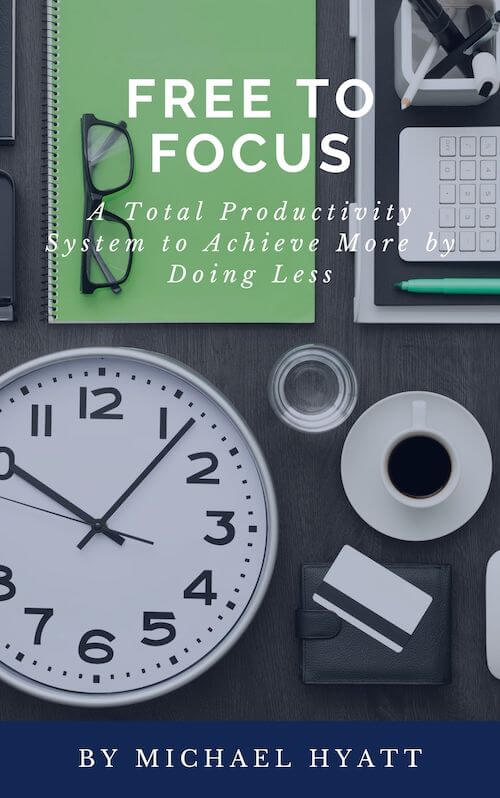
The well-known adage, “Less is More” is not typically applied when speaking of business and work. Productivity is often gauged by the length of the to-do lists and the number of check marks on them. But in Free to Focus: A Total Productivity System to Achieve More by Doing Less, Michael Hyatt introduces the revolutionary idea that not-to-do-lists are actually more valuable and useful. In his book, Hyatt teaches a productivity system that outlines three elementary steps to achieving simplified success. They are: stop, cut, and act.
In today’s society, we live a fast, busy, and preoccupied pace. While time is a premium, the way it is spent is often not measured by the level of quality activities, but more by the quantity of what we get done. Without realizing it, the amount of busyness we allow into our lives by the hour robs us of accomplishing what’s most important. We are easily distracted by what is right in front of us, what the world tells us is pressing, and by the addictiveness of the platforms we use for business and communication, i.e. social media.
The first step to regaining control of our time and its potential success is to stop, analyze, and recognize that our time may not actually be as productive as it feels. For example, when we let work time carry over into the weekends and even our vacations, which seems almost inescapable with the remote access (i.e. technology such as cell phones) that is constantly with us, our well-being pays the price and, by extension, the quality of our accomplishments.
Business leaders should take time to stop and assess how their time is being used and to evaluate their goals against how well their current activities support those objectives. Part of this analysis is considering both what they are proficient at as well as what is a passion. Being clear about what elements of the job mean most to them, along with the overall mission, will help business leaders know what activities to prioritize.
Hyatt asserts that cutting is at the heart of productivity. In the rush of daily tasks, it is most important to identify what not to do, above what needs to be done. This is an innovative way to look at time management, but because of the nature of our modes of communication and information, controlling what doesn’t make it onto our desks can be the bigger challenge. Since time isn’t a renewable resource, it’s essential we are intentional about not wasting it.
Too often people have difficulty saying “no” to the demands put on their time, but by not saying “no” to certain things, they are unwittingly saying “no” to what could have filled their time, which may have actually been more important. This is an important perspective to keep when fulfilling Step Two… Cutting!
When the task is reducing the amount of work to contend with, there are three approaches.
Free to Focus is ideal for busy professionals, entrepreneurs, and leaders who feel trapped by endless to-do lists and constant busyness. If you struggle to focus on what truly matters because you're overwhelmed by urgent but unimportant tasks, this book offers a clear framework to reclaim your time and energy.
In today's hyper-connected world, productivity is often measured by sheer volume rather than impact, leading to burnout and mediocre results. Michael Hyatt's system challenges this broken paradigm by teaching you to eliminate, delegate, and automate low-value work so you can concentrate on activities where you excel and find meaning.
Turn ideas from Free to Focus into action with a short guided reflection: identify the biggest takeaway, connect it to your life, and commit to one step you can take in the next 24 hours.
Free to Focus is a productivity and leadership guide authored by Michael Hyatt, a seasoned business leader and founder of Michael Hyatt & Company. Hyatt is widely recognized for his expertise in leadership development and personal effectiveness, leveraging his experience to offer a systematic approach to achieving more by doing less. This book stands out in the crowded productivity genre by challenging conventional wisdom that equates busyness with success, instead advocating for intentional reduction and prioritization. Its significance lies in its holistic framework that integrates psychological insights with practical business strategies, making it relevant for leaders and professionals seeking sustainable productivity in an era dominated by distraction.
At the heart of Free to Focus is the argument that true productivity arises not from doing more tasks, but from doing fewer, more meaningful ones. Hyatt posits that the key to effective time management is the deliberate identification and elimination of nonessential activities through a three-step process: stop, cut, and act. This approach reframes productivity as a function of selective focus—prioritizing tasks aligned with one’s passions and proficiencies, delegating or automating the rest, and structuring work through rituals that minimize distractions. Ultimately, Hyatt asserts that passion-driven work enhances both efficiency and fulfillment, challenging the traditional emphasis on sheer volume of output.
Free to Focus is ideally suited for business leaders, managers, entrepreneurs, and professionals who feel overwhelmed by the demands of modern work and seek a structured yet flexible system to reclaim their time and enhance their impact. It is particularly valuable for those open to introspection about their work habits and willing to embrace a mindset shift from quantity to quality. Additionally, readers interested in leadership development and the integration of personal passion with professional productivity will find Hyatt’s insights compelling and actionable. However, those looking for deeply empirical or academic treatments of productivity may find this book more inspirational than exhaustive.
Try a few questions from the Free to Focus quiz. Unlock the full summary for the full quiz and answers that will help the ideas stick.
Question 1 of 5
The summary states that Hyatt's system outlines three steps: stop, cut, and act.
Question 2 of 5
Step One (STOP) advises stopping to analyze and recognize that time may not be as productive as it feels and assessing how time is used.
Question 3 of 5
The summary explains three approaches for cutting: remove the activity, delegate it to someone proficient, or automate it.
Question 4 of 5
STEP THREE: ACT includes consolidation, which groups similar activities together; the other options are not listed as ACT approaches.
Question 5 of 5
The summary states that passion should lead activities and that tasks we are passionate and proficient at are a wiser use of time.
Free to Focus by Michael Hyatt is a productivity system that teaches you to achieve more by doing less. Rather than adding more tasks, Hyatt's approach focuses on strategically eliminating, delegating, and automating low-value work so you can concentrate on activities where you excel and find meaning. The core system consists of three steps: Stop (assess your current habits), Cut (eliminate or hand off non-essential work), and Act (implement rituals and consolidation to maximize impact).
Free to Focus is ideal for busy professionals, entrepreneurs, managers, and leaders who feel overwhelmed by endless to-do lists and lack focus on what truly matters. Anyone struggling with burnout, perfectionism, or the inability to delegate will benefit from Hyatt's framework. The book is especially valuable for high achievers who equate productivity with volume rather than impact.
The main takeaways include: not-to-do lists are more powerful than to-do lists; saying no to low-priority work protects time for what matters most; delegation and automation multiply your effectiveness as a leader; your passion and proficiency should guide what work you keep; and daily rituals reduce decision fatigue while freeing mental energy for high-impact thinking. The underlying message is that quality of work and alignment with your strengths matter far more than the sheer volume of tasks completed.
Stop involves pausing to assess how you currently spend time and whether it aligns with your goals and passions. Cut focuses on eliminating, delegating, or automating work that doesn't require your unique skills or energize you. Act puts these insights into practice through consolidation (batching similar tasks), designation (scheduling important work with clear deadlines), and activation (minimizing distractions so tasks feel manageable rather than emergencies).
Hyatt argues that work you're passionate about and proficient in gets done faster, better, and with more energy than work you dislike. By tracking which tasks you love versus loathe, you can design your role to focus on high-passion, high-skill activities while delegating or eliminating everything else. This alignment improves both your motivation and your results, which is counterintuitive in a culture that often glorifies grinding through unpleasant tasks first.
Rituals are mechanized routines that automate recurring decisions and tasks, freeing your mind for creative and strategic work. Examples include a daily shutdown sequence (like reviewing tomorrow's priorities and formally ending your workday) or batching email checks at set times. Rituals reduce decision fatigue and prevent work-related anxiety from following you beyond work hours, ultimately boosting both productivity and well-being.
Hyatt emphasizes that delegation is not a sign of weakness but a core leadership skill that multiplies your impact. Perfectionists often struggle because they believe only they can do the work correctly. The book challenges this through examples like Navy SEAL Jocko Willink, whose team members actually found better solutions when given full ownership. Delegation frees leaders to focus on strategic work that only they can do, while empowering team members to grow and contribute.
Sumizeit is a profitable Scomy LLC company based in Miami, Florida. It has been helping readers learn from nonfiction books for 7 years with expert-written summaries in text, audio, podcast, and video.
Join thousands of learners getting smarter every day
"Great experience. Detailed summaries. Loved the gamification feature. Makes learning fun. Good customer service. I recommend Sumizeit to anyone. You'll learn a lot."
"I always felt busy but still wanting to keep up with the book discussion in my friend group. This was a great supplement to help me keep reading the books I find fun while keeping up with important books."
"I love this website. Instead of scrolling social media, I find myself learning a lot. I use it everyday. I recommend this app for anyone who is too busy and wants to get up to speed with their favorite books."
Looking for a Free to Focus Book Summary PDF you can save and revisit offline? Our Free to Focus Book Summary PDF captures the book’s core ideas in a clean, printable format — the key frameworks, takeaways, and structure without the fluff. Download the Free to Focus Book Summary PDF when you want a reference you can annotate, share with your team, or review on the go. Get your Free to Focus Book Summary PDF from the download page below.
Download Free to Focus Book Summary PDFReaders who explored Free to Focus often enjoyed these titles next.
Popular Book Summaries at sumizeit, leading book summary app