


Prefer the print book? Buy on Amazon
As an Amazon Associate, Sumizeit earns from qualifying purchases.
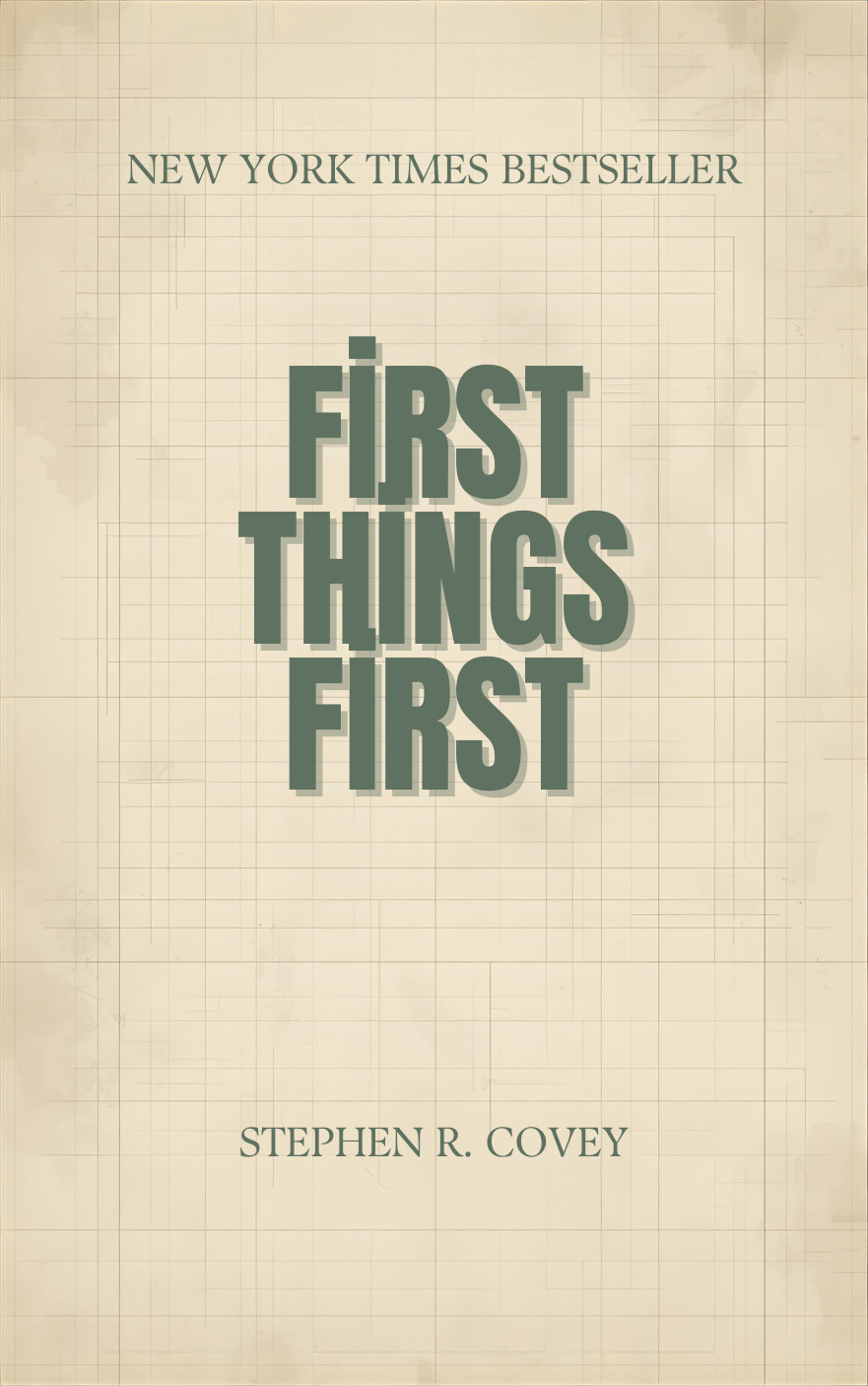
First Things First Book Summary
This First Things First Book Summary covers the key ideas, lessons, and takeaways in about 20 minutes.
Short Description:
First Things First prioritizes important tasks to transform life from reactive to.
Covey offers tools to reverse this pattern: the Time Management Matrix, mission statements, weekly planning, role-based goals, principle-centered decision-making, and Quadrant II living. When we use these practices, we shift from a reactive life to a purposeful one—centered on relationships, growth, health, purpose, and contribution.
When you put first things first, you don’t just manage time better—you transform your life from the inside out.
Helps with these goals
Preview the First Things First book summary
Below is a preview of Sumizeit’s comprehensive human-written summary of First Things First by Stephen Richards Covey. The full summary is 15-20 minutes long and covers the book’s key ideas in text, audio, visual, and video formats. Unlock the full 20 Minute Summary
Most people move through their days in a rush, racing from task to task, answering notifications, joining meetings, and responding to demands that never seem to stop. Yet despite all this activity, many feel strangely dissatisfied—exhausted but not fulfilled, productive yet not truly progressing in what matters most. First Things First by Stephen R. Covey is written as a remedy to this modern dilemma. It is not just another time-management manual; it is a reorientation of how we think about life, priorities, and purpose.
Covey argues that the central problem isn’t that we lack tools or techniques to organize our schedules. The deeper issue is that we have confused urgency with importance. We are so conditioned to respond to what shouts the loudest that we rarely pause to consider whether those demands deserve our best time and energy. The book invites readers to step out of the frantic pace, examine their values, and consciously choose to design their days around what they truly care about rather than what happens to be screaming for attention.
Instead of asking, “How can I get more done?” Covey suggests asking, “What is worth doing at all?” This shift—from efficiency to effectiveness, from the clock to the compass—forms the backbone of the entire book.
The Trap of Urgency and the Illusion of Productivity
Covey describes a pervasive cultural condition he calls “urgency addiction.” Many people feel an almost compulsive need to respond instantly to messages, handle interruptions, and put out fires. This habit is reinforced by praise from others (“You’re so responsive!”), workplace expectations, and internal pressure to always be on. The rush of solving a crisis or ticking off a long to-do list can even feel emotionally rewarding, giving a temporary sense of accomplishment.
But over time, this pattern becomes destructive. When life is dominated by urgent tasks, there is no space for reflection, no breathing room for planning, no capacity for long-term projects, and little energy left for meaningful relationships. People may become experts at crisis management while neglecting the very activities that would reduce crises in the future. They become reactive instead of proactive, controlled by events rather than guided by intention.
Covey challenges the assumption that busyness equals value. You can be extremely busy and yet be moving in circles. Activity is not the same as progress. Many tasks may be necessary, but not all tasks are important. Without a filtering mechanism, the urgent will always override the important, and the result is a life full of noise but lacking in direction.
The Time Management Matrix: Seeing Your Life in Four Quadrants
To help people distinguish between activity and priority, Covey introduces a powerful model called the Time Management Matrix. It organizes tasks based on urgency and importance, producing four quadrants.
Quadrant I contains tasks that are both urgent and important—crises, deadlines, emergencies, and essential problems. These require immediate action. Everyone will spend some time here, but living almost exclusively in this quadrant leads to constant stress and burnout.
Quadrant III…
Want the complete 20-minute summary?
- Full structured summary
- Video Summary
- Podcast Summary
- Audio summary
- Key takeaways
- Exercises
- Quiz
- Highlights and notes
- Ask the book with AI
Who should read First Things First?
First Things First is for anyone feeling trapped in a cycle of busyness without fulfillment—professionals drowning in urgent tasks, parents struggling to balance competing demands, and individuals who suspect their hectic schedules aren't actually aligned with what matters most. If you're productive yet unfulfilled, or constantly reactive rather than intentional, this book offers a roadmap to reclaim your life.
Why does First Things First matter?
In an age of constant notifications, endless to-do lists, and cultural pressure to always be responsive, most people confuse urgency with importance and mistake activity for progress. First Things First addresses this modern crisis by showing how to distinguish between what merely demands attention and what truly deserves your energy. By learning to prioritize what matters, you can transform from a reactive, exhausted life into one that's purposeful, balanced, and genuinely fulfilling.
What are the key themes in First Things First?
- The distinction between urgency and importance
- Principle-centered living as a compass for decisions
- Holistic human needs: to live, love, learn, and leave a legacy
- Quadrant II activities as the foundation of real progress
- Personal agency through four human endowments
- Win-win relationships and empathic listening
- Purpose-driven planning over reactive task management
How can you apply ideas from First Things First?
- Create a personal mission statement that articulates who you want to be and what you want to contribute, then use it as a filter for decisions
- Map your current tasks onto the Time Management Matrix to identify which quadrants consume most of your energy and which deserve more attention
- Establish clear life roles (parent, partner, professional, community member, etc.) and set one or two important goals for each role weekly
- Schedule your weekly planning session and identify your 'big rocks'—high-value, important activities—before allowing lower-priority tasks to fill your calendar
- Practice empathic listening in one important relationship by genuinely seeking to understand before being understood, and notice how trust deepens
- Choose one Quadrant III activity (urgent but unimportant) to eliminate or delegate this week to reclaim time for Quadrant II priorities
- Evaluate your health, relationships, learning, and sense of purpose monthly to ensure all four human needs are being nourished
What common mistakes do readers make with First Things First?
- Assuming that managing time better means cramming more tasks in—when the real goal is doing fewer things with greater intention and impact
- Treating all urgent tasks as important and responding reflexively to interruptions instead of pausing to ask whether they deserve your energy
- Setting a mission statement and then ignoring it, rather than using it as a consistent filter for deciding what to say yes and no to
- Neglecting one life dimension (like health or relationships) in pursuit of professional success, not realizing that this imbalance undermines overall effectiveness
Sumizeit Exercises Apply what you've learned
Turn ideas from First Things First into action with a short guided reflection: identify the biggest takeaway, connect it to your life, and commit to one step you can take in the next 24 hours.
What is the expert analysis of First Things First?
Overview
First Things First is a seminal work by Stephen Richards Covey, a towering figure in the fields of leadership, personal development, and organizational culture. Published as a follow-up to his groundbreaking The 7 Habits of Highly Effective People, this book transcends conventional time-management manuals by addressing the deeper existential challenge of aligning daily actions with core values and long-term purpose. Covey’s stature as a thought leader and his ability to synthesize philosophy, psychology, and practical wisdom make this book a significant contribution to self-improvement literature and leadership theory.
Core Thesis
At its heart, First Things First posits that the prevalent modern malaise—constant busyness without fulfillment—stems from a fundamental confusion between urgency and importance. Covey argues that most people are trapped in a reactive mode, responding incessantly to urgent but often trivial demands, thereby neglecting Quadrant II activities: those that are important but not urgent. This shift from a clock-based efficiency mindset to a compass-driven effectiveness philosophy underpins the book’s central insight. By prioritizing principle-centered living, mission-driven roles, and conscious planning, individuals can transform their lives from chaotic reactivity to intentional purposefulness.
Strengths
- Timeless Framework: The Time Management Matrix remains a powerful heuristic for distinguishing between urgent and important tasks, providing clarity in an age overwhelmed by distractions.
- Holistic Approach: Covey’s integration of physical, emotional, mental, and spiritual dimensions addresses the whole person, emphasizing balance and sustainability rather than fragmented productivity.
- Principle-Centered Living: The emphasis on immutable principles as a compass elevates the discussion beyond tactics to foundational ethics and values, lending the book enduring relevance.
- Practical Tools: The use of mission statements, role identification, and weekly planning translates abstract ideals into actionable strategies, facilitating real behavioral change.
- Leadership Insights: Covey’s focus on empowerment, trust, and win-win relationships enriches the book’s applicability to organizational contexts as well as personal life.
Critiques & Counterarguments
- Evidence and Empiricism: While Covey’s frameworks are compelling, the book leans heavily on anecdotal and philosophical reasoning rather than rigorous empirical validation. Contemporary research in behavioral economics and cognitive psychology sometimes nuances or challenges the simplicity of the urgency-importance dichotomy.
- Oversimplification of Modern Complexity: The categorization into four quadrants, while elegant, may oversimplify the fluid and overlapping nature of tasks in complex, dynamic environments, especially in digital and gig economies where urgency and importance can be intertwined.
- Cultural and Contextual Limitations: Covey’s principles, rooted in Western individualism and Judeo-Christian ethics, may not seamlessly translate across diverse cultural contexts or organizational cultures that prioritize collective over individual values.
- Competing Theories: Alternative models such as Cal Newport’s “Deep Work” emphasize focused, uninterrupted effort but also acknowledge the role of deliberate distraction and rest, suggesting a more nuanced approach than strict Quadrant II prioritization.
- Real-World Constraints: In many professional and personal scenarios, urgent demands are unavoidable and sometimes essential for survival or competitive advantage, limiting the feasibility of consistently prioritizing Quadrant II activities.
Who Should Read This
First Things First is essential reading for thoughtful professionals, leaders, and individuals seeking to transcend the frenetic pace of modern life and cultivate a deeply intentional existence. It is particularly valuable for those interested in integrating ethical principles with practical time management and for readers who appreciate a holistic approach to personal and organizational effectiveness. Anyone feeling overwhelmed by busyness yet unfulfilled by their productivity will find Covey’s insights a clarion call to reexamine priorities and reclaim agency over their lives.
Frequently asked questions about the First Things First book summary
What is First Things First about?
First Things First by Stephen R. Covey is about breaking free from the trap of urgency and learning to prioritize what truly matters. Rather than another time-management manual, it's a guide to reorienting your entire life around principles, purpose, and fulfillment instead of reacting to endless demands. The book teaches that the real challenge isn't getting more done—it's ensuring that the things that matter most come first.
Who should read First Things First?
Anyone feeling busy but unfulfilled should read this book—including overwhelmed professionals, parents juggling competing demands, and individuals who suspect their hectic schedules don't align with their values. If you're exhausted from constant urgency, reactive rather than intentional, or simply wanting to live more purposefully, First Things First provides practical tools and a mindset shift that can transform your life.
What are the main takeaways from First Things First?
The main takeaways include: (1) distinguish between urgent and important tasks using the Time Management Matrix, (2) prioritize Quadrant II activities (important but not urgent) that build long-term well-being, (3) anchor decisions in timeless principles rather than pressure, (4) address all four human needs—to live, love, learn, and leave a legacy, and (5) use weekly planning and role-based goal-setting to align daily choices with your personal mission and values.
What is the Time Management Matrix and how does it work?
The Time Management Matrix organizes all activities into four quadrants based on urgency and importance. Quadrant I contains urgent and important crises, Quadrant II includes important but non-urgent activities like planning and growth, Quadrant III has urgent but unimportant interruptions, and Quadrant IV encompasses time-wasting distractions. Covey argues that shifting more time into Quadrant II—where real progress happens—is the key to reducing stress and increasing fulfillment.
What does Covey mean by the four human needs?
Covey identifies four fundamental dimensions of a fulfilling life: to live (physical health and stability), to love (meaningful relationships and connection), to learn (growth, curiosity, and mental stimulation), and to leave a legacy (purpose, contribution, and lasting impact). A balanced life nurtures all four dimensions; neglecting any one weakens the others and creates a fragmented, incomplete existence.
How do you create a personal mission statement?
A personal mission statement articulates who you want to be and what you want to contribute—your values, purpose, and the impact you wish to have. Covey suggests reflecting deeply on what matters most to you, then writing a clear declaration that becomes a north star for your decisions. Once created, it serves as a filter to distinguish between obligations that align with your values and distractions that don't.
What is Quadrant II and why is it so important?
Quadrant II contains activities that are important but not urgent—relationship building, planning, health, skill development, and creative work. These tasks are critical for long-term success and fulfillment, yet they're easy to postpone because they don't demand immediate attention. Covey argues that building a Quadrant II lifestyle, where you consistently invest in these activities, transforms stress into clarity and activity into meaningful progress.
About Sumizeit
Sumizeit is a profitable Scomy LLC company based in Miami, Florida. Our founders, Clemens Raemy and Weina Scott, are successful entrepreneurs with several exits. Sumizeit is a popular book summary app / micro learning app used by busy professionals and entrepreneurs with over 2,500 non-fiction book summaries and 10,000 podcast summaries in text, audio, visual, podcast, and video format. We also have stellar retention tools to make ideas stick - such as flashcards with spaced repetition, quizzes, streaks, highlighting and notes, daily challenges, riddles, mini-courses, meditation, and more. You won't only learn the idea, but also remember it. Over 90% of our users change their habits with Sumizeit.
Upgrade Now
Here's why readers love Sumizeit
Join thousands of learners getting smarter every day
"Great experience. Detailed summaries. Loved the gamification feature. Makes learning fun. Good customer service. I recommend Sumizeit to anyone. You'll learn a lot."
"I always felt busy but still wanting to keep up with the book discussion in my friend group. This was a great supplement to help me keep reading the books I find fun while keeping up with important books."
"I love this website. Instead of scrolling social media, I find myself learning a lot. I use it everyday. I recommend this app for anyone who is too busy and wants to get up to speed with their favorite books."
First Things First Book Summary PDF
Looking for a First Things First Book Summary PDF you can save and revisit offline? Our First Things First Book Summary PDF captures the book’s core ideas in a clean, printable format — the key frameworks, takeaways, and structure without the fluff. Download the First Things First Book Summary PDF when you want a reference you can annotate, share with your team, or review on the go. Get your First Things First Book Summary PDF from the download page below.
Download First Things First Book Summary PDFPeople also liked these summaries
Readers who explored First Things First often enjoyed these titles next.



Ready to read the whole thing?
- Full structured summary
- Video Summary
- Podcast Summary
- Audio summary
- Key takeaways
- Exercises
- Quiz
- Highlights and notes
- Ask the book with AI
Featured Book Titles
Popular Book Summaries at sumizeit, leading book summary app