


Prefer the print book? Buy on Amazon
As an Amazon Associate, Sumizeit earns from qualifying purchases.
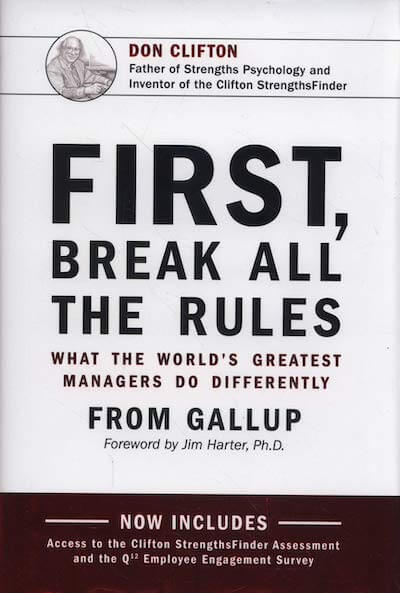
First, Break All the Rules Book Summary
This First, Break All the Rules Book Summary covers the key ideas, lessons, and takeaways in about 20 minutes.
Short Description:
Great managers focus on strengths and engagement, breaking traditional rules.
Helps with these goals
Preview the First, Break All the Rules book summary
Below is a preview of Sumizeit’s comprehensive human-written summary of First, Break All the Rules by Marcus Buckingham and Curt Coffman. The full summary is 15-20 minutes long and covers the book’s key ideas in text, audio, visual, and video formats. Unlock the full 20 Minute Summary
All managers have a different leadership style, but there is one common trait that all great managers share: they are not afraid to break the rules. Great managers don’t make room for each employee to overcome his or her weaknesses. They don’t provide abundant training for employees to gain the skills they lack. In this book, several managers or front-line supervisors of thriving companies were interviewed. The people interviewed excelled at one main goal: transforming employees’ talents into strong performance.
The big picture summary: Choose employees based on their talents instead of their skills or experience.
The main points of this book are:
Great managers break all the rules. They operate on the assumption that people probably can’t change many of their traits, so they focus on employee strength instead. The first key to being a strong manager is to select employees based on talent rather than experience or intelligence. The second key is to evaluate performance based on desired outcomes rather than direct control over the way a worker performs his or her job. The third key is to stop trying to develop your workers. Focus on their strengths, instead. The fourth and final key is to find the right fit for your employees’ talents. Strong managers look inside of their employees and drive out the best in them.
Now let’s take a closer look at what these points really mean:
Chapter Summaries
Chapter 1. The measuring stick. A disaster off the Scilly Isles: what do we know to be important but are unable to measure?
Chapter 2. The wisdom of great managers. Words from the wise: who did Gallup interview?
Chapter 3. The first key: select for talent. Talent: how great managers define it: why does every role, performed at excellence, require talent?
Chapter 4. The second key: define the right outcomes. Managing by remote control: why is it so hard to manage people well?
Chapter 5. The third key: focus on strengths. Let them become more of who they already are: how do great managers release each person's potential?
Chapter 6. The fourth key: find the right fit. The blind, breathless climb: what's wrong with the old career path?
Chapter 7. Turning the keys: a practical guide. The art of interviewing for talent: which are the right questions to ask?
The key takeaway is, don’t manage a team through leadership or through conventional appraisal systems. Manage them by placing members in the best positions for their talents. This will allow you to further assist them with honing those talents, and it will help drive the business forward.
Marcus Buckingham, born January 11th of 1966, was raised in the village of Radlett, north of London. As a child, he suffered from a stammer which caused him to not speak much until the age of 13. In 1987, he graduated from Pembroke College, Cambridge, with a degree in Social and Political Sciences.
Want the complete 20-minute summary?
- Full structured summary
- Video Summary
- Podcast Summary
- Audio summary
- Key takeaways
- Exercises
- Quiz
- Highlights and notes
- Ask the book with AI
Who should read First, Break All the Rules?
First, Break All the Rules is essential for managers, team leaders, and HR professionals who want to move beyond conventional management wisdom. It's also valuable for anyone in leadership who feels frustrated with traditional approaches to employee development and performance management. If you're responsible for building high-performing teams, this book challenges you to rethink how you hire, evaluate, and develop your people.
Why does First, Break All the Rules matter?
Organizations waste enormous resources trying to fix employee weaknesses rather than amplifying their natural talents. In today's competitive business environment, the difference between mediocre and exceptional teams often comes down to how well managers understand and deploy individual talent. First, Break All the Rules, based on Gallup's research of thousands of top-performing managers, reveals that the best leaders operate by a completely different set of principles than conventional management training teaches.
What are the key themes in First, Break All the Rules?
- Talent-based hiring over experience-based hiring
- Managing by outcomes rather than direct control
- Leveraging strengths instead of fixing weaknesses
- Creating the right role fit for individual talents
- Breaking conventional management rules that don't work
- Building engaged workplace environments
How can you apply ideas from First, Break All the Rules?
- Redesign your interview process to ask open-ended questions that reveal recurring patterns of behavior, feeling, and thought rather than just asking about past titles and accomplishments
- Audit your current team roles and identify where people's talents are underutilized or misaligned, then work to reposition them into better-fitting roles
- Implement weekly recognition and praise for specific accomplishments rather than relying on annual performance reviews or generic thank-you emails
- Create a development conversation habit where you meet one-on-one with direct reports to understand their goals, preferences for praise, and how they like to work
- Define outcome-based expectations for major projects and roles, then trust team members to find their own path to achieving those outcomes
- Stop investing in training programs designed to fix weaknesses; instead, identify what employees do best and create roles or project assignments that amplify those strengths
- Document the 12 Gallup engagement questions and track them in your team's regular survey or pulse check to identify which areas need attention
What common mistakes do readers make with First, Break All the Rules?
- Assuming that experience and credentials predict success in a role—talent fit matters far more than resume credentials
- Using generic training and development programs to fix employee weaknesses instead of building on their natural strengths
- Waiting for annual reviews to give feedback rather than providing regular recognition and guidance throughout the year
- Promoting successful individual contributors into management roles where they lack the talent to manage others, or where they lose the opportunity to use their core strengths
Sumizeit Exercises Apply what you've learned
Turn ideas from First, Break All the Rules into action with a short guided reflection: identify the biggest takeaway, connect it to your life, and commit to one step you can take in the next 24 hours.
What is the expert analysis of First, Break All the Rules?
Overview
First, Break All the Rules, authored by Marcus Buckingham and Curt Coffman, stands as a seminal work in the field of management and organizational psychology. Drawing on extensive empirical research conducted at the Gallup Organization, the book challenges conventional wisdom about leadership and talent management. Buckingham and Coffman leverage their deep experience in employee engagement and organizational behavior to offer a paradigm-shifting perspective on what truly distinguishes exceptional managers. Their work has not only influenced corporate practices worldwide but has also secured a place among the most influential business books of the late 20th century.
Core Thesis
The central argument of First, Break All the Rules is that great managers succeed by defying traditional management doctrines. Instead of attempting to fix employees' weaknesses or conforming to rigid leadership styles, they focus relentlessly on identifying and cultivating individual talents. The authors contend that talent—defined as recurring patterns of thought, feeling, and behavior—is largely innate and immutable. Therefore, the most effective management strategy is to select employees based on their natural talents, define clear performance outcomes rather than micromanaging processes, concentrate on strengthening existing capabilities, and ensure employees are placed in roles that fit their unique talents. This approach, the authors argue, drives superior performance and employee engagement.
Strengths
- Empirical Foundation: The book’s insights are grounded in rigorous research involving thousands of managers and employees across diverse industries, lending credibility and practical relevance.
- Challenging Conventional Wisdom: By overturning traditional assumptions about employee development and management control, the authors provoke critical rethinking of entrenched practices.
- Actionable Framework: The four keys—selecting for talent, defining outcomes, focusing on strengths, and finding the right fit—offer a clear, implementable roadmap for managers.
- Focus on Individuality: Emphasizing personalized management and recognizing unique employee needs fosters a more human-centered leadership style.
- Practical Tools: The inclusion of specific interview techniques and survey questions equips managers with concrete methods to apply the book’s principles.
Critiques & Counterarguments
- Overemphasis on Innate Talent: The authors’ assertion that talent is largely fixed and cannot be taught may underestimate the potential for skill development and learning, as supported by growth mindset research (Carol Dweck) and neuroplasticity studies.
- Potential Neglect of Weaknesses: While focusing on strengths is valuable, ignoring critical weaknesses can sometimes impair team cohesion and overall performance, especially in roles requiring comprehensive skill sets.
- Contextual Limitations: The research primarily reflects corporate environments prevalent in the 1990s and early 2000s; contemporary shifts toward agile, collaborative, and cross-functional teams may require more nuanced approaches.
- Management as Remote Control: The idea of “remote control” management might be critiqued for potentially fostering disengagement if not balanced with adequate support and communication, contrasting with transformational leadership models emphasizing inspiration and shared vision.
- Alternative Theoretical Perspectives: Schools of thought such as servant leadership, emotional intelligence frameworks (Daniel Goleman), and positive organizational scholarship propose more holistic and dynamic views of leadership that integrate both strengths and developmental opportunities.
Who Should Read This
This book is indispensable for experienced and aspiring managers, HR professionals, and organizational leaders seeking to enhance employee engagement and performance through evidence-based, innovative management practices. It also appeals to scholars and students of organizational psychology and business leadership interested in empirical research on talent management. Readers who value pragmatic, research-driven insights into human behavior at work will find this book a rich resource. However, those looking for comprehensive developmental strategies or more contemporary leadership models may need to supplement it with additional literature.
Frequently asked questions about the First, Break All the Rules book summary
What is First, Break All the Rules about?
First, Break All the Rules, written by Marcus Buckingham and Curt Coffman, reveals how the world's best managers achieve exceptional results by breaking conventional management wisdom. Based on Gallup Organization research with thousands of top-performing managers, the book presents four key principles: selecting employees for talent rather than experience, defining clear outcomes while allowing autonomy, focusing on amplifying strengths rather than fixing weaknesses, and finding the right role fit for each person's natural abilities.
Who should read First, Break All the Rules?
This book is essential for managers, team leaders, HR professionals, and anyone in a leadership position responsible for building and developing teams. It's particularly valuable for leaders frustrated with traditional management approaches and those looking to improve employee retention, engagement, and performance. Even individual contributors who want to understand what great managers do differently will find practical insights.
What are the main takeaways from First, Break All the Rules?
The four main takeaways are: (1) hire for talent—recurring patterns of thought, feeling, and behavior that can't be taught, (2) manage by defining desired outcomes and allowing autonomy rather than micromanaging methods, (3) build performance by amplifying what people do best instead of fixing weaknesses, and (4) create role fit by positioning employees where their talents are fully utilized. The book also emphasizes that the best management often requires breaking conventional rules.
How do great managers interview differently?
Great managers interview for talent by asking open-ended questions designed to reveal how candidates think, feel, and behave in recurring patterns. Rather than focusing on credentials, degrees, or previous titles, they listen for clues about the candidate's fundamental talents. They ask questions like what roles the candidate learned quickly and what satisfies them about past work—signals that reveal talent alignment with the role.
What are the 12 questions Gallup used to measure employee engagement?
Gallup's 12-question survey revealed that highly engaged employees answered yes to questions about knowing expectations, having needed equipment, doing what they do best daily, receiving recognition, having a caring manager, having a development advocate, feeling heard, understanding company mission, working with committed colleagues, having a best friend at work, discussing progress regularly, and having learning opportunities. Notably, none involved pay, benefits, or organizational structure.
Why do great managers focus on strengths instead of weaknesses?
Great managers focus on strengths because talent—the recurring patterns of thought, feeling, and behavior underlying performance—cannot be trained or taught in the traditional sense. While weaknesses can be managed through better tools or processes, true performance breakthroughs come from helping naturally talented people become even better at what they already do well. This approach yields faster, more sustainable performance improvement.
What does remote control management mean?
Remote control management means defining clear desired outcomes and allowing employees the autonomy to achieve those outcomes in their own way, rather than micromanaging the methods or process. This approach respects employees' talent and judgment, builds self-reliance, and allows people to apply their unique strengths to problem-solving. In contrast, direct control—prescribing exactly how work should be done—weakens organizations by suggesting employees lack sufficient talent.
How does First, Break All the Rules challenge traditional career paths?
The book challenges the conventional assumption that career advancement always means moving up the ladder to the next rung. Instead, it argues that talented people performing excellently shouldn't be forced into unsuitable higher-level roles, and companies shouldn't spend extra resources promoting people whose talents don't align with the next level. Great managers create alternative advancement paths that allow employees to continue using their strengths while increasing responsibility and recognition.
About Sumizeit
Sumizeit is a profitable Scomy LLC company based in Miami, Florida. Our founders, Clemens Raemy and Weina Scott, are successful entrepreneurs with several exits. Sumizeit is a popular book summary app / micro learning app used by busy professionals and entrepreneurs with over 2,500 non-fiction book summaries and 10,000 podcast summaries in text, audio, visual, podcast, and video format. We also have stellar retention tools to make ideas stick - such as flashcards with spaced repetition, quizzes, streaks, highlighting and notes, daily challenges, riddles, mini-courses, meditation, and more. You won't only learn the idea, but also remember it. Over 90% of our users change their habits with Sumizeit.
Upgrade Now
Here's why readers love Sumizeit
Join thousands of learners getting smarter every day
"Great experience. Detailed summaries. Loved the gamification feature. Makes learning fun. Good customer service. I recommend Sumizeit to anyone. You'll learn a lot."
"I always felt busy but still wanting to keep up with the book discussion in my friend group. This was a great supplement to help me keep reading the books I find fun while keeping up with important books."
"I love this website. Instead of scrolling social media, I find myself learning a lot. I use it everyday. I recommend this app for anyone who is too busy and wants to get up to speed with their favorite books."
First, Break All the Rules Book Summary PDF
Looking for a First, Break All the Rules Book Summary PDF you can save and revisit offline? Our First, Break All the Rules Book Summary PDF captures the book’s core ideas in a clean, printable format — the key frameworks, takeaways, and structure without the fluff. Download the First, Break All the Rules Book Summary PDF when you want a reference you can annotate, share with your team, or review on the go. Get your First, Break All the Rules Book Summary PDF from the download page below.
Download First, Break All the Rules Book Summary PDFPeople also liked these summaries
Readers who explored First, Break All the Rules often enjoyed these titles next.

Ready to read the whole thing?
- Full structured summary
- Video Summary
- Podcast Summary
- Audio summary
- Key takeaways
- Exercises
- Quiz
- Highlights and notes
- Ask the book with AI
Featured Book Titles
Popular Book Summaries at sumizeit, leading book summary app