


As an Amazon Associate, Sumizeit earns from qualifying purchases.
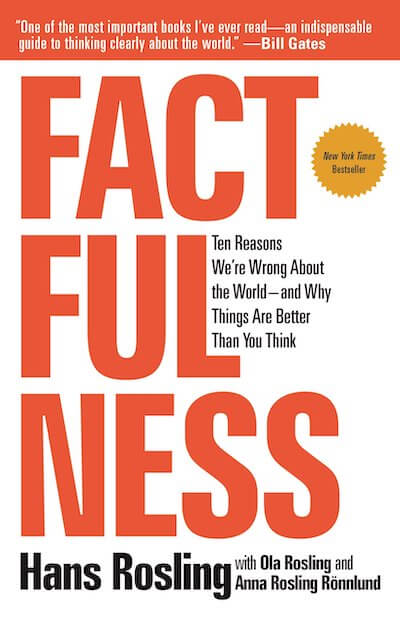
Factfulness Book Summary
This Factfulness Book Summary covers the key ideas, lessons, and takeaways in about 20 minutes.
Helps with these goals
Want the complete 20-minute summary?
- Full structured summary
- Video Summary
- Podcast Summary
- Audio summary
- Key takeaways
- Exercises
- Quiz
- Highlights and notes
- Ask the book with AI
What is in the Factfulness book summary?
Below is a preview of Sumizeit’s expert-written summary of Factfulness by Hans Rosling. The full summary covers the book’s key ideas in text, audio, and video.
Hans Rosling worked his whole life to reveal global truths. Throughout his upbringing, he was taught to believe that the world was going downhill.
But after studying the world and interviewing its people, he discovered that most think that the state of the world is much direr than it actually is.
Furthermore, he discovered that the belief was based on one single problem we have as humans and that is our overpowering cynical perspectives.
Rosling believed that humans have a hard time forgetting their long-thought cynical beliefs than accepting new information that combats it.
“Forming your worldview by relying on the media would be like forming your view about me by looking only at a picture of my foot.”- Hans Rosling
And because of that, in his book, “Factfulness: Ten Reasons We’re Wrong About the World - and Why Things Are Better Than You Think,” Rosling proposes that a fact-based outlook on life is the solution to the problems we are facing.
The Gap Instinct
From the beginning of time, jumping to conclusions has been a survival tactic. You can think of it as a “better safe than sorry” method.
Even today, you can see this behavior in social interactions like gossip between friends or coworkers.
As we continue to evolve, and science tries to prove things through fact to us, we continue to rely on this old habit of assumption.
And because of this, we are using information and data to scare ourselves, rather than to heal or understand.
The gap instinct is a voice inside our heads that separates the world and all of its information into black and white, male and female, good and bad, etc. without ever looking at the gray spots or the in-betweens.
One of the biggest examples of this in our society is rich versus poor.
75% of people actually fall into the middle-class according to their income.
So, the idea of developing nations being poor is not as true as we like to think.
Low-income countries and areas are in existence. But they only make up 9% of the world.
That means that a total of 91% are middle-class or higher.
Rosling encourages looking at income status in levels:
Most people live somewhere between level 2 and 3. Level 4 would be people who are extremely wealthy.
In order to eliminate our gap instinct we need to:
A lot of us cannot even understand level 1 poverty. And that’s because we aren’t living it. That is why we create our own dramatic image of it, just like we do with level 4.
If we looked at it with a “factfulness” approach, we would start to understand the gray areas of wealth.
The Negativity Instinct
Rosling spent time traveling and interviewing people around the world. What he discovered was that 50% of the people he talked to believed that the world was going downhill.
“Every group of people I ask thinks the world is more frightening, more violent, and more hopeless—in short, more…
Want the complete 20-minute summary?
- Full structured summary
- Video Summary
- Podcast Summary
- Audio summary
- Key takeaways
- Exercises
- Quiz
- Highlights and notes
- Ask the book with AI
Who should read Factfulness?
Factfulness is essential for anyone who feels pessimistic about global progress or relies on news media to understand the world. Whether you're a student, professional, policymaker, or simply someone concerned about humanity's future, this book challenges your assumptions with data-backed evidence. It's particularly valuable for leaders, educators, and decision-makers who need fact-based perspectives to drive better choices.
Why does Factfulness matter?
In an age of constant negative headlines and information overload, Factfulness by Hans Rosling offers a critical antidote to distorted worldviews. Most people dramatically underestimate global progress on health, poverty, education, and quality of life—and this cognitive bias shapes policy, investment, and personal well-being. By learning to think factually rather than emotionally, readers can make better decisions, reduce unnecessary anxiety, and recognize genuine improvements happening worldwide.
What are the key themes in Factfulness?
- Cognitive biases that distort our perception of reality
- The gap between how the world actually is versus how we perceive it
- Data literacy and fact-based thinking as essential life skills
- Global progress is real but invisible due to negativity bias
- Media sensationalism amplifies fear and distorts perspective
- Systemic thinking versus blame and scapegoating
- Gradual improvement over dramatic change
What are the key lessons from the Factfulness book summary?
The Gap Instinct divides the world into extremes
We see the world in black and white categories (rich vs. poor, developed vs. undeveloped) when reality exists across a nuanced spectrum. Rosling shows that 91% of the world is middle-class or above, not the extreme poverty we imagine.
The Negativity Instinct makes us overestimate danger
Our brains are wired to focus on threats and bad news, causing us to believe the world is worse than data shows. Media amplifies this by emphasizing tragic stories over positive trends.
The Straight Line Instinct causes us to extrapolate growth indefinitely
We assume trends continue forever in one direction, like population growth. Real data follows curves that plateau, decline, or shift—requiring contextual understanding rather than linear assumptions.
Fear overwhelms our ability to process facts accurately
When afraid, our minds reject data and logic in favor of emotion. Natural disasters, plane crashes, and terrorism cause disproportionate fear despite statistically low death rates.
Generalization prevents us from seeing within-group variation
Blanket assumptions about countries, cultures, or communities blind us to diversity and individual differences. Every group contains significant variation that stereotypes ignore.
The Destiny Instinct assumes cultures cannot change
We often believe groups are trapped by tradition or nature, overlooking rapid cultural and economic transformations happening globally. Change is constant but subtle.
Single perspectives limit complex understanding
Using one analytical tool or viewpoint to understand complex issues leads to distorted conclusions. Multiple perspectives and acknowledged limitations provide more accurate insights.
The Blame Instinct oversimplifies causation
We seek convenient scapegoats rather than understanding multiple factors in complex outcomes. Systems and causes matter more than identifying villains or heroes.
The Urgency Instinct pushes false all-or-nothing thinking
We pressure ourselves and others into immediate action using crisis mentality, when most meaningful change happens gradually. Patience and incremental progress are more realistic and sustainable.
Progress is measurable but underreported
Extreme poverty dropped from 28% in 1960 to 9% today; child mortality, disease, and illiteracy have all declined dramatically. Good news is simply less visible than bad news.
Statistics require context to be meaningful
Raw numbers without historical comparison, regional breakdown, or baseline understanding can terrify rather than inform. Context transforms alarming figures into evidence of improvement.
Media cannot be expected to show balanced reality
News organizations prioritize engagement and urgency, making tragedy and conflict their core content. Relying solely on media for worldview is like judging a person by a photo of their foot.
Comparative thinking reveals hidden progress
Comparing current conditions to past baselines shows improvement; comparing extremes creates false despair. The middle matters most because most people live there.
Educational systems should teach factual literacy
Schools must teach children to question news, understand statistics, and adopt comparative perspective. Critical thinking about sources and methods prevents bias propagation.
Expert consensus can be wrong or outdated
Even experts hold biased assumptions and fail to update knowledge as conditions change. Admitting knowledge gaps and seeking fresh data combats false certainty.
Small gradual improvements compound into dramatic change
Transformations often appear frozen until suddenly recognized; tracking incremental progress reveals continuous improvement invisible to dramatic thinking.
Natural disasters are increasingly survivable through preparation
Deaths from natural disasters have dropped since the 1930s because societies develop preparedness systems. Infrastructure and knowledge reduce mortality more than pessimism assumes.
Poverty has many levels, not just rich and poor
Rosling's four-level income framework shows most people earn $2-32 daily; understanding gradations prevents both despair about extremes and ignorance of moderate struggles.
Traveling and listening dismantle blanket assumptions
Direct experience with diverse populations reveals complexity that statistics alone cannot convey. Conversation challenges stereotypes more effectively than argument.
Want the complete 20-minute summary?
- Full structured summary
- Video Summary
- Podcast Summary
- Audio summary
- Key takeaways
- Exercises
- Quiz
- Highlights and notes
- Ask the book with AI
How can you apply ideas from Factfulness?
- Before reacting to alarming news, research historical trends and broader context to determine if danger has actually increased or is simply being reported more
- Teach children to question media narratives by asking: What's the baseline? What improved? Who benefits from this story?
- Replace all-or-nothing thinking with incremental goal-setting in business and personal projects; expect gradual improvement rather than sudden transformation
- When making policy or investment decisions, demand multiple perspectives and acknowledge limitations rather than relying on single analytical frameworks
- Use income and development level frameworks to move beyond stereotyping nations, regions, or communities and recognize internal diversity
- Practice separating your emotional reaction from factual analysis by pausing, breathing, and researching before making urgent decisions
- In leadership, focus on systemic improvements and causal factors rather than blaming individuals; design better processes instead of hunting scapegoats
What common mistakes do readers make with Factfulness?
- Assuming current media coverage reflects actual risk; terrorism and plane crashes receive disproportionate attention despite causing less than 1% of deaths combined
- Comparing poor countries to wealthy countries without acknowledging the vast middle tier where most global population lives
- Believing cultural traits are fixed and immutable rather than recognizing continuous cultural evolution and adaptation
- Accepting expert consensus without questioning whether their data is current or their assumptions are tested against new evidence
Sumizeit Exercises Apply what you've learned
Turn ideas from Factfulness into action with a short guided reflection: identify the biggest takeaway, connect it to your life, and commit to one step you can take in the next 24 hours.
What is the expert analysis of Factfulness?
Overview
Factfulness: Ten Reasons We’re Wrong About the World — and Why Things Are Better Than You Think is a seminal work authored by Hans Rosling, alongside Ola Rosling and Anna Rosling Rönnlund. Hans Rosling, a distinguished Swedish physician, academic, and public health expert, is renowned for his pioneering use of data visualization to challenge widespread misconceptions about global development. His career, marked by rigorous statistical inquiry and global health advocacy, lends the book an authoritative voice. The significance of Factfulness lies in its systematic debunking of pessimistic worldviews by demonstrating, through empirical evidence, that many aspects of global human progress are improving contrary to popular belief.
Core Thesis
The central argument of Factfulness is that humans possess inherent cognitive biases—such as the gap instinct, negativity instinct, and fear instinct—that skew their perception of reality, making the world appear worse than it is. Rosling posits that these instincts cause people to overlook nuanced, data-driven realities in favor of dramatic, simplistic narratives. The book advocates for a “fact-based worldview,” urging readers to adopt a mindset grounded in statistical literacy and critical thinking to better understand global trends. By categorizing income levels, challenging binary thinking, and emphasizing gradual improvements, Rosling reveals that the majority of humanity is experiencing progress in health, wealth, and education, despite persistent challenges.
Strengths
- Data-Driven Clarity: Rosling’s use of robust statistical data and innovative visualizations provides a compelling, accessible foundation for challenging entrenched misconceptions.
- Psychological Insight: The identification and elucidation of ten cognitive instincts that distort perception offer readers a valuable framework for self-reflection and critical analysis.
- Nuanced Worldview: By rejecting binary categorizations such as “rich vs. poor” and emphasizing the “gray areas,” the book fosters a more sophisticated understanding of global socioeconomic realities.
- Optimistic Yet Realistic: The book balances recognition of ongoing global problems with evidence of significant progress, encouraging informed hope rather than naive optimism.
- Practical Guidance: Rosling’s actionable advice on overcoming biases equips readers with tools to approach news and data more judiciously.
Critiques & Counterarguments
- Potential Oversimplification: While the book admirably counters doom-laden narratives, it may understate the complexity and severity of certain global issues, such as climate change or systemic inequality, which do not always follow linear improvement trajectories.
- Selection Bias in Data Presentation: Critics might argue that Rosling’s emphasis on positive trends selectively highlights successes, potentially glossing over regions or populations where conditions have stagnated or worsened.
- Competing Perspectives on Development: Alternative schools of thought, such as dependency theory or postcolonial critiques, emphasize structural and historical factors that complicate the narrative of steady global progress.
- Media Influence and Information Ecology: Although Rosling critiques media sensationalism, some scholars argue that media’s role in shaping perceptions is more nuanced and that selective exposure and confirmation bias also play significant roles beyond the instincts described.
- Changing Global Dynamics: Since the book’s publication, emergent crises (e.g., pandemics, geopolitical conflicts) have tested the durability of the optimistic trends Rosling highlights, suggesting the need for continuous reevaluation.
Who Should Read This
Factfulness is essential reading for intellectually curious individuals seeking to refine their understanding of global affairs beyond sensational headlines and ingrained biases. It is particularly valuable for:
- Policy makers and development professionals who require a balanced, data-informed perspective to guide decision-making.
- Educators and students in fields such as international relations, public health, economics, and media studies aiming to cultivate critical thinking skills.
- Journalists and communicators who wish to responsibly report on complex global issues without succumbing to negativity bias.
- General readers interested in self-improvement through enhanced cognitive awareness and a more fact-based worldview.
Ultimately, the book serves as a corrective lens, encouraging readers to embrace complexity, question assumptions, and appreciate the incremental progress humanity has achieved.
Frequently asked questions about the Factfulness book summary
What is Factfulness about?
Factfulness by Hans Rosling is about understanding why most people hold pessimistic, inaccurate views of the world despite overwhelming evidence of global progress. The book identifies ten cognitive biases—from gap instinct to urgency instinct—that distort our perception of reality and shows how data-driven thinking can reveal the world is actually much better than we believe.
Who should read Factfulness?
Factfulness is essential for anyone who feels anxious about global events, consumes news media regularly, or makes decisions affecting others. Leaders, educators, policymakers, and professionals in development, healthcare, and social impact will find it particularly valuable for making fact-based rather than fear-based decisions.
What are the main takeaways from Factfulness?
The main takeaways are: (1) Our brains are wired with cognitive biases that make us see the world more negatively than data supports, (2) Extreme poverty has dropped to 9%, child mortality has fallen dramatically, and progress is measurable across most development metrics, and (3) Adopting factful thinking—using context, avoiding generalizations, and resisting fear—allows us to make better decisions and recognize genuine improvement.
What are the ten instincts that distort our worldview?
Hans Rosling identifies the gap instinct (seeing extremes only), negativity instinct (focusing on bad news), straight line instinct (assuming trends continue forever), fear instinct (overestimating danger), generalization instinct (stereotyping groups), destiny instinct (assuming unchangeable culture), single perspective instinct (using one analytical tool), blame instinct (seeking scapegoats), urgency instinct (forcing premature action), and size instinct (misunderstanding statistics without context).
How does Hans Rosling measure global progress?
Rosling uses data across multiple dimensions including life expectancy, child mortality, extreme poverty rates, disease prevalence, and education levels. He compares current statistics to historical baselines to demonstrate improvement, and breaks data into regional and income-level categories to avoid misleading averages that hide real variation.
Why does media coverage make the world seem worse than it is?
Media organizations prioritize stories that engage readers—tragedy, conflict, and urgency generate attention while incremental progress and gradual improvement bore audiences. This systematic bias toward negative news creates a distorted worldview that contradicts statistical evidence of improvement in health, poverty, literacy, and other metrics.
Can factfulness be learned?
Yes, Rosling emphasizes that factfulness is a learnable skill that requires practice, humility, and willingness to update beliefs based on current data. By recognizing your cognitive biases, seeking context before reacting, and actively resisting fear-based thinking, anyone can develop a more accurate and balanced understanding of global reality.
About Sumizeit
Sumizeit is a profitable Scomy LLC company based in Miami, Florida. It has been helping readers learn from nonfiction books for 7 years with expert-written summaries in text, audio, podcast, and video.
Want the complete 20-minute summary?
- Full structured summary
- Video Summary
- Podcast Summary
- Audio summary
- Key takeaways
- Exercises
- Quiz
- Highlights and notes
- Ask the book with AI
Here's why readers love Sumizeit
Join thousands of learners getting smarter every day
"Great experience. Detailed summaries. Loved the gamification feature. Makes learning fun. Good customer service. I recommend Sumizeit to anyone. You'll learn a lot."
"I always felt busy but still wanting to keep up with the book discussion in my friend group. This was a great supplement to help me keep reading the books I find fun while keeping up with important books."
"I love this website. Instead of scrolling social media, I find myself learning a lot. I use it everyday. I recommend this app for anyone who is too busy and wants to get up to speed with their favorite books."
Factfulness Book Summary PDF
Looking for a Factfulness Book Summary PDF you can save and revisit offline? Our Factfulness Book Summary PDF captures the book’s core ideas in a clean, printable format — the key frameworks, takeaways, and structure without the fluff. Download the Factfulness Book Summary PDF when you want a reference you can annotate, share with your team, or review on the go. Get your Factfulness Book Summary PDF from the download page below.
Download Factfulness Book Summary PDFPeople also liked these summaries
Readers who explored Factfulness often enjoyed these titles next.



Want the complete 20-minute summary?
- Full structured summary
- Video Summary
- Podcast Summary
- Audio summary
- Key takeaways
- Exercises
- Quiz
- Highlights and notes
- Ask the book with AI
Featured Book Titles
Popular Book Summaries at sumizeit, leading book summary app