Question 1 of 10


Prefer the print book? Buy on Amazon
As an Amazon Associate, Sumizeit earns from qualifying purchases.
Book Summary
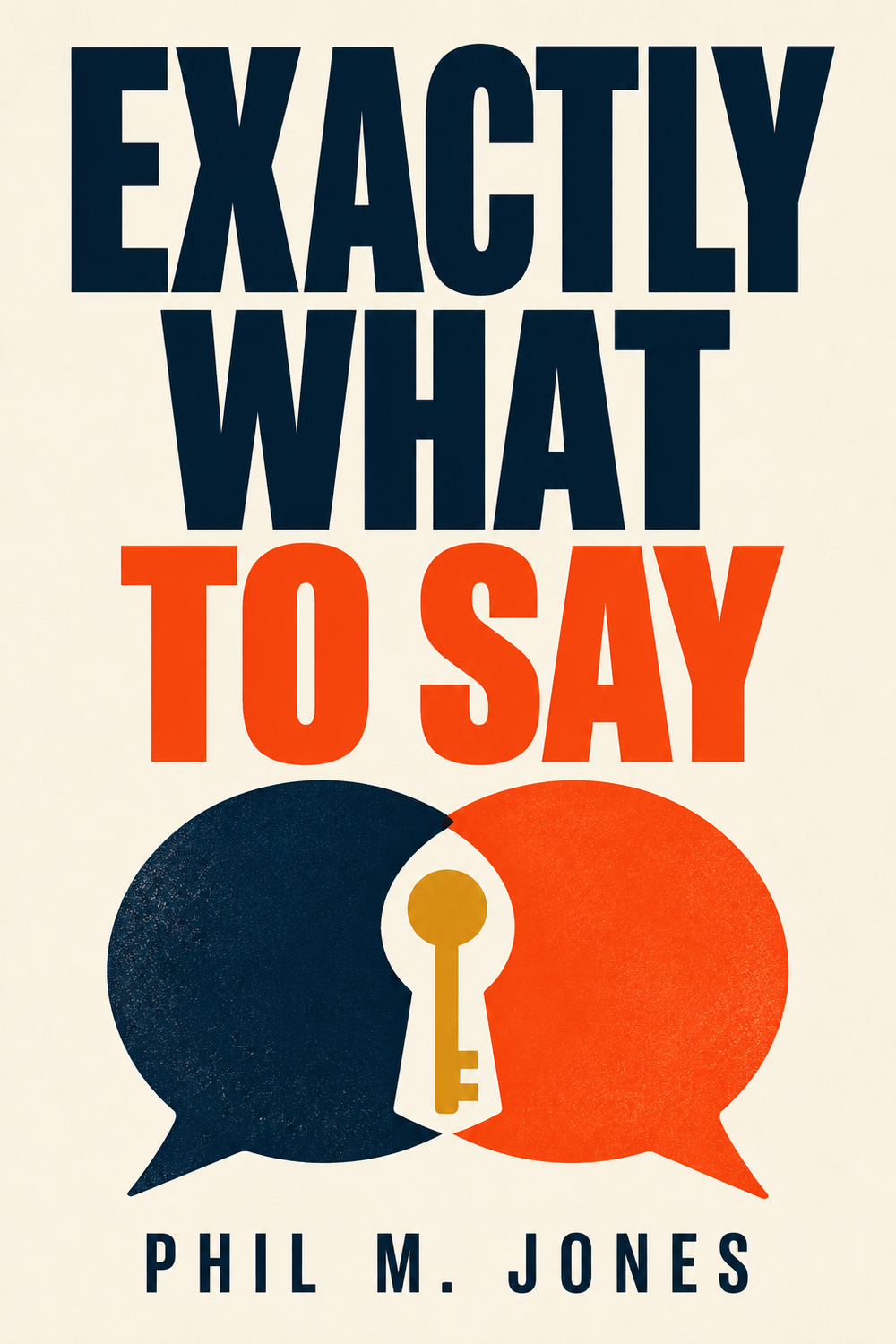
Exactly What to Say Book Summary
This Exactly What to Say Book Summary covers the key ideas, lessons, and takeaways in about 20 minutes.
Short Description:
Book summary of Phil M. Jones’s magic phrases for winning sales and referrals
Small, well chosen phrases change how people respond because they speak to the part of the mind that decides quickly and emotionally, so learn a handful of Jones's magic words, match each to the moment it fits, from opening the conversation to handling doubt, objections, and the final answer, and use them with real care for the other person, because the goal is to make saying yes feel easy and natural, not to pressure anyone.
Helps with these goals
Preview the Exactly What to Say book summary
Below is a preview of Sumizeit’s comprehensive human-written summary of Exactly What to Say by Phil M. Jones. The full summary is 15-20 minutes long and covers the book’s key ideas in text, audio, visual, and video formats. Unlock the full 20 Minute Summary
Most people think a sale is won by a great product, a sharp presentation, or a lot of charm. Phil M. Jones says the real lever is smaller than that. It is the exact words you use at the exact moment you use them. He calls these short phrases magic words. They are not tricks that fool anyone. They are simple, tested ways of speaking that nudge a listener toward agreeing with you.
The idea rests on how people actually decide. Most buying choices happen below the level of careful thought. We feel first and justify later. When you say something like "Just imagine how good it will feel to add this to your collection," the listener doesn't weigh pros and cons. They picture the scene and feel the emotion that goes with it. Jones builds the whole book on this. Each phrase is meant to trigger a quick, almost automatic reaction, so the person says yes faster and spends less time stalling or picking your offer apart.
Jones has sold since he was a teenager, across fields as different as pro soccer and real estate. He now trains and speaks around the world. His main belief is that the quality of a conversation decides the outcome, and that small changes in phrasing can lift results a lot. He aims the advice at business, but he says the same words work in any setting where you want someone to say yes.
The book follows the natural flow of a conversation. You open it, you handle people who haven't made up their minds, you deal with objections, and you finish well whether the answer is no or yes. We'll walk through it in that order.
Opening the Conversation
The first few seconds set the tone. People tend to meet a pitch with a wall of resistance, so the opening phrases are built to lower that wall. They take pressure off, make the listener curious, and quietly settle a few points before you ever make your offer.
The first phrase is "Not sure if it's for you, but…" It works because it removes the feeling of being sold to. You aren't pushing. You're mentioning something that may or may not suit them. That small doubt makes people curious, and curious people lean in to find out whether it is for them. Jones calls it rejection free, since the listener will usually either ask for more or say they'll think about it. In practice a person can still say no, so it won't save every pitch. But it gives you a far gentler start than a direct ask. You might say, "Not sure if it's for you, but I run a course that teaches entrepreneurship skills."
The second phrase is "How open minded are you about…?" Almost everyone sees themselves as open minded, and almost nobody wants to look closed off.
Want the complete 20-minute summary?
- Full structured summary
- Video Summary
- Podcast Summary
- Audio summary
- Key takeaways
- Exercises
- Quiz
- Highlights and notes
- Ask the book with AI
Who should read Exactly What to Say?
Exactly What to Say is for anyone who needs to persuade others—salespeople, entrepreneurs, managers, and professionals across industries. If you struggle with objections, indecision, or closing conversations, this book offers practical phrases to turn those moments around. Even in personal settings where you want someone to say yes, Jones's language techniques apply and deliver results.
Why does Exactly What to Say matter?
Most people assume sales and persuasion rely on product quality, presentation skill, or charisma, but Phil M. Jones reveals that the exact words you choose at the exact moment matter far more. In a world where people make decisions emotionally first and justify them logically later, mastering a handful of tested phrases can shift outcomes dramatically. Learning to speak with precision cuts through resistance, builds trust, and makes saying yes feel natural instead of forced.
What are the key themes in Exactly What to Say?
- The power of carefully chosen words in conversation
- Emotional decision-making happens faster than rational thought
- Removing pressure and resistance from the listener
- Building common ground and curiosity upfront
- Handling objections as useful information, not conflict
- Leveraging reciprocity and fairness to create agreement
- Making complex choices simpler through strategic framing
How can you apply ideas from Exactly What to Say?
- Open sales calls with 'Not sure if it's for you, but...' to lower resistance and invite curiosity
- Ask 'How open minded are you about...?' early to secure a psychological yes and fair hearing
- When someone hesitates, ask 'How would you feel if...' with either a positive or regret-focused outcome to trigger emotion
- Test true commitment with 'If I can..., then will you...?' to separate real barriers from stalling
- After rejection, offer a scaled-down option with 'Just one more thing...' to capture a partial win
- Request referrals immediately after a yes with 'Could I ask a small favor?' while gratitude is high
- Use open questions instead of closed ones to keep prospects talking and sharing information
What common mistakes do readers make with Exactly What to Say?
- Arguing back when someone voices an objection, turning the conversation into a contest instead of staying on their side
- Accepting a timing objection at face value instead of asking 'When would be a good time?' to nudge them toward a specific date
- Making your opening pitch too direct or pushy, triggering defensiveness instead of curiosity
- Offering too many options or paths forward, which paralyzes the listener instead of simplifying the choice
- Waiting too long after a yes to ask for a referral, missing the peak moment of gratitude and reciprocity
Sumizeit Exercises Apply what you've learned
Turn ideas from Exactly What to Say into action with a short guided reflection: identify the biggest takeaway, connect it to your life, and commit to one step you can take in the next 24 hours.
What is the expert analysis of Exactly What to Say?
Overview
Exactly What to Say is authored by Phil M. Jones, a seasoned British sales and communication expert known for his practical approach to influencing outcomes through language. The book’s significance lies in its focused exploration of micro-level conversational tactics—what Jones terms "magic words"—that aim to subtly steer decisions in sales and beyond. Drawing on decades of experience across diverse industries, Jones distills communication into precise, repeatable phrases designed to engage the listener’s emotional, often subconscious, decision-making processes. This work stands out in the crowded field of sales literature by emphasizing the timing and wording of dialogue rather than grand strategies or personality-driven techniques.
Core Thesis
The central argument of Exactly What to Say is that the success of persuasion hinges less on the product or presentation and more on the exact words used at critical moments in conversation. Jones posits that most decisions, especially purchasing ones, are made emotionally and then rationalized intellectually. By employing carefully crafted phrases—“magic words”—a speaker can trigger automatic, favorable responses that reduce resistance, hasten agreement, and smooth the path through hesitation and objections. The book systematically maps these phrases onto stages of a conversation, from opening to closing, advocating for a conversational flow that respects the listener’s autonomy while gently nudging them toward a “yes.”
Strengths
- Practical and Actionable: Jones provides concrete, easy-to-apply phrases that readers can immediately integrate into their communication, making the book highly utilitarian.
- Psychological Insight: The emphasis on emotional decision-making aligns with contemporary behavioral science, recognizing that people often decide based on feelings rather than logic.
- Conversational Structure: The book’s organization mirrors the natural progression of dialogue, offering a coherent roadmap from initial contact to final response.
- Versatility: While rooted in sales, the techniques are presented as broadly applicable to any scenario requiring persuasion, enhancing the book’s relevance.
- Respectful Persuasion: Jones advocates for making “yes” feel easy and natural rather than pressured, which is ethically commendable and likely to foster genuine rapport.
Critiques & Counterarguments
- Oversimplification of Human Decision-Making: While the book rightly highlights emotional triggers, it risks reducing complex interpersonal dynamics to formulaic phrases, potentially neglecting the nuance required in varied contexts.
- Limited Empirical Evidence: The “magic words” are presented as tested and effective, but the book offers scant rigorous, peer-reviewed data to substantiate their universal efficacy across cultures and industries.
- Potential Manipulation Concerns: Critics from ethical persuasion frameworks might argue that even subtle nudges can border on manipulation if used without genuine regard for the listener’s best interest.
- Competing Schools of Thought: Approaches like consultative selling emphasize deep listening and co-creation of value rather than pre-scripted phrases, suggesting that rigid adherence to “magic words” might stifle authentic dialogue.
- Real-World Variability: In high-stakes or complex negotiations, simplistic phrasing may fail to address substantive objections or power dynamics, limiting the book’s applicability beyond transactional or low-commitment interactions.
Who Should Read This
Exactly What to Say is ideal for business professionals, salespeople, entrepreneurs, and anyone interested in improving their persuasive communication in practical, everyday settings. It suits readers who appreciate concise, actionable advice grounded in psychological insight but who also value ethical influence over coercion. Those new to sales or communication training will find it an accessible entry point, while experienced practitioners might use it as a tactical supplement to broader relational strategies. However, readers seeking deep theoretical analysis or extensive empirical validation may find the book’s approach somewhat surface-level.
Discussion questions for Exactly What to Say Short questions you can actually use in a conversation
Frequently asked questions about the Exactly What to Say book summary
What is Exactly What to Say about?
Exactly What to Say by Phil M. Jones is about using specific, tested phrases at the right moments in a conversation to guide people toward agreement. Jones argues that the exact words you choose matter far more than your product, presentation, or charm, and he provides ready-to-use language for opening conversations, handling indecision, overcoming objections, and closing with either a yes or no.
Who should read Exactly What to Say?
Sales professionals, entrepreneurs, managers, and anyone who needs to persuade others should read this book. It's useful for people who struggle with objections, hesitant prospects, or closing conversations, and the principles apply to any setting where you want someone to say yes—from business deals to personal requests.
What are the main takeaways from Exactly What to Say?
The main takeaways include: small, well-chosen phrases are more powerful than charisma or product quality; people decide emotionally first and justify logically later; opening with low-pressure curiosity beats direct asks; objections reveal what's actually in the way and should be met with questions, not arguments; and reciprocity and fairness are powerful levers for turning hesitation into agreement. Learning a handful of matched phrases for each stage of a conversation—opening, indecision, objections, and close—can dramatically shift outcomes.
How do 'magic words' work in Exactly What to Say?
Magic words are simple phrases that trigger emotional and automatic responses rather than conscious deliberation. They work by removing pressure, building curiosity, tapping into fairness, leveraging regret and reciprocity, and simplifying choices. Because people decide with emotion first, these phrases make saying yes feel natural and easy instead of forced.
Can Exactly What to Say be applied outside of sales?
Yes, absolutely. While Jones's experience comes from sales, he notes that these phrases work in any setting where you need someone to say yes—including managing teams, making personal requests, negotiating, or asking for favors. The underlying principles of emotion-driven decision-making and strategic framing apply across contexts.
Why does 'How would you feel if...?' work better than presenting facts?
Because people make decisions emotionally, asking them to imagine and feel a scenario is more persuasive than listing facts or features. This phrase makes them experience the outcome rather than analyze it, and studies show that fear of regret moves people faster than hope of gain.
How does reciprocity play a role in Exactly What to Say?
Reciprocity—the human urge to repay a kindness or concession—underlies several of Jones's key phrases. When you give something or make a small sacrifice, people feel obligated to return the gesture. This principle explains why 'If I can..., then will you...?' works, why 'Just one more thing...' can salvage a lost sale, and why asking for a referral right after a yes often succeeds.
About Sumizeit
Sumizeit is a profitable Scomy LLC company based in Miami, Florida. Our founders, Clemens Raemy and Weina Scott, are successful entrepreneurs with several exits. Sumizeit is a popular book summary app / micro learning app used by busy professionals and entrepreneurs with over 2,500 non-fiction book summaries and 10,000 podcast summaries in text, audio, visual, podcast, and video format. We also have stellar retention tools to make ideas stick - such as flashcards with spaced repetition, quizzes, streaks, highlighting and notes, daily challenges, riddles, mini-courses, meditation, and more. You won't only learn the idea, but also remember it. Over 90% of our users change their habits with Sumizeit.
Upgrade Now
Here's why readers love Sumizeit
Join thousands of learners getting smarter every day
"Great experience. Detailed summaries. Loved the gamification feature. Makes learning fun. Good customer service. I recommend Sumizeit to anyone. You'll learn a lot."
"I always felt busy but still wanting to keep up with the book discussion in my friend group. This was a great supplement to help me keep reading the books I find fun while keeping up with important books."
"I love this website. Instead of scrolling social media, I find myself learning a lot. I use it everyday. I recommend this app for anyone who is too busy and wants to get up to speed with their favorite books."
Exactly What to Say Book Summary PDF
Looking for a Exactly What to Say Book Summary PDF you can save and revisit offline? Our Exactly What to Say Book Summary PDF captures the book’s core ideas in a clean, printable format — the key frameworks, takeaways, and structure without the fluff. Download the Exactly What to Say Book Summary PDF when you want a reference you can annotate, share with your team, or review on the go. Get your Exactly What to Say Book Summary PDF from the download page below.
Download Exactly What to Say Book Summary PDFPeople also liked these summaries
Readers who explored Exactly What to Say often enjoyed these titles next.




Ready to read the whole thing?
- Full structured summary
- Video Summary
- Podcast Summary
- Audio summary
- Key takeaways
- Exercises
- Quiz
- Highlights and notes
- Ask the book with AI
Featured Book Titles
Popular Book Summaries at sumizeit, leading book summary app
Atomic Habits Book Summary Rich Dad Poor Dad Book Summary The Four Agreements Book Summary The 48 Laws of Power Book Summary When Breath Becomes Air Book Summary Think and Grow Rich Book Summary