


Prefer the print book? Buy on Amazon
As an Amazon Associate, Sumizeit earns from qualifying purchases.
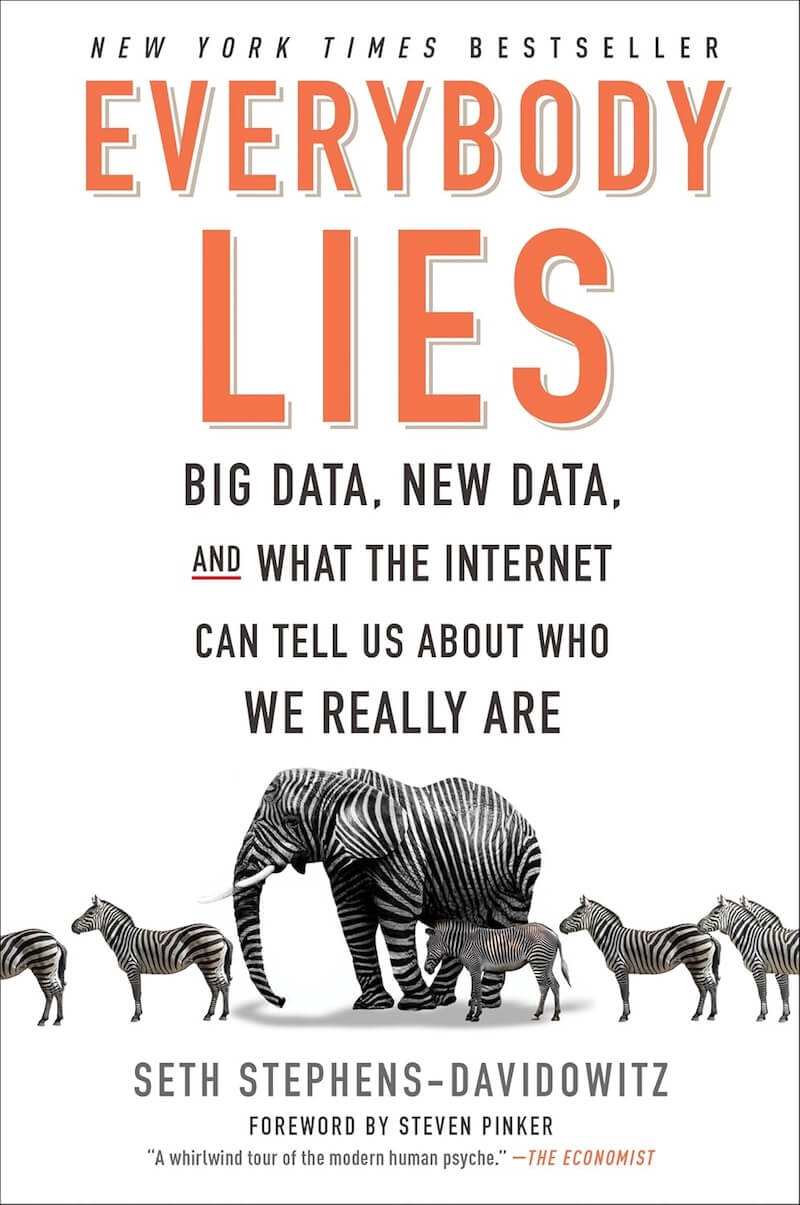
Everybody Lies Book Summary
This Everybody Lies Book Summary covers the key ideas, lessons, and takeaways in about 20 minutes.
Short Description:
Everybody Lies reveals Big Data uncovers hidden truths behind human behavior.
Used wisely, Big Data can transform public policy, reduce inequality, guide innovation, and improve understanding of mental health, racism, sexuality, and culture. Used recklessly, it threatens privacy and autonomy. The future depends not only on what data reveals — but on how responsibly we interpret and apply it.
In a world where everyone lies face-to-face, our search bar confessions tell the truth.
Helps with these goals
Preview the Everybody Lies book summary
Below is a preview of Sumizeit’s comprehensive human-written summary of Everybody Lies by Seth Stephens-Davidowitz. The full summary is 15-20 minutes long and covers the book’s key ideas in text, audio, visual, and video formats. Unlock the full 20 Minute Summary
Human behavior has two layers — what we say and what we actually think. Surveys capture the first. Google captures the second. Seth Stephens-Davidowitz’s Everybody Lies isn’t just a book about data — it’s a revealing journey into the private world people expose only when no one is watching. The core idea is simple but transformative: when individuals are alone with search engines, they confess their insecurities, desires, prejudices, curiosities, obsessions, and fears with remarkable honesty. The book exposes this shadow-world of truth using Big Data, particularly Google search behavior, social media analytics, pornography consumption, and A/B experimentation.
Stephens-Davidowitz argues that the digital footprints we leave tell a more accurate story about the human condition than interviews, polls, or self-reported research ever could. The internet has become humanity’s uncensored diary — and inside it lies a raw, uncomfortable, enlightening image of who we truly are.
Google as the World’s Most Honest Confessional Booth
People lie in public. They lie to keep peace with family. They lie on surveys because they want to look respectable. They lie to coworkers to appear competent. They lie to themselves to preserve self-image. But when they type into search bars — they whisper the truth.
Stephens-Davidowitz refers to search data as a modern form of “digital truth serum.” People type questions they would never say aloud: sexual concerns, private anxieties, fears of illness, doubts about partners, political resentments, secret prejudices. The internet becomes a therapist without judgment — one that quietly records.
Search analytics reveal emotional trends. Contrary to the assumption that humor is used to mask sadness, jokes spike during moments of collective joy, not despair. Parents’ assumptions about their children are also exposed: searches like “Is my son gifted?” massively outnumber “Is my daughter gifted?” revealing unconscious bias toward male intellectual superiority. Anxiety-related searches, instead of clustering among stressed urban professionals, surface in rural regions with lower education levels — a reversal of common stereotypes.
Through the aggregate sum of private questions, society becomes transparent. Not polished. Not polite. Just honest.
The Dark Side of Prejudice Hidden Online
Traditional research suggests racism has declined because few openly admit racist beliefs. Everybody Lies dismantles this illusion. Racism hasn’t vanished — it has simply retreated into private spaces. Stephens-Davidowitz shows that when anonymity exists, prejudice reappears without filter.
Racial slurs and hateful jokes dominate some of the most frequently searched offensive terms in America. Geographic search patterns correlate directly with voting behavior, economic inequality, and the treatment of minority groups. During historic events — Barack Obama’s election or racial justice incidents — racist queries surged. Big Data revealed what polls could not capture because no one wants to look racist in a phone interview.
By quantifying online hostility, Stephens-Davidowitz estimates Barack Obama could have gained several additional percentage points in elections if racial resentment were absent. Regions with a high density of racist search patterns also show lower economic outcomes for black citizens.
Want the complete 20-minute summary?
- Full structured summary
- Video Summary
- Podcast Summary
- Audio summary
- Key takeaways
- Exercises
- Quiz
- Highlights and notes
- Ask the book with AI
Who should read Everybody Lies?
Everybody Lies is essential reading for data analysts, policymakers, researchers, and anyone curious about what human behavior really looks like beneath social masks. If you want to understand the gap between what people say and what they actually think—revealed through their search history, online behavior, and digital footprints—this book exposes uncomfortable truths that surveys and interviews can never capture.
Why does Everybody Lies matter?
In an age of unprecedented digital data collection, Everybody Lies argues that Google searches reveal our authentic selves far more honestly than any poll or interview ever could. Seth Stephens-Davidowitz's insights are crucial for anyone making decisions about public policy, marketing, mental health support, or understanding systemic issues like racism and inequality—because addressing real problems requires seeing real human behavior, not the curated version we present to the world.
What are the key themes in Everybody Lies?
- The gap between public performance and private truth
- Big Data as a tool for uncovering authentic human behavior
- How anonymity reveals prejudice and desire hidden in plain sight
- The power and dangers of digital experimentation at scale
- Search engines as modern confessionals exposing shame and fear
- Social media as performance art versus Google as honest diary
- Childhood timing shapes lifelong identity and preferences
- Ethical implications of surveillance and data-driven manipulation
How can you apply ideas from Everybody Lies?
- Use search behavior data to identify real mental health needs and allocate psychological support to regions where anxiety and depression searches cluster, rather than relying on self-reported surveys or stereotypes
- Direct racism and equity initiatives toward geographic areas where hostile search patterns indicate hidden prejudice, allowing resources to target actual sentiment rather than assumed need
- Design product features, user interfaces, and marketing campaigns based on what people actually search for rather than focus groups, increasing conversion and engagement
- Improve sexual health and relationship education by acknowledging the diversity of private desire revealed in search data, reducing shame around unconventional preferences and normalizing honest conversation
- Implement randomized A/B testing in policy rollouts (notification wording, application processes, benefit communication) to discover which small changes produce outsized behavioral improvements
- Train healthcare providers to recognize that patients often search symptoms privately rather than ask doctors, and use this knowledge to improve diagnostic conversations and reduce diagnostic delays
- Evaluate social media claims about corporate culture, relationships, or satisfaction against search behavior data to identify discrepancies between public narrative and private reality
- Adjust educational curricula and career guidance based on what students and parents secretly search about rather than what they publicly express as interests or capabilities
What common mistakes do readers make with Everybody Lies?
- Assuming social media posts and self-reported surveys accurately reflect how people think and feel, when search data often contradicts what people claim publicly
- Ignoring the 'curse of dimensionality'—believing that any correlation discovered in Big Data is meaningful, when random patterns can appear significant with enough variables
- Applying data-driven insights without considering context, leading to flawed conclusions (e.g., interpreting declining reports as declining problems rather than changing reporting behavior)
- Underestimating how much childhood timing and early exposure shape adult identity, treating preferences as freely chosen when they're often inherited from circumstance
- Overlooking the ethical implications of experimental manipulation at scale, assuming that harmless optimization is acceptable even when users don't consent to being subjects
- Relying exclusively on quantitative data while discarding qualitative context, missing the human stories and systemic factors behind the numbers
Sumizeit Exercises Apply what you've learned
Turn ideas from Everybody Lies into action with a short guided reflection: identify the biggest takeaway, connect it to your life, and commit to one step you can take in the next 24 hours.
What is the expert analysis of Everybody Lies?
Overview
Everybody Lies by Seth Stephens-Davidowitz is a groundbreaking exploration of human behavior through the lens of Big Data, particularly Google search queries. Stephens-Davidowitz, a data scientist and former Google analyst with a strong academic background in mathematics and economics, leverages his expertise to reveal the stark contrast between public personas and private truths. This book is significant because it challenges traditional methods of understanding human psychology and social dynamics, such as surveys and polls, by introducing digital footprints as a more authentic source of insight. Its interdisciplinary approach intersects data science, psychology, sociology, and cultural studies, making it a pivotal work for readers interested in the hidden facets of human nature and societal trends.
Core Thesis
The central argument of Everybody Lies is that people’s true thoughts, desires, prejudices, and anxieties are best revealed not through what they say publicly but through what they search for privately online. The internet, especially search engines, functions as a “digital truth serum,” exposing the unvarnished realities of human behavior that conventional research methods fail to capture due to social desirability bias and self-censorship. By analyzing massive datasets from search queries, social media, and online behavior, Stephens-Davidowitz contends that we can uncover profound truths about racism, sexuality, mental health, political attitudes, and identity formation. This approach not only exposes uncomfortable realities but also offers a new foundation for public policy, marketing, and social science grounded in authentic human experience rather than curated performances.
Strengths
- Innovative Use of Big Data: The book excels in demonstrating how large-scale digital data can reveal hidden patterns in human behavior, offering a fresh methodological paradigm that transcends traditional social science limitations.
- Interdisciplinary Insight: Stephens-Davidowitz adeptly synthesizes insights from economics, psychology, sociology, and data science, enriching the analysis with a broad intellectual context.
- Revelatory and Provocative Findings: The exposure of private prejudices, taboo sexual interests, and unconscious biases challenges readers to reconsider assumptions about social norms and identity.
- Accessible and Engaging Narrative: Despite the technical nature of Big Data analytics, the author writes with clarity and compelling storytelling, making complex ideas accessible without oversimplification.
- Ethical Awareness: The book thoughtfully addresses the moral dilemmas posed by data privacy and the potential misuse of digital information, encouraging responsible engagement with Big Data.
Critiques & Counterarguments
- Overreliance on Search Data: While search queries provide candid insights, they represent only a subset of human behavior and may be skewed by demographic and technological access disparities. Not all populations use search engines equally, potentially biasing conclusions.
- Contextual Ambiguity: Search terms lack nuance and context, making it difficult to definitively interpret intent or sentiment behind queries. For example, a spike in certain searches might reflect curiosity rather than endorsement or personal experience.
- Privacy and Consent Concerns: The ethical implications of analyzing private search data without explicit consent raise questions about surveillance and autonomy that the book acknowledges but does not fully resolve.
- Competing Research Paradigms: Qualitative methods and ethnographic research emphasize context, meaning, and subjective experience, which Big Data analytics can overlook. Critics argue that data-driven approaches risk reducing complex human phenomena to mere correlations.
- Potential for Misinterpretation and Overgeneralization: The book’s broad claims about human nature and societal trends may oversimplify diverse cultural and individual differences, and some findings may not generalize across different temporal or geographic contexts.
Who Should Read This
Everybody Lies is essential reading for scholars and practitioners in social sciences, data analytics, psychology, and public policy who seek to understand the evolving landscape of human behavior in the digital age. It also appeals to informed general readers interested in the intersection of technology and society, as well as professionals in marketing, political strategy, and ethics who grapple with the implications of Big Data. Those curious about the hidden dimensions of identity, prejudice, and desire will find the book both enlightening and challenging, as it compels readers to confront uncomfortable truths about the private selves behind public facades.
Frequently asked questions about the Everybody Lies book summary
What is Everybody Lies about?
Everybody Lies by Seth Stephens-Davidowitz argues that Google searches and digital behavior reveal authentic human truth far more honestly than surveys, interviews, or social media ever could. The book uses Big Data—particularly search analytics, online behavior, and experimentation—to expose hidden prejudices, secret desires, private anxieties, and genuine beliefs that people conceal in public. It demonstrates that while people lie face-to-face, their search bar confessions tell the truth.
Who should read Everybody Lies?
Everybody Lies is essential for data analysts, policymakers, marketers, researchers, psychologists, and anyone interested in understanding real human behavior beneath social performance. It's valuable for professionals making decisions based on data, people curious about what online behavior reveals about society, and those concerned with privacy and ethics in the digital age. Anyone working in product design, public health, education, or social policy will find insights that challenge assumptions about how people actually think and behave.
What are the main takeaways from Everybody Lies?
The core takeaways are: people's private searches reveal authentic beliefs that public statements hide, Big Data exposes hidden prejudices and desires that traditional research misses, social media is performance while Google is truth, early life experiences permanently shape lifelong identity, and small experimental changes produce surprisingly large behavioral effects. The book also warns that while Big Data can transform policy and innovation, it poses serious ethical risks regarding privacy and manipulation if misused.
How does Stephens-Davidowitz use Google search data to understand human behavior?
Stephens-Davidowitz treats Google searches as a 'digital truth serum' because people type questions they would never ask aloud—about sexual anxieties, health fears, prejudices, insecurities, and doubts. By analyzing aggregate search patterns, he identifies emotional trends, reveals bias, tracks what people genuinely worry about, and exposes gaps between public claims and private concerns. Search data becomes a window into authentic human thought when social filters are removed.
What does Everybody Lies reveal about racism and prejudice?
The book demonstrates that while public opinion polls suggest racism has declined, anonymous search behavior reveals prejudice thrives in private spaces. Stephens-Davidowitz's analysis of racial slurs, hateful jokes, and discriminatory searches shows racism hasn't vanished—it's retreated online. Geographic patterns of racist searches correlate directly with voting behavior, economic inequality, and outcomes for Black citizens, suggesting hidden hostility influences policy, hiring, education, and crime decisions.
How does Everybody Lies discuss sexuality and desire?
Stephens-Davidowitz uses pornography data and search patterns to argue that sexual desire is far more diverse, imaginative, and unconventional than public discussion or survey responses suggest. Men consuming same-sex content while identifying as heterosexual, women's divergence between stated preferences and actual searches, and the prevalence of taboo fantasies all reveal that sexuality exists on a spectrum. The analysis challenges binary sexual categories and shows how search data exposes desires people fear confessing.
Why does Stephens-Davidowitz say social media is unreliable for understanding human behavior?
Social media is a curated stage where people post vacations, anniversaries, and accomplishments while hiding breakdowns, loneliness, and regrets. Couples praise their 'amazing spouse' on Facebook while privately searching complaints about their partner; people post gym photos while searching weight-loss tips. Stephens-Davidowitz argues that Google searches reveal what people actually think and fear, while social media shows only the idealized version they want others to see.
What ethical concerns does Everybody Lies raise about Big Data?
The book highlights that Big Data, while powerful, raises serious privacy and autonomy risks. Users often don't know they're experimental subjects in behavioral nudges; employers could judge applicants using search patterns; insurers might adjust rates based on symptom searches. Stephens-Davidowitz emphasizes the need for ethical oversight, anonymization, and responsible interpretation, warning that Big Data can illuminate society or control it depending on how it's misused.
About Sumizeit
Sumizeit is a profitable Scomy LLC company based in Miami, Florida. Our founders, Clemens Raemy and Weina Scott, are successful entrepreneurs with several exits. Sumizeit is a popular book summary app / micro learning app used by busy professionals and entrepreneurs with over 2,500 non-fiction book summaries and 10,000 podcast summaries in text, audio, visual, podcast, and video format. We also have stellar retention tools to make ideas stick - such as flashcards with spaced repetition, quizzes, streaks, highlighting and notes, daily challenges, riddles, mini-courses, meditation, and more. You won't only learn the idea, but also remember it. Over 90% of our users change their habits with Sumizeit.
Upgrade Now
Here's why readers love Sumizeit
Join thousands of learners getting smarter every day
"Great experience. Detailed summaries. Loved the gamification feature. Makes learning fun. Good customer service. I recommend Sumizeit to anyone. You'll learn a lot."
"I always felt busy but still wanting to keep up with the book discussion in my friend group. This was a great supplement to help me keep reading the books I find fun while keeping up with important books."
"I love this website. Instead of scrolling social media, I find myself learning a lot. I use it everyday. I recommend this app for anyone who is too busy and wants to get up to speed with their favorite books."
Everybody Lies Book Summary PDF
Looking for a Everybody Lies Book Summary PDF you can save and revisit offline? Our Everybody Lies Book Summary PDF captures the book’s core ideas in a clean, printable format — the key frameworks, takeaways, and structure without the fluff. Download the Everybody Lies Book Summary PDF when you want a reference you can annotate, share with your team, or review on the go. Get your Everybody Lies Book Summary PDF from the download page below.
Download Everybody Lies Book Summary PDFPeople also liked these summaries
Readers who explored Everybody Lies often enjoyed these titles next.




Ready to read the whole thing?
- Full structured summary
- Video Summary
- Podcast Summary
- Audio summary
- Key takeaways
- Exercises
- Quiz
- Highlights and notes
- Ask the book with AI
Featured Book Titles
Popular Book Summaries at sumizeit, leading book summary app