


Prefer the print book? Buy on Amazon
As an Amazon Associate, Sumizeit earns from qualifying purchases.
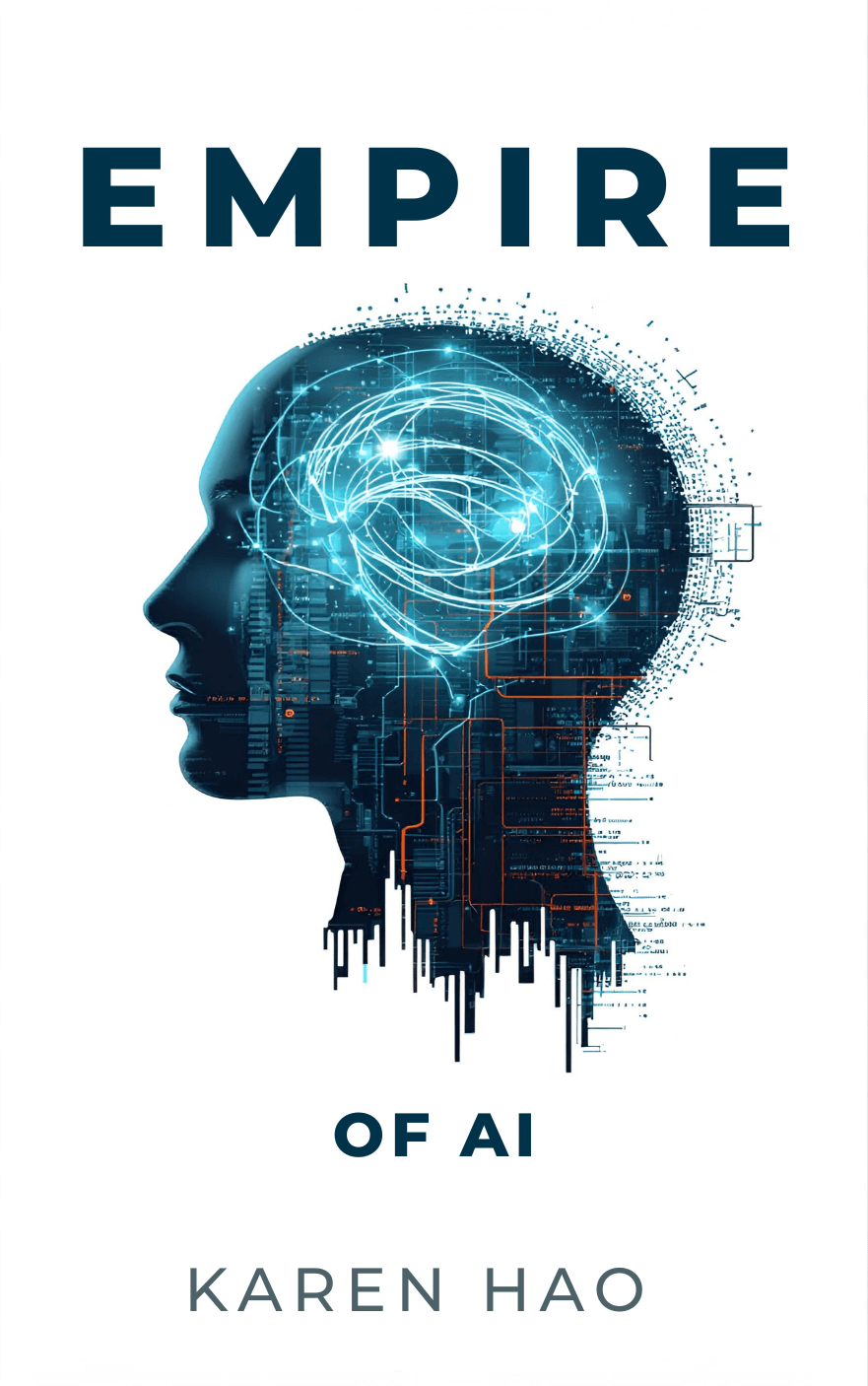
Empire of AI Book Summary
This Empire of AI Book Summary covers the key ideas, lessons, and takeaways in about 20 minutes.
Short Description:
Empire of AI critiques scale-first AI and offers a counter-vision.
At the center is a doctrine: bigger models, more compute, more data. That doctrine drives everything—massive partnerships, secrecy, rushed deployment, and a policy agenda that can entrench incumbents. The book insists that this “scale-first” worldview is not destiny. It is a choice that creates its own inevitability by forcing everyone into the same resource-intensive race.
The empire grows by extracting what it needs: unpaid cultural data, underpaid global labor, and scarce environmental resources. The public is sold a story about future abundance, while the present reality includes exploited workers, strained communities, and governance systems that collapse when tested.
Yet the book is not only critique. It offers a counter-vision: AI developed with consent, constrained by accountability, built with smaller and more purposeful systems, and governed by the communities most affected by its infrastructure and outcomes. In Hao’s framing, the question is not whether AI will shape the future. It is who gets to decide the shape—and who pays for it.
Helps with these goals
Want a Free Weekly Read?
Get a free summary every week straight to your mailbox.
Preview the Empire of AI book summary
Below is a preview of Sumizeit’s comprehensive human-written summary of Empire of AI by Karen Hao. The full summary is 15-20 minutes long and covers the book’s key ideas in text, audio, visual, and video formats. Unlock the full 20 Minute Summary
Empire of AI is a work of investigative narrative that treats today’s most influential AI companies—especially OpenAI—not as quirky startups or neutral research labs, but as the command centers of a new kind of power. Karen Hao’s central idea is that the modern AI boom resembles empire-building: it is expansive, extractive, and justified by grand stories about progress. The book follows the rise of OpenAI from its idealistic origin story to a sprawling enterprise that depends on enormous capital, vast physical infrastructure, and hidden human work distributed across the globe.
Rather than describing AI as an inevitable technological wave, the book insists that what happened was the result of choices made by particular people under particular incentives. The “race” to artificial general intelligence (AGI) is portrayed not as destiny, but as a strategy—one that encourages risk-taking, secrecy, and concentration of control. Hao shows how the pursuit of “frontier” capability became the organizing principle for everything else: corporate structure, product launches, safety decisions, lobbying priorities, and even the story OpenAI tells about itself.
What emerges is a portrait of an industry that sells a future of abundance while operating through familiar patterns: resource extraction, labor exploitation, and political capture. The book does not argue that AI must be abandoned. It argues that AI as currently built is not the only possible version of AI—and that the reigning model has costs that are systematically shifted onto the least powerful.
Founding Myth: From Mission-First Idealism to Competitive Dominance
OpenAI’s early identity, as presented here, is almost purpose-built to sound like a moral counterweight to Big Tech. Founded as a nonprofit with high-profile backers, it pledged enormous funding and framed its goal as building AGI for the benefit of everyone. The founding language emphasized openness and a willingness to cooperate—even to step aside—if another group was closer to success. A major motivation was the fear that a single company could dominate AGI, particularly a giant with deep resources and a strong head start.
Hao argues that this moral framing mattered because it functioned as legitimacy. It positioned OpenAI as a public-spirited institution rather than another profit machine. But within a few years, the organization increasingly came to resemble the thing it claimed to be preventing: a powerful, secretive entity determined to win.
After internal tensions and the departure of key figures, the project began drifting toward commercialization. Financial reality played a role, but the book also emphasizes status, ego, and competitive urgency. The desire to “get there first” became a moral argument in itself: if OpenAI didn’t win, someone worse would. That logic can justify almost anything—especially opacity and acceleration.
The transformation accelerated with a structural shift: OpenAI reorganized into a “capped-profit” model that allowed it to raise huge capital while still claiming mission alignment. That move unlocked investments on a scale a nonprofit could not support, most notably a billion-dollar deal with Microsoft. But it also changed the DNA of the organization. Transparency became selective. Collaboration became conditional. Research became product-driven.
Want the complete 20-minute summary?
- Full structured summary
- Video Summary
- Podcast Summary
- Audio summary
- Key takeaways
- Exercises
- Quiz
- Highlights and notes
- Ask the book with AI
Who should read Empire of AI?
Empire of AI is essential for policymakers, technologists, and informed citizens who want to understand how AI power actually concentrates in practice. Anyone concerned about labor exploitation, environmental costs, or tech governance will find detailed documentation of how these systems work behind the scenes. Readers seeking to challenge the heroic narratives around AI progress will find a rigorously reported alternative account.
Why does Empire of AI matter?
As AI companies reshape economies and influence policy globally, understanding their structural incentives and hidden costs has become urgent. Karen Hao's investigation reveals how empire-building logic—extraction, secrecy, and concentration of control—governs the industry in ways that affect workers, communities, and environmental resources worldwide. The book exposes gaps between the public promises of AI companies and the actual conditions required to build their systems, making it essential reading for anyone affected by or accountable for AI deployment.
What are the key themes in Empire of AI?
- AI development as empire-building: expansion, extraction, and power concentration
- Scale as ideology: how the belief in bigger models became self-reinforcing doctrine
- Hidden labor: the global supply chain of underpaid and exploited workers behind AI systems
- Physical infrastructure and environmental cost: data centers, energy, water, and minerals
- Governance failure: how organizational structures collapse when tested by capital and competition
- Policy capture: how AI leaders shape regulation to entrench dominance
- Alternatives to extraction: community-led, smaller-scale, and consent-based AI development
How can you apply ideas from Empire of AI?
- Audit supply chains: organizations deploying AI should trace where training data comes from, who labeled it, and under what conditions, then demand transparency and fair compensation
- Strengthen labor protections: policymakers should regulate data annotation and content moderation work with minimum wage requirements, mental health support, and employment stability
- Design governance with enforceable constraints: institutions building powerful AI should establish boards with real power (not advisory roles) and independent authority to slow deployment when safety concerns arise
- Prioritize smaller, targeted systems: organizations should explore whether task-specific models with lower compute demands can meet actual needs instead of always scaling toward general capability
- Build community consent mechanisms: before deploying AI in communities or using local resources (land, water, electricity), establish genuine permission processes with benefit-sharing agreements
- Disclose environmental costs: AI companies should publish full lifecycle footprints including mining impacts, water use, and energy consumption, with mitigation funded by those profiting from the technology
- Advocate for comprehensive regulation: support policy that addresses present harms (labor, bias, copyright) alongside speculative future risks, and resists compute thresholds that entrench incumbents
What common mistakes do readers make with Empire of AI?
- Assuming AI innovation is neutral and inevitable rather than the result of deliberate choices made by people under specific incentives
- Treating OpenAI's nonprofit structure or moral language as evidence of genuine mission alignment, without examining actual organizational behavior and incentive structures
- Accepting the 'AI race' logic that competition justifies secrecy, speed, and cutting corners—this framing masks choices that concentrate power
- Overlooking the hidden human labor and environmental costs of 'automated' systems by focusing only on technical capability rather than entire supply chains
Sumizeit Exercises Apply what you've learned
Turn ideas from Empire of AI into action with a short guided reflection: identify the biggest takeaway, connect it to your life, and commit to one step you can take in the next 24 hours.
What is the expert analysis of Empire of AI?
Overview
Empire of AI by Karen Hao is a seminal investigative work that reframes the contemporary AI landscape through the lens of power dynamics and empire-building. Hao, a seasoned technology journalist, leverages her deep expertise in AI’s social, political, and economic ramifications to expose how leading AI organizations—particularly OpenAI—have evolved from idealistic ventures into sprawling, extractive empires. The book’s significance lies in its meticulous synthesis of technical, corporate, and geopolitical narratives, offering a rare, critical perspective on the human and environmental costs underpinning the AI revolution. Rather than celebrating AI as an inevitable technological triumph, Hao situates it within a broader political economy, challenging prevailing Silicon Valley mythologies.
Core Thesis
At its core, Empire of AI argues that the contemporary AI boom is not a neutral or purely scientific progression but a deliberate strategy of empire-building characterized by expansive resource extraction, labor exploitation, and political consolidation. Hao contends that the dominant AI model—epitomized by OpenAI’s trajectory—is driven by a doctrine of scale, where ever-larger models and massive computational infrastructure become both a self-fulfilling necessity and a mechanism of control. This scaling imperative compels secrecy, accelerates risk-taking, and centralizes power, all while cloaked in grand narratives of progress and universal benefit. Crucially, the book asserts that this model is neither natural nor inevitable; alternative AI paradigms grounded in community consent, transparency, and sustainability are possible but marginalized.
Strengths
- Comprehensive Investigative Rigor: Hao’s extensive research and hundreds of interviews provide a richly detailed account that bridges technical complexity with social critique, making the book both authoritative and accessible.
- Nuanced Portrayal of OpenAI: The book excels in tracing OpenAI’s transformation from a mission-driven nonprofit to a competitive, profit-oriented powerhouse, illuminating the internal tensions and governance challenges that accompany rapid growth.
- Illumination of Hidden Labor: By foregrounding the often invisible, precarious workforce behind AI training and moderation, Hao disrupts the dominant narrative of automation and highlights ethical and psychological costs rarely discussed.
- Environmental and Geopolitical Context: The analysis of AI’s physical infrastructure—data centers, mineral extraction, water use—situates AI development within global ecological and political struggles, expanding the conversation beyond abstract algorithms.
- Critical Engagement with Policy and Power: Hao’s exploration of regulatory strategies reveals how policy can entrench incumbent advantages under the guise of safety, offering a sober assessment of governance in high-stakes technological domains.
Critiques & Counterarguments
- Potential Overemphasis on Empire Metaphor: While evocative, the empire analogy may risk oversimplifying the multifaceted motivations and innovations within AI research, potentially conflating diverse actors and intentions under a singular narrative of extraction and domination.
- Limited Engagement with Technical Counterpoints: The book foregrounds scaling as ideology but could more thoroughly address competing AI paradigms that emphasize algorithmic innovation, efficiency, or decentralized architectures, which may challenge the inevitability of scale-centric approaches.
- Insufficient Exploration of AI’s Positive Societal Impacts: Hao’s critical stance might underplay instances where AI has demonstrably improved accessibility, healthcare, or education, thereby risking a one-sided portrayal that emphasizes harms without equally weighing benefits.
- Governance and Safety Debates Could Be Expanded: The depiction of internal OpenAI conflicts and safety trade-offs is compelling but might benefit from a broader comparative analysis with other organizations or international regulatory efforts to contextualize these dynamics.
- Alternative Models’ Scalability and Influence: While the book highlights promising community-driven and smaller-scale AI initiatives, it could more critically assess their practical viability and potential impact in a landscape dominated by massive capital and infrastructure.
Who Should Read This
Empire of AI is essential reading for scholars, policymakers, and practitioners at the intersection of technology, ethics, and society who seek a rigorous, critical understanding of AI’s socio-political dimensions. It is particularly valuable for those interested in the governance of emerging technologies, labor rights in the digital economy, environmental sustainability, and the geopolitics of innovation. Moreover, the book offers a vital corrective to technocratic optimism, making it indispensable for anyone concerned with who wields power in the AI era and how its costs and benefits are distributed globally.
Frequently asked questions about the Empire of AI book summary
What is Empire of AI about?
Empire of AI by Karen Hao is an investigative account of how modern AI development—centered on OpenAI—operates like historical empires: extracting resources, concentrating power, and justifying exploitation through grand progress narratives. The book traces how OpenAI evolved from a mission-driven nonprofit to a frontier lab pursuing scale at all costs, revealing the hidden labor, environmental damage, and governance failures required to build systems like ChatGPT.
Who should read Empire of AI?
Empire of AI is essential for policymakers shaping AI regulation, technologists building these systems, and anyone affected by their deployment. It's important reading for labor advocates concerned with exploitation, environmentalists tracking resource consumption, researchers questioning dominant narratives, and citizens seeking to understand how power concentrates in the AI industry.
What are the main takeaways from Empire of AI?
The main takeaways are: (1) AI development is political choice, not inevitable progress; (2) the 'scaling doctrine' benefits incumbents by forcing expensive resource races; (3) systems presented as automated depend on hidden, exploited global labor; (4) environmental and social costs are systematically shifted to vulnerable communities; (5) governance structures collapse under competitive pressure; and (6) alternatives exist if we prioritize community consent, smaller systems, and power redistribution over dominance.
How does Karen Hao characterize OpenAI's transformation?
Hao shows OpenAI evolving from idealistic nonprofit to competitive power-seeker. Founded to distribute AI power, the company shifted toward commercialization through a 'capped-profit' structure enabling massive Microsoft investment. Transparency became selective, collaboration became conditional, and research became product-driven. This transformation, Hao argues, was not a compromise but a reorientation of purpose from mission-first to dominance-first.
What is the 'scaling doctrine' and why does it matter?
The scaling doctrine is the belief that AI progress requires ever-larger models trained on vast compute, data, and infrastructure. Hao argues this became ideology rather than just observation. It created self-reinforcing logic: if bigger is inevitable, you must secure more chips and capital than rivals or fall behind. This manufactured necessity justifies massive capital raises, secrecy, and speed—benefits the largest players and sets industry standards everyone must follow.
What does Empire of AI reveal about AI labor practices?
Empire of AI exposes that systems marketed as automated are built on massive hidden labor: workers in crisis economies filter data, label training sets, and moderate content for under $2 per hour with no adequate mental health support. These workers encounter traumatic material including child abuse content. This global supply chain is essential yet invisible, exemplifying how AI companies extract value from the most vulnerable.
How does Empire of AI address environmental impacts?
The book documents AI's massive resource demands: projections of data centers consuming large shares of US electricity by 2030, and AI-driven freshwater use reaching crisis levels. Hao shows these burdens fall on communities already shaped by extraction histories, causing water depletion, grid strain, and displacement. She argues sustainability claims often function as PR while companies avoid real transparency about their footprint.
What does the 2023 OpenAI board crisis reveal according to Hao?
Hao frames the November 2023 board crisis—when the nonprofit board removed Sam Altman then capitulated after backlash—as exposing structural governance failure. Employee threats, investor pressure, and Microsoft support overwhelmed the board's authority, showing that formal accountability mechanisms collapse under combined pressure. The episode revealed that power had concentrated around Altman personally, and that governance structures relying on moral commitment rather than enforceable constraints are fragile.
About Sumizeit
Sumizeit is a profitable Scomy LLC company based in Miami, Florida. Our founders, Clemens Raemy and Weina Scott, are successful entrepreneurs with several exits. Sumizeit is a popular book summary app / micro learning app used by busy professionals and entrepreneurs with over 2,500 non-fiction book summaries and 10,000 podcast summaries in text, audio, visual, podcast, and video format. We also have stellar retention tools to make ideas stick - such as flashcards with spaced repetition, quizzes, streaks, highlighting and notes, daily challenges, riddles, mini-courses, meditation, and more. You won't only learn the idea, but also remember it. Over 90% of our users change their habits with Sumizeit.
Upgrade Now
Here's why readers love Sumizeit
Join thousands of learners getting smarter every day
"Great experience. Detailed summaries. Loved the gamification feature. Makes learning fun. Good customer service. I recommend Sumizeit to anyone. You'll learn a lot."
"I always felt busy but still wanting to keep up with the book discussion in my friend group. This was a great supplement to help me keep reading the books I find fun while keeping up with important books."
"I love this website. Instead of scrolling social media, I find myself learning a lot. I use it everyday. I recommend this app for anyone who is too busy and wants to get up to speed with their favorite books."
Empire of AI Book Summary PDF
Looking for a Empire of AI Book Summary PDF you can save and revisit offline? Our Empire of AI Book Summary PDF captures the book’s core ideas in a clean, printable format — the key frameworks, takeaways, and structure without the fluff. Download the Empire of AI Book Summary PDF when you want a reference you can annotate, share with your team, or review on the go. Get your Empire of AI Book Summary PDF from the download page below.
Download Empire of AI Book Summary PDFPeople also liked these summaries
Readers who explored Empire of AI often enjoyed these titles next.




Ready to read the whole thing?
- Full structured summary
- Video Summary
- Podcast Summary
- Audio summary
- Key takeaways
- Exercises
- Quiz
- Highlights and notes
- Ask the book with AI
Featured Book Titles
Popular Book Summaries at sumizeit, leading book summary app