


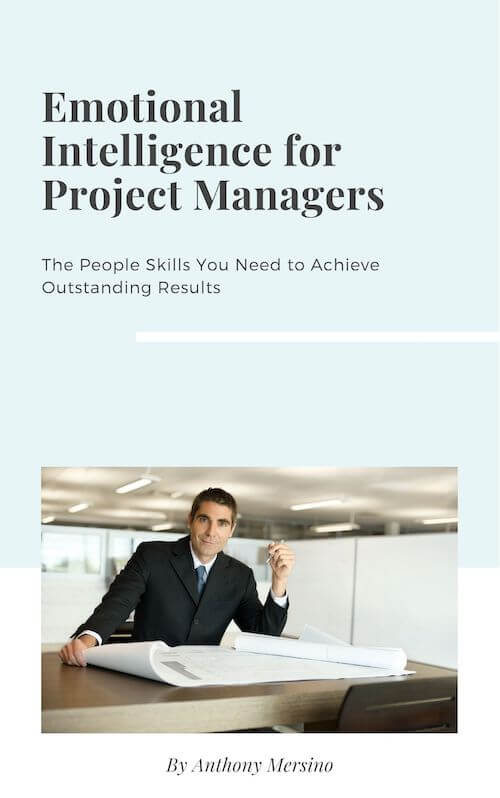
Prefer the print book? Buy on Amazon
As an Amazon Associate, Sumizeit earns from qualifying purchases.
Emotional Intelligence for Project Managers Book Summary
This Emotional Intelligence for Project Managers Book Summary covers the key ideas, lessons, and takeaways in about 20 minutes.
Short Description:
Emotional intelligence helps project managers lead effectively.
Be self-aware about your emotions and learn to control them. Use your understanding of emotion to become socially and organizationally aware. Take this understanding to manage your team more effectively. Emotional intelligence about yourself, your team, and other stakeholders will allow you to be an inspirational and resonant leader.
Helps with these goals
Preview the Emotional Intelligence for Project Managers book summary
Below is a preview of Sumizeit’s comprehensive human-written summary of Emotional Intelligence for Project Managers by Anthony Mersino. The full summary is 15-20 minutes long and covers the book’s key ideas in text, audio, visual, and video formats. Unlock the full 20 Minute Summary
Projects need leaders that can manage a team of people that may not be used to working together. Emotional intelligence is essential in working with people effectively.
Before you’re able to manage the others, you have to be able to manage yourself. That means having the self-awareness and emotional intelligence to lead yourself where you need to go. Emotional intelligence is your capability to understand and manage your emotions.
From a team perspective, relationships are critical to getting the work done effectively. Project management has moved away from the hierarchical structure of the team leader announcing what will be done. You can encourage the development of team members and move into a more agile workflow.
What you’ll learn
Who this is for
Emotional intelligence is the capacity to manage your own emotions.
The first step in emotional intelligence is understanding your own emotions. You have to be able to perceive and name what you’re feeling.
A starting place is the acronym SASHET. This stands for sad, angry, scared, happy, excited, and tender. While these emotions don’t include every possible feeling you could have, they cover the big categories.
Each of the emotions in SASHET has other emotions that fall under them. There are variations of feeling sad, with some deeper and darker than others. But the idea of feeling sad and understanding that it is affecting you is the beginning of emotional intelligence.
Once you understand your emotions, you can begin to manage them. You know that a certain emotion may take away your focus. But if you manage that emotion, you’re able to keep it from taking over. The management is critical to emotional intelligence because you don’t allow the emotions to detract from the goals.
You can improve your emotional self-awareness.
Leading yourself with emotional intelligence first requires self-awareness. This is not a trait you’re born with that is genetically determined. You can work to become better at emotional self-awareness.
Start with a journal. Keep track of what you’re feeling and how often you feel it. Have someone with whom you can safely share those feelings. Also, use that person to get some feedback about the expressions you have during each of those emotional states. When you have negative feelings, try to identify what caused them.
You also have to think about the emotional habits you’ve learned that may feel normal for you. Maybe you don’t register emotional changes, but you experience physical symptoms. For example, you think you’ve handled a dispute or frustration calmly. But if you pay attention to your body, you’ll have a flush and a rapid heartbeat that indicates anger.
Once you recognize your emotions, what triggers them, and how they manifest, you have to start becoming aware of what you do with them. Some people respond to emotions like fear with jokes or respond to anger with passive-aggressive commentary.
Use an honest self-assessment to ask yourself what you’re doing and why.
Want the complete 20-minute summary?
- Full structured summary
- Video Summary
- Podcast Summary
- Key takeaways
- Exercises
- Quiz
- Highlights and notes
- Ask the book with AI
Who should read Emotional Intelligence for Project Managers?
Project managers, team leaders, and anyone responsible for guiding people through temporary initiatives should read this book. It's especially valuable if you lead cross-functional teams, manage in agile environments, or struggle with the interpersonal dynamics that can derail projects. Whether you're new to leadership or an experienced manager looking to improve team dynamics, this book provides practical tools for leading through emotional awareness.
Why does Emotional Intelligence for Project Managers matter?
Modern project management has shifted from top-down hierarchy to collaborative, agile environments where emotional intelligence directly impacts team performance and project success. Mersino's Emotional Intelligence for Project Managers addresses the reality that technical skills alone don't create high-performing teams—understanding and managing emotions does. In complex projects and virtual teams, the ability to read people, control your own emotional responses, and inspire your team has become non-negotiable for effective leadership.
What are the key themes in Emotional Intelligence for Project Managers?
- Self-awareness and emotional recognition form the foundation of effective leadership
- Self-management prevents negative emotions from poisoning the team environment
- Social awareness and empathy enable you to understand team members' needs and motivations
- Relationship management turns emotional insights into concrete actions that strengthen teams
- Inspirational leadership and positive culture create conditions where teams flourish
- Agile and collaborative management styles require higher emotional intelligence than traditional hierarchies
How can you apply ideas from Emotional Intelligence for Project Managers?
- Keep an emotion journal to track what you feel, when you feel it, and what triggers those emotions, then review patterns monthly to understand your emotional landscape
- Implement HALT checks before high-stakes meetings or difficult conversations to ensure you're not operating from a place of hunger, anger, loneliness, or fatigue
- Ask a trusted colleague for feedback on how you come across emotionally in meetings and what nonverbal cues you're sending without realizing it
- Establish team ground rules for communication and conflict resolution in your first team meeting, explicitly naming what respectful disagreement looks like
- Practice active listening in one-on-ones by putting away devices, asking clarifying questions, and reflecting back what you heard before responding
- Use conflict resolution conversations to ask 'How did this make you feel?' alongside 'What happened?' to ensure solutions address emotional as well as factual dimensions
- Recognize and celebrate team wins publicly and regularly, connecting achievements back to project vision to maintain motivation across long initiatives
What common mistakes do readers make with Emotional Intelligence for Project Managers?
- Assuming emotional intelligence means suppressing negative emotions rather than acknowledging and managing them constructively
- Waiting until emotions are already out of control instead of recognizing early warning signs and taking preventive action
- Delivering critical feedback without considering how the person will feel, resulting in defensiveness and damaged relationships
- Ignoring organizational culture and politics, which leads to misreading team dynamics and making tone-deaf decisions that don't fit the context
Sumizeit Exercises Apply what you've learned
Turn ideas from Emotional Intelligence for Project Managers into action with a short guided reflection: identify the biggest takeaway, connect it to your life, and commit to one step you can take in the next 24 hours.
What is the expert analysis of Emotional Intelligence for Project Managers?
Overview
Emotional Intelligence for Project Managers is authored by Anthony Mersino, a recognized expert in agile training and organizational dynamics. As the founder of Vitality Chicago, Mersino brings practical experience in team development and leadership within complex project environments. This book marks his initial foray into publishing, focusing on the critical intersection of emotional intelligence (EI) and project management. Its significance lies in addressing a growing recognition that technical skills alone are insufficient for effective project leadership, especially in agile and dynamic team settings.
Core Thesis
Mersino’s central argument is that emotional intelligence is indispensable for project managers who must navigate the complexities of human dynamics within teams. He posits that self-awareness and self-management form the foundation of EI, enabling leaders to regulate their emotions and avoid negative impacts on team morale and productivity. Beyond personal regulation, the author emphasizes social and organizational awareness—understanding others’ emotions and the broader cultural context—as essential for fostering positive relationships and managing conflicts. Ultimately, Mersino advocates for a shift from traditional hierarchical leadership toward inspirational and resonant leadership styles that empower agile teams to flourish.
Strengths
- Practical Frameworks: Mersino provides accessible tools such as the SASHET acronym for categorizing emotions and HALT for identifying emotional triggers, which offer concrete starting points for readers to develop emotional self-awareness.
- Integration of Agile Principles: The book thoughtfully aligns emotional intelligence with agile project management, highlighting how EI supports collaboration, adaptability, and team empowerment.
- Holistic Approach: The progression from self-awareness to social and organizational awareness reflects a comprehensive understanding of emotional intelligence as a multi-dimensional skill set.
- Emphasis on Leadership Evolution: By contrasting traditional top-down models with inspirational and resonant leadership, Mersino situates EI within contemporary leadership theory and practice.
- Real-World Applicability: The focus on managing emotions to create positive team environments and resolve conflicts resonates with the everyday challenges faced by project managers.
Critiques & Counterarguments
- Evidence Base and Depth: While the book offers practical advice, it relies heavily on generalized concepts and lacks rigorous empirical support or detailed case studies demonstrating the efficacy of EI interventions in project management contexts.
- Oversimplification of Emotions: The SASHET model, while useful for beginners, may oversimplify the complexity and nuance of human emotions, potentially limiting deeper emotional literacy necessary for sophisticated leadership.
- Underdeveloped Organizational Dynamics: The treatment of organizational culture and politics is somewhat cursory, not fully engaging with the extensive literature on power dynamics, systemic barriers, and cultural resistance that can impede emotional intelligence application.
- Competing Views on Leadership: Some leadership scholars argue that emotional intelligence, while valuable, is insufficient alone to guarantee project success, emphasizing instead structural factors, technical competence, or transformational leadership theories that incorporate vision and strategy beyond emotional skills.
- Contextual Limitations: The book’s focus on agile environments may limit its applicability in more traditional or rigid project settings where hierarchical authority and formal processes dominate, suggesting a need for more nuanced guidance across diverse organizational types.
Who Should Read This
This book is ideally suited for project managers, team leaders, and project team members who seek to enhance their interpersonal effectiveness and leadership capabilities within agile or collaborative work environments. It offers a foundational introduction to emotional intelligence tailored for those managing complex human dynamics in projects. Additionally, professionals transitioning from technical roles into leadership positions will find Mersino’s practical frameworks valuable for developing essential soft skills. However, readers looking for deep theoretical analysis or empirical research on emotional intelligence may need to supplement this work with more scholarly texts.
Frequently asked questions about the Emotional Intelligence for Project Managers book summary
What is Emotional Intelligence for Project Managers about?
Emotional Intelligence for Project Managers by Anthony Mersino explores how project leaders can develop emotional awareness and skills to lead teams more effectively. The book covers self-awareness and self-management, social awareness and empathy, and relationship management as core competencies for inspiring teams and creating positive project environments, especially in agile and collaborative settings.
Who should read Emotional Intelligence for Project Managers?
Project managers, team leaders, scrum masters, and anyone responsible for guiding temporary teams should read this book. It's particularly valuable for leaders managing agile projects, cross-functional teams, virtual teams, or complex initiatives where interpersonal dynamics significantly affect outcomes.
What are the main takeaways from Emotional Intelligence for Project Managers?
The core takeaways are: develop self-awareness about your emotions and learn to manage them before they affect your team, understand your team members' emotions and needs through empathy and observation, use this awareness to build strong relationships and set healthy boundaries, and transform this emotional intelligence into inspirational leadership that empowers teams. Emotional intelligence is a learnable skill that directly impacts project success.
How can I improve my emotional self-awareness as a project manager?
Mersino recommends keeping an emotion journal to track what you're feeling and how often, asking trusted people for honest feedback about how you come across emotionally, identifying your physical warning signs (like tension or flushing), and reflecting on what triggers your emotions. Understanding your emotional patterns is the foundation for managing them effectively.
What is the HALT framework and how do project managers use it?
HALT stands for Hungry, Angry, Lonely, and Tired—four states that make people more prone to emotional explosions. Project managers can use HALT as a checklist before important meetings or difficult conversations to ensure they're not operating from a compromised emotional state. Addressing these basic needs proactively strengthens your ability to handle triggers calmly.
How should project managers handle conflict with emotional intelligence?
Rather than focusing only on the facts of a conflict, emotionally intelligent leaders acknowledge the feelings involved and ensure that people feel heard and respected in the resolution. This approach prevents resentment and strengthens relationships, whereas ignoring emotions often leads to lingering tension even if the practical problem is solved.
What role does empathy play in project team leadership?
Empathy—understanding and acknowledging others' emotions and perspectives—is central to building trust and managing teams effectively. By listening carefully, observing nonverbal cues, and challenging your own biases, you can understand what your team members truly need, which allows you to support them in ways that strengthen both relationships and project outcomes.
About Sumizeit
Sumizeit is a profitable Scomy LLC company based in Miami, Florida. Our founders, Clemens Raemy and Weina Scott, are successful entrepreneurs with several exits. Sumizeit is a popular book summary app / micro learning app used by busy professionals and entrepreneurs with over 2,500 non-fiction book summaries and 10,000 podcast summaries in text, audio, visual, podcast, and video format. We also have stellar retention tools to make ideas stick - such as flashcards with spaced repetition, quizzes, streaks, highlighting and notes, daily challenges, riddles, mini-courses, meditation, and more. You won't only learn the idea, but also remember it. Over 90% of our users change their habits with Sumizeit.
Upgrade Now
Here's why readers love Sumizeit
Join thousands of learners getting smarter every day
"Great experience. Detailed summaries. Loved the gamification feature. Makes learning fun. Good customer service. I recommend Sumizeit to anyone. You'll learn a lot."
"I always felt busy but still wanting to keep up with the book discussion in my friend group. This was a great supplement to help me keep reading the books I find fun while keeping up with important books."
"I love this website. Instead of scrolling social media, I find myself learning a lot. I use it everyday. I recommend this app for anyone who is too busy and wants to get up to speed with their favorite books."
Emotional Intelligence for Project Managers Book Summary PDF
Looking for a Emotional Intelligence for Project Managers Book Summary PDF you can save and revisit offline? Our Emotional Intelligence for Project Managers Book Summary PDF captures the book’s core ideas in a clean, printable format — the key frameworks, takeaways, and structure without the fluff. Download the Emotional Intelligence for Project Managers Book Summary PDF when you want a reference you can annotate, share with your team, or review on the go. Get your Emotional Intelligence for Project Managers Book Summary PDF from the download page below.
Download Emotional Intelligence for Project Managers Book Summary PDFPeople also liked these summaries
Readers who explored Emotional Intelligence for Project Managers often enjoyed these titles next.



Ready to read the whole thing?
- Full structured summary
- Video Summary
- Podcast Summary
- Key takeaways
- Exercises
- Quiz
- Highlights and notes
- Ask the book with AI
Featured Book Titles
Popular Book Summaries at sumizeit, leading book summary app