

Elon Musk’s life, as chronicled by Ashlee Vance, is not just a biography—it’s a case study in what happens when unrelenting vision collides with impossible odds. Musk is portrayed as both hero and antihero: a man whose single-minded pursuit of progress reshapes the world but often comes at immense personal and emotional cost. His story demonstrates that groundbreaking innovation rarely arises from comfort or consensus—it emerges from obsession, risk, and the willingness to endure ridicule, exhaustion, and failure in the name of a higher goal.
At its heart, Elon Musk is about the pursuit of human advancement through sheer willpower. Every one of Musk’s ventures—Tesla, SpaceX, SolarCity, and later ventures like Neuralink and Starlink—feeds into a unified mission: to ensure the long-term survival and prosperity of the human species. For him, business isn’t about quarterly profits or market dominance; it’s a vehicle for civilization-scale problem-solving. Musk views climate change, fossil fuel dependence, and humanity’s confinement to a single planet as existential threats. His solution is an interconnected ecosystem of technologies: electric vehicles to decarbonize transportation, solar power to harness renewable energy, batteries to store it, and rockets to make humanity multiplanetary. Each of these companies—once dismissed as vanity projects—has not only succeeded but reshaped entire industries.
Vance underscores that Musk’s genius lies not in one invention but in his ability to connect ideas across domains. He doesn’t merely disrupt markets; he rewrites the physics, economics, and psychology behind them. SpaceX reimagined aerospace with reusable rockets; Tesla turned cars into software-driven machines; SolarCity merged energy production with smart storage; and Starlink is attempting to provide internet to every corner of Earth. His “first principles thinking” allows him to challenge assumptions so deeply entrenched that most people don’t even question them. Where others see costs, Musk sees inefficiencies; where others see limits, he sees solvable equations.
But Vance also highlights the paradox of Musk’s brilliance: his superhuman ambition often coexists with emotional volatility and near-messianic intensity. He is known to berate employees, set impossible deadlines, and micromanage down to the smallest engineering detail. Yet even his harshest critics admit that his relentless pressure is what turns the impossible into reality. His companies have repeatedly hovered on the brink of collapse—Tesla’s near-bankruptcy in 2008, SpaceX’s failed rocket launches, and production chaos during the Model 3 rollout—but Musk thrives on brinkmanship. He bets everything, including his fortune and health, because he sees failure not as an endpoint, but as data. His resilience in the face of repeated disaster reflects a core truth: for Musk, survival itself is a form of innovation.
In a broader sense, Musk’s life serves as a mirror for humanity’s potential. He demonstrates that one individual—armed with intellect, audacity, and refusal to accept limits—can bend the trajectory of entire civilizations. He reminds us that progress depends on dreamers who are willing to risk everything to expand what is possible. The story of Elon Musk isn’t just about technology; it’s about the raw, unfiltered force of human will.
Ultimately, Vance presents Musk as a flawed visionary—a man whose success and suffering are inseparable. He is the rare entrepreneur whose goals transcend profit and ego, rooted instead in existential urgency: to push civilization forward before it’s too late. Whether he’s remembered as a genius or a tyrant, his work ensures that the world will never again dismiss the idea that humanity can change its fate through courage, creativity, and relentless pursuit of the extraordinary.
Helps with these goals
As an Amazon Associate, Sumizeit earns from qualifying purchases.
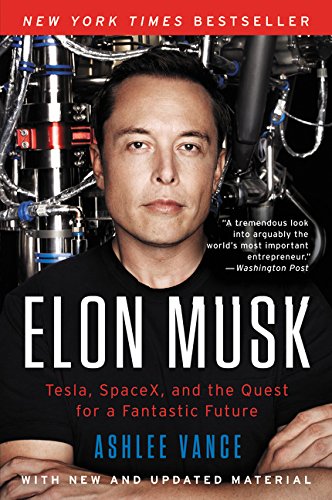
In Elon Musk: Tesla, SpaceX, and the Quest for a Fantastic Future, journalist Ashlee Vance paints an extraordinary picture of a man whose life reads like science fiction brought to life. Born in Pretoria, South Africa, in 1971, Elon Musk endured a childhood of deep emotional and physical pain that would later fuel his relentless ambition. He was small, bookish, and often lost in thought—a target for bullies. At one point, a group of boys pushed him down a flight of stairs and beat him until he lost consciousness, landing him in the hospital for two weeks.
At home, Musk’s relationship with his father, Errol Musk, was even more scarring. Vance recounts how Errol’s manipulative and cruel behavior deeply affected Elon’s sense of safety and trust. Musk described living with him as “a never-ending horror show.” Yet the abuse toughened him, teaching him early that emotional resilience was essential for survival. His mother, Maye Musk, a Canadian model and nutritionist, provided a counterbalance—supportive, independent, and driven. She worked multiple jobs to support her children after divorcing Errol, instilling in them the belief that hardship is something to endure, not escape.
Despite the chaos, Musk was a voracious reader. He consumed up to ten hours of books daily, from Isaac Asimov’s Foundation series to physics textbooks. Vance reveals that Musk was so immersed in thought that people sometimes believed he had gone deaf—he would stare into space, completely detached, processing ideas. Books like The Lord of the Rings and Hitchhiker’s Guide to the Galaxy shaped his worldview, convincing him that the purpose of life was to solve big problems and expand humanity’s potential.
By age 12, Musk had written and sold a space-themed video game called Blastar for $500. He also built small rockets and tinkered with chemistry sets, often blowing things up in his backyard. But South Africa’s apartheid-era militarism disgusted him, so at 17, he fled to Canada—alone—with little money, determined to eventually reach the United States.
After attending Queen’s University and later transferring to the University of Pennsylvania, Musk earned dual degrees in physics and economics. His college essays and projects often revolved around clean energy, sustainable technology, and space travel. He wasn’t just dreaming about Mars—he was already thinking about how to make life multiplanetary.
In 1995, after dropping out of a Stanford PhD program after just two days, Musk and his brother Kimbal Musk founded Zip2, a startup that created online business directories linked to maps—essentially a digital Yellow Pages. They lived in their office, showered at the local YMCA, and coded day and night. When they landed an investment from Mohr Davidow Ventures, the company grew rapidly. However, the board eventually replaced Elon as CEO, frustrating him but teaching him the importance of maintaining control.
When Compaq acquired Zip2 for $307 million in 1999, Musk made $22 million at just 27 years old. Instead of retiring, he poured $12 million into a new company—X.com, an online bank that let users transfer money instantly. His concept predated modern fintech by two decades. After merging with a rival startup called Confinity, X.com became PayPal, revolutionizing online payments. Although Musk was again ousted as CEO while on vacation, he retained the largest ownership stake. When eBay bought PayPal for $1.5 billion in 2002, Musk walked away with $250 million.
Vance points out that this experience taught Musk two crucial lessons: control your companies at all costs, and don’t shy away from industries that others find too complex or regulated. He had proven that speed, technology, and conviction could outmaneuver entrenched incumbents.
Musk’s next mission seemed impossible. Frustrated by NASA’s lack of ambition after the Apollo era, he decided to reignite humanity’s space dream. He founded Space Exploration Technologies (SpaceX) in 2002 with a single audacious goal: make space travel affordable and pave the way for colonizing Mars.
Vance describes how Musk initially tried to buy refurbished rockets from Russia, only to be laughed out of the room by engineers who didn’t take him seriously. On the flight home, Musk ran calculations on his laptop and realized he could build rockets himself at a fraction of the cost. “If they can do it, so can we—better and cheaper,” he said.
With $100 million of his own money, he started SpaceX in a small warehouse in El Segundo, California. His engineers—many in their twenties—worked 100-hour weeks under Musk’s relentless drive. They designed Falcon 1, a small, reusable rocket, and the Merlin engine from scratch. The first three launches, between 2006 and 2008, ended in fiery failure. The company teetered on bankruptcy. Musk poured in the last of his personal fortune, telling employees that one more success would save them.
On September 28, 2008, the fourth Falcon 1 finally reached orbit, making SpaceX the first privately funded company to do so. Days later, NASA awarded a $1.6 billion contract to deliver cargo to the International Space Station. Musk had done what no private entrepreneur had achieved before—he broke the monopoly of government space agencies.
Over the years, SpaceX accomplished milestones once thought impossible:
2010: Falcon 9 successfully launched and landed.
2012: Dragon became the first commercial spacecraft to dock with the ISS.
2015: First vertical rocket landing, revolutionizing cost structures.
2020: The Crew Dragon carried NASA astronauts into orbit from U.S. soil—the first such mission since the Space Shuttle era.
2023: Starlink, SpaceX’s global satellite internet network, reached over 2 million subscribers, providing connectivity even in war zones like Ukraine.
Through vertical integration, Musk cut costs dramatically by building everything in-house—from engines to software to launch systems. His “fail fast, learn faster” culture became a blueprint for modern aerospace innovation.
While building rockets, Musk was also revolutionizing another industry: automobiles. In 2004, he joined a small startup called Tesla Motors, founded by engineers Martin Eberhard and Marc Tarpenning, who dreamed of creating high-performance electric cars. Musk invested $6.3 million and became chairman, later taking over as CEO.
Tesla’s first model, the Roadster, stunned the auto industry. It could go from 0 to 60 mph in 3.9 seconds—faster than a Porsche 911—and ran entirely on lithium-ion batteries. But success didn’t come easily. Production delays, exploding battery packs, and skyrocketing costs brought Tesla to the edge of collapse during the 2008 financial crisis. Musk borrowed money from friends to make payroll, sleeping on the factory floor.
When the U.S. Department of Energy loaned Tesla $465 million in 2010, the company finally stabilized. Two years later, the Model S launched and became an instant success. It won Motor Trend’s Car of the Year, received a 99/100 rating from Consumer Reports, and proved that electric cars could be luxurious, fast, and desirable.
Under Musk’s leadership, Tesla introduced groundbreaking innovations:
Autopilot: Semi-autonomous driving technology updated via software.
Supercharger Network: Fast-charging stations worldwide to solve “range anxiety.”
Direct Sales Model: Selling cars online and in Tesla stores, bypassing dealerships.
Gigafactories: Massive facilities that produce batteries and components at scale.
Vance notes that Tesla’s culture mirrored Musk’s intensity—employees worked through weekends and holidays, motivated by the belief they were changing history. By 2020, Tesla became the world’s most valuable car manufacturer, forcing giants like Ford, GM, and Volkswagen to electrify their fleets.
In 2006, Musk helped his cousins Lyndon and Peter Rive launch SolarCity, a company dedicated to making solar energy affordable. The business offered no-upfront-cost installations and innovative leasing models, turning millions of homeowners into solar adopters. SolarCity grew to become the largest residential solar provider in the U.S., partnering with companies like Walmart and Home Depot.
In 2016, Tesla acquired SolarCity for $2.6 billion, forming Tesla Energy. The merger integrated three pillars of sustainability:
Solar panels for clean energy production.
Powerwall batteries for home energy storage.
Tesla vehicles for clean transportation.
The result was a closed-loop energy ecosystem—a household could power itself entirely through renewable energy. Although critics accused Musk of a conflict of interest, seeing the acquisition as a bailout for a struggling company, Musk insisted it was part of his larger mission to create a sustainable planet.
Vance highlights Musk’s intellectual superpower: first principles thinking. Instead of reasoning by analogy (“that’s how it’s always been done”), Musk deconstructs problems to their fundamentals and rebuilds solutions from scratch.
Examples include:
Realizing rocket materials were cheap, but inefficient processes made them expensive.
Calculating that lithium-ion batteries could achieve competitive cost per kilowatt-hour, making EVs viable.
Designing the Gigafactory after identifying that scaling production, not technology, was the key bottleneck in battery costs.
This method—borrowed from physics—lets Musk challenge assumptions in entrenched industries. It’s why he can compete simultaneously in aerospace, automotive, and energy sectors that few dare to enter.
Musk’s management style is notorious. Employees describe him as brutally demanding yet inspirational. “Elon doesn’t care about your feelings,” one engineer told Vance. “He cares about results.” He expects perfection, personally reviews engineering drawings, and emails teams at 3 a.m. demanding updates.
Vance recounts how Musk once confronted a factory manager at 2 a.m. about a minor part delay, asking, “Why are you at home when there’s a production problem?” Yet his intensity inspires loyalty. Many of his employees work extreme hours, motivated by the belief that they’re contributing to something historic—humanity’s survival.
Musk’s style blends engineering precision with visionary storytelling. He frequently sets impossible deadlines, such as promising to colonize Mars within decades or build a million cars a year. Most are missed, but his teams accomplish far more than they believed possible.
Both SpaceX and Tesla nearly collapsed multiple times. In 2008, Musk had to decide how to divide his dwindling fortune between them. “I thought both would die,” he admitted. Yet days after the Falcon 1 success, SpaceX secured its NASA contract, and Tesla closed its funding round on Christmas Eve—hours from bankruptcy.
Even in success, crises continued. During Tesla’s Model 3 ramp-up, Musk famously slept on the factory floor for months, diagnosing production bottlenecks firsthand. He described it as “manufacturing hell.” Yet the company ultimately delivered hundreds of thousands of cars and became profitable.
SpaceX, too, suffered painful losses—rockets exploded midair, payloads were destroyed—but Musk viewed each failure as an experiment. “Failure is an option here,” he told his team. “If things are not failing, you’re not innovating enough.”
For Musk, all his ventures converge on one purpose: securing humanity’s future. Through SpaceX’s Starship program, he aims to build a fully reusable spacecraft capable of carrying 100 passengers to Mars. Starship’s stainless steel design evokes science fiction, yet it’s real—tested and iterated continuously in Texas.
Musk envisions a self-sustaining Martian city of one million people, complete with solar power, greenhouses, and local manufacturing. He predicts cargo flights to Mars within the 2030s and crewed missions soon after. Beyond Mars, he dreams of exploring other planets and eventually interstellar travel. “I’d like to die on Mars,” he says, “just not on impact.”
Elon Musk’s influence transcends business. He revitalized public interest in “hard tech” at a time when Silicon Valley was dominated by software apps. His companies forced entire industries to evolve:
Automotive: Tesla’s success pushed every major automaker toward electric mobility.
Aerospace: SpaceX made reusability an industry standard.
Energy: SolarCity and Tesla Energy popularized renewable storage solutions.
Beyond his companies, Musk’s ventures like Starlink, Neuralink, and The Boring Company further expand his reach—from global internet connectivity to brain-computer interfaces and underground transport systems.
Like Steve Jobs, Musk redefined what it means to be a 21st-century innovator. He proved that business can serve civilization itself—that profit and planetary progress are not mutually exclusive.
Elon Musk’s life, as chronicled by Ashlee Vance, is not just a biography—it’s a case study in what happens when unrelenting vision collides with impossible odds. Musk is portrayed as both hero and antihero: a man whose single-minded pursuit of progress reshapes the world but often comes at immense personal and emotional cost. His story demonstrates that groundbreaking innovation rarely arises from comfort or consensus—it emerges from obsession, risk, and the willingness to endure ridicule, exhaustion, and failure in the name of a higher goal.
At its heart, Elon Musk is about the pursuit of human advancement through sheer willpower. Every one of Musk’s ventures—Tesla, SpaceX, SolarCity, and later ventures like Neuralink and Starlink—feeds into a unified mission: to ensure the long-term survival and prosperity of the human species. For him, business isn’t about quarterly profits or market dominance; it’s a vehicle for civilization-scale problem-solving. Musk views climate change, fossil fuel dependence, and humanity’s confinement to a single planet as existential threats. His solution is an interconnected ecosystem of technologies: electric vehicles to decarbonize transportation, solar power to harness renewable energy, batteries to store it, and rockets to make humanity multiplanetary. Each of these companies—once dismissed as vanity projects—has not only succeeded but reshaped entire industries.
Vance underscores that Musk’s genius lies not in one invention but in his ability to connect ideas across domains. He doesn’t merely disrupt markets; he rewrites the physics, economics, and psychology behind them. SpaceX reimagined aerospace with reusable rockets; Tesla turned cars into software-driven machines; SolarCity merged energy production with smart storage; and Starlink is attempting to provide internet to every corner of Earth. His “first principles thinking” allows him to challenge assumptions so deeply entrenched that most people don’t even question them. Where others see costs, Musk sees inefficiencies; where others see limits, he sees solvable equations.
But Vance also highlights the paradox of Musk’s brilliance: his superhuman ambition often coexists with emotional volatility and near-messianic intensity. He is known to berate employees, set impossible deadlines, and micromanage down to the smallest engineering detail. Yet even his harshest critics admit that his relentless pressure is what turns the impossible into reality. His companies have repeatedly hovered on the brink of collapse—Tesla’s near-bankruptcy in 2008, SpaceX’s failed rocket launches, and production chaos during the Model 3 rollout—but Musk thrives on brinkmanship. He bets everything, including his fortune and health, because he sees failure not as an endpoint, but as data. His resilience in the face of repeated disaster reflects a core truth: for Musk, survival itself is a form of innovation.
In a broader sense, Musk’s life serves as a mirror for humanity’s potential. He demonstrates that one individual—armed with intellect, audacity, and refusal to accept limits—can bend the trajectory of entire civilizations. He reminds us that progress depends on dreamers who are willing to risk everything to expand what is possible. The story of Elon Musk isn’t just about technology; it’s about the raw, unfiltered force of human will.
Ultimately, Vance presents Musk as a flawed visionary—a man whose success and suffering are inseparable. He is the rare entrepreneur whose goals transcend profit and ego, rooted instead in existential urgency: to push civilization forward before it’s too late. Whether he’s remembered as a genius or a tyrant, his work ensures that the world will never again dismiss the idea that humanity can change its fate through courage, creativity, and relentless pursuit of the extraordinary.
Ashlee Vance is an award-winning journalist and author known for his deep dives into Silicon Valley’s most transformative figures. A former writer for The New York Times and Bloomberg Businessweek, Vance has profiled leaders like Jeff Bezos, Peter Thiel, and Larry Page. Elon Musk: Tesla, SpaceX, and the Quest for a Fantastic Future (2015) remains the definitive biography of Musk, blending insider interviews with rigorous reporting. Vance’s narrative captures both the triumphs and the turmoil behind one of the most consequential innovators in modern history.
Looking for a Elon Musk Book Summary PDF you can save and revisit offline? Our Elon Musk Book Summary PDF captures the book’s core ideas in a clean, printable format — the key frameworks, takeaways, and structure without the fluff. Download the Elon Musk Book Summary PDF when you want a reference you can annotate, share with your team, or review on the go. Get your Elon Musk Book Summary PDF from the download page below.
Download Elon Musk Book Summary PDFGet full access to 2,500+ book summaries with audio and video
Start Free Trial →