


As an Amazon Associate, Sumizeit earns from qualifying purchases.
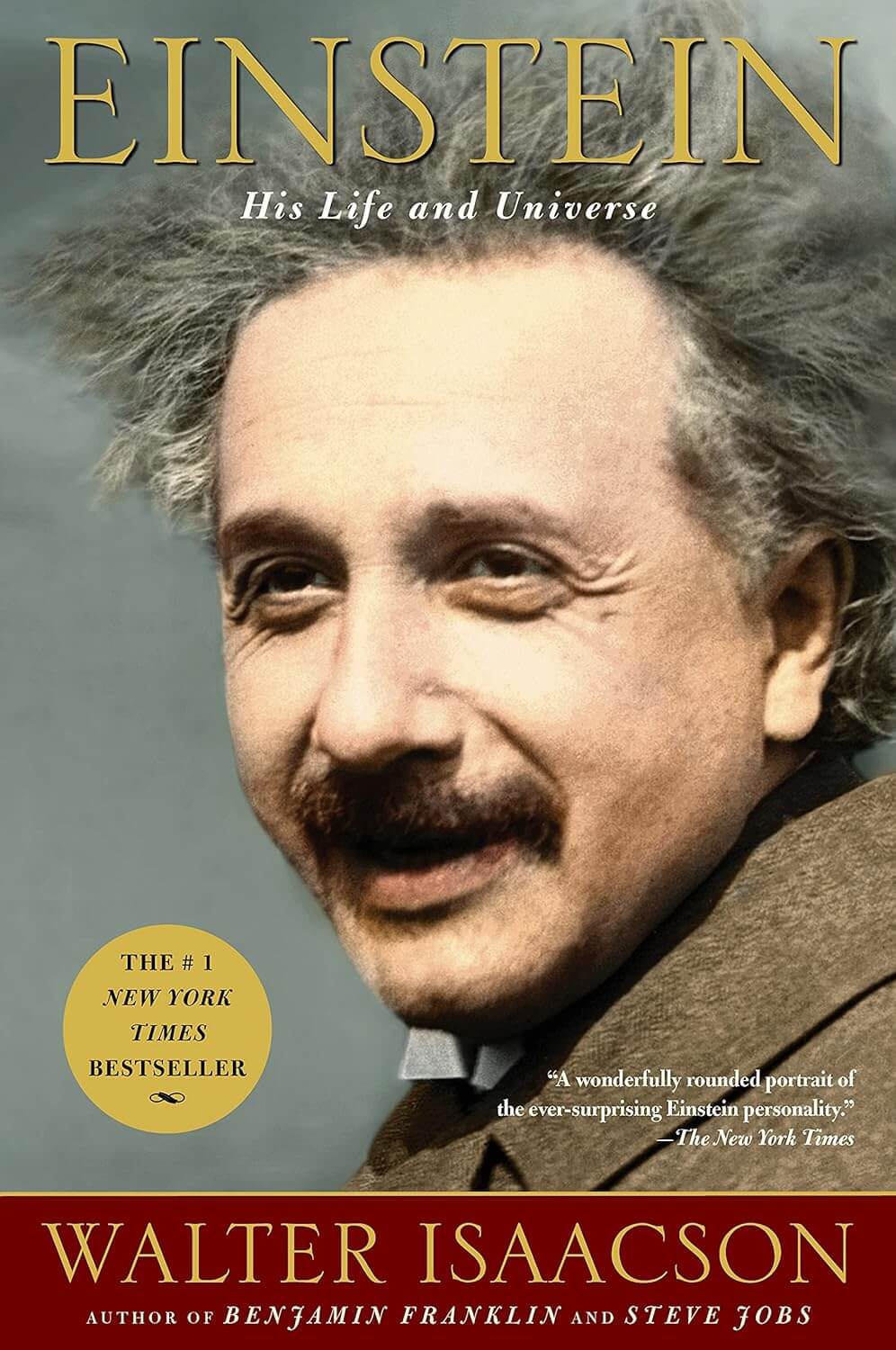
Einstein: His Life and Universe Book Summary
This Einstein: His Life and Universe Book Summary covers the key ideas, lessons, and takeaways in about 20 minutes.
Einstein was not just a scientist who transformed our understanding of space, time, and matter—he was a thinker who believed that intellectual freedom and human compassion were inseparable. His scientific theories reshaped modern physics, but his moral courage, humanitarian activism, and spiritual humility revealed a worldview grounded in awe and responsibility.
Isaacson’s biography reveals Einstein as both extraordinary and profoundly human: playful yet disciplined, stubborn yet compassionate, solitary yet deeply connected to the world’s struggles. His legacy endures not only in equations and theories but in the reminder that imagination—guided by integrity—can illuminate the universe.
Helps with these goals
Want the complete 20-minute summary?
- Full structured summary
- Video Summary
- Podcast Summary
- Audio summary
- Key takeaways
- Exercises
- Quiz
- Highlights and notes
- Ask the book with AI
What is in the Einstein: His Life and Universe book summary?
Below is a preview of Sumizeit’s expert-written summary of Einstein: His Life and Universe by Walter Isaacson. The full summary covers the book’s key ideas in text, audio, and video.
Albert Einstein’s early years were not the predictable beginnings of a future scientific legend. He grew up with a temperament that blended gentle introversion with fierce independence. Slow to speak and uninterested in typical childhood activities, he was perceived by many adults as withdrawn, even aloof. Yet beneath this still exterior lived a boy obsessed with understanding how the world worked. His fascination ignited the moment his father handed him a small magnetic compass. Einstein fixated on the needle that moved without being touched, compelled by an invisible force he could not see. This singular moment sparked a lifelong quest to understand nature’s hidden order.
His upbringing challenged the strict cultural norms of late-19th-century Germany. Einstein bristled against authoritarian teachers and rigid school structures. He disliked memorization, distrusted dogma, and rejected the notion that knowledge was something to be passively received. This rebellion wasn’t mere mischief—it reflected a foundational worldview: truth must be discovered, not adopted.
His home life played just as important a role. His mother encouraged his violin lessons not for discipline but for beauty, instilling in him a lifelong belief that harmony—musical or scientific—expresses profound truths. His father and uncle exposed him to mathematics and scientific puzzles that gave shape to his early intellectual passions. These threads of curiosity, skepticism, and aesthetic appreciation would eventually merge into the distinctive style of thinking that allowed him to reimagine the universe.
The Formation of a Free Thinker: Education, Self-Study, and the Making of a Rebel Scientist
Einstein’s formal education was rocky. Though clearly bright, he had little patience for strict classrooms or teachers who demanded obedience. He left school in Germany and completed his education in Switzerland, whose more liberal approach suited him far better. Yet even in the supportive environment of the Zurich Polytechnic, Einstein was more committed to independent study than to impressing professors. He skipped classes, devoured physics papers on his own, and embraced the ideas of thinkers like Ernst Mach who questioned long-standing scientific assumptions.
This independent streak came at a cost. Upon graduation, most of his professors—alienated by his disregard for academic hierarchy—refused to write recommendation letters. Unable to secure a teaching or research assistantship, Einstein took a clerical job at the Swiss Patent Office in Bern. The position seemed mundane, but it became one of the most productive periods of his life. The regular hours and steady income gave him space to think freely, while the patent applications he reviewed sharpened his ability to imagine physical processes from first principles.
This intellectual freedom prepared him for the breakthroughs that would soon reshape modern physics.
Love, Collaboration, and Companionship: The Complex Influences of Mileva and Elsa
Einstein’s personal relationships influenced his scientific development in significant ways. His first marriage, to Mileva Marić—a fellow physics student—began as an intense intellectual partnership. They debated scientific problems, corresponded about shared interests, and energized each other during their student years.
Want the complete 20-minute summary?
- Full structured summary
- Video Summary
- Podcast Summary
- Audio summary
- Key takeaways
- Exercises
- Quiz
- Highlights and notes
- Ask the book with AI
Who should read Einstein: His Life and Universe?
Einstein: His Life and Universe is ideal for anyone curious about how one of history's greatest minds approached problems and lived. Whether you're a science enthusiast, student of biography, or someone seeking inspiration from a life of intellectual courage and moral conviction, this book offers profound insights into both genius and humanity. It appeals equally to those interested in physics, philosophy, or the lives of people who changed the world.
Why does Einstein: His Life and Universe matter?
Walter Isaacson's biography reveals how creativity, independence, and moral conviction shaped not just scientific breakthroughs but a worldview that remains deeply relevant today. In an era of increasing specialization and conformity, Einstein's life demonstrates the power of questioning authority and pursuing ideas with integrity. The book shows how one person's relentless curiosity and commitment to justice can influence generations and reshape human understanding.
What are the key themes in Einstein: His Life and Universe?
- The power of independent thinking and intellectual rebellion
- Imagination and creativity as tools for scientific discovery
- The intersection of personal relationships and intellectual achievement
- Moral responsibility and the use of scientific knowledge for good
- Wonder and beauty as driving forces in understanding nature
- The courage to challenge established dogma
- Balancing solitude with engagement in the world's struggles
What are the key lessons from the Einstein: His Life and Universe book summary?
Curiosity begins with wonder
Einstein's lifelong quest was ignited by a simple moment—a magnetic compass that moved without being touched. The ability to notice mystery in ordinary things and pursue genuine questions is foundational to discovery.
Resist authority without rejecting learning
Einstein's refusal to accept dogma or memorize facts didn't hinder his education—it deepened it. Questioning assumptions and seeking truth independently leads to more genuine understanding than passive acceptance.
Freedom and space enable creative breakthroughs
Einstein's most transformative work came not in prestigious academic positions but in a patent office with regular hours and mental freedom. The right environment for thinking matters more than prestige.
Simplicity and elegance reveal truth
Einstein believed nature must follow simple, harmonious laws. Seeking elegant solutions and mathematical beauty often points toward deeper truths about how the universe works.
Imagination precedes calculation
Einstein's breakthroughs began with imaginative thought experiments—picturing a falling elevator or the bending of light—before the mathematics could follow. Visualization and intuition fuel discovery.
Skepticism can coexist with humility
While Einstein questioned quantum mechanics and pursued his own unified field theory, he remained intellectually humble about what remained unknown. Healthy skepticism isn't arrogance but careful reasoning.
Personal relationships shape intellectual work
Einstein's collaborations with Mileva, support from Elsa, and intellectual friendships all influenced his scientific development. The human dimension of work is inseparable from achievement.
Persistence through failure teaches resilience
Einstein spent decades pursuing unified field theory without success, yet continued exploring. The willingness to pursue meaningful questions even without guaranteed results is essential to growth.
Moral conviction and scientific inquiry are interdependent
Einstein's activism against war, discrimination, and injustice wasn't separate from his science—it reflected the same commitment to truth and beauty that guided his physics.
Beauty in nature deserves reverence
Einstein's spiritual outlook was rooted in awe at the universe's mathematical harmony. Cultivating wonder and appreciation deepens both scientific understanding and human meaning-making.
Collaboration requires intellectual equality
Einstein thrived when working with peers he respected as equals and suffered when surrounded by sycophants. Authentic partnerships demand mutual respect and genuine debate.
Reinvention is possible at any stage
Einstein's exile to America, while tragic, became a period of reinvention where he found new purpose in public advocacy and intellectual freedom. Change can open unexpected pathways.
Fame comes with costs and responsibilities
Einstein's sudden global celebrity brought exhaustion and intrusion but also a platform for justice. Those with visibility carry responsibility to use it wisely.
Solitude and engagement must balance
Einstein needed quiet time to think yet felt compelled to engage with the world's moral crises. Sustainable creativity requires both focused work and meaningful connection to others.
Determinism and responsibility coexist
Despite rejecting free will, Einstein held himself and others accountable for moral choices. A deterministic worldview doesn't eliminate the imperative to act ethically.
Legacy transcends a single discipline
Einstein's impact extends far beyond physics into philosophy, culture, and moral imagination. A truly transformative life influences how humanity thinks across many domains.
Unconventional personalities often drive unconventional insights
Einstein's eccentricity, gentle introversion, and disregard for hierarchy weren't obstacles to genius—they protected his independence and nourished original thinking.
The pursuit of truth requires intellectual honesty
Einstein remained willing to critique his own work and accept evidence against his preferences, as shown by his eventual acknowledgment of quantum mechanics' success despite his doubts.
Meaning comes from struggle and uncertainty
Einstein found life's deepest satisfaction not in solved problems but in the ongoing pursuit of understanding—the questions matter more than final answers.
Want the complete 20-minute summary?
- Full structured summary
- Video Summary
- Podcast Summary
- Audio summary
- Key takeaways
- Exercises
- Quiz
- Highlights and notes
- Ask the book with AI
How can you apply ideas from Einstein: His Life and Universe?
- Cultivate genuine curiosity by noticing mystery in everyday observations rather than accepting surface explanations
- Create protected thinking time by establishing routines and boundaries that shield focused work from constant demands
- Question institutional authority respectfully by developing independent judgment about what you believe to be true
- Seek elegance and simplicity as guides when solving complex problems or making difficult decisions
- Use thought experiments and visualization before diving into detailed planning or technical work
- Engage in meaningful collaboration with intellectual equals who can challenge and refine your thinking
- Align your public influence and professional work with your deepest moral convictions rather than compartmentalizing them
What common mistakes do readers make with Einstein: His Life and Universe?
- Assuming that brilliance requires isolation—Einstein's creativity actually depended on relationships, feedback, and engagement with others' ideas
- Believing that success comes from following authority and established paths—Einstein's breakthroughs came from questioning orthodoxy and forging his own way
- Thinking that fame and public recognition automatically follow great work—Einstein's celebrity surprised even him and required navigation rather than pursuit
- Viewing scientific inquiry as purely objective and separate from moral responsibility—Einstein showed that how we use knowledge matters as much as discovering it
- Confusing stubbornness with integrity—Einstein held his convictions but also changed his mind when evidence warranted it, and recognized when he was wrong
Sumizeit Exercises Apply what you've learned
Turn ideas from Einstein: His Life and Universe into action with a short guided reflection: identify the biggest takeaway, connect it to your life, and commit to one step you can take in the next 24 hours.
What is the expert analysis of Einstein: His Life and Universe?
Overview
Einstein: His Life and Universe is a meticulously researched biography authored by Walter Isaacson, a distinguished historian and biographer renowned for his nuanced portrayals of transformative figures in science and culture. This work stands out for its comprehensive synthesis of Albert Einstein’s personal life, intellectual development, and enduring scientific legacy. Isaacson’s narrative transcends the archetype of the isolated genius by situating Einstein within the social, philosophical, and political contexts that shaped his thought and character. The book is significant not only for its detailed chronicling of Einstein’s scientific breakthroughs but also for its exploration of the moral and spiritual dimensions that underpinned his worldview.
Core Thesis
Isaacson’s central argument posits that Einstein’s genius was inseparable from his distinctive personality traits—his rebellious independence, relentless curiosity, and profound moral conviction. The biography contends that Einstein’s scientific achievements arose from a synthesis of imagination and disciplined inquiry, intuition and rigorous mathematics, as well as a persistent questioning of authority and dogma. Moreover, Einstein’s life exemplifies how intellectual freedom and human compassion can coexist, with his scientific theories deeply intertwined with his humanitarian activism and philosophical reflections on the nature of reality and ethics.
Strengths
- Comprehensive Integration: Isaacson masterfully weaves Einstein’s scientific milestones with his personal relationships, philosophical beliefs, and political engagements, offering a holistic portrait rather than a narrow scientific biography.
- Use of Primary Sources: The biography benefits from newly available archival materials, including personal correspondence, which enrich the narrative with intimate insights into Einstein’s thoughts and emotions.
- Accessible yet Sophisticated: Isaacson balances clarity and depth, making complex scientific concepts like special and general relativity understandable without oversimplification, thus appealing to both lay readers and scholars.
- Humanizing the Icon: By highlighting Einstein’s contradictions—his rebelliousness alongside humility, his personal flaws alongside moral courage—the book challenges the myth of the flawless genius and presents a relatable human figure.
- Philosophical and Ethical Contextualization: The exploration of Einstein’s spiritual outlook and political commitments adds layers of meaning, situating his scientific work within broader questions about truth, justice, and the human condition.
Critiques & Counterarguments
- Romanticizing Independence: While Isaacson emphasizes Einstein’s rebellious spirit as a driver of creativity, some scholars argue that this narrative risks overstating individualism at the expense of acknowledging the collaborative and cumulative nature of scientific progress.
- Limited Engagement with Competing Scientific Perspectives: The biography primarily centers on Einstein’s viewpoint and legacy, with less critical examination of how later developments—such as quantum mechanics’ ascendancy—challenged or superseded his ideas, potentially underrepresenting the complexity of scientific debates.
- Philosophical Oversimplifications: Isaacson’s portrayal of Einstein’s deterministic worldview and skepticism toward quantum mechanics, while accurate, may underplay the nuanced philosophical positions within the broader scientific community that embraced indeterminacy and probabilistic interpretations as fundamental.
- Potential Hagiography: Despite acknowledging Einstein’s personal flaws, the narrative occasionally veers toward hagiography, glossing over more contentious aspects, such as his complicated relationships with women or his political stances, which invite more critical scrutiny.
- Historical Context and Dated Examples: Some contextual explanations, particularly regarding early 20th-century scientific culture or political environments, might benefit from deeper analysis to avoid anachronistic interpretations or simplifications.
Who Should Read This
This biography is ideal for readers seeking a richly textured understanding of one of history’s most influential scientists beyond his equations and theories. It appeals to intellectually curious individuals interested in the intersections of science, philosophy, and history, as well as those fascinated by the human dimensions of genius. Scholars and students in physics, history of science, and philosophy will find Isaacson’s synthesis valuable for its accessible yet thorough treatment of complex ideas. Additionally, readers drawn to biographies that illuminate the moral and spiritual lives of their subjects will appreciate the nuanced portrayal of Einstein’s ethical commitments and worldview.
Frequently asked questions about the Einstein: His Life and Universe book summary
What is Einstein: His Life and Universe about?
Einstein: His Life and Universe by Walter Isaacson is a comprehensive biography that traces Albert Einstein's life from childhood through his groundbreaking scientific contributions to his moral activism and later years. The book explores how Einstein's curiosity, independence, and creativity led to revolutionary theories in physics while showing the deeply human side of his life, including his relationships, spiritual worldview, and commitment to justice.
Who should read Einstein: His Life and Universe?
This biography appeals to science enthusiasts, students, history buffs, and anyone interested in how creative breakthroughs happen. You'll benefit from reading it whether you want to understand Einstein's scientific achievements, learn about the life of an extraordinary thinker, draw inspiration from his independence and moral courage, or explore the intersection of genius, creativity, and human responsibility.
What are the main takeaways from Einstein: His Life and Universe?
The book reveals that Einstein's genius stemmed not just from intellect but from character—his independence, curiosity, moral conviction, and sense of wonder. Key insights include the power of questioning authority, the importance of creative thinking over mere calculation, the role of freedom in enabling breakthroughs, and the inseparability of scientific integrity from moral responsibility. Isaacson shows that Einstein's greatest legacy lies in demonstrating how imagination guided by integrity can illuminate both the universe and human consciousness.
What are Einstein's most important scientific contributions?
Einstein's major contributions include his work on the photoelectric effect and light quanta (helping launch quantum mechanics), the proof of atomic reality through Brownian motion analysis, special relativity which redefined time and space, the famous equation E=mc², and general relativity which revolutionized our understanding of gravity as a geometric property of spacetime. His 1905 papers alone transformed physics, and his 1915 general relativity theory earned him global recognition.
How did Einstein's personal life influence his scientific work?
Isaacson demonstrates that Einstein's personal relationships and life circumstances significantly shaped his intellectual development. His first wife Mileva was an intellectual peer who contributed to early discussions, while his second wife Elsa provided domestic stability that freed him to focus on complex calculations. His experiences with both success and failure, his moral struggles, and his spiritual outlook all informed how he approached science and shaped his philosophical stance on the nature of reality.
What was Einstein's view on religion and spirituality?
Einstein rejected traditional religious dogma but embraced what he called 'cosmic religion'—a spiritual awe at the universe's mathematical order and natural beauty. Influenced by Spinoza, he viewed God and nature as one, finding reverence in the harmonious laws of physics rather than belief in a personal deity. For Einstein, curiosity and wonder about nature were spiritual virtues, and science expressed humanity's desire to understand the mind of the universe.
How did Einstein's life change after he fled Nazi Germany?
Einstein renounced his German citizenship and settled in Princeton at the Institute for Advanced Study, where he found both refuge and freedom to continue research. In America, he became a public intellectual, defending civil liberties and civil rights while condemning McCarthyism and nuclear proliferation. His exile forced reinvention but ultimately gave him a platform to advocate for justice and humanity on a global scale.
Why did Einstein reject aspects of quantum mechanics?
Although Einstein helped pioneer quantum theory with his work on light quanta, he grew troubled by the probabilistic and measurement-dependent nature of quantum mechanics. He believed reality must exist independently of observation and that randomness indicated missing information rather than fundamental truth. His famous statement 'God does not play dice' summed up his conviction that the universe follows deterministic laws, even as his critiques influenced later developments in quantum information science and entanglement theory.
About Sumizeit
Sumizeit is a profitable Scomy LLC company based in Miami, Florida. It has been helping readers learn from nonfiction books for 7 years with expert-written summaries in text, audio, podcast, and video.
Want the complete 20-minute summary?
- Full structured summary
- Video Summary
- Podcast Summary
- Audio summary
- Key takeaways
- Exercises
- Quiz
- Highlights and notes
- Ask the book with AI
Here's why readers love Sumizeit
Join thousands of learners getting smarter every day
"Great experience. Detailed summaries. Loved the gamification feature. Makes learning fun. Good customer service. I recommend Sumizeit to anyone. You'll learn a lot."
"I always felt busy but still wanting to keep up with the book discussion in my friend group. This was a great supplement to help me keep reading the books I find fun while keeping up with important books."
"I love this website. Instead of scrolling social media, I find myself learning a lot. I use it everyday. I recommend this app for anyone who is too busy and wants to get up to speed with their favorite books."
Einstein: His Life and Universe Book Summary PDF
Looking for a Einstein: His Life and Universe Book Summary PDF you can save and revisit offline? Our Einstein: His Life and Universe Book Summary PDF captures the book’s core ideas in a clean, printable format — the key frameworks, takeaways, and structure without the fluff. Download the Einstein: His Life and Universe Book Summary PDF when you want a reference you can annotate, share with your team, or review on the go. Get your Einstein: His Life and Universe Book Summary PDF from the download page below.
Download Einstein: His Life and Universe Book Summary PDFPeople also liked these summaries
Readers who explored Einstein: His Life and Universe often enjoyed these titles next.





Want the complete 20-minute summary?
- Full structured summary
- Video Summary
- Podcast Summary
- Audio summary
- Key takeaways
- Exercises
- Quiz
- Highlights and notes
- Ask the book with AI
Featured Book Titles
Popular Book Summaries at sumizeit, leading book summary app