


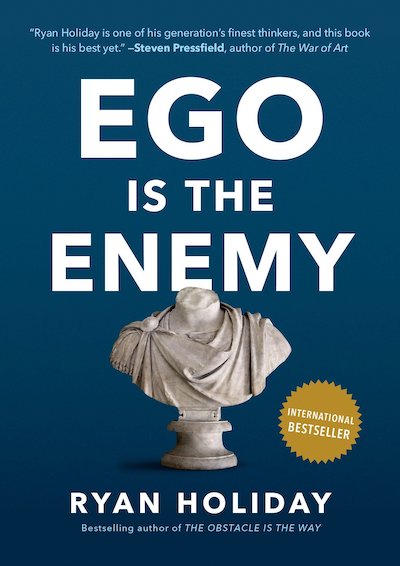
Prefer the print book? Buy on Amazon
As an Amazon Associate, Sumizeit earns from qualifying purchases.
Ego is the Enemy Book Summary
This Ego is the Enemy Book Summary covers the key ideas, lessons, and takeaways in about 20 minutes.
Helps with these goals
Want the complete 20-minute summary?
- Full structured summary
- Video Summary
- Podcast Summary
- Audio summary
- Key takeaways
- Exercises
- Quiz
- Highlights and notes
- Ask the book with AI
Not ready to upgrade?
Get this summary + 2 more picks sent to your inbox, free.
What is in the Ego is the Enemy book summary?
Below is a preview of Sumizeit’s expert-written summary of Ego is the Enemy by Ryan Holiday. The full summary covers the book’s key ideas in text, audio, and video.
Everyone is motivated by something. If you are driven to achieve things because you want attention and praise, it's likely you’re being driven by your ego. While there is nothing wrong with being motivated by egocentric goals (goals that primarily benefit you or make you look good to others), it's easy for your ego to get out of hand. When someone’s ego is the correct size, they have enough confidence to take risks, and they can handle failure without losing their cool. But, once someone's ego gets out of proportion, they can end up reaping painful consequences in the long run. Problems with ego management can lead to the inability to achieve meaningful success because of damaged relationships with colleagues, shortsightedness, missed opportunities, and many other problems. Here’s how to shift away from the pitfalls of egoist living, and move into a more success oriented perspective.
Exercise ambition, instead of ego
In opposition to those who are primarily motivated by their ego, there are those motivated by ambition. They desire to be the best in their field, whether other people notice it or not. A historical example of this principle is William Tecumseh Sherman, a general in the military during the Civil War. He cared more about being the best at his role than he cared for prestige and recognition. His leadership abilities were so exceptional, he was asked to run for president. After talking with Lincoln, he realized he wanted to stay in the field of military leadership. He passed up the recognition he could receive as president to continue excelling in what he loved. By comparison, ego driven Ulysses S. Grant ran for president even though he lacked any experience in a similar role. His ego drove him to believe he could successfully tackle an endeavor when he had no experience. This is not to say that those who are ambitious shouldn’t take risks: but rather focus your risk taking in an area that you feel passionate about, not just an area where you think you can get praise and attention.
Recognize there’s always more to learn
Humility is the antidote to egoism. How do you maintain humility? Recognize that there is always more to learn. No matter what field you are in, there is always someone more skilled you can learn from. Retaining this humility will allow you to continue to develop your skill set. Develop the perspective of a student and remain willing to be taught, and keep the awareness that no matter how much you excel at what you do, there will always be someone who’s better.
This attitude has been helpful to guitarist Kirk Hammett, who was offered the position of guitarist in Metallica in the 1980s. He refused, because he knew that once he started playing in a band, he would miss out on the opportunity to grow his skills. He instead became a student of world-renowned guitar legend Joe Satriani.
Want the complete 20-minute summary?
- Full structured summary
- Video Summary
- Podcast Summary
- Audio summary
- Key takeaways
- Exercises
- Quiz
- Highlights and notes
- Ask the book with AI
Who should read Ego is the Enemy?
Ego is the Enemy is ideal for ambitious professionals, entrepreneurs, and leaders who want to achieve meaningful success without self-sabotage. If you find yourself driven by recognition and praise rather than genuine mastery, or struggle with delegation and receiving feedback, this book offers practical wisdom to recalibrate your mindset.
Why does Ego is the Enemy matter?
In a world obsessed with personal branding and self-promotion, Ryan Holiday's Ego is the Enemy provides a counterintuitive perspective: unchecked ego is one of the biggest obstacles to lasting achievement and fulfillment. By understanding how ego undermines relationships, clouds judgment, and limits growth, readers can break free from patterns that sabotage their success and build a more resilient, humble foundation for genuine accomplishment.
What are the key themes in Ego is the Enemy?
- Ambition versus ego as competing motivators
- Humility as the foundation for continuous learning
- The dangers of pride and complacency
- Delegation and collaborative success
- Accepting what is and isn't within your control
- Credit and recognition in teamwork
Want the complete 20-minute summary?
- Full structured summary
- Video Summary
- Podcast Summary
- Audio summary
- Key takeaways
- Exercises
- Quiz
- Highlights and notes
- Ask the book with AI
How can you apply ideas from Ego is the Enemy?
- Delegate specific tasks this week and trust your team to execute, freeing yourself for strategic work
- After your next success or win, explicitly credit team members or external factors rather than taking sole credit
- When facing criticism or feedback, pause before responding and ask: 'What is true in this feedback that I can use?'
- Identify one area where you can become a student again—take a course, find a mentor, or apprentice under an expert
- In your next meeting or conversation, ask more questions than you provide answers, and focus on understanding others' perspectives
- Review a recent setback and list only the factors outside your control; then identify what you can improve next time
- Practice saying 'no' to an opportunity that doesn't align with your core expertise or passion, even if it seems prestigious
What common mistakes do readers make with Ego is the Enemy?
- Believing that success means you've figured everything out and no longer need to learn from others
- Taking feedback or rejection as personal attacks instead of signals for improvement
- Insisting on doing everything yourself because you believe only you can do it right, leading to burnout and missed growth opportunities
- Attributing all your wins to personal genius while blaming external factors for failures, creating a distorted self-image
Sumizeit Exercises Apply what you've learned
Turn ideas from Ego is the Enemy into action with a short guided reflection: identify the biggest takeaway, connect it to your life, and commit to one step you can take in the next 24 hours.
What is the expert analysis of Ego is the Enemy?
Overview
Ego is the Enemy is a compelling work by Ryan Holiday, a prominent author and media strategist known for his deep engagement with Stoic philosophy and modern self-improvement literature. Holiday’s background as a marketer and thinker who bridges classical philosophy with contemporary challenges lends the book a unique blend of historical insight and practical wisdom. This book is significant because it tackles the pervasive and often destructive role of ego in personal and professional development, offering a Stoic-inspired framework to manage ambition, humility, and success.
Core Thesis
At its core, Ego is the Enemy argues that unchecked ego is a fundamental barrier to meaningful achievement and personal growth. Holiday distinguishes ego-driven behavior—marked by a desire for recognition, pride, and defensiveness—from ambition grounded in humility and continuous learning. The book posits that true success arises from subordinating ego, embracing humility, recognizing the contributions of others, and maintaining a learner’s mindset. Ego, when inflated, leads to shortsightedness, damaged relationships, and missed opportunities, whereas managing ego effectively fosters resilience, collaboration, and sustained achievement.
Strengths
- Historical and Contemporary Examples: Holiday’s use of well-chosen historical figures such as William Tecumseh Sherman, Steve Jobs, and John DeLorean enriches the narrative, providing vivid illustrations that ground abstract concepts in real-world outcomes.
- Accessible Stoic Philosophy: The book distills complex Stoic ideas into practical advice, making ancient wisdom relevant and actionable for modern readers navigating ego-driven environments.
- Balanced Perspective on Ambition: By differentiating ego from ambition, Holiday offers a nuanced view that encourages risk-taking and excellence without the pitfalls of self-centeredness.
- Emphasis on Humility and Lifelong Learning: The advocacy for maintaining a student mindset and recognizing the value of teamwork resonates deeply in both personal development and organizational contexts.
- Practical Strategies: The book’s recommendations—such as delegating effectively, avoiding pride, and reframing success and failure—are actionable and grounded in psychological insight.
Critiques & Counterarguments
- Potential Oversimplification: The dichotomy between ego and ambition, while useful, may oversimplify the complexity of human motivation. In reality, ego and ambition often coexist and interact in nuanced ways that the book does not fully explore.
- Limited Engagement with Contemporary Psychology: The book leans heavily on Stoic philosophy and anecdotal evidence but offers limited integration with modern psychological research on ego, self-esteem, and motivation, which could provide a more robust empirical foundation.
- Historical Examples as Selective Narratives: While compelling, some historical anecdotes risk confirmation bias, highlighting successes that fit the thesis while neglecting counterexamples where ego may have played a constructive role or where humility did not prevent failure.
- Contrasting Views on Ego: Certain schools of thought, such as positive psychology, argue that a healthy ego is essential for confidence and well-being. The book’s framing might underappreciate how ego, when balanced, can be a source of motivation rather than an obstacle.
- Practical Challenges in Application: The advice to “shut down ego” can be difficult to operationalize, especially in highly competitive or hierarchical environments where self-promotion is often rewarded. The book could benefit from deeper exploration of these contextual challenges.
Who Should Read This
Ego is the Enemy is ideally suited for readers who are engaged in leadership, entrepreneurship, or creative professions where ego dynamics frequently influence outcomes. It appeals to those interested in Stoic philosophy, self-improvement, and psychological resilience, offering a thoughtful framework to navigate ambition and humility. Additionally, anyone seeking to understand the subtle ways ego can undermine success and relationships will find this book a valuable guide. However, readers looking for rigorous scientific analysis or a comprehensive psychological treatment of ego might find the approach more philosophical and anecdotal than empirical.
Frequently asked questions about the Ego is the Enemy book summary
What is Ego is the Enemy about?
Ego is the Enemy by Ryan Holiday explores how unchecked ego undermines success and provides practical strategies for cultivating humility and ambition instead. The book uses historical figures and modern examples to show how excessive ego damages relationships, clouds judgment, and prevents genuine achievement, while genuine ambition—paired with humility—leads to lasting success.
Who should read Ego is the Enemy?
This book is essential for entrepreneurs, leaders, professionals, and anyone driven to achieve their goals. It's particularly valuable if you struggle with delegation, defensive reactions to criticism, or the tendency to rest on past success. Anyone seeking to build meaningful achievement without sabotaging themselves through ego-driven behavior will find practical wisdom in these pages.
What are the main takeaways from Ego is the Enemy?
Key takeaways include: prioritize ambition and mastery over attention and praise; maintain a perpetual student mindset; avoid pride's complacency by staying humble even after wins; delegate effectively and credit your team; and recognize that outcomes depend partly on factors beyond your control. Together, these lessons show how humility accelerates growth and strengthens relationships that drive true success.
How does Ryan Holiday define ego versus ambition?
Holiday distinguishes ego as seeking external validation, praise, and recognition, while ambition is the internal drive to excel and master your field regardless of applause. Ego is self-centered and fragile; ambition is grounded, resilient, and focused on the work itself rather than how others perceive you.
Can ego ever be positive, or should it be eliminated entirely?
Holiday doesn't advocate eliminating all ego but rather right-sizing it. A healthy ego provides confidence to take risks; the problem emerges when it becomes outsized and drives destructive behaviors like denial of failure, inability to collaborate, or defensive reactions to feedback. The goal is balance—enough confidence to act, but enough humility to learn and grow.
What does Ego is the Enemy teach about failure and setbacks?
The book teaches that failure is partly outside your control and should be treated as a learning opportunity rather than a personal indictment. Rather than taking it personally or blaming others (ego responses), a humble mindset extracts lessons from failure to inform future improvement. This reframing transforms setbacks into fuel for growth.
How does Ego is the Enemy address teamwork and collaboration?
Holiday emphasizes that teams achieve more than individuals and that ego corrodes collaboration through defensiveness, credit-hogging, and micromanagement. The book advocates actively crediting teammates, delegating authority, and recognizing others' contributions—both as the right thing to do and as a practical strategy for stronger results and attracted talent.
About Sumizeit
Sumizeit is a profitable Scomy LLC company based in Miami, Florida. It has been helping readers learn from nonfiction books for 7 years with expert-written summaries in text, audio, podcast, and video.
Want the complete 20-minute summary?
- Full structured summary
- Video Summary
- Podcast Summary
- Audio summary
- Key takeaways
- Exercises
- Quiz
- Highlights and notes
- Ask the book with AI
Here's why readers love Sumizeit
Join thousands of learners getting smarter every day
"Great experience. Detailed summaries. Loved the gamification feature. Makes learning fun. Good customer service. I recommend Sumizeit to anyone. You'll learn a lot."
"I always felt busy but still wanting to keep up with the book discussion in my friend group. This was a great supplement to help me keep reading the books I find fun while keeping up with important books."
"I love this website. Instead of scrolling social media, I find myself learning a lot. I use it everyday. I recommend this app for anyone who is too busy and wants to get up to speed with their favorite books."
Ego is the Enemy Book Summary PDF
Looking for a Ego is the Enemy Book Summary PDF you can save and revisit offline? Our Ego is the Enemy Book Summary PDF captures the book’s core ideas in a clean, printable format — the key frameworks, takeaways, and structure without the fluff. Download the Ego is the Enemy Book Summary PDF when you want a reference you can annotate, share with your team, or review on the go. Get your Ego is the Enemy Book Summary PDF from the download page below.
Download Ego is the Enemy Book Summary PDFPeople also liked these summaries
Readers who explored Ego is the Enemy often enjoyed these titles next.
Want the complete 20-minute summary?
- Full structured summary
- Video Summary
- Podcast Summary
- Audio summary
- Key takeaways
- Exercises
- Quiz
- Highlights and notes
- Ask the book with AI
Featured Book Titles
Popular Book Summaries at sumizeit, leading book summary app