


As an Amazon Associate, Sumizeit earns from qualifying purchases.
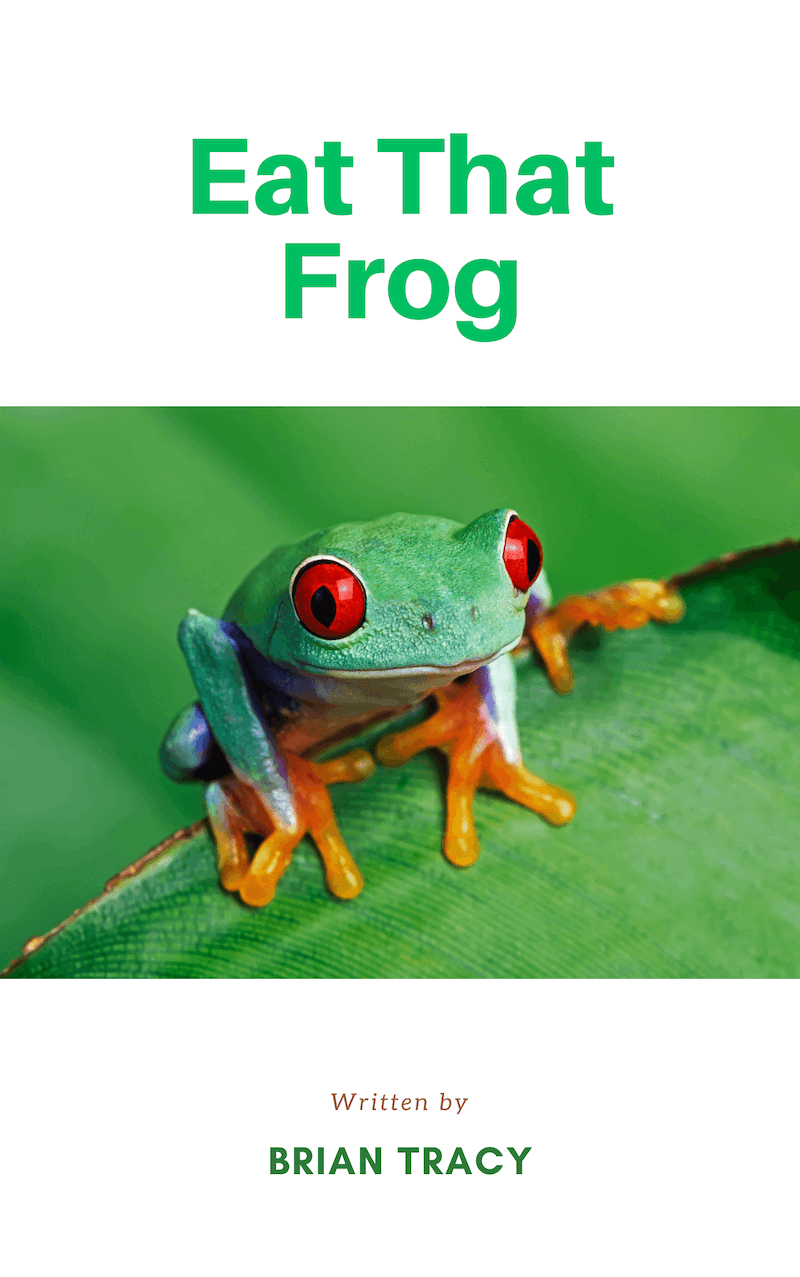
Eat That Frog Book Summary
This Eat That Frog Book Summary covers the key ideas, lessons, and takeaways in about 20 minutes.
When you’re planning out your day take the time to think about where your strengths and weaknesses are. Utilize your strengths and learn how to develop your weak points so that you can maximize your potential. Don’t be afraid to learn new things.
Procrastination is detrimental to productivity. The best way for you to tackle distractions is to get ahead of them. Create a clear plan for each day and assign the time you have to each task. Keep focused on your deadlines to make sure you’re accomplishing everything you want to accomplish.
Don’t be afraid to delegate unimportant tasks to someone else, or even remove them altogether. Tackle the most important items of your agenda first and you will increase your output exponentially.
Finally, stay focused and stay positive. Positivity is one of the biggest factors in generating high productivity. Instill yourself with some confidence and believe in your abilities to get things done. When you have a positive view of yourself, you will be at your most productive.
Helps with these goals
Want the complete 20-minute summary?
- Full structured summary
- Video Summary
- Podcast Summary
- Audio summary
- Key takeaways
- Exercises
- Quiz
- Highlights and notes
- Ask the book with AI
What is in the Eat That Frog book summary?
Below is a preview of Sumizeit’s expert-written summary of Eat That Frog by Bryan Tracy. The full summary covers the book’s key ideas in text, audio, and video.
Are you always rushing around but getting nothing done? Do you find that your to-do list keeps getting bigger? If the answer is yes then it sounds like you’re being overwhelmed by frogs.
Fortunately, these frogs are metaphorical. Frogs are the tasks that are too big or too hard to tackle easily and end up being pushed to the back of the line.
However, there is a way to make life easier and more productive. That is to handle these tasks first or to put it another way, by ‘eating the frog’. Learning how to ‘eat the frog’ will enable you to be more productive and get more out of your day without feeling overwhelmed.
Write down your daily goals.
It sounds pretty obvious but having a good plan reduces procrastination and increases your productivity. If you have a defined list of goals for the day, you are going to have a better chance of completing those tasks.
A simple but effective way to plan is to write out a list starting with the most important goals for the day. When you have something down in writing, you have something physical you can see and focus on.
The added benefit of writing goals down for the day is the ability to feel you accomplished something when you cross off each item on the list. Most people who do not write down their goals for the day rarely get them done, so they rarely feel accomplished.
Having a clear purpose outlined in writing will make you more determined and focused to complete tasks. When you see something you need to do written down, you’ll be more motivated. You’re holding yourself accountable to the goals that you’ve set. That makes you more effective.
Apply this planning process to your day, week, month, and beyond. Your commitment to accomplishing the goals you set for yourself should become a habit.
Prioritize tasks.
How do you prioritize your to-do lists? Do you put the easiest and less pressing tasks at the top of the list? This is a common strategy. Perhaps it feels like, by doing them first, you’ll have the rest of the day to concentrate on more important tasks. Or maybe you view the quickest tasks as a warm-up for the actual work?
The reality is that if you work this way you are more likely to fail in completing your important tasks. You’re not just warming up or getting distractions out of the way. You’re spending your limited time and energy on things that don’t matter as much. By leaving them until the end you risk running out of time.
However, if you prioritize properly, you can make sure all of the important matters are taken care of first. You’re giving your attention to the things that matter the most for getting the results you want. If you run out of time it won’t matter as much. The less important tasks can wait until another time.
To prioritize, you need a method…
Want the complete 20-minute summary?
- Full structured summary
- Video Summary
- Podcast Summary
- Audio summary
- Key takeaways
- Exercises
- Quiz
- Highlights and notes
- Ask the book with AI
Who should read Eat That Frog?
Eat That Frog is ideal for professionals, entrepreneurs, and anyone struggling with procrastination and overwhelm. If you constantly feel busy but unproductive, or if your to-do list seems to grow faster than you can complete it, this book offers practical strategies to reclaim your time and energy. It's especially valuable for those who want to maximize their output without burning out.
Why does Eat That Frog matter?
In today's distraction-filled world, the ability to focus on what truly matters has become increasingly rare and valuable. Bryan Tracy's framework cuts through the noise to help readers identify and complete their most important work first, directly impacting career success, personal goals, and overall life satisfaction. The strategies in this book are timeless yet urgently relevant as remote work, digital distractions, and endless notifications make focus harder than ever.
What are the key themes in Eat That Frog?
- Tackling difficult tasks first eliminates procrastination and builds momentum
- Prioritization based on impact multiplies productivity more than simply working harder
- Self-awareness about strengths and weaknesses is essential for effective time management
- Focus and single-tasking deliver better results than multitasking
- Positive mindset and self-belief directly influence ability to complete challenging work
- Time-blocking and deadline management force efficiency and prevent task creep
- Delegation and elimination of low-impact work free up energy for high-value activities
What are the key lessons from the Eat That Frog book summary?
The Frog Metaphor Reframes Procrastination
Difficult or important tasks are 'frogs' that we instinctively avoid. Accepting this reality and choosing to tackle them first transforms procrastination from a character flaw into a solvable problem.
Writing Goals Creates Accountability
Committing goals to paper, rather than keeping them mental, dramatically increases completion rates and provides measurable progress that boosts motivation.
The ABCDE Prioritization Method Clarifies What Matters
Categorizing tasks by importance (A, B, C) and delegability (D, E) removes ambiguity about where to focus energy and prevents low-value work from stealing time.
The 80/20 Principle Identifies High-Impact Work
Recognizing that 20% of your efforts typically generate 80% of results allows you to ruthlessly concentrate on the vital few tasks rather than spreading effort thin.
Knowing Your Weaknesses Is as Important as Leveraging Strengths
Self-awareness about limitations enables you to either develop weak areas strategically or recruit others to fill gaps, preventing weaknesses from becoming bottlenecks.
Breaking Large Projects Into Smaller Actions Reduces Intimidation
Decomposing overwhelming tasks into manageable sub-tasks makes them feel less daunting and builds confidence as you complete each increment.
Consequences Drive Priority Clarity
Asking 'What happens if I don't complete this?' reveals which tasks truly matter; if failure has no meaningful consequence, the task is likely removable.
Multitasking Destroys Focus and Quality
Contrary to popular belief, switching between tasks increases errors and reduces overall efficiency; single-tasking produces better results faster.
Sleep Is a Productivity Multiplier
Adequate rest directly impacts focus, decision-making, and sustained effort; neglecting sleep undermines all other productivity strategies.
Time Blocking Forces Realistic Planning
Assigning specific time blocks to each task prevents underestimating duration and helps you identify whether your plan is actually achievable before the day begins.
Artificial Deadlines Reduce Pressure Without Sacrificing Progress
Setting internal deadlines earlier than actual deadlines provides a buffer, maintains focus, and reduces stress while keeping you on track.
Positive Self-Belief Increases Willingness to Tackle Hard Tasks
Confidence and optimism aren't just feel-good concepts; they directly counteract the self-doubt that makes difficult work seem insurmountable.
Strategic Breaks Sustain Long-Term Productivity
Rest periods aren't lost time; they're essential for maintaining focus and output quality throughout the day and preventing burnout.
Delegation and Elimination Multiply Available Capacity
Removing or reassigning unimportant tasks isn't laziness; it's a critical strategy that frees your limited time and energy for truly high-value work.
Daily Planning Becomes a Habit That Compounds Over Time
Applying the planning process consistently across days, weeks, and months transforms productivity from sporadic bursts to sustainable, predictable output.
Visibility of Progress Sustains Motivation
Crossing items off a written list provides tangible proof of accomplishment that keeps motivation high and prevents the despair of invisible progress.
Want the complete 20-minute summary?
- Full structured summary
- Video Summary
- Podcast Summary
- Audio summary
- Key takeaways
- Exercises
- Quiz
- Highlights and notes
- Ask the book with AI
How can you apply ideas from Eat That Frog?
- Write a prioritized daily to-do list every morning, ranking tasks by importance rather than ease or urgency
- Use the ABCDE method to categorize your weekly workload and commit to completing all A-priority items before moving to B items
- Apply the 80/20 rule to identify your top two or three high-impact tasks each day and allocate your best hours to them
- Block specific time windows on your calendar for focused work on major projects, treating these blocks as non-negotiable meetings
- Set an internal deadline 24-48 hours before the actual deadline to reduce last-minute pressure while maintaining quality
- Conduct a weekly skills assessment to identify one weakness to develop and one task to delegate or eliminate
- Create a distraction-management plan that includes turning off notifications, closing unnecessary browser tabs, and scheduling social media breaks rather than constant checking
What common mistakes do readers make with Eat That Frog?
- Tackling easy or small tasks first to 'warm up,' which wastes peak energy and mental clarity on low-impact work
- Attempting to multitask on important work, which reduces focus and increases errors without saving meaningful time
- Failing to write goals down, relying on memory, which dramatically reduces completion rates and accountability
- Confusing busyness with productivity—staying constantly occupied with low-priority tasks while neglecting what truly matters
Sumizeit Exercises Apply what you've learned
Turn ideas from Eat That Frog into action with a short guided reflection: identify the biggest takeaway, connect it to your life, and commit to one step you can take in the next 24 hours.
What is the expert analysis of Eat That Frog?
Overview
Eat That Frog is a productivity and time-management classic authored by Brian Tracy, a prolific figure in personal and professional development. With over 70 books and extensive global speaking experience, Tracy distills decades of expertise into actionable advice aimed at overcoming procrastination and maximizing efficiency. The book’s significance lies in its clear, metaphor-driven approach that transforms the daunting task of managing overwhelming to-do lists into a manageable, prioritized system. Tracy’s reputation as a motivational speaker and consultant lends credibility to the practical strategies he presents, making this work a staple for those seeking structured self-improvement in productivity.
Core Thesis
The central insight of Eat That Frog is that productivity hinges on prioritizing and tackling the most important and challenging tasks first—metaphorically “eating the frog.” Tracy argues that by confronting these difficult or unpleasant tasks head-on, individuals can overcome procrastination, reduce overwhelm, and significantly increase their output. The book advocates for disciplined planning, clear goal-setting, focused execution, and mindful time management as essential components of a productive life. It emphasizes leveraging one’s strengths, systematically breaking down large projects, and maintaining a positive mindset to sustain momentum.
Strengths
- Clarity and Accessibility: Tracy’s use of the “frog” metaphor simplifies the complex issue of procrastination, making the concept memorable and actionable for a wide audience.
- Practical Frameworks: The book offers concrete methods such as the ABCDE prioritization technique and time-blocking strategies, which readers can immediately implement.
- Holistic Approach: Beyond task management, Tracy addresses psychological elements like self-awareness of strengths and weaknesses, and the importance of a positive outlook, integrating mindset with productivity.
- Emphasis on Accountability: Encouraging written goal-setting and self-imposed deadlines fosters personal responsibility, a key driver of sustained productivity.
- Broad Applicability: The principles apply across professional and personal contexts, making the book relevant for entrepreneurs, managers, students, and anyone seeking better time management.
Critiques & Counterarguments
- Oversimplification of Procrastination: While the metaphor is effective, the book tends to understate the psychological complexity of procrastination, which can be rooted in anxiety, perfectionism, or deeper cognitive-behavioral patterns that require more nuanced interventions than prioritization alone.
- Limited Engagement with Modern Work Realities: The book’s examples and advice may feel dated in the context of today’s digital distractions and multitasking demands, where task-switching and interruptions are pervasive and require adaptive strategies beyond time-blocking.
- Potential Neglect of Work-Life Balance: The relentless focus on productivity and “eating frogs” risks encouraging a work-centric mindset that may overlook the importance of rest, creativity, and unstructured time for sustainable well-being.
- Competing Research on Multitasking: Although Tracy advises against multitasking, some contemporary cognitive science research suggests that certain forms of task-switching can be efficient if managed skillfully, indicating that rigid single-task focus may not always be optimal.
- Alternative Productivity Paradigms: Schools of thought such as Agile methodologies or deep work theory propose iterative, flexible approaches to task management that contrast with Tracy’s more linear prioritization model, highlighting the need for customization based on individual work styles and environments.
Who Should Read This
Eat That Frog is ideal for professionals, entrepreneurs, students, and anyone struggling with procrastination or feeling overwhelmed by their workload. It suits readers who appreciate straightforward, actionable advice and are seeking to develop disciplined habits for prioritization and time management. Those new to productivity literature or looking for a motivational yet practical guide will find this book particularly valuable. However, readers interested in deeper psychological insights or contemporary, flexible productivity frameworks may need to supplement Tracy’s work with additional resources.
Frequently asked questions about the Eat That Frog book summary
What is Eat That Frog about?
Eat That Frog by Bryan Tracy is a productivity guide that teaches readers how to overcome procrastination by tackling their most important and challenging tasks first. The 'frog' is a metaphor for difficult tasks that people instinctively avoid, and Tracy provides practical frameworks like prioritization methods, time management techniques, and mindset strategies to help readers eat their frogs and accomplish their most meaningful work.
Who should read Eat That Frog?
Anyone struggling with procrastination, overwhelm, or feeling busy but unproductive will benefit from Eat That Frog. The book is especially valuable for professionals, entrepreneurs, students, and managers who want to maximize their output, eliminate distractions, and focus their limited time and energy on what truly matters.
What are the main takeaways from Eat That Frog?
The core takeaways include: prioritize tasks based on impact, not ease; write goals down to increase accountability; use methods like the ABCDE system and the 80/20 principle to focus on what matters; break overwhelming tasks into smaller pieces; manage time with specific blocks; eliminate or delegate low-value work; maintain focus by single-tasking; and cultivate a positive mindset. Together, these strategies transform how you work and what you accomplish.
What is the ABCDE method in Eat That Frog?
The ABCDE method is a prioritization system where A tasks are most important, B tasks are moderately important, and C tasks are minor. D tasks are delegable, and E tasks can be eliminated entirely. By categorizing your work this way, you ensure that high-impact work gets your best effort while low-value tasks don't consume your limited time and energy.
How does the 80/20 rule apply to productivity?
According to Tracy's use of the Pareto Principle, approximately 20% of your work generates 80% of your results. By identifying which tasks fall into that vital 20%, you can concentrate your effort there and dramatically multiply your output without working harder or longer.
Why does Eat That Frog emphasize doing hard tasks first?
Tackling your most difficult 'frog' first thing maximizes your mental clarity, energy, and willpower when they're at their peak. Once you complete the hardest task, everything else feels easier, momentum builds, and you gain confidence. Conversely, delaying hard tasks until later means you face them with depleted energy and cognitive resources.
Can I really increase productivity by sleeping more, according to Eat That Frog?
Yes. Tracy emphasizes that adequate sleep directly impacts focus, decision-making, and sustained effort. Without sufficient rest, even the best time-management and prioritization strategies fail because your mind and body lack the resources to execute. Sleep is not a luxury but a foundational requirement for high productivity.
About Sumizeit
Sumizeit is a profitable Scomy LLC company based in Miami, Florida. It has been helping readers learn from nonfiction books for 7 years with expert-written summaries in text, audio, podcast, and video.
Want the complete 20-minute summary?
- Full structured summary
- Video Summary
- Podcast Summary
- Audio summary
- Key takeaways
- Exercises
- Quiz
- Highlights and notes
- Ask the book with AI
Here's why readers love Sumizeit
Join thousands of learners getting smarter every day
"Great experience. Detailed summaries. Loved the gamification feature. Makes learning fun. Good customer service. I recommend Sumizeit to anyone. You'll learn a lot."
"I always felt busy but still wanting to keep up with the book discussion in my friend group. This was a great supplement to help me keep reading the books I find fun while keeping up with important books."
"I love this website. Instead of scrolling social media, I find myself learning a lot. I use it everyday. I recommend this app for anyone who is too busy and wants to get up to speed with their favorite books."
Eat That Frog Book Summary PDF
Looking for a Eat That Frog Book Summary PDF you can save and revisit offline? Our Eat That Frog Book Summary PDF captures the book’s core ideas in a clean, printable format — the key frameworks, takeaways, and structure without the fluff. Download the Eat That Frog Book Summary PDF when you want a reference you can annotate, share with your team, or review on the go. Get your Eat That Frog Book Summary PDF from the download page below.
Download Eat That Frog Book Summary PDFPeople also liked these summaries
Readers who explored Eat That Frog often enjoyed these titles next.


Want the complete 20-minute summary?
- Full structured summary
- Video Summary
- Podcast Summary
- Audio summary
- Key takeaways
- Exercises
- Quiz
- Highlights and notes
- Ask the book with AI
Featured Book Titles
Popular Book Summaries at sumizeit, leading book summary app