
Question 1 of 10


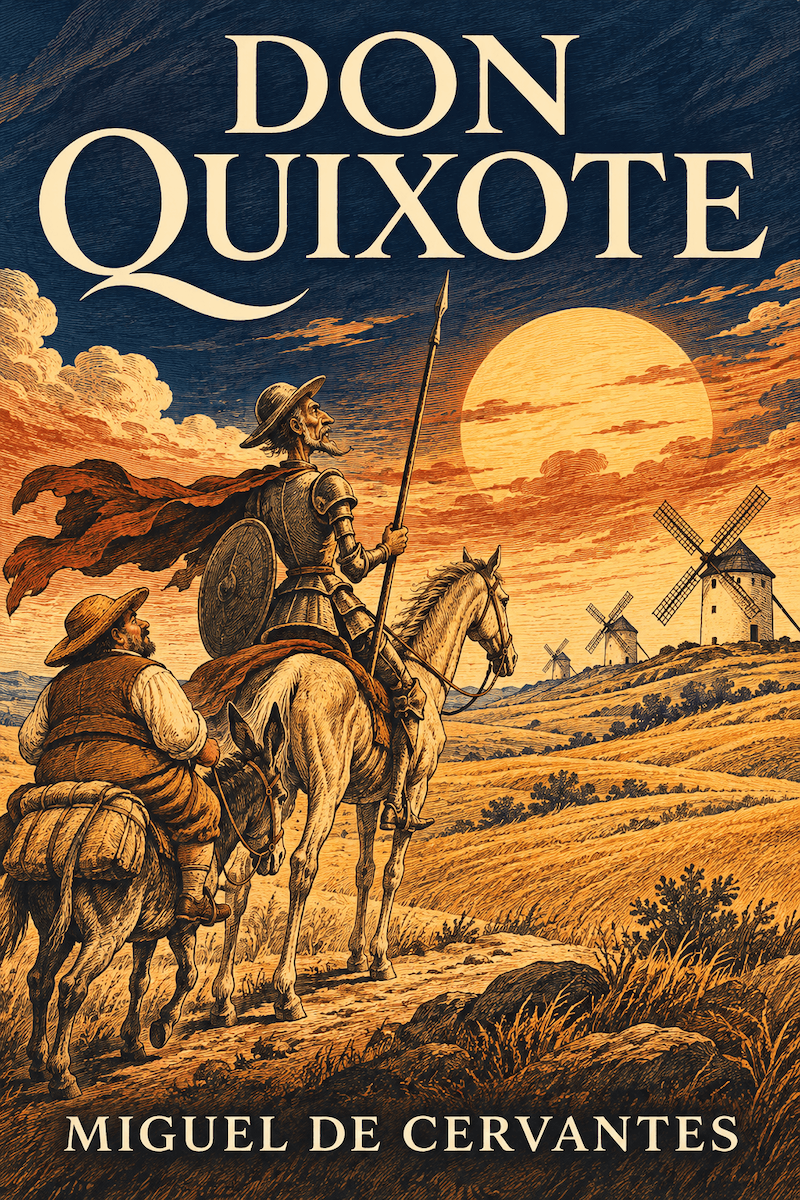
Prefer the print book? Buy on Amazon
As an Amazon Associate, Sumizeit earns from qualifying purchases.
Book Summary
Don Quixote Book Summary
This Don Quixote Book Summary covers the key ideas, lessons, and takeaways in about 20 minutes.
Short Description:
A madcap knight and his squire chase glory across Spain and learn what’s real.
Don Quixote is a book about the gap between what we imagine and what is true, and it refuses to say which one is better. Don Quixote is a fool who gets beaten again and again, yet his courage, his kindness, and his refusal to accept a dull world make him more admirable than almost everyone around him. Sancho is the realist, yet he is changed by his master's dreams, and by the end he is the one pleading for the dream to go on. Cervantes shows that people shape the world they live in through what they believe, and that a life lived with stubborn hope can be both ridiculous and deeply moving.
Helps with these goals
Preview the Don Quixote book summary
Below is a preview of Sumizeit’s comprehensive human-written summary of Don Quixote by Miguel de Cervantes. The full summary is 15-20 minutes long and covers the book’s key ideas in text, audio, visual, and video formats. Unlock the full 20 Minute Summary
Alonso Quixano lives in a village in La Mancha, in central Spain. He is about fifty, thin, a little poor, and he has one obsession. He reads tales of knights who ride around fighting giants, rescuing princesses, and winning fame. He reads them day and night, until his brain dries up and he loses his grip on what is real.
So he decides to become one of those knights. He digs up some rusty armor from his great grandfather and patches the broken helmet with cardboard. He names his bony old horse Rocinante, which roughly means "formerly a workhorse." He renames himself Don Quixote de la Mancha. And since every knight needs a lady to dedicate his deeds to, he picks a farm girl from a nearby village, a woman he barely knows, and calls her Dulcinea del Toboso. She has no idea any of this is happening.
The book is split into two parts, published ten years apart. Part One came out in 1605 and Part Two in 1615. Here is how the whole story goes.
Part One, the first sally
Don Quixote sneaks out alone one summer morning. He reaches an inn and decides it is a castle. He begs the innkeeper to knight him, and the innkeeper, who sees a lunatic but plays along, gives him a silly ceremony in the stable yard.
On the road home he stops a farmer from beating his young servant, Andrés. Don Quixote makes the farmer swear to pay the boy and rides off feeling heroic. The moment he leaves, the farmer beats the boy even harder. This is the first sign that Don Quixote's good intentions can make things worse.
He then attacks a group of merchants for refusing to declare that Dulcinea is the most beautiful woman alive. A mule driver breaks his lance and beats him senseless. A neighbor finds him lying in the road and carries him home.
The burning of the books
While Don Quixote recovers, his niece, his housekeeper, the village priest, and the barber decide the books are to blame. They go through his library one by one. Most of the chivalry novels go out the window to be burned. A few get spared because the priest thinks they are well written. Then they wall up the library room and tell Don Quixote an enchanter carried it off.
This scene matters because it shows the book making fun of its own genre while clearly loving it. The priest and the barber are also not villains. They are neighbors who care about him, which makes the whole thing sadder and funnier at once.
Sancho Panza joins the road
Don Quixote talks a local farmer named Sancho Panza into becoming his squire. He promises Sancho he will one day rule an island. Sancho is short, round, practical, and a little greedy, and he believes the promise because he wants to. He rides a donkey called Dapple.
The two make a perfect pair.
Want the complete 20-minute summary?
- Full structured summary
- Video Summary
- Podcast Summary
- Audio summary
- Key takeaways
- Exercises
- Quiz
- Highlights and notes
- Ask the book with AI
Who should read Don Quixote?
Don Quixote by Miguel de Cervantes appeals to readers who love exploring the tension between idealism and reality, as well as anyone curious about literature's most influential novel. It speaks to those interested in character-driven stories, philosophical fiction, and how belief shapes our lives. Whether you're a student of classics or someone seeking a profound meditation on hope, madness, and human dignity, this novel offers layers of meaning that reward both casual reading and deep analysis.
Why does Don Quixote matter?
Don Quixote is widely considered the first modern novel and remains one of the most important books ever written, influencing centuries of literature, art, and thought. Its exploration of how imagination collides with reality speaks directly to how we construct meaning in our own lives and the gap between who we wish to be and who we are. Published in 1605, it still resonates because it asks timeless questions about the value of idealism in a cynical world, the price of self-delusion, and whether a life lived with stubborn hope matters even when it ends in failure.
What are the key themes in Don Quixote?
- Imagination versus reality and the power of belief to shape experience
- The tension between idealism and pragmatism
- Madness and sanity as matters of perspective rather than absolute truth
- The redemptive power of hope and courage despite repeated failure
- How literature and stories influence how we see the world
- The dignity found in pursuing a meaningful life, however foolish it may appear
- The transformation that occurs when opposing worldviews collide
How can you apply ideas from Don Quixote?
- Examine your own beliefs and assumptions to understand how they filter your perception of events and shape your interpretation of reality
- Consider the gap between your intentions and actual outcomes when making decisions that affect others; good intentions do not guarantee good results
- Develop the humility to listen to people who see the world differently than you do, as they may catch what your perspective misses
- Build relationships across differences rather than only with those who think as you do; diverse viewpoints create growth
- Reflect on what stories and books have shaped your worldview and whether you have questioned their accuracy or limitations
- Commit genuinely to your principles and word, even when facing defeat or embarrassment; integrity matters more than winning
- Balance idealism with practical wisdom rather than choosing one over the other completely
What common mistakes do readers make with Don Quixote?
- Reading Don Quixote as a simple satire of chivalry novels when it is actually a complex meditation on the value of imagination and hope
- Viewing Don Quixote as merely a fool rather than recognizing that his idealism and courage make him admirable despite his failures
- Missing the transformation in Sancho, focusing only on Don Quixote's delusions while overlooking how the squire changes through the journey
- Treating the novel's comedy and philosophy as separate rather than understanding that Cervantes uses humor to explore profound truths about belief and reality
- Assuming the book takes the side of either idealism or pragmatism when its genius lies in showing both positions have merit and limitation
Sumizeit Exercises Apply what you've learned
Turn ideas from Don Quixote into action with a short guided reflection: identify the biggest takeaway, connect it to your life, and commit to one step you can take in the next 24 hours.
What is the expert analysis of Don Quixote?
Overview
Don Quixote, authored by Miguel de Cervantes, stands as a monumental work in Western literature and is often hailed as the first modern novel. Published in two parts (1605 and 1615), it chronicles the adventures of Alonso Quixano, a middle-aged man who, consumed by chivalric romances, transforms into the errant knight Don Quixote de la Mancha. Cervantes, a Spanish soldier and writer with a tumultuous life marked by captivity and hardship, crafted a narrative that simultaneously parodies and pays homage to the chivalric tradition. The novel’s significance lies not only in its narrative innovation and rich characterizations but also in its profound exploration of reality, illusion, and the human condition.
Core Thesis
The central insight of Don Quixote revolves around the tension between imagination and reality. Cervantes probes the consequences of living according to idealized, often outdated, conceptions of the world versus embracing pragmatic realism. Don Quixote’s quixotic quest embodies the nobility and folly of idealism, while Sancho Panza’s grounded pragmatism offers a counterbalance. The narrative refuses to privilege either perspective unequivocally, instead illustrating how belief shapes experience and how dreams and disillusionments coexist in human life. Ultimately, the novel meditates on the transformative power of stories and the complex interplay between perception and truth.
Strengths
- Innovative Narrative Structure: Cervantes’ use of metafiction, especially in Part Two where characters are aware of their literary fame, anticipates postmodern techniques and deepens the novel’s thematic complexity.
- Rich Character Dynamics: The interplay between Don Quixote and Sancho Panza provides a nuanced exploration of contrasting worldviews, friendship, and mutual influence, making their relationship timeless and universally resonant.
- Genre Deconstruction: The novel simultaneously parodies and venerates chivalric romances, using humor and irony to critique social norms and literary conventions without dismissing their cultural value.
- Philosophical Ambiguity: Cervantes resists simplistic moralizing, instead presenting a layered meditation on idealism, madness, justice, and the human need for meaning, which invites ongoing interpretation.
- Cultural and Historical Insight: The text subtly incorporates contemporary Spanish social issues, such as the expulsion of the Moriscos, enriching the narrative with historical depth and social critique.
Critiques & Counterarguments
- Potential Oversimplification of Idealism vs. Realism: While the novel masterfully explores this dichotomy, some critics argue that the characters can sometimes feel emblematic rather than fully fleshed individuals, reducing the complexity of their philosophical positions.
- Historical and Cultural Distance: Modern readers may find certain social contexts, such as the treatment of Moors or gender roles, dated or problematic, which complicates straightforward admiration of the text without critical contextualization.
- Competing Literary Traditions: Later realist and existentialist literature often critiques the romantic idealism that Don Quixote embodies, emphasizing the harshness and absurdity of existence without the redemptive quality of hope that Cervantes offers.
- Question of Madness: Some psychological readings suggest Don Quixote’s delusions represent mental illness rather than noble idealism, challenging the romanticized interpretation of his character and inviting a more clinical perspective.
- Reception of Metafictional Elements: The self-referential aspects, while innovative, can be disorienting or alienating for readers expecting a straightforward narrative, and some may view them as undermining the story’s emotional engagement.
Who Should Read This
Don Quixote is essential reading for those interested in the foundations of the modern novel, literary innovation, and the philosophical exploration of reality and illusion. Scholars and readers fascinated by the interplay of narrative form and thematic depth will find Cervantes’ work endlessly rewarding. Additionally, those engaged with cultural history, psychology, and the evolution of storytelling will appreciate its layered complexity. The novel appeals to a sophisticated audience that values both intellectual challenge and rich, enduring human drama, making it a cornerstone for anyone seeking to understand the literary and cultural heritage of the Western canon.
Discussion questions for Don Quixote Short questions you can actually use in a conversation
Frequently asked questions about the Don Quixote book summary
What is Don Quixote about?
Don Quixote by Miguel de Cervantes follows a middle-aged man who reads so many chivalry novels that he loses his grip on reality and decides to become a knight errant himself. He renames himself Don Quixote, sets out on adventures with a squire named Sancho Panza, and repeatedly encounters reality that contradicts his romantic delusions—attacking windmills he mistakes for giants, freeing prisoners he thinks are unjustly held, and pursuing a farm girl he has renamed Dulcinea as his lady love. The novel explores the tension between imagination and reality, showing how belief shapes experience and what value idealism holds in a practical world.
Who should read Don Quixote?
Don Quixote appeals to readers interested in classic literature, philosophy, and the human condition, as well as anyone curious about how we construct meaning through imagination and belief. It resonates with those who appreciate character-driven stories with humor and depth, students exploring the origins of the modern novel, and people drawn to meditations on hope, madness, and dignity. Whether you enjoy epic adventures, complex relationships, or explorations of how stories shape our lives, this novel offers something valuable across different reading preferences and life experiences.
What are the main takeaways from Don Quixote?
Don Quixote teaches that the gap between imagination and reality is not simply a measure of madness but a fundamental aspect of how we live and find meaning. The novel shows that idealism and hope matter despite repeated failure, that people shape the world through their beliefs, and that dignity comes from commitment to principles rather than success. It demonstrates how opposing worldviews—Don Quixote's dreams and Sancho's practicality—can transform each other, and ultimately suggests that a life lived with stubborn conviction, however foolish it appears, is more admirable than a safe existence without purpose.
Is Don Quixote a tragedy or a comedy?
Don Quixote is both, which is part of its genius—Cervantes uses comedy and humor to explore genuinely tragic themes about self-delusion, the clash between idealism and reality, and the human desire for meaning. The book makes readers laugh at Don Quixote's absurd failures while simultaneously deepening their admiration for his courage and refusal to accept a dull world. The ending is particularly tragic, as Don Quixote recovers his sanity only to die, yet the sadness is mixed with the recognition that something precious—his hope and imagination—died before his body did.
How does Don Quixote change throughout the novel?
Don Quixote does not fundamentally abandon his beliefs until the very end when he recovers his sanity on his deathbed, but he gradually learns practical wisdom from Sancho and becomes more aware of the real consequences of his actions. More significantly, Sancho changes dramatically—he begins as a skeptic focused on material reward but gradually adopts his master's idealism, eventually begging Don Quixote not to abandon knighthood. The greatest change happens in how they perceive each other: Sancho moves from seeing his master as mad to recognizing his dignity, while Don Quixote learns to listen and value Sancho's common sense without entirely surrendering his vision.
What is the significance of Dulcinea in Don Quixote?
Dulcinea represents the power of imagination and belief to create reality; she is a farm girl Don Quixote barely knows and transforms into his ideal lady through pure conviction. When Sancho later lies and points to peasant girls, claiming one is Dulcinea under a spell, the invented deception becomes the driving force of much of Part Two. Dulcinea exists primarily as an idea, an ideal that Don Quixote dedicates his actions to, showing that imagined things can be as powerful as real ones in shaping how we live and what we believe we must do.
Why is Don Quixote considered the first modern novel?
Don Quixote is often called the first modern novel because it broke with literary traditions of its time by creating complex, psychologically realistic characters who grow and change, focusing on internal experience and perspective rather than just external plot. Cervantes invented the technique of the narrator stepping into and out of the story, making readers aware they are reading a constructed narrative, and he explored how interpretation and belief shape reality in ways that influenced all fiction that followed. The novel's self-awareness—characters discussing how they were portrayed in the book about themselves—was revolutionary and remains central to modern literature's exploration of how stories work.
About Sumizeit
Sumizeit is a profitable Scomy LLC company based in Miami, Florida. Our founders, Clemens Raemy and Weina Scott, are successful entrepreneurs with several exits. Sumizeit is a popular book summary app / micro learning app used by busy professionals and entrepreneurs with over 2,500 non-fiction book summaries and 10,000 podcast summaries in text, audio, visual, podcast, and video format. We also have stellar retention tools to make ideas stick - such as flashcards with spaced repetition, quizzes, streaks, highlighting and notes, daily challenges, riddles, mini-courses, meditation, and more. You won't only learn the idea, but also remember it. Over 90% of our users change their habits with Sumizeit.
Upgrade Now
Here's why readers love Sumizeit
Join thousands of learners getting smarter every day
"Great experience. Detailed summaries. Loved the gamification feature. Makes learning fun. Good customer service. I recommend Sumizeit to anyone. You'll learn a lot."
"I always felt busy but still wanting to keep up with the book discussion in my friend group. This was a great supplement to help me keep reading the books I find fun while keeping up with important books."
"I love this website. Instead of scrolling social media, I find myself learning a lot. I use it everyday. I recommend this app for anyone who is too busy and wants to get up to speed with their favorite books."
Don Quixote Book Summary PDF
Looking for a Don Quixote Book Summary PDF you can save and revisit offline? Our Don Quixote Book Summary PDF captures the book’s core ideas in a clean, printable format — the key frameworks, takeaways, and structure without the fluff. Download the Don Quixote Book Summary PDF when you want a reference you can annotate, share with your team, or review on the go. Get your Don Quixote Book Summary PDF from the download page below.
Download Don Quixote Book Summary PDFPeople also liked these summaries
Readers who explored Don Quixote often enjoyed these titles next.

Ready to read the whole thing?
- Full structured summary
- Video Summary
- Podcast Summary
- Audio summary
- Key takeaways
- Exercises
- Quiz
- Highlights and notes
- Ask the book with AI
Featured Book Titles
Popular Book Summaries at sumizeit, leading book summary app
Atomic Habits Book Summary Rich Dad Poor Dad Book Summary The Four Agreements Book Summary The 48 Laws of Power Book Summary When Breath Becomes Air Book Summary Think and Grow Rich Book Summary