


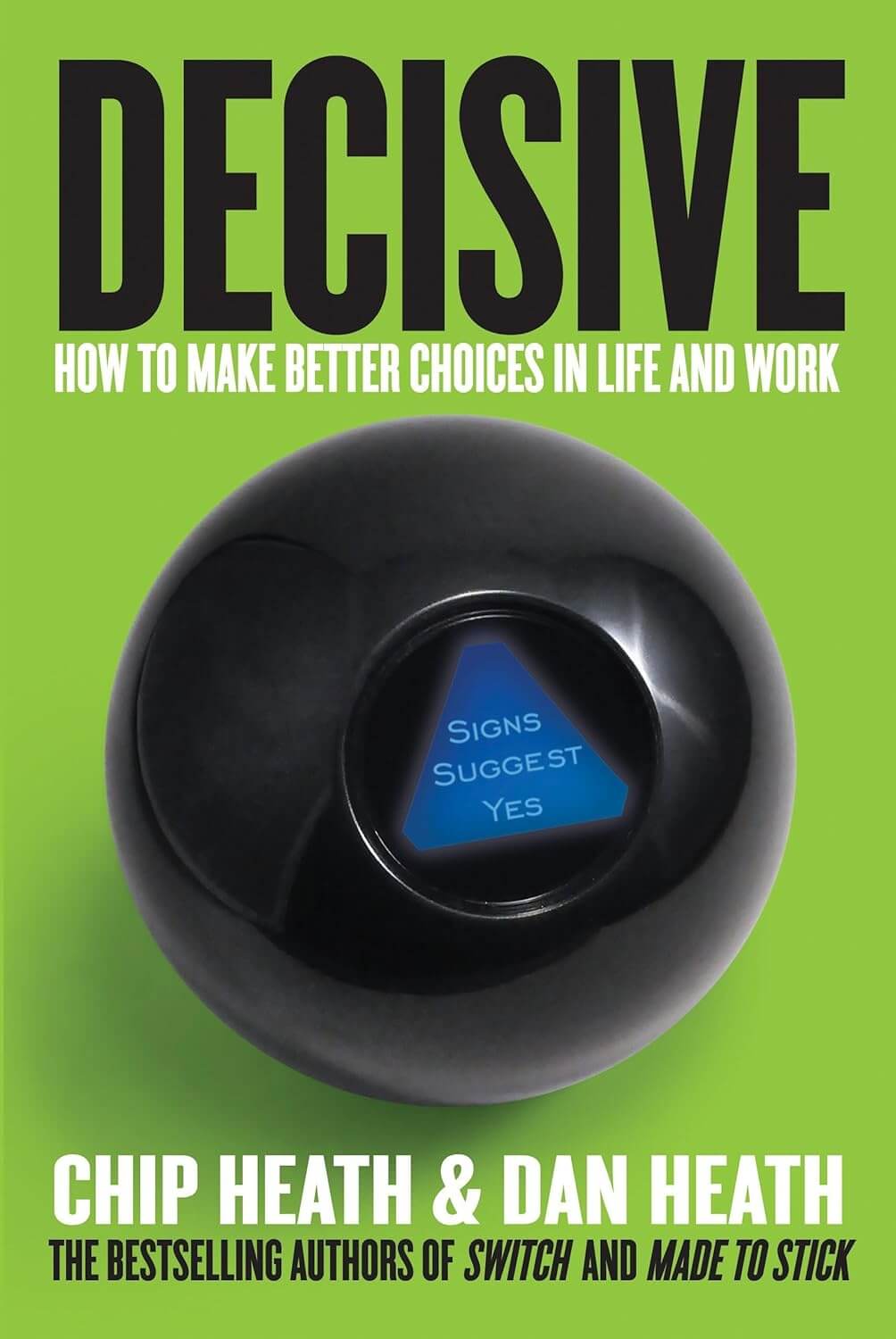
Prefer the print book? Buy on Amazon
As an Amazon Associate, Sumizeit earns from qualifying purchases.
Decisive Book Summary
This Decisive Book Summary covers the key ideas, lessons, and takeaways in about 20 minutes.
Short Description:
Decisive teaches structured processes improve flawed human judgment.
However, we are not helpless. By adopting a structured decision-making process, we can consistently make better choices—even in complex, uncertain situations. The key is not to trust ourselves more, but to trust a process that compensates for our weaknesses.
The four-step framework—expanding options, testing assumptions, gaining emotional distance, and preparing for uncertainty—serves as a practical checklist for navigating life’s toughest decisions. It does not guarantee success, but it dramatically improves the odds.
Ultimately, Decisive teaches that wisdom is not about having perfect foresight. It is about designing decisions that are resilient, thoughtful, and adaptable. When we stop asking, “What’s the right choice?” and start asking, “What’s the right process?” we transform decision-making from a source of stress into a skill that can be learned and improved.
Helps with these goals
Want the complete 20-minute summary?
- Full structured summary
- Video Summary
- Podcast Summary
- Audio summary
- Key takeaways
- Exercises
- Quiz
- Highlights and notes
- Ask the book with AI
Want a Free Weekly Read?
Get a free summary every week straight to your mailbox.
Preview the Decisive book summary
Below is a preview of Sumizeit’s comprehensive human-written summary of Decisive by Chip Heath. The full summary is 15-20 minutes long and covers the book’s key ideas in text, audio, visual, and video formats. Unlock the full 20 Minute Summary
Every major turning point in life—choosing a career path, starting or ending a relationship, moving cities, launching a business—rests on a decision. We tend to assume that important choices deserve deep thought and careful analysis, yet many of our most consequential decisions are shaped by invisible mental traps. In Decisive, Chip Heath (with his brother Dan Heath) argues that the problem is not a lack of intelligence or motivation. Instead, it’s the way the human mind naturally approaches decisions.
The Heaths contend that people don’t fail at decision-making because they don’t care enough. They fail because their thinking is predictably distorted. We fall into patterns that feel reasonable but consistently lead us astray. Rather than trusting instinct or hoping experience alone will make us wiser, Decisive offers a structured method designed to counteract these distortions. The book is grounded in behavioral psychology, real-world examples, and practical tools that can be applied to decisions both personal and professional.
At its core, Decisive reframes decision-making as a process problem, not a character flaw. If we rely on the same flawed mental habits, we will repeat the same mistakes. But if we use a deliberate framework that anticipates those flaws, we can dramatically improve the quality of our choices—even when outcomes remain uncertain.
The Central Problem: Decisions Are Hijacked by Bias
Most people believe they make decisions logically. We identify options, weigh pros and cons, and select the best alternative. On the surface, this seems sensible. The Heaths argue, however, that this neat picture ignores a deeper truth: our reasoning is compromised at every stage by cognitive biases.
These biases do not announce themselves. They feel like common sense. They whisper reassuring stories that justify what we already want to do. As a result, even well-intentioned people systematically narrow their options, misjudge evidence, cling to comfort, and overestimate their ability to predict the future.
The authors organize these distortions into four recurring decision-making failures. Each one shows up at a different stage of the decision process, quietly undermining our judgment.
The First Trap: Narrow Framing
One of the most damaging habits in decision-making is the tendency to see choices as binaries. We frame decisions as either/or questions instead of exploring a broader landscape of possibilities. Should I stay or leave? Accept the job or decline it? Buy the house or walk away?
This limited framing feels efficient, but it is deeply misleading. By reducing a complex situation to two opposing options, we eliminate creativity before it has a chance to emerge. We assume that the best choice must already be on the table, even though the most effective solution often lies outside the initial framing.
Binary thinking persists because it simplifies complexity. The brain prefers clarity over ambiguity, even when that clarity is false. Faced with uncertainty, we gravitate toward clean contrasts rather than messy possibilities. Unfortunately, this shortcut can trap us into choosing between two mediocre options while overlooking better alternatives entirely.
The Heaths emphasize that many great decisions are not…
Want the complete 20-minute summary?
- Full structured summary
- Video Summary
- Podcast Summary
- Audio summary
- Key takeaways
- Exercises
- Quiz
- Highlights and notes
- Ask the book with AI
Who should read Decisive?
Decisive is for anyone facing major life choices—career transitions, relationship decisions, business launches, or significant life changes. If you've ever made a decision you later regretted or felt uncertain about your reasoning, this book offers practical tools to improve your decision-making process regardless of your intelligence or experience level.
Why does Decisive matter?
In an age of information overload and endless options, our natural decision-making instincts fail us in predictable ways. Chip Heath demonstrates that poor decisions aren't caused by lack of effort but by invisible cognitive biases that derail our thinking at every stage. Learning to recognize and counteract these biases is essential for making better choices in your career, relationships, and life direction.
What are the key themes in Decisive?
- Cognitive biases distort decision-making in predictable patterns
- Process matters more than intuition or willpower
- Expanding options prevents narrow, limiting thinking
- Evidence and reality-testing overcome confirmation bias
- Emotional distance improves long-term decision quality
- Preparing for uncertainty reduces overconfidence
- Decisions are ongoing processes, not one-time events
Want the complete 20-minute summary?
- Full structured summary
- Video Summary
- Podcast Summary
- Audio summary
- Key takeaways
- Exercises
- Quiz
- Highlights and notes
- Ask the book with AI
How can you apply ideas from Decisive?
- Use the WRAP framework (Widen options, Reality-test assumptions, Attain distance, Prepare for being wrong) as a checklist for major decisions
- Generate at least three distinct alternatives before committing to any significant choice, even if you're already confident about one option
- Actively seek evidence against your preferred option by asking 'Why might this fail?' rather than 'Why might this work?'
- Apply the 10/10/10 technique by asking how you'll feel about a decision in ten minutes, ten months, and ten years to reduce short-term emotional bias
- Create contingency plans and safety margins for important decisions to prepare for uncertainty and surprise outcomes
- Consult others who've faced similar decisions to expand your sense of available options beyond what you'd generate alone
- Set up early warning systems or reassessment deadlines to catch problems early and treat decisions as ongoing processes rather than one-time events
- Use base rates and historical data to anchor expectations rather than relying on optimistic gut feelings about unique outcomes
What common mistakes do readers make with Decisive?
- Viewing decisions as binary choices when multiple alternatives exist, eliminating creativity before exploring possibilities
- Seeking information that confirms what you already believe while dismissing warning signs that contradict your preference
- Allowing temporary emotions to dominate decisions with long-term consequences because the present feels more real than the future
- Assuming that because a decision feels right, it will unfold as planned, leading to inadequate preparation for what actually happens
Sumizeit Exercises Apply what you've learned
Turn ideas from Decisive into action with a short guided reflection: identify the biggest takeaway, connect it to your life, and commit to one step you can take in the next 24 hours.
What is the expert analysis of Decisive?
Overview
Decisive, authored by Chip Heath in collaboration with his brother Dan Heath, stands as a seminal work in the intersection of behavioral psychology and practical decision-making. Chip Heath, a Stanford Graduate School of Business professor, brings academic rigor and accessible prose to the exploration of why humans consistently falter in making optimal choices. The book’s significance lies in its reframing of decision-making not as a matter of intelligence or motivation but as a process vulnerable to predictable cognitive biases. By offering a structured, research-backed framework, Decisive bridges scholarly insights and everyday applicability, appealing to both personal and professional contexts.
Core Thesis
The central argument of Decisive is that flawed decision-making stems from systematic cognitive distortions rather than individual failings of will or intellect. The Heath brothers identify four primary mental traps—narrow framing, confirmation bias, short-term emotional influence, and overconfidence—that hijack our reasoning at various stages. The book’s core insight is that awareness of these biases is insufficient; instead, a deliberate, four-step decision-making process is required to counteract them. This process—expanding options, testing assumptions, gaining emotional distance, and preparing for uncertainty—transforms decision-making from an intuitive gamble into a disciplined, adaptive skill.
Strengths
- Integration of Behavioral Science and Practical Tools: The Heaths adeptly translate complex psychological research into actionable strategies, making the science of decision-making accessible without oversimplification.
- Clear Identification of Cognitive Traps: By categorizing common biases into four distinct traps, the book provides a memorable and systematic way to diagnose and address decision errors.
- Balanced Emphasis on Process Over Outcome: The focus on designing a resilient decision process rather than seeking perfect choices offers a refreshing, realistic approach that reduces the emotional burden of decision-making.
- Use of Real-World Examples and Experiments: Illustrations from diverse domains ground the theoretical framework in lived experience, enhancing reader engagement and comprehension.
- Recognition of Contextual and Structural Factors: The acknowledgment that social and economic conditions influence decision quality adds nuance beyond individual responsibility, opening avenues for systemic improvement.
Critiques & Counterarguments
- Potential Oversimplification of Complex Decisions: While the four-step framework is elegant, real-world decisions often involve multifaceted variables and competing stakeholders that may resist neat categorization or procedural fixes.
- Evidence Scope and Depth: Although grounded in behavioral psychology, some critics might argue that the book relies heavily on illustrative anecdotes and secondary research rather than original empirical studies, which could limit the robustness of its prescriptions.
- Underestimation of Emotional Intelligence: The book advocates distancing from immediate emotions but may underplay the constructive role emotions can play in nuanced judgment and moral reasoning, as emphasized in affective neuroscience and decision theory.
- Competing Schools of Thought: Alternative decision-making models, such as naturalistic decision-making and intuition-based approaches championed by scholars like Gary Klein, suggest that in certain complex, time-pressured environments, heuristics and experience-driven intuition outperform structured frameworks.
- Challenges in Implementation: The prescribed framework assumes a level of cognitive bandwidth and time that may not be available in high-stakes or rapid decision contexts, potentially limiting its practical utility for some readers.
Who Should Read This
Decisive is ideally suited for professionals, leaders, and individuals who regularly face complex decisions and seek to improve their judgment through evidence-based methods. It appeals to those interested in behavioral economics, psychology, and self-improvement, offering a pragmatic toolkit to counteract common mental pitfalls. Additionally, readers who appreciate a synthesis of academic research with real-world application will find this book valuable. However, those looking for quick-fix solutions or purely intuitive decision strategies might find the structured approach demanding but ultimately rewarding.
Frequently asked questions about the Decisive book summary
What is Decisive about?
Decisive by Chip Heath explains how cognitive biases derail decision-making in predictable ways and offers a practical four-step framework to counteract them. The book argues that most people don't fail at decisions because of lack of intelligence but because their thinking is systematically distorted by narrow framing, confirmation bias, emotional short-termism, and overconfidence about the future.
Who should read Decisive?
Decisive is for anyone facing major life or professional decisions—whether choosing a career path, starting a business, ending a relationship, or relocating. If you've ever regretted a decision or felt uncertain about your reasoning, this book provides practical tools to improve your decision-making process regardless of experience level.
What are the main takeaways from Decisive?
The core message of Decisive is that better decisions come from better processes, not better intuition. The book's four-step WRAP framework—Widen options, Reality-test assumptions, Attain distance from emotion, and Prepare for being wrong—provides a structured checklist for navigating complex choices. By systematically counteracting cognitive biases, you can make more thoughtful, resilient decisions even when outcomes remain uncertain.
What is the WRAP framework in Decisive?
WRAP is a four-step decision-making process that directly counters cognitive biases. It stands for Widen your options to overcome narrow framing, Reality-test your assumptions to fight confirmation bias, Attain distance from immediate emotions to reduce short-term bias, and Prepare for being wrong to combat overconfidence. Following this framework systematically improves decision quality across personal and professional contexts.
How does Decisive address overconfidence?
Decisive teaches that people routinely underestimate uncertainty and overestimate their ability to predict outcomes. The book counters this by recommending contingency plans, safety margins, and early warning systems that prepare you for multiple possible futures. Instead of betting on accuracy, you build resilience by assuming your predictions will be imperfect and planning accordingly.
How does confirmation bias affect decision-making according to Decisive?
Chip Heath explains that once you lean toward a particular option, your mind acts like a defense attorney seeking evidence for your preference rather than a judge weighing evidence fairly. Decisive counters this by recommending you actively seek disconfirming information, consult base rates and historical data, and run small experiments to test assumptions against reality rather than relying on selective evidence.
What is the 10/10/10 technique mentioned in Decisive?
The 10/10/10 approach helps reduce short-term emotional bias by asking how you'll feel about a decision in ten minutes, ten months, and ten years. This temporal expansion reveals which emotions are temporary versus which consequences are lasting, helping you make choices aligned with your long-term values rather than present comfort or anxiety.
Can Decisive help with everyday decisions or just major life choices?
While Decisive focuses on major decisions like career changes or relationship commitments, the WRAP framework and principles apply to decisions of any scale. Whether choosing a business strategy, deciding whether to stay in a job, or navigating a significant relationship question, the bias-fighting process improves decision quality across all contexts.
About Sumizeit
Sumizeit is a profitable Scomy LLC company based in Miami, Florida. Our founders, Clemens Raemy and Weina Scott, are successful entrepreneurs with several exits. Sumizeit is a popular book summary app / micro learning app used by busy professionals and entrepreneurs with over 2,500 non-fiction book summaries and 10,000 podcast summaries in text, audio, visual, podcast, and video format. We also have stellar retention tools to make ideas stick - such as flashcards with spaced repetition, quizzes, streaks, highlighting and notes, daily challenges, riddles, mini-courses, meditation, and more. You won't only learn the idea, but also remember it. Over 90% of our users change their habits with Sumizeit.
Upgrade Now
Want the complete 20-minute summary?
- Full structured summary
- Video Summary
- Podcast Summary
- Audio summary
- Key takeaways
- Exercises
- Quiz
- Highlights and notes
- Ask the book with AI
Here's why readers love Sumizeit
Join thousands of learners getting smarter every day
"Great experience. Detailed summaries. Loved the gamification feature. Makes learning fun. Good customer service. I recommend Sumizeit to anyone. You'll learn a lot."
"I always felt busy but still wanting to keep up with the book discussion in my friend group. This was a great supplement to help me keep reading the books I find fun while keeping up with important books."
"I love this website. Instead of scrolling social media, I find myself learning a lot. I use it everyday. I recommend this app for anyone who is too busy and wants to get up to speed with their favorite books."
Decisive Book Summary PDF
Looking for a Decisive Book Summary PDF you can save and revisit offline? Our Decisive Book Summary PDF captures the book’s core ideas in a clean, printable format — the key frameworks, takeaways, and structure without the fluff. Download the Decisive Book Summary PDF when you want a reference you can annotate, share with your team, or review on the go. Get your Decisive Book Summary PDF from the download page below.
Download Decisive Book Summary PDFPeople also liked these summaries
Readers who explored Decisive often enjoyed these titles next.


Want the complete 20-minute summary?
- Full structured summary
- Video Summary
- Podcast Summary
- Audio summary
- Key takeaways
- Exercises
- Quiz
- Highlights and notes
- Ask the book with AI
Featured Book Titles
Popular Book Summaries at sumizeit, leading book summary app