


Prefer the print book? Buy on Amazon
As an Amazon Associate, Sumizeit earns from qualifying purchases.
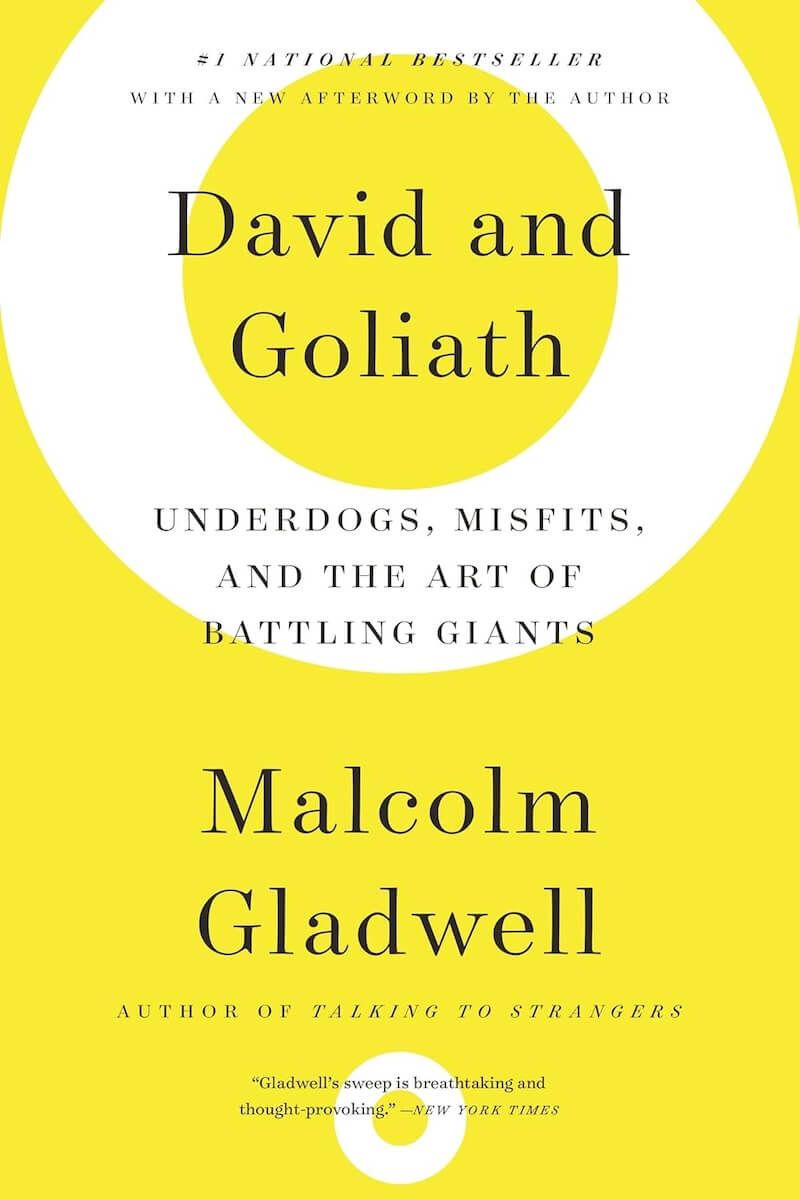
David and Goliath Book Summary
This David and Goliath Book Summary covers the key ideas, lessons, and takeaways in about 20 minutes.
Helps with these goals
Want the complete 20-minute summary?
- Full structured summary
- Video Summary
- Podcast Summary
- Audio summary
- Key takeaways
- Exercises
- Quiz
- Highlights and notes
- Ask the book with AI
Not ready to upgrade?
Get this summary + 2 more picks sent to your inbox, free.
What is in the David and Goliath book summary?
Below is a preview of Sumizeit’s expert-written summary of David and Goliath by Malcolm Gladwell. The full summary covers the book’s key ideas in text, audio, and video.
In David and Goliath: Underdogs, Misfits, and the Art of Battling Giants, Malcolm Gladwell turns one of history’s most famous stories into a lens for examining human struggle, resilience, and power. The familiar tale of a young shepherd defeating a warrior giant is often viewed as a miracle—a symbol of divine intervention or luck. Gladwell reinterprets it as a study in perception and psychology. David’s victory, he argues, was no fluke: it was a logical outcome of mismatched expectations and misunderstood strength. Using this narrative as a framework, Gladwell investigates how underdogs—those burdened with disadvantages, disabilities, or lack of resources—consistently find creative ways to triumph over overwhelming odds. His conclusion is radical yet inspiring: weakness can be a source of power, and advantage, when taken for granted, can easily become a trap.
The Real David and Goliath: Science, Strategy, and Misconception
The book begins by stripping away the mythology of David’s battle. Goliath, a heavily armored warrior standing over nine feet tall, appeared unbeatable. Yet his size, caused by acromegaly, likely came with impaired vision and sluggishness—his greatest assets were also his greatest liabilities. David, a nimble shepherd, declined Saul’s armor and sword, relying instead on his sling—a weapon as deadly as a modern firearm. Ancient slingers were elite marksmen capable of striking birds in flight from hundreds of feet away. The stone David fired would have hit Goliath’s exposed forehead with the velocity of a bullet, shattering bone and rendering the giant helpless.
This reinterpretation reframes the story entirely. David’s success came not from luck or faith alone, but from tactical insight—he changed the rules of engagement. He refused to fight like a giant, and that decision transformed the outcome. Gladwell uses this as a metaphor: the powerful often assume battles will be fought on their terms, while the underdog wins by reimagining what the game even is.
How Underdogs Rewrite the Rules
Gladwell weaves modern and historical examples to show that “Davids” have always used ingenuity and defiance to overcome “Goliaths.” During World War I, T.E. Lawrence led a small Arab force against the Ottoman Empire’s massive army. Knowing he couldn’t win a conventional war, Lawrence adopted guerrilla tactics—swift attacks on railways, surprise ambushes, and desert maneuvers that exhausted his opponents. His strategy mirrored David’s: refuse to meet the giant on its own terms.
In another striking example, Gladwell recounts Vivek Ranadivé’s improbable journey as an underdog basketball coach. An Indian-born software engineer unfamiliar with the sport, he coached his daughter’s team of undersized, inexperienced players to the U.S. national championships. Ranadivé used a full-court press defense, forcing constant pressure and chaos. Traditional coaches mocked his approach, yet it worked because he broke from convention. Gladwell uses Ranadivé’s story to illustrate a broader truth: underdogs succeed not because they are lucky, but because they work harder, think differently, and break rules others assume are sacred.
He also cites the Viet Minh during the First Indochina War. French generals, relying on superior firepower and rigid…
Want the complete 20-minute summary?
- Full structured summary
- Video Summary
- Podcast Summary
- Audio summary
- Key takeaways
- Exercises
- Quiz
- Highlights and notes
- Ask the book with AI
Who should read David and Goliath ?
David and Goliath is for anyone who feels disadvantaged, underestimated, or stuck in an unfavorable situation—whether in business, education, relationships, or personal growth. It's equally valuable for leaders, parents, and managers who want to understand how to build resilient teams and recognize hidden strengths in unconventional places. If you've ever wondered why underdogs sometimes win or whether your weaknesses might actually be assets, this book speaks directly to you.
Why does David and Goliath matter?
In a world obsessed with size, scale, and traditional measures of power, Malcolm Gladwell's David and Goliath offers a radically different perspective: that disadvantage can be a source of strength, and that the rules we assume are fixed can be rewritten. The book challenges the myth that success requires elite credentials, abundant resources, or perfect conditions—a message increasingly relevant as economies shift, disruption accelerates, and unconventional thinkers reshape industries. Understanding how to think like David in a Goliath-dominated world is essential for anyone seeking innovation, resilience, or meaningful change.
What are the key themes in David and Goliath ?
- Reframing weakness as a source of hidden strength
- How underdogs succeed by changing the rules of engagement
- The inverted U-curve: when advantage becomes a disadvantage
- The power of moral authority and legitimacy over force
- Desirable difficulties and how adversity builds resilience
- Context and psychology matter more than raw ability
- Courage born from survival and confronting fear
Want the complete 20-minute summary?
- Full structured summary
- Video Summary
- Podcast Summary
- Audio summary
- Key takeaways
- Exercises
- Quiz
- Highlights and notes
- Ask the book with AI
How can you apply ideas from David and Goliath ?
- Reassess your supposed weaknesses in work or education—identify how they might contain hidden strengths or unique perspectives others lack
- When facing a more powerful competitor or obstacle, ask: What are the unspoken rules I'm expected to follow, and which can I break to change the game?
- If managing or parenting privileged individuals, deliberately introduce meaningful challenges and scarcity to build resilience and empathy
- Build organizational legitimacy through voice, predictability, and fairness rather than relying on hierarchy or coercion alone
- Choose environments and peer groups where you can be a 'big fish in a small pond' rather than constantly comparing yourself to the absolute best—context shapes confidence
- When designing strategy or policy, account for how the powerful often underestimate unconventional approaches and how legitimate grievances breed defiance
- Model courage visibly in your leadership; surviving and moving forward from setbacks gives others permission to be brave
What common mistakes do readers make with David and Goliath ?
- Assuming that prestigious credentials, wealth, or size automatically confer advantage—these can actually create complacency, entitlement, and poor decision-making
- Fighting the powerful on their terms instead of reimagining the game entirely; underdogs win by changing the rules, not by becoming better at the existing game
- Relying on force, hierarchy, or coercion to enforce decisions without building legitimacy through fairness, voice, and predictability
- Believing that elite institutions guarantee success; context and relative confidence often matter more than absolute prestige or credentials
Sumizeit Exercises Apply what you've learned
Turn ideas from David and Goliath into action with a short guided reflection: identify the biggest takeaway, connect it to your life, and commit to one step you can take in the next 24 hours.
What is the expert analysis of David and Goliath ?
Overview
David and Goliath by Malcolm Gladwell is a compelling reinterpretation of one of history’s most iconic narratives, transforming the biblical tale into a profound exploration of human resilience, strategy, and the paradoxes of power. Gladwell, a celebrated journalist and author known for his ability to weave storytelling with social science, challenges conventional wisdom about advantage and disadvantage. This book stands out in the landscape of popular non-fiction for its interdisciplinary approach, drawing on psychology, history, and sociology to argue that perceived weaknesses can be powerful assets when leveraged creatively.
Core Thesis
Gladwell’s central argument is that what society typically views as disadvantages—whether physical limitations, lack of resources, or social marginalization—can become unexpected sources of strength. By refusing to engage on the dominant party’s terms, underdogs rewrite the rules of competition and often prevail. The book posits that advantages can become traps, breeding complacency and rigidity, while adversity fosters innovation, grit, and moral courage. This thesis reframes success as a function of context, mindset, and strategic adaptation rather than sheer power or resources.
Strengths
- Innovative Reframing: Gladwell’s reinterpretation of the David and Goliath story as a metaphor for strategic asymmetry is both original and intellectually stimulating, encouraging readers to question assumptions about strength and weakness.
- Rich, Diverse Examples: The book’s strength lies in its eclectic use of historical and contemporary case studies—from T.E. Lawrence’s guerrilla tactics to dyslexic entrepreneurs—making abstract concepts tangible and relatable.
- Accessible yet Thought-Provoking: Gladwell’s narrative style balances scholarly insight with engaging storytelling, making complex psychological and sociological ideas accessible to a broad audience without sacrificing depth.
- Interdisciplinary Insight: By integrating research on “desirable difficulties,” legitimacy in authority, and moral communities, the book offers a nuanced understanding of how adversity shapes character and social dynamics.
- Emphasis on Moral and Psychological Dimensions: The exploration of forgiveness, moral courage, and “productive disagreeableness” adds a profound ethical layer, elevating the discussion beyond mere strategy or success metrics.
Critiques & Counterarguments
- Selective Use of Evidence: Gladwell’s tendency to cherry-pick compelling anecdotes risks oversimplifying complex phenomena. The narrative sometimes prioritizes storytelling over rigorous empirical validation, which can lead to confirmation bias.
- Overgeneralization of “Desirable Difficulties”: While adversity can foster resilience, research also shows that excessive hardship often impairs development and opportunity, suggesting a more nuanced, context-dependent relationship than Gladwell implies.
- Neglect of Structural Factors: The book emphasizes individual agency and mindset but underplays systemic barriers such as institutional racism, economic inequality, and social capital that can limit the underdog’s capacity to “rewrite the rules.”
- Competing Research on Advantage: Contrary to the inverted U-curve thesis, some studies highlight that sustained access to resources and elite environments can catalyze exceptional achievement, especially when combined with supportive mentorship and networks.
- Real-World Contradictions: The romanticization of underdog success stories may obscure the harsh reality that many disadvantaged individuals do not overcome their circumstances, pointing to survivorship bias in Gladwell’s examples.
Who Should Read This
David and Goliath is ideal for readers interested in psychology, leadership, and social dynamics who appreciate a fresh perspective on adversity and success. It appeals to entrepreneurs, educators, activists, and anyone fascinated by the interplay between power and resilience. Those seeking inspiration to challenge conventional wisdom or to understand how marginalized individuals and groups can leverage their unique strengths will find this book particularly rewarding. However, readers looking for a rigorous academic treatise or comprehensive policy analysis may need to supplement Gladwell’s narrative with more critical, data-driven works.
Frequently asked questions about the David and Goliath book summary
What is David and Goliath about?
David and Goliath by Malcolm Gladwell reinterprets the biblical story as a lesson in how underdogs win by changing the rules of engagement, then uses modern examples to show that weakness can be a source of strength, advantage can become a trap, and unconventional thinkers often defeat the powerful.
Who should read David and Goliath?
Anyone facing disadvantage, seeking to innovate, or leading teams should read this book. It speaks to entrepreneurs, students, parents, managers, and anyone who feels underestimated or wants to understand how to build resilience and think unconventionally in competitive situations.
What are the main takeaways from David and Goliath?
The main takeaways are: apparent advantages often contain hidden liabilities; underdogs succeed by refusing to play by conventional rules; desirable difficulties forge extraordinary skills; excessive privilege can undermine resilience; and moral authority matters more than raw power. Success belongs to those who adapt, believe differently, and fight on their own terms.
How does Gladwell explain David's victory as more than luck?
Gladwell argues David won through tactical insight, not miracle or chance. Goliath's enormous size caused vision impairment and sluggishness, while David was a skilled slinger—a weapon-master whose stone projectile matched modern firearm velocity. David changed the rules of engagement rather than fighting on Goliath's terms.
What does the inverted U-curve explain?
The inverted U-curve shows that too much of a good thing—wealth, prestige, intelligence—eventually becomes a disadvantage. A little advantage provides opportunity; excessive advantage breeds entitlement, complacency, and poor judgment. Moderate advantage is often optimal.
What is 'desirable difficulty' and why does it matter?
Desirable difficulty refers to hardships—like dyslexia, poverty, or trauma—that force people to develop unconventional skills and resilience. About one-third of successful entrepreneurs have learning disabilities. Adversity creates grit, creativity, and resourcefulness that privilege and comfort cannot teach.
What does Gladwell say about legitimacy and power?
Gladwell argues that power without legitimacy breeds resistance and failure. True authority requires three pillars: voice (people feel heard), predictability (rules are consistent), and fairness (power is not arbitrary). Coercion alone—whether in policing or law—actually increases defiance and crime.
Why does the story of Le Chambon matter in David and Goliath?
Le Chambon-sur-Lignon, a French village that sheltered 5,000 Jews during WWII, demonstrates that moral communities united by shared conviction can defy tyranny. Gladwell shows that ordinary people with strong collective purpose can perform extraordinary acts of resistance against even the most powerful oppression.
About Sumizeit
Sumizeit is a profitable Scomy LLC company based in Miami, Florida. It has been helping readers learn from nonfiction books for 7 years with expert-written summaries in text, audio, podcast, and video.
Want the complete 20-minute summary?
- Full structured summary
- Video Summary
- Podcast Summary
- Audio summary
- Key takeaways
- Exercises
- Quiz
- Highlights and notes
- Ask the book with AI
Here's why readers love Sumizeit
Join thousands of learners getting smarter every day
"Great experience. Detailed summaries. Loved the gamification feature. Makes learning fun. Good customer service. I recommend Sumizeit to anyone. You'll learn a lot."
"I always felt busy but still wanting to keep up with the book discussion in my friend group. This was a great supplement to help me keep reading the books I find fun while keeping up with important books."
"I love this website. Instead of scrolling social media, I find myself learning a lot. I use it everyday. I recommend this app for anyone who is too busy and wants to get up to speed with their favorite books."
David and Goliath Book Summary PDF
Looking for a David and Goliath Book Summary PDF you can save and revisit offline? Our David and Goliath Book Summary PDF captures the book’s core ideas in a clean, printable format — the key frameworks, takeaways, and structure without the fluff. Download the David and Goliath Book Summary PDF when you want a reference you can annotate, share with your team, or review on the go. Get your David and Goliath Book Summary PDF from the download page below.
Download David and Goliath Book Summary PDFPeople also liked these summaries
Readers who explored David and Goliath often enjoyed these titles next.




Want the complete 20-minute summary?
- Full structured summary
- Video Summary
- Podcast Summary
- Audio summary
- Key takeaways
- Exercises
- Quiz
- Highlights and notes
- Ask the book with AI
Featured Book Titles
Popular Book Summaries at sumizeit, leading book summary app