


Prefer the print book? Buy on Amazon
As an Amazon Associate, Sumizeit earns from qualifying purchases.
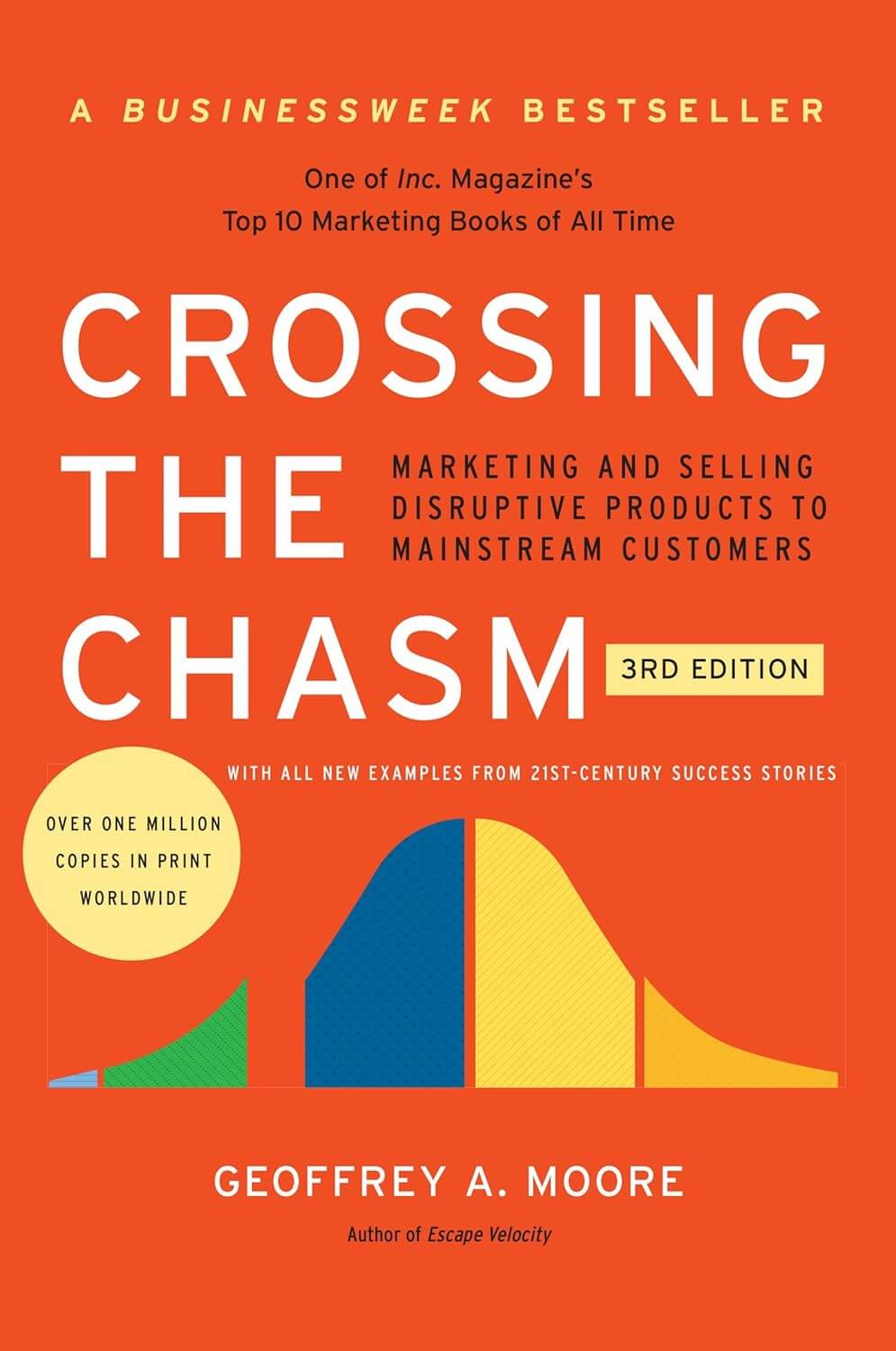
Crossing the Chasm Book Summary
This Crossing the Chasm Book Summary covers the key ideas, lessons, and takeaways in about 20 minutes.
Short Description:
Crossing the Chasm shows startups must focus on niche markets to succeed.
Helps with these goals
Preview the Crossing the Chasm book summary
Below is a preview of Sumizeit’s comprehensive human-written summary of Crossing the Chasm by Geoffrey A. Moore. The full summary is 15-20 minutes long and covers the book’s key ideas in text, audio, visual, and video formats. Unlock the full 20 Minute Summary
Geoffrey A. Moore’s Crossing the Chasm is a strategic roadmap for technology companies attempting to turn early enthusiasm into widespread commercial adoption. The book explores why many breakthrough innovations experience explosive excitement in the beginning but fail to sustain growth once they move beyond early adopters. Moore highlights that between the pioneering customer base and the mainstream market lies a dangerous gap often large enough to collapse promising ventures. His core premise is that achieving success depends on recognizing how expectations, motivations, and buying behavior differ dramatically across customer segments and adjusting strategy accordingly.
Moore explains that new technologies almost always follow a recognizable adoption pattern, known as the Technology Adoption Life Cycle. While this model is widely accepted across the business world, he argues that it contains a subtle but critical discontinuity: the transition point between early adopters and the early majority. Many businesses mistakenly assume that enthusiasm will naturally expand outward from innovators to the bulk of the market, but the early majority holds entirely different priorities. If a company treats them the same way, momentum stalls, sales slow, and investor confidence evaporates. The book is a guide for bridging this gulf deliberately rather than relying on luck.
Examining the Technology Adoption Life Cycle
Moore’s narrative begins with a breakdown of the five consumer groups that adopt new technology in sequential waves. Each group possesses a unique relationship with innovation, defined by their tolerance for risk and expectations of value.
The first group is the Innovators, individuals who passionately pursue emerging technology for its own sake. They relish experimentation, accept imperfections, and derive satisfaction purely from novelty. They are small in number but essential because they validate technical feasibility and offer constructive feedback.
Next come the Early Adopters, who share the excitement for originality but focus their attention on strategic advantage rather than experimentation. These buyers are visionaries who believe new technology can create dramatic business breakthroughs. They are willing to tolerate flaws and uncertainty if it means outperforming competitors.
After them come the Early Majority, the largest group and the most influential for commercial scale. These pragmatic customers will only invest once a solution has been proven reliable and established in their industry. They look for proven results, recognizable references, and comprehensive solutions—not experimental prototypes.
After this group is the Late Majority, made up of skeptics who adopt innovations only when not adopting becomes painful. They prefer stability and are uncomfortable with change.
Finally there are Laggards, who resist new technology entirely and may never adopt it.
Moore emphasizes that the biggest challenge lies between the early adopters and the early majority—a sharp discontinuity he calls the Chasm. While the first two groups tolerate risk and incompleteness, the early majority demands predictable outcomes and reliable infrastructure. They expect the product to function without heroics, customization, or trial-and-error integration. Their expectations cannot be met through the same strategies used to attract early adopters.
Want the complete 20-minute summary?
- Full structured summary
- Video Summary
- Podcast Summary
- Audio summary
- Key takeaways
- Exercises
- Quiz
- Highlights and notes
- Ask the book with AI
Who should read Crossing the Chasm?
Crossing the Chasm is essential for technology entrepreneurs, product managers, and marketing leaders who have built innovative products but struggle to gain mainstream market acceptance. If you're frustrated by early success that hasn't translated into sustainable growth, or if you're preparing to scale beyond your initial enthusiast customer base, this book provides a strategic framework for understanding why and how to overcome the critical barrier between early adopters and mainstream buyers.
Why does Crossing the Chasm matter?
Most breakthrough technologies fail not because they lack innovation, but because companies misunderstand how different customer segments evaluate and adopt new solutions. In today's competitive tech landscape, understanding the fundamental gap between visionary early adopters and pragmatic mainstream buyers is the difference between scaling successfully and watching promising products stall. Geoffrey A. Moore's framework has become the industry standard for go-to-market strategy, helping companies avoid the costly mistake of treating all customers the same way.
What are the key themes in Crossing the Chasm?
- The Technology Adoption Life Cycle and the critical discontinuity between early adopters and the early majority
- Why breakthrough products fail to achieve mainstream adoption despite initial success
- The importance of niche market focus and building a beachhead before broader expansion
- Understanding pragmatist buyer psychology and what drives their purchasing decisions
- Building the whole product as a complete solution rather than just core technology
- Positioning and messaging strategies that resonate with mainstream rather than visionary customers
- Organizational transformation required to serve pragmatist expectations
- Strategic partnerships and alliances as essential components of crossing the chasm
How can you apply ideas from Crossing the Chasm?
- Define your target beachhead market with precision before pursuing broader expansion, and allocate all resources toward dominating that segment completely
- Audit your whole product across all four layers (generic, expected, augmented, potential) and identify which components must be built or partnered to meet pragmatist expectations
- Develop case studies and quantifiable proof points from your early adopter segment to create the references pragmatists require for adoption decisions
- Restructure positioning and messaging to focus on industry-specific problems, proven results, and risk mitigation rather than technological innovation and visionary breakthroughs
- Evaluate and establish strategic partnerships that fill critical gaps in your whole product offering rather than attempting to build every component internally
- Shift your sales approach from visionary storytelling to consultative selling that demonstrates understanding of pragmatist buyer concerns and industry-specific needs
- Align organizational structure, compensation, and team composition to reward pragmatist-focused outcomes like repeatability and customer success rather than innovation velocity
What common mistakes do readers make with Crossing the Chasm?
- Assuming that early enthusiasm and success automatically extends to mainstream markets without deliberate strategy and positioning changes
- Attempting to appeal to broad market segments simultaneously rather than concentrating force on a single well-defined niche with urgent needs
- Continuing to use early-adopter messaging focused on innovation potential when pragmatists demand proof, industry references, and complete solutions
- Pricing too aggressively or discounting to gain pragmatist customers, which signals immaturity and weakness rather than market leadership and reliability
- Treating the whole product as merely the core technology instead of building comprehensive support, integration, and industry-specific components that pragmatists expect
Sumizeit Exercises Apply what you've learned
Turn ideas from Crossing the Chasm into action with a short guided reflection: identify the biggest takeaway, connect it to your life, and commit to one step you can take in the next 24 hours.
What is the expert analysis of Crossing the Chasm?
Overview
Crossing the Chasm, authored by Geoffrey A. Moore, stands as a seminal work in the field of technology marketing and innovation adoption. Moore, a seasoned business strategist with deep expertise in high-tech market dynamics, crafts a nuanced framework that addresses a critical inflection point in the commercialization of disruptive technologies. The book’s significance lies in its articulation of the “chasm” — a conceptual and practical gap that many innovative products fail to bridge when transitioning from early adopters to the mainstream market. This work has become a foundational text for entrepreneurs, marketers, and executives aiming to scale technological innovations beyond niche enthusiasts to broad-based commercial success.
Core Thesis
Moore’s central argument is that the Technology Adoption Life Cycle, while widely accepted, contains a crucial discontinuity between early adopters and the early majority — the “chasm.” Early adopters are visionaries who embrace innovation for strategic advantage despite imperfections, whereas the early majority are pragmatic buyers who demand proven, reliable, and fully integrated solutions. The failure to recognize and strategically address the distinct motivations and expectations of these groups leads to stalled growth and market failure. Success requires focused targeting of a narrow market niche, development of a “whole product” solution that meets pragmatist standards, and alignment of marketing, sales, and organizational structures to these realities.
Strengths
- Insightful Segmentation: Moore’s detailed breakdown of customer groups and their distinct buying behaviors provides a powerful lens for understanding market dynamics beyond simplistic adoption curves.
- Practical Framework: The book offers actionable strategies, such as niche targeting and whole product development, that translate theory into concrete steps for companies navigating complex markets.
- Emphasis on Market Realities: By highlighting the pragmatist’s demand for references, reliability, and integration, Moore grounds innovation adoption in real-world buyer psychology rather than idealized enthusiasm.
- Organizational Implications: The recognition that crossing the chasm requires internal cultural and structural transformation adds depth, acknowledging that market success is as much about company evolution as product features.
- Enduring Relevance: Despite rapid technological change, the core principles remain applicable across diverse technology sectors and stages of innovation diffusion.
Critiques & Counterarguments
- Oversimplification of Buyer Categories: The rigid segmentation into five discrete adopter groups may obscure the fluidity and overlap in real-world customer behavior, where pragmatism and visionary traits can coexist or shift over time.
- Limited Empirical Validation: While widely influential, Moore’s chasm model is largely based on anecdotal and case-study evidence rather than systematic quantitative research, inviting questions about its universal applicability.
- Neglect of Network Effects and Ecosystems: The framework underemphasizes the role of network externalities and platform dynamics, which in many modern technologies (e.g., social media, software platforms) can accelerate adoption in ways that bypass traditional chasm constraints.
- Alternative Theories of Adoption: Competing models, such as Everett Rogers’ Diffusion of Innovations theory, offer more granular insights into social systems and communication channels that influence adoption, suggesting Moore’s focus on pragmatists may be too narrow.
- Changing Market Contexts: The rise of agile development, freemium models, and continuous deployment challenge the notion that a fully “whole product” must be delivered upfront, as many successful companies now iterate rapidly with early majority involvement.
Who Should Read This
Crossing the Chasm is essential reading for entrepreneurs, product managers, and executives in technology-driven industries who seek to understand and overcome the critical hurdles of mainstream market adoption. It is particularly valuable for those involved in early-stage startups aiming to transition from niche markets to broader commercial success. Additionally, strategists and marketers looking to deepen their grasp of customer segmentation, positioning, and organizational alignment will find Moore’s insights both practical and profound. While its lessons are most directly applicable to high-tech sectors, the book’s principles resonate with any innovation-driven enterprise confronting the challenge of scaling adoption beyond early enthusiasts.
Frequently asked questions about the Crossing the Chasm book summary
What is Crossing the Chasm about?
Crossing the Chasm by Geoffrey A. Moore is a strategic guide explaining why many breakthrough technologies fail to achieve mainstream adoption despite early success. The book reveals that a critical gap—the Chasm—exists between early adopters and the pragmatic mainstream market, and provides a framework for bridging that gap through focused niche targeting, whole product development, and strategic positioning tailored to pragmatist buyer expectations.
Who should read Crossing the Chasm?
Technology entrepreneurs, product managers, marketing leaders, and executives at startups or established companies seeking to scale innovations should read this book. It is essential for anyone leading a product or company that has achieved early traction but struggles to gain mainstream market acceptance, or for those preparing a go-to-market strategy for disruptive technology.
What are the main takeaways from Crossing the Chasm?
The main takeaways are: (1) a critical discontinuity exists between early adopters and the early majority that requires fundamentally different strategies; (2) companies must concentrate resources on dominating a single niche market rather than pursuing broad appeal; (3) pragmatist buyers demand complete whole products with proven results, industry references, and comprehensive support; (4) positioning and messaging must shift from innovation emphasis to practicality and measurable outcomes; and (5) organizational structure, sales approach, and product development must align with pragmatist expectations rather than early-adopter preferences.
What is the Technology Adoption Life Cycle and why does it matter?
The Technology Adoption Life Cycle describes five sequential customer segments: Innovators, Early Adopters, Early Majority, Late Majority, and Laggards. It matters because Moore reveals a critical discontinuity between Early Adopters and the Early Majority—the Chasm—where customer expectations, buying behavior, and risk tolerance differ so dramatically that strategies effective with early adopters actively repel pragmatists, causing many promising products to stall before reaching mainstream success.
What is the whole product and why is it critical?
The whole product encompasses everything required for a buyer to achieve the promised outcome, comprising four layers: generic product (core offering), expected product (minimal supporting components), augmented product (customization and complementary services), and potential product (future improvements). It is critical because pragmatists will not adopt incomplete solutions requiring improvisation; they expect vendors to deliver finished systems that address every barrier preventing success.
How do you select a target beachhead market?
Select a beachhead market by identifying a group with an urgent problem that your solution directly addresses, clear and realistic expectations about your product's capabilities, and genuine willingness to adopt if a complete solution is available. The goal is finding a contained segment where you can dominate, build satisfied customer references, and establish credibility that later expands to adjacent markets—following a military invasion strategy of concentrated force at one strategic point rather than scattered assault.
What is the difference between early adopters and pragmatists?
Early Adopters are visionaries who tolerate risk, incompleteness, and customization in pursuit of competitive advantage, and they evaluate solutions based on innovation potential and breakthrough possibilities. Pragmatists are methodical buyers who demand proven reliability, industry references, complete solutions with comprehensive support, and measurable return on investment; they prioritize risk mitigation and proven performance over innovation. These differences in values and buying behavior create the Chasm between the two segments.
How does positioning change when crossing from early adopters to pragmatists?
Positioning for early adopters emphasizes breakthrough potential, technological superiority, and visionary benefits that create competitive advantage. Positioning for pragmatists shifts to focus on proven performance, industry-specific solutions, risk mitigation, return on investment, and established market presence. Effective pragmatist positioning addresses five elements: category clarity, target customer identification, critical problem solved, competitive differentiation, and proof of vendor staying power.
About Sumizeit
Sumizeit is a profitable Scomy LLC company based in Miami, Florida. Our founders, Clemens Raemy and Weina Scott, are successful entrepreneurs with several exits. Sumizeit is a popular book summary app / micro learning app used by busy professionals and entrepreneurs with over 2,500 non-fiction book summaries and 10,000 podcast summaries in text, audio, visual, podcast, and video format. We also have stellar retention tools to make ideas stick - such as flashcards with spaced repetition, quizzes, streaks, highlighting and notes, daily challenges, riddles, mini-courses, meditation, and more. You won't only learn the idea, but also remember it. Over 90% of our users change their habits with Sumizeit.
Upgrade Now
Here's why readers love Sumizeit
Join thousands of learners getting smarter every day
"Great experience. Detailed summaries. Loved the gamification feature. Makes learning fun. Good customer service. I recommend Sumizeit to anyone. You'll learn a lot."
"I always felt busy but still wanting to keep up with the book discussion in my friend group. This was a great supplement to help me keep reading the books I find fun while keeping up with important books."
"I love this website. Instead of scrolling social media, I find myself learning a lot. I use it everyday. I recommend this app for anyone who is too busy and wants to get up to speed with their favorite books."
Crossing the Chasm Book Summary PDF
Looking for a Crossing the Chasm Book Summary PDF you can save and revisit offline? Our Crossing the Chasm Book Summary PDF captures the book’s core ideas in a clean, printable format — the key frameworks, takeaways, and structure without the fluff. Download the Crossing the Chasm Book Summary PDF when you want a reference you can annotate, share with your team, or review on the go. Get your Crossing the Chasm Book Summary PDF from the download page below.
Download Crossing the Chasm Book Summary PDFPeople also liked these summaries
Readers who explored Crossing the Chasm often enjoyed these titles next.




Ready to read the whole thing?
- Full structured summary
- Video Summary
- Podcast Summary
- Audio summary
- Key takeaways
- Exercises
- Quiz
- Highlights and notes
- Ask the book with AI
Featured Book Titles
Popular Book Summaries at sumizeit, leading book summary app