


Prefer the print book? Buy on Amazon
As an Amazon Associate, Sumizeit earns from qualifying purchases.
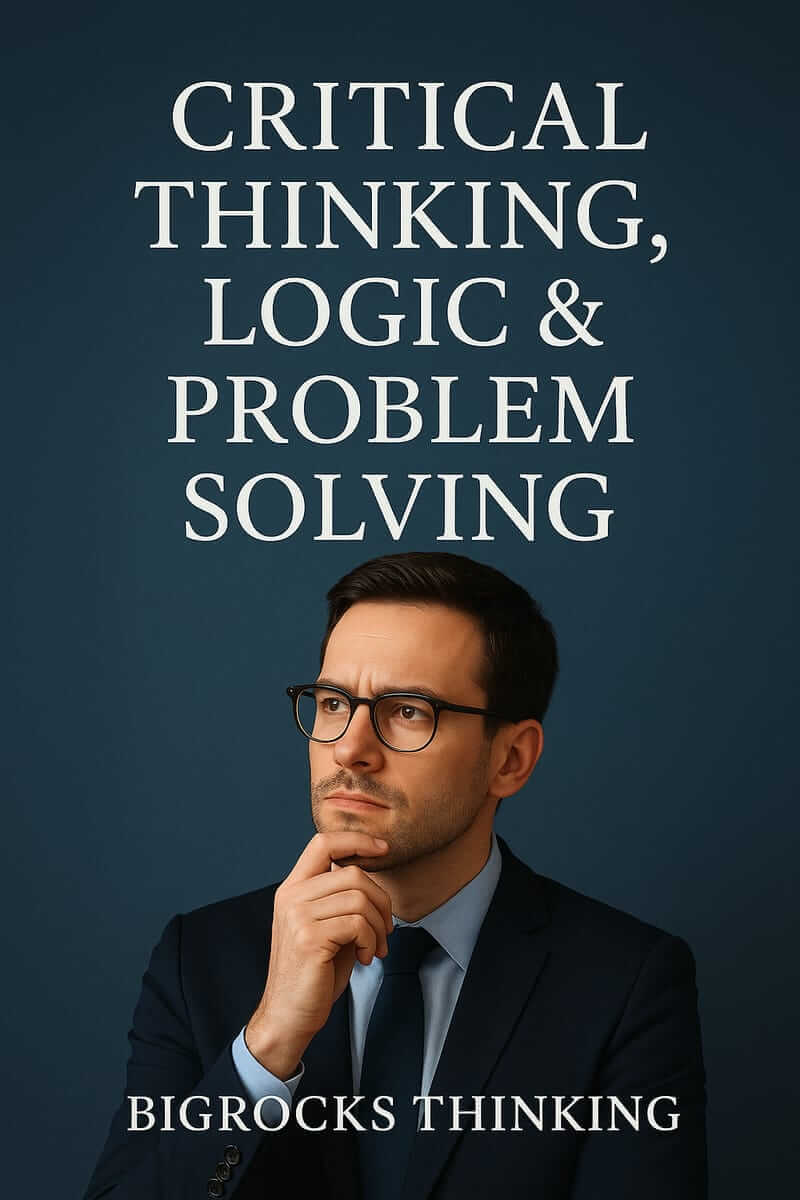
Critical Thinking, Logic & Problem Solving Book Summary
This Critical Thinking, Logic & Problem Solving Book Summary covers the key ideas, lessons, and takeaways in about 20 minutes.
Helps with these goals
Want the complete 20-minute summary?
- Full structured summary
- Video Summary
- Podcast Summary
- Audio summary
- Key takeaways
- Exercises
- Quiz
- Highlights and notes
- Ask the book with AI
Not ready to upgrade?
Get this summary + 2 more picks sent to your inbox, free.
What is in the Critical Thinking, Logic & Problem Solving book summary?
Below is a preview of Sumizeit’s expert-written summary of Critical Thinking, Logic & Problem Solving by Bigrocks Thinking. The full summary covers the book’s key ideas in text, audio, and video.
Most of us assume good thinkers are born that way. Some people just seem sharper. They catch the flaw in an argument before anyone else, they fix problems fast, and when they talk, people listen. This book pushes back on that idea. Its central claim is simple. Clear thinking is a skill, and like any skill, you get better at it with practice.
The book comes from Bigrocks Thinking, and it covers three connected areas. First, it walks you through how to think critically about information. Then it shows you how to use that thinking to solve real problems. Finally, it teaches you how to take your ideas and present them in a way that makes sense to other people and sticks with them. You can use all of it at school, at work, or at home with your partner and kids.
This summary follows the same path. You'll get the four stages of critical thinking, the five stages of problem solving, and then the tools the book offers for speaking, structuring your ideas, and telling stories.
What critical thinking means
The authors describe critical thinking as using deliberate mental steps to understand ideas, solve problems, and communicate well. Notice the word deliberate. Critical thinking is not the quick gut reaction you have when you read a headline. It's the slower work of stopping, checking, and reasoning your way to a conclusion.
Here's the encouraging part. You don't need a special talent for it. The authors say practice matters more than anything else. The more often you walk through the process on purpose, the more natural it becomes.
And you use it all the time, whether you notice or not. Should you adopt a dog? How do you convince your manager you've earned a raise? Why does your teenager keep skipping breakfast? Every one of these calls for the same basic habit of collecting facts, weighing them, and reaching a sound conclusion.
The book breaks critical thinking into four steps. You gather information. You analyze it. You evaluate what you came up with. Then you look back and improve your process for next time.
Step one of critical thinking is gathering information
You can't think clearly about something you don't know much about. So the first job is to collect what you need.
Start by pinning down the question. What exactly are you trying to figure out, and what's the setting around it? Once you know the boundaries of your question, you can go looking for answers. That means data, opinions from people involved, and any other facts that might help.
The authors use a workplace example. Say morale on your team has dropped. You'd want proof that it really has dropped, so you might look at productivity numbers. Then you'd want clues about the cause, which means talking with your team and hearing what they've noticed and how they feel.
As you collect information, you also need to sort it. Not every fact is worth your time.
Want the complete 20-minute summary?
- Full structured summary
- Video Summary
- Podcast Summary
- Audio summary
- Key takeaways
- Exercises
- Quiz
- Highlights and notes
- Ask the book with AI
Who should read Critical Thinking, Logic & Problem Solving?
This book is for anyone who wants to think more clearly and solve problems more effectively. Whether you're a student tackling complex assignments, a professional pitching ideas at work, or someone navigating personal decisions, Critical Thinking, Logic & Problem Solving by Bigrocks Thinking offers practical tools you can use immediately. You don't need a background in logic or philosophy—the book is written for everyday readers who want to sharpen their reasoning skills.
Why does Critical Thinking, Logic & Problem Solving matter?
Clear thinking has become increasingly valuable in a world flooded with information, misinformation, and competing opinions. This book challenges the myth that good thinkers are born, not made, and shows you that critical thinking is a learnable skill that improves with practice. By mastering these frameworks, you'll make better decisions, spot flawed arguments before they mislead you, and persuade others more effectively with well-structured ideas and compelling stories.
What are the key themes in Critical Thinking, Logic & Problem Solving?
- Critical thinking is a learnable skill, not an inborn talent
- Deliberate, structured processes lead to better decisions than gut reactions
- Recognizing and avoiding bias is essential to sound reasoning
- Clear communication amplifies the value of good thinking
- Logical fallacies hide in everyday arguments and our own reasoning
- Reflection and iteration improve your thinking over time
Want the complete 20-minute summary?
- Full structured summary
- Video Summary
- Podcast Summary
- Audio summary
- Key takeaways
- Exercises
- Quiz
- Highlights and notes
- Ask the book with AI
How can you apply ideas from Critical Thinking, Logic & Problem Solving?
- Use the 5W2H method before starting any project to ensure you've thought through all the essential details and caught potential problems early
- Create a logic tree whenever you face a decision with multiple options to visualize tradeoffs and explain your choice to others more clearly
- Build weighted pros and cons lists for major decisions to remove bias and defend your choices with evidence rather than intuition
- Apply the pyramid principle when presenting ideas—state your main recommendation first, then explain your reasoning, then provide supporting evidence
- Use situation-complication-resolution storytelling when trying to persuade someone to adopt your solution or point of view
- Practice the Pixar story framework when you need to teach someone a lesson or inspire action by making your point emotionally resonant
- Before accepting someone's argument, check for logical fallacies like false causation, middle ground fallacy, and anecdotal evidence to spot weak reasoning
What common mistakes do readers make with Critical Thinking, Logic & Problem Solving?
- Accepting the first piece of information you encounter as more trustworthy than later information, even when the later information is more reliable
- Seeking out only information that confirms your existing beliefs while dismissing contradictory evidence as unreliable
- Confusing correlation with causation and concluding that two things happening together means one caused the other
- Using a few personal stories as proof of a larger trend without gathering broader data to support the generalization
Sumizeit Exercises Apply what you've learned
Turn ideas from Critical Thinking, Logic & Problem Solving into action with a short guided reflection: identify the biggest takeaway, connect it to your life, and commit to one step you can take in the next 24 hours.
What is the expert analysis of Critical Thinking, Logic & Problem Solving?
Overview
Critical Thinking, Logic & Problem Solving is a practical guide authored by Bigrocks Thinking, a collective known for producing accessible works on cognitive skills. Published in late 2022, this book stands out for its clear, structured approach to cultivating better thinking habits. Rather than positing critical thinking as an innate talent, it democratizes the skill, emphasizing deliberate practice and systematic methods applicable across personal, academic, and professional contexts. Its significance lies in synthesizing diverse disciplines—psychology, logic, consulting, and storytelling—into a coherent, user-friendly framework designed for everyday readers seeking to enhance reasoning, problem-solving, and communication abilities.
Core Thesis
The central argument of the book is that effective thinking is not a mysterious gift but a learnable, repeatable process. Critical thinking involves four deliberate steps: gathering reliable information, analyzing it through pattern recognition and open questioning, evaluating conclusions via deductive reasoning, and continuously refining one’s approach through reflection. This disciplined process extends naturally into problem solving, which the authors frame as bridging the gap between current and desired states using structured tools like 5W2H and SCQH. The final crucial component is communication—organizing ideas with the pyramid principle and embedding them in compelling stories to ensure understanding and retention. Ultimately, the book asserts that with consistent practice, these steps become intuitive, transforming how individuals think and act.
Strengths
- Clarity and Accessibility: The book excels at breaking down complex cognitive skills into manageable, actionable steps without sacrificing depth, making it highly approachable for a broad audience.
- Integration of Thinking and Communication: By coupling critical thinking and problem solving with storytelling and structured presentation techniques, the book addresses the often-overlooked final mile of effective idea transmission.
- Practical Tools and Frameworks: The inclusion of well-established methods such as 5W2H, SCQH, logic trees, and the pyramid principle provides readers with tangible instruments to apply immediately.
- Focus on Bias and Fallacies: The detailed attention to cognitive biases and logical fallacies equips readers to critically evaluate both external information and their own reasoning processes.
- Encouragement of Reflective Practice: Emphasizing metacognition as a habit promotes ongoing improvement rather than static knowledge acquisition.
Critiques & Counterarguments
- Potential Oversimplification: While the book’s stepwise approach aids comprehension, it may underrepresent the complexity and nuance inherent in real-world critical thinking, where ambiguity and incomplete information often prevail.
- Limited Engagement with Competing Theories: The text largely endorses inductive and deductive reasoning without deeply engaging alternative epistemological frameworks such as abductive reasoning or the role of intuition in expert judgment.
- Evidence Base and Empirical Support: The book’s practical orientation comes at the expense of rigorous academic citations or discussion of empirical studies validating the effectiveness of its recommended tools, which might limit its appeal to scholarly readers.
- Contextual Constraints: Some tools, like the 5W2H method or logic trees, may be less applicable or require adaptation in highly dynamic or culturally diverse environments where problem definitions and information reliability differ significantly.
- Communication Emphasis May Overshadow Critical Nuance: The strong focus on storytelling and persuasion, while valuable, risks encouraging rhetorical techniques that prioritize emotional engagement over critical scrutiny, potentially leading to manipulation if misused.
Who Should Read This
This book is ideally suited for readers seeking a foundational yet comprehensive introduction to structured thinking and problem solving. It is particularly valuable for professionals aiming to improve decision-making and communication in workplace settings, students developing academic reasoning skills, and anyone interested in enhancing everyday judgment and interpersonal influence. Its straightforward style and practical orientation make it an excellent resource for those who prefer actionable guidance over theoretical exposition. However, readers with advanced expertise in philosophy, cognitive science, or formal logic might find its treatment somewhat elementary and may need to supplement it with more specialized texts.
Frequently asked questions about the Critical Thinking, Logic & Problem Solving book summary
What is Critical Thinking, Logic & Problem Solving about?
Critical Thinking, Logic & Problem Solving by Bigrocks Thinking is a practical guide showing that clear thinking is a learnable skill, not an inborn talent. The book covers three connected areas: how to think critically about information by gathering reliable facts and spotting bias and fallacies, how to apply that thinking to solve real problems using structured frameworks, and how to communicate your ideas effectively through clear structure and storytelling. The book breaks each area into repeatable steps that you can use at work, school, or home.
Who should read Critical Thinking, Logic & Problem Solving?
This book is ideal for students, professionals, and anyone making decisions who wants to think more clearly and persuade others more effectively. You should read it if you struggle to spot flawed arguments, want to make better decisions, need to present ideas convincingly, or find yourself uncertain about how to solve complex problems. No background in logic or philosophy is required—the book is written in plain language with everyday examples.
What are the main takeaways from Critical Thinking, Logic & Problem Solving?
The main takeaways are that good thinking follows a repeatable four-step process (gather information, analyze it, evaluate conclusions, reflect to improve), problem solving applies that same discipline using tools like the 5W2H framework and logic trees, and clear communication amplifies the value of your thinking through structure and storytelling. The core message is that practice these steps consistently, and they become second nature—you'll make better decisions, spot manipulation in arguments, and convince others of your ideas more effectively.
How do you identify a reliable source according to Critical Thinking, Logic & Problem Solving?
A reliable source is knowledgeable about its subject, backs up its claims with evidence rather than assumptions, and reveals where its information comes from. You should check whether the author knows the field, whether the outlet is respected, and whether the piece explains its origins. You can also compare sources with friends or colleagues to develop a shared sense of which outlets tend to be trustworthy versus which spread misinformation or paid advertising disguised as news.
What is the pyramid principle mentioned in Critical Thinking, Logic & Problem Solving?
The pyramid principle is a communication structure that puts your main idea first and the supporting details last. You state your recommendation or big idea upfront, then explain your reasoning for arriving at that conclusion, then lay out the evidence and facts that back it up. This order works because it matches how people absorb information—they immediately understand where you're going and why each piece of information matters, rather than waiting until the end to learn your point.
What are logical fallacies and why does Critical Thinking, Logic & Problem Solving emphasize them?
Logical fallacies are flaws in reasoning where the evidence doesn't actually support the conclusion, even though the argument might sound persuasive. Examples include the middle ground fallacy (assuming the right answer is always halfway between extremes), false cause (confusing correlation with causation), and anecdotal evidence fallacy (using a few personal stories as proof of something larger). The book emphasizes them because learning to spot fallacies in others' arguments and your own thinking helps you avoid poor conclusions and resist manipulation.
How does Critical Thinking, Logic & Problem Solving suggest structuring a persuasive story?
For persuasive storytelling, the book recommends the situation-complication-resolution approach. You describe the situation and context, introduce the complication or problem that makes things difficult, and then present your proposed resolution. This structure works because it builds tension and leaves your audience wanting a solution, so when you offer it, they're primed to accept it. The emotional arc of the story makes your recommendation feel like the answer they've been waiting for.
What is the Pixar story framework in Critical Thinking, Logic & Problem Solving?
The Pixar story framework uses six simple sentence starters to build an emotionally engaging story: 'Once upon a time' and 'Every day' set up the normal world, 'Then one day' introduces the disruption, 'Because of that' and 'And because of that' show the chain of consequences, and 'Until finally' delivers the resolution. The book likes this framework because it naturally includes a goal, an obstacle, and a change—the three elements that make people lean in emotionally and remember your message long after you've finished.
About Sumizeit
Sumizeit is a profitable Scomy LLC company based in Miami, Florida. It has been helping readers learn from nonfiction books for 7 years with expert-written summaries in text, audio, podcast, and video.
Want the complete 20-minute summary?
- Full structured summary
- Video Summary
- Podcast Summary
- Audio summary
- Key takeaways
- Exercises
- Quiz
- Highlights and notes
- Ask the book with AI
Here's why readers love Sumizeit
Join thousands of learners getting smarter every day
"Great experience. Detailed summaries. Loved the gamification feature. Makes learning fun. Good customer service. I recommend Sumizeit to anyone. You'll learn a lot."
"I always felt busy but still wanting to keep up with the book discussion in my friend group. This was a great supplement to help me keep reading the books I find fun while keeping up with important books."
"I love this website. Instead of scrolling social media, I find myself learning a lot. I use it everyday. I recommend this app for anyone who is too busy and wants to get up to speed with their favorite books."
Critical Thinking, Logic & Problem Solving Book Summary PDF
Looking for a Critical Thinking, Logic & Problem Solving Book Summary PDF you can save and revisit offline? Our Critical Thinking, Logic & Problem Solving Book Summary PDF captures the book’s core ideas in a clean, printable format — the key frameworks, takeaways, and structure without the fluff. Download the Critical Thinking, Logic & Problem Solving Book Summary PDF when you want a reference you can annotate, share with your team, or review on the go. Get your Critical Thinking, Logic & Problem Solving Book Summary PDF from the download page below.
Download Critical Thinking, Logic & Problem Solving Book Summary PDFPeople also liked these summaries
Readers who explored Critical Thinking, Logic & Problem Solving often enjoyed these titles next.


Want the complete 20-minute summary?
- Full structured summary
- Video Summary
- Podcast Summary
- Audio summary
- Key takeaways
- Exercises
- Quiz
- Highlights and notes
- Ask the book with AI
Featured Book Titles
Popular Book Summaries at sumizeit, leading book summary app