


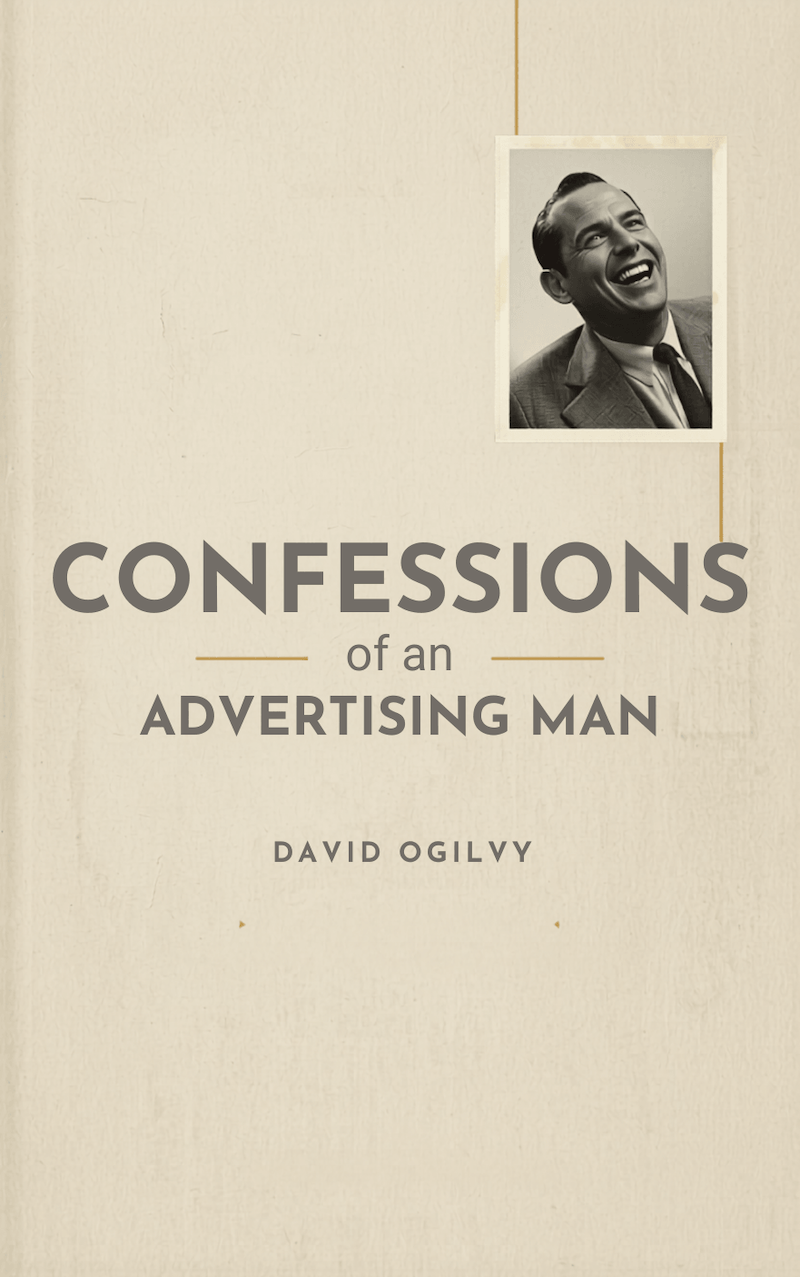
Prefer the print book? Buy on Amazon
As an Amazon Associate, Sumizeit earns from qualifying purchases.
Confessions of an Advertising Man Book Summary
This Confessions of an Advertising Man Book Summary covers the key ideas, lessons, and takeaways in about 20 minutes.
A clear, practical guide to mastering persuasive advertising and building powerful brands.
Beyond individual advertisements, Ogilvy’s ideas extend to the broader business of advertising. Success requires consistency, strong brand identity, rigorous testing, and long-term thinking. It also depends on people—hiring creative talent, building trust with clients, and maintaining a reputation for excellence. Whether you are creating ads, managing a team, or building a career, the underlying principle remains the same: prioritize quality, understand your audience deeply, and commit to doing the work better than anyone else.
Helps with these goals
Want the complete 20-minute summary?
- Full structured summary
- Video Summary
- Podcast Summary
- Audio summary
- Key takeaways
- Exercises
- Quiz
- Highlights and notes
- Ask the book with AI
Want a Free Weekly Read?
Get a free summary every week straight to your mailbox.
Preview the Confessions of an Advertising Man book summary
Below is a preview of Sumizeit’s comprehensive human-written summary of Confessions of an Advertising Man by David Ogilvy. The full summary is 15-20 minutes long and covers the book’s key ideas in text, audio, visual, and video formats. Unlock the full 20 Minute Summary
David Ogilvy’s philosophy begins with a simple but powerful premise: advertising exists to sell. While creativity, aesthetics, and cleverness all matter, they are meaningless if they fail to persuade someone to take action. According to Ogilvy, the most effective advertisements share three defining traits—they are truthful, rich in useful details, and engaging enough to stand out in a crowded marketplace.
Honesty is foundational. When an advertisement exaggerates or misleads, it may generate short-term sales, but it damages trust and undermines the brand over time. Customers who feel deceived rarely return. Ogilvy emphasizes that long-term success depends on building credibility, not tricking people into buying once.
Equally important is substance. Many advertisements focus on style rather than meaning, assuming consumers won’t pay attention to facts. Ogilvy strongly disagrees. He argues that people are far more interested in products that clearly explain how they improve their lives. Providing concrete information—features, benefits, and proof—makes advertising persuasive.
Finally, advertising must capture attention. Even the most informative message will fail if it blends into the background. The best ads combine clarity with originality, presenting information in a way that sparks curiosity and invites further reading.
Together, these principles create a balance: tell the truth, provide value, and deliver it in a compelling way.
The Critical Role of the Headline
Ogilvy believed that the headline is the most important part of any advertisement. It acts as the gateway to everything that follows. If the headline fails, the rest of the ad is irrelevant because most people will never read it.
He emphasized that many readers only glance at headlines before deciding whether to continue. Therefore, the headline must carry the weight of the entire message. It should clearly communicate the product’s main benefit, include the brand name, and be immediately understandable.
Simplicity is essential. A headline that requires effort to interpret will lose the reader instantly. Even if it’s clever, complexity kills engagement. Ogilvy preferred direct, benefit-driven statements that quickly answer the reader’s unspoken question: “Why should I care?”
He also believed that a headline should function as a complete advertisement on its own. If someone reads only the headline, they should still walk away with a meaningful impression of the product.
A famous example illustrates this principle: a Rolls-Royce advertisement highlighted the quietness of the car by stating that the loudest sound at high speed came from the clock. This single sentence communicated luxury, engineering excellence, and a unique selling point—all without unnecessary complexity.
The Power of a Central Idea
Great advertising doesn’t emerge from random creativity—it revolves around a strong central concept. Ogilvy argued that every successful campaign is built on a single, clear idea that ties everything together.
This “big idea” acts as the backbone of the advertisement. It connects the headline, visuals, and body text into a cohesive message. Without it, ads feel scattered and forgettable.
Interestingly, Ogilvy did not believe that these ideas come from strict logical processes. Instead, he emphasized the importance of intuition and subconscious thinking.
Want the complete 20-minute summary?
- Full structured summary
- Video Summary
- Podcast Summary
- Audio summary
- Key takeaways
- Exercises
- Quiz
- Highlights and notes
- Ask the book with AI
Who should read Confessions of an Advertising Man?
Confessions of an Advertising Man is essential for marketing professionals, business owners, and anyone responsible for communicating a product or service to an audience. It's equally valuable for creatives who want to understand how to balance artistic vision with business results, and for leaders seeking to build high-performing teams and manage client relationships effectively.
Why does Confessions of an Advertising Man matter?
David Ogilvy's principles remain strikingly relevant in today's cluttered media landscape where capturing attention and driving action are more challenging than ever. His insistence that advertising must be truthful, substantive, and strategically focused offers a counterbalance to short-term thinking and empty creativity. Whether you're crafting social media content, designing campaigns, or building a brand, Ogilvy's framework provides timeless guidance on how to persuade people authentically and profitably.
What are the key themes in Confessions of an Advertising Man?
- Advertising exists to sell, not merely to entertain or impress
- Truthfulness and credibility are foundations of long-term success
- Clear, simple communication outperforms complexity and cleverness
- Testing and evidence beat guesswork and intuition alone
- Consistent brand identity builds trust and loyalty over time
- Effective teams require hiring and nurturing creative talent
- Personal excellence and reliability are keys to career advancement
Want the complete 20-minute summary?
- Full structured summary
- Video Summary
- Podcast Summary
- Audio summary
- Key takeaways
- Exercises
- Quiz
- Highlights and notes
- Ask the book with AI
How can you apply ideas from Confessions of an Advertising Man?
- Audit your headlines: rewrite them to clearly communicate your product's main benefit in simple language, and test whether each could stand alone as a complete message
- Create a central idea document for your next campaign that distills your concept into a single sentence, then ensure every visual and copy element reinforces it
- Conduct A/B testing on ad copy, headlines, and visuals before launching full campaigns to gather evidence about what resonates with your actual audience
- Develop a brand consistency guide that defines your visual identity, tone, core message, and target audience, then enforce it across all customer touchpoints
- Build curiosity into your visuals by using unexpected or mysterious images that prompt viewers to read your copy for explanation rather than showing obvious product shots
- Simplify your marketing language by rewriting it as if explaining to a friend—remove jargon, shorten sentences, and use conversational tone to increase clarity and connection
- Establish a process for testing creative ideas before full investment by gathering feedback from small audience samples and refining based on real response data
What common mistakes do readers make with Confessions of an Advertising Man?
- Prioritizing cleverness and originality over clarity—audiences prefer straightforward messaging that explains benefits over ads that require effort to understand
- Abandoning working campaigns too early because they feel stale internally, forgetting that consumers see ads far less frequently than the marketing team does
- Focusing on style and aesthetics rather than substance, assuming people won't pay attention to detailed product information when they're actually hungry for it
- Neglecting to test campaigns before launch, relying instead on creative intuition and guesswork rather than gathering evidence from real audiences about what persuades them
- Trying to appeal to everyone with a diluted message instead of targeting a specific audience with a distinct brand identity that becomes memorable
Sumizeit Exercises Apply what you've learned
Turn ideas from Confessions of an Advertising Man into action with a short guided reflection: identify the biggest takeaway, connect it to your life, and commit to one step you can take in the next 24 hours.
What is the expert analysis of Confessions of an Advertising Man?
Overview
Confessions of an Advertising Man, authored by David Ogilvy, stands as a seminal work in the field of advertising and marketing. Ogilvy, often hailed as the "Father of Advertising," revolutionized the discipline by blending creativity with rigorous research and strategic clarity. His agency, Ogilvy & Mather, became a global powerhouse under his leadership, and his principles have deeply influenced how brands communicate with consumers. This book is significant not merely as a manual of advertising tactics but as a philosophical treatise on the ethics, psychology, and craft of persuasion in the commercial realm.
Core Thesis
At its core, Ogilvy’s thesis is elegantly straightforward: advertising’s fundamental purpose is to sell products by communicating truthfully, richly, and engagingly. He rejects superficial cleverness and aesthetic embellishment that do not serve the ultimate goal of persuasion. Instead, he posits that effective advertising must be anchored in honesty to build long-term brand trust, provide substantial and useful information to consumers, and capture attention through clarity and originality. This triad—truth, substance, and compelling presentation—forms the backbone of his philosophy, emphasizing that advertising is a disciplined craft rather than mere art or entertainment.
Strengths
- Timeless Principles: Ogilvy’s insistence on honesty and detailed product information anticipates modern concerns about consumer trust and transparency, making his advice enduringly relevant.
- Balance of Creativity and Discipline: The book deftly navigates the tension between creative intuition and systematic testing, advocating for a harmonious blend that maximizes effectiveness.
- Practical Guidance: From headline writing to client management, Ogilvy offers actionable insights grounded in decades of experience, making the book both inspirational and utilitarian.
- Brand Strategy Focus: The emphasis on consistency and long-term brand building elevates advertising from episodic campaigns to a sustained business strategy.
- Human-Centered Approach: Ogilvy’s focus on understanding consumer psychology and fostering authentic client relationships underscores the relational dimension of advertising.
Critiques & Counterarguments
- Potential Oversimplification: Ogilvy’s clear-cut triad of truth, substance, and engagement may understate the complexity of modern advertising ecosystems, where emotional resonance and cultural context often play equally crucial roles.
- Limited Consideration of Digital Evolution: Written before the digital age, the book does not address the nuances of online advertising, social media dynamics, or data-driven personalization, areas where traditional principles sometimes require adaptation.
- Creativity vs. Formulaic Approaches: While Ogilvy champions creativity, his strong emphasis on testing and repeatability might constrain radical innovation, potentially favoring safe, incremental improvements over disruptive ideas.
- Competing Schools of Thought: Postmodern and experiential marketing theories challenge Ogilvy’s focus on clear messaging and product-centric advertising, advocating instead for narrative ambiguity, brand mythmaking, and immersive experiences.
- Real-World Contradictions: Some successful contemporary campaigns thrive on emotional storytelling or brand activism that may stretch or reinterpret the notion of “truth” as Ogilvy defines it, highlighting tensions between ethical rigor and persuasive impact.
Who Should Read This
This book is essential reading for advertising professionals, marketers, brand strategists, and business leaders seeking foundational wisdom on effective communication and brand building. It is equally valuable for students of marketing and communications who wish to ground their understanding in the principles that shaped modern advertising. Furthermore, anyone interested in the psychology of persuasion and the ethical dimensions of commercial messaging will find Ogilvy’s insights both illuminating and challenging. While some content reflects its mid-20th-century context, the core lessons remain a vital touchstone for navigating the evolving landscape of advertising with integrity and impact.
Frequently asked questions about the Confessions of an Advertising Man book summary
What is Confessions of an Advertising Man about?
Confessions of an Advertising Man by David Ogilvy is a seminal guide to creating effective advertising and managing successful marketing campaigns. Ogilvy argues that advertising's core purpose is to sell by combining truthfulness, useful information, and compelling presentation. The book covers practical techniques—from writing powerful headlines to building brand consistency—alongside broader principles for hiring talent, retaining clients, and building a career in advertising.
Who should read Confessions of an Advertising Man?
This book is essential for marketers, advertisers, business owners, creative professionals, and anyone responsible for persuading an audience. It's valuable for leaders building teams, entrepreneurs launching products, and career professionals seeking advancement in marketing or communications. Even if you don't work in advertising, Ogilvy's principles apply to any communication that aims to inform and convince.
What are the main takeaways from Confessions of an Advertising Man?
The core takeaways are that effective advertising must be truthful and substantive rather than merely clever, that clear communication beats complexity, and that testing beats guesswork. Ogilvy emphasizes building consistent brand identity over time, the critical importance of headlines, and the power of a single central idea. For business leaders, he stresses that success depends on hiring creative talent, maintaining reputation through quality, and prioritizing long-term relationships with clients.
How does David Ogilvy define an effective headline?
Ogilvy believed the headline is the most important part of any advertisement because most readers decide whether to continue based on it alone. An effective headline must clearly communicate the product's main benefit, include the brand name, and be immediately understandable. He emphasized simplicity over cleverness and argued that a great headline should function as a complete advertisement even if readers go no further.
Why does Ogilvy emphasize testing in advertising?
Ogilvy recognized that even experienced professionals cannot predict with certainty what will work. Testing advertisements before full launch reveals weaknesses in messaging, headlines, and positioning, allowing refinement based on real audience feedback rather than guesswork. This disciplined approach treats advertising as a strategic process with measurable objectives rather than purely an artistic endeavor.
What does Ogilvy say about repetition in advertising campaigns?
Ogilvy argued that successful advertisements should be used repeatedly rather than constantly replaced. Many companies abandon effective campaigns prematurely because they become bored internally, but consumers encounter ads far less frequently than marketers do. Repetition reaches new customers while reinforcing messages among existing ones, building the familiarity that ultimately drives purchasing decisions.
How should you write body copy according to Confessions of an Advertising Man?
Ogilvy advocated for detailed, informative copy using simple, conversational language rather than sophisticated writing. He recommended short sentences and paragraphs that read like explaining something to a friend. Rather than worrying about length, include as much relevant information as possible—interested readers will continue regardless. The goal is clarity and connection, not impressing readers with sophistication.
What is Ogilvy's approach to building and maintaining brand identity?
Ogilvy emphasized that a brand is a collection of impressions in the consumer's mind, so consistency across all messaging is critical for long-term success. Rather than constantly reinventing themselves, strong brands reinforce the same core identity repeatedly. This consistency creates familiarity and trust, and Ogilvy noted that strong brands succeed by targeting a specific audience and maintaining a distinct personality rather than trying to appeal to everyone.
About Sumizeit
Sumizeit is a profitable Scomy LLC company based in Miami, Florida. Our founders, Clemens Raemy and Weina Scott, are successful entrepreneurs with several exits. Sumizeit is a popular book summary app / micro learning app used by busy professionals and entrepreneurs with over 2,500 non-fiction book summaries and 10,000 podcast summaries in text, audio, visual, podcast, and video format. We also have stellar retention tools to make ideas stick - such as flashcards with spaced repetition, quizzes, streaks, highlighting and notes, daily challenges, riddles, mini-courses, meditation, and more. You won't only learn the idea, but also remember it. Over 90% of our users change their habits with Sumizeit.
Upgrade Now
Want the complete 20-minute summary?
- Full structured summary
- Video Summary
- Podcast Summary
- Audio summary
- Key takeaways
- Exercises
- Quiz
- Highlights and notes
- Ask the book with AI
Here's why readers love Sumizeit
Join thousands of learners getting smarter every day
"Great experience. Detailed summaries. Loved the gamification feature. Makes learning fun. Good customer service. I recommend Sumizeit to anyone. You'll learn a lot."
"I always felt busy but still wanting to keep up with the book discussion in my friend group. This was a great supplement to help me keep reading the books I find fun while keeping up with important books."
"I love this website. Instead of scrolling social media, I find myself learning a lot. I use it everyday. I recommend this app for anyone who is too busy and wants to get up to speed with their favorite books."
Confessions of an Advertising Man Book Summary PDF
Looking for a Confessions of an Advertising Man Book Summary PDF you can save and revisit offline? Our Confessions of an Advertising Man Book Summary PDF captures the book’s core ideas in a clean, printable format — the key frameworks, takeaways, and structure without the fluff. Download the Confessions of an Advertising Man Book Summary PDF when you want a reference you can annotate, share with your team, or review on the go. Get your Confessions of an Advertising Man Book Summary PDF from the download page below.
Download Confessions of an Advertising Man Book Summary PDFPeople also liked these summaries
Readers who explored Confessions of an Advertising Man often enjoyed these titles next.


Want the complete 20-minute summary?
- Full structured summary
- Video Summary
- Podcast Summary
- Audio summary
- Key takeaways
- Exercises
- Quiz
- Highlights and notes
- Ask the book with AI
Featured Book Titles
Popular Book Summaries at sumizeit, leading book summary app