
Question 1 of 10


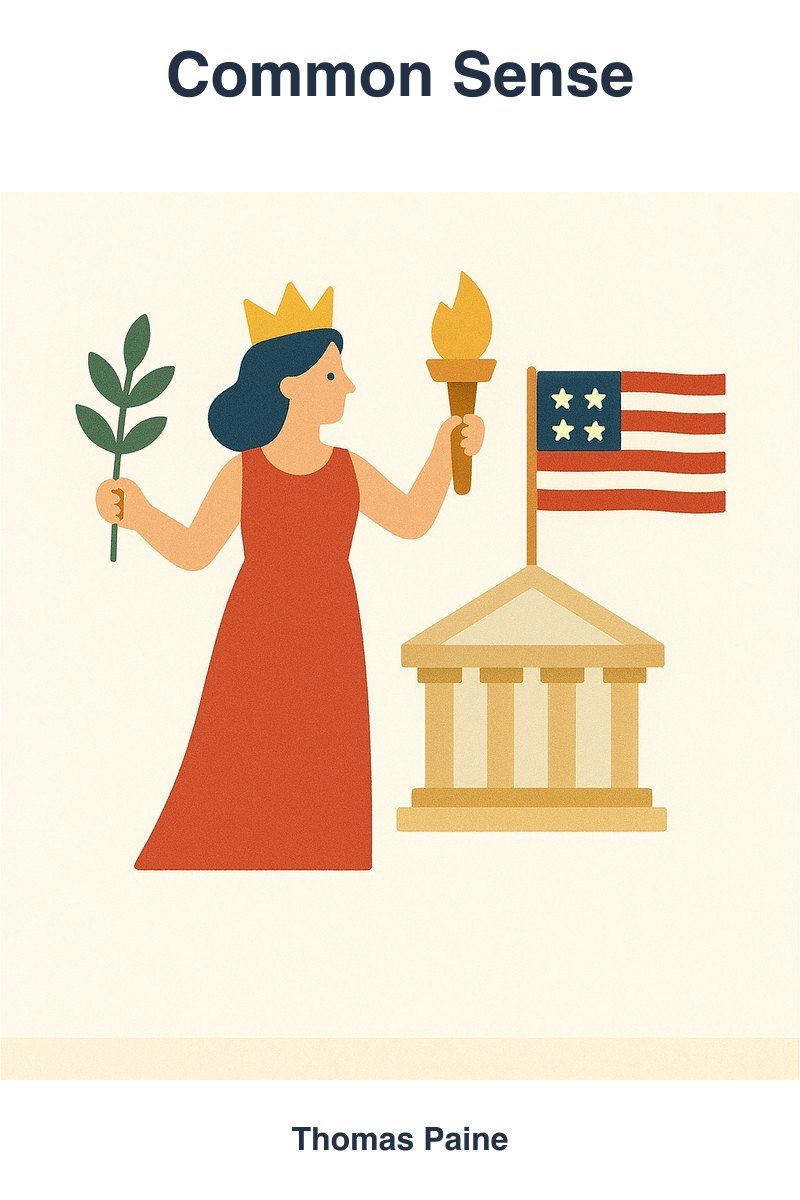
Prefer the print book? Buy on Amazon
As an Amazon Associate, Sumizeit earns from qualifying purchases.
Book Summary
Common Sense Book Summary
This Common Sense Book Summary covers the key ideas, lessons, and takeaways in about 20 minutes.
Short Description:
Paine’s plain case for American independence and a government ruled by law
The central lesson of Common Sense is that government belongs to the people it serves, and any system that hands power to someone because of his birth will eventually fail those people. Paine reduces politics to a few plain ideas. Government is a tool for safety and nothing more. Leaders must stay close to the public through frequent elections. Hereditary rule offends reason, history, and fairness. And when a ruler turns his power against his own people, the people have the right to build something better, ideally before fear and habit talk them out of it. He wrote all of this in language everyone could read, which is why a pamphlet by an unknown tax man helped turn a regional quarrel into a national cause, and why its argument still speaks to anyone who has doubted whether ordinary people can govern themselves.
Helps with these goals
Want a Free Weekly Read?
Get a free summary every week straight to your mailbox.
Preview the Common Sense book summary
Below is a preview of Sumizeit’s comprehensive human-written summary of Common Sense by Thomas Paine. The full summary is 15-20 minutes long and covers the book’s key ideas in text, audio, visual, and video formats. Unlock the full 20 Minute Summary
In January 1776, a short, unsigned pamphlet appeared on the streets of Philadelphia. It ran under fifty pages, it cost almost nothing, and it was written in plain language that a farmer, a sailor, or a shopkeeper could follow. Within months it had spread through every colony. People read it aloud in taverns and in town squares. Historians still debate the exact print numbers, but nobody disputes that it sold at a pace the colonies had never seen for any publication.
The timing matters. Fighting had already broken out at Lexington and Concord, and the Boston Tea Party was behind everyone. Even so, most colonists did not think of themselves as rebels. They saw their quarrel as a dispute with Parliament, or with the King's ministers, and they hoped the King himself would step in and fix things. Many wanted reconciliation. The word independence still sounded dangerous and a little crazy.
Common Sense attacked that mood head on. Thomas Paine told his readers that the dispute was never about a few bad taxes or a handful of foolish advisers. The problem was the whole structure. A kingdom built on inherited power, he argued, cannot serve free people, and a continent should not take orders from an island across the ocean. He then went a step further than complaint. He sketched what a better government might look like, and he made the case that the moment to build it was right now.
Paine organized the pamphlet in four parts, plus a short introduction and a few later additions. He starts with the purpose of government and shows how England has strayed from it. Then he turns on monarchy itself. Next he looks at the current fight between the colonies and Britain. Finally he asks whether America is strong enough to stand alone. This summary follows that same path.
The man holding the pen
Paine did not come from the world of Boston lawyers and Virginia planters who filled the ranks of the Founding Fathers. He was born in England in 1737 into a modest family. He worked as a corset maker, a sailor for a short stretch, and a tax collector. None of these jobs made him rich, and he lost one of them after agitating for better pay for his fellow officers. By his late thirties he was broke, and his life looked like a string of small failures.
A meeting with Benjamin Franklin in London gave him a way out. Franklin saw something in him and helped him move to Philadelphia in 1774. Paine landed a job editing a magazine, and he soon found that he could write in a voice that ordinary people loved. He had no patience for fancy Latin phrases or long legal arguments. He wrote like someone talking across a table.
That outsider status shaped the pamphlet. Paine had seen English class privilege up close, and he had felt its weight.
Want the complete 20-minute summary?
- Full structured summary
- Video Summary
- Podcast Summary
- Audio summary
- Key takeaways
- Exercises
- Quiz
- Highlights and notes
- Ask the book with AI
Who should read Common Sense?
Common Sense by Thomas Paine speaks to anyone questioning the legitimacy of inherited power or wondering whether ordinary people can govern themselves. It's essential reading for students of American history, political philosophy, and revolutionary movements, as well as for citizens curious about the intellectual foundations of democracy and individual liberty.
Why does Common Sense matter?
Published in 1776 at a pivotal moment, Common Sense transformed colonial discontent into a unified call for independence by using plain language and accessible reasoning rather than academic arguments. Today, its core ideas about government's purpose, the dangers of unchecked power, and the right of people to replace unjust systems remain vital to debates about democracy, representation, and political legitimacy worldwide.
What are the key themes in Common Sense?
- Government as a necessary tool, not a source of glory
- The corruption of hereditary power and inherited rule
- The natural equality of all people at birth
- The importance of frequent elections and close representation
- The destructiveness of monarchy as a system
- America's potential as a refuge for freedom
- The right of people to overthrow unjust rulers
How can you apply ideas from Common Sense?
- Evaluate whether government remains limited to its proper function of providing security, or whether it has grown to glorify itself and enrich those in power
- Assess your country's leaders by their actions, not their promises or promises of their predecessors, especially if force has already been used against citizens
- Design political systems with short terms, frequent elections, and regular rotation of leadership to keep officials accountable and prevent the accumulation of unchecked power
- Question whether distant or complex governments can truly serve the people who must live under their rules, and advocate for decisions made locally where affected citizens can participate
- Identify when moderate voices are actually delaying necessary change and when patience is allowing injustice to entrench itself more deeply
- Recognize self-interest in political arguments—whether speakers profit from the current system or have skin in the outcome—rather than accepting their claims at face value
- Build a vision for what just government should look like before attempting to change the current system, so that revolution leads to better order rather than new tyranny
What common mistakes do readers make with Common Sense?
- Assuming that distant rulers can govern effectively across seas or continents, ignoring how communication delays make policy obsolete before it arrives
- Believing that inherited power works well if the current ruler happens to be competent, overlooking how the system inevitably produces incompetent successors
- Thinking that compromise and patience will eventually win over an unjust ruler, when history shows that once violence is used against people, trust is destroyed beyond repair
- Trusting moderate voices that counsel delay and gradualism, not realizing that comfort and incremental change often allow tyranny to grow stronger
- Overlooking the self-interest of those who defend the current system, such as officials and merchants who profit from existing arrangements
- Waiting for the 'perfect moment' to establish a just government, missing the actual window of unity and opportunity that may not open again
Sumizeit Exercises Apply what you've learned
Turn ideas from Common Sense into action with a short guided reflection: identify the biggest takeaway, connect it to your life, and commit to one step you can take in the next 24 hours.
What is the expert analysis of Common Sense?
Overview
Common Sense is a seminal political pamphlet authored by Thomas Paine in 1776, a work that profoundly influenced the course of American history and political thought. Paine, an English-born political activist and writer, crafted this concise yet powerful argument for American independence at a critical juncture when colonial loyalty to Britain was still widespread. Its plainspoken style and accessible reasoning made revolutionary ideas comprehensible and compelling to a broad audience, catalyzing public support for the American Revolution. The pamphlet’s significance lies not only in its immediate political impact but also in its enduring articulation of republican ideals and democratic governance.
Core Thesis
Paine’s central argument is that government is a necessary but limited institution, created solely to protect society from human failings such as injustice and violence. He distinguishes society, which is inherently good and based on mutual benefit, from government, which exists as a “necessary evil.” Paine contends that hereditary monarchy and aristocracy are fundamentally illegitimate and incompatible with natural equality. He argues that the English system, despite its reputation, is a disguised monarchy that fails to serve the people’s interests. Consequently, the American colonies must reject British rule and establish a republic grounded in popular sovereignty, frequent elections, and laws that embody the collective will rather than the whims of a ruler or ruling class.
Strengths
- Clarity and Accessibility: Paine’s plain language and conversational tone democratized political discourse, making complex ideas about governance and rights understandable to ordinary colonists, which was unprecedented at the time.
- Timeliness and Urgency: The pamphlet’s publication at a moment when colonial unity was fragile and the prospect of independence seemed radical gave it immense persuasive power, helping to crystallize public opinion.
- Philosophical and Historical Grounding: Paine effectively blends Enlightenment principles of natural rights with biblical references familiar to his audience, lending moral and intellectual weight to his critique of monarchy.
- Visionary Political Design: His sketch of a republican government anticipates many features of the later American political system, emphasizing accountability, representation, and the rule of law as paramount.
- Boldness in Challenging Established Authority: Paine’s uncompromising rejection of monarchy and hereditary succession was radical and helped shift the political discourse from reform to revolution.
Critiques & Counterarguments
- Idealization of Republicanism: Paine’s vision assumes a level of civic virtue and political engagement that may be overly optimistic. Later historical developments, including factionalism and political corruption, suggest that simple republican models face significant practical challenges.
- Oversimplification of English Governance: Paine dismisses the English constitutional monarchy as a mere façade, but this overlooks the complex evolution of parliamentary democracy and legal protections that influenced later democratic systems worldwide.
- Limited Consideration of Stability and Order: While Paine warns against tyranny, his critique underestimates the potential for instability in newly formed republics, which history has shown can be vulnerable to factionalism, populism, or authoritarian takeover.
- Geopolitical Naivety: Paine’s dismissal of European alliances and the strategic value of British protection may underestimate the complexities of international politics and the risks of isolation for a nascent nation.
- Religious Argumentation: His use of biblical narratives to argue against monarchy, while rhetorically effective for his audience, may be less persuasive or relevant to secular or non-Christian readers and risks conflating religious and political authority.
Who Should Read This
Common Sense is essential reading for students and scholars of political philosophy, American history, and revolutionary thought. It offers invaluable insight into the origins of republican ideals and the intellectual underpinnings of the American Revolution. Additionally, it is recommended for readers interested in the dynamics of political persuasion and the role of rhetoric in social change. Modern advocates of democracy and self-governance will find Paine’s arguments foundational, while critics of inherited privilege and authoritarianism will appreciate his enduring critique of monarchy. Finally, anyone curious about the power of accessible political writing to mobilize public opinion will find this pamphlet a masterclass in effective communication.
Discussion questions for Common Sense Short questions you can actually use in a conversation
Frequently asked questions about the Common Sense book summary
What is Common Sense about?
Common Sense by Thomas Paine is a short pamphlet published in 1776 that makes the case for American independence from British rule. Rather than legal arguments or grand rhetoric, Paine uses plain language and simple reasoning to explain why government belongs to the people, why hereditary monarchy is unjust, and why the American colonies should become an independent nation. The pamphlet became a bestseller and profoundly shaped colonial opinion during the Revolutionary era.
Who should read Common Sense?
Anyone interested in political philosophy, the American Revolution, or the foundations of democracy should read Common Sense. It's essential for students of history and political theory, and it remains relevant to anyone questioning the legitimacy of government, the proper role of leaders, or the rights of ordinary people to govern themselves. The book's accessibility and clear reasoning make it engaging for general readers as well as scholars.
What are the main takeaways from Common Sense?
Common Sense teaches that government exists solely to protect people from each other's worst impulses, not to glorify rulers or hand down power through bloodlines. Paine argues that authority must come from the people through frequent elections, that hereditary monarchy is unjust and ineffective, and that America has both the right and the ability to become independent. He also emphasizes that the moment for creating a just government is now, while the colonies are united, because such opportunities do not last forever.
Why did Common Sense have such a massive impact?
Common Sense became wildly popular because Thomas Paine wrote in plain, accessible language that ordinary farmers, sailors, and shopkeepers could understand, rather than using the legal jargon and Latin phrases favored by educated elites. He published at exactly the right moment, when colonists were angry but still uncertain about independence, and his arguments spoke directly to their doubts. The pamphlet's short length and low cost made it easy to distribute and share, allowing it to spread rapidly through every colony.
What does Paine say about monarchy?
Paine argues that monarchy has no natural basis and is unjust at its root. He contends that all people are born equal, and that the division between rulers and ruled is a human invention, often secured by force. He attacks hereditary succession especially harshly, pointing out that merit does not travel through blood, that raising a child as a future king corrupts their character, and that royal succession has repeatedly led to civil wars. He concludes that the best government would place the law as king, not any person.
Does Paine offer any specific ideas for American government?
Yes. Paine sketches a rough outline of what an American government could look like, including annual assemblies to keep power close to voters, a limited president answering to Congress, large numbers of representatives from each colony, and a three-fifths majority requirement for passing major laws. He proposes a rotation system for the presidency to spread power evenly. His goal is a simple, transparent system that is easy for citizens to understand and repair, with frequent elections ensuring that leaders remain accountable.
What are Paine's arguments for why America can succeed as an independent nation?
Paine argues that America has many advantages: a large population sufficient for defense, abundant natural resources including timber and iron for shipbuilding, vast unsettled land that can be sold to pay off debt, no national debt to begin with, and strong unity among the colonies. He adds that America does not need a navy as large as Britain's, only enough to defend its own coast. Most importantly, he stresses that the moment to act is now, because unity will fade and the window of opportunity may never return.
About Sumizeit
Sumizeit is a profitable Scomy LLC company based in Miami, Florida. Our founders, Clemens Raemy and Weina Scott, are successful entrepreneurs with several exits. Sumizeit is a popular book summary app / micro learning app used by busy professionals and entrepreneurs with over 2,500 non-fiction book summaries and 10,000 podcast summaries in text, audio, visual, podcast, and video format. We also have stellar retention tools to make ideas stick - such as flashcards with spaced repetition, quizzes, streaks, highlighting and notes, daily challenges, riddles, mini-courses, meditation, and more. You won't only learn the idea, but also remember it. Over 90% of our users change their habits with Sumizeit.
Upgrade Now
Here's why readers love Sumizeit
Join thousands of learners getting smarter every day
"Great experience. Detailed summaries. Loved the gamification feature. Makes learning fun. Good customer service. I recommend Sumizeit to anyone. You'll learn a lot."
"I always felt busy but still wanting to keep up with the book discussion in my friend group. This was a great supplement to help me keep reading the books I find fun while keeping up with important books."
"I love this website. Instead of scrolling social media, I find myself learning a lot. I use it everyday. I recommend this app for anyone who is too busy and wants to get up to speed with their favorite books."
Common Sense Book Summary PDF
Looking for a Common Sense Book Summary PDF you can save and revisit offline? Our Common Sense Book Summary PDF captures the book’s core ideas in a clean, printable format — the key frameworks, takeaways, and structure without the fluff. Download the Common Sense Book Summary PDF when you want a reference you can annotate, share with your team, or review on the go. Get your Common Sense Book Summary PDF from the download page below.
Download Common Sense Book Summary PDFPeople also liked these summaries
Readers who explored Common Sense often enjoyed these titles next.


Ready to read the whole thing?
- Full structured summary
- Video Summary
- Podcast Summary
- Audio summary
- Key takeaways
- Exercises
- Quiz
- Highlights and notes
- Ask the book with AI
Featured Book Titles
Popular Book Summaries at sumizeit, leading book summary app
Atomic Habits Book Summary Rich Dad Poor Dad Book Summary The Four Agreements Book Summary The 48 Laws of Power Book Summary When Breath Becomes Air Book Summary Think and Grow Rich Book Summary