
Question 1 of 10


Prefer the print book? Buy on Amazon
As an Amazon Associate, Sumizeit earns from qualifying purchases.
Book Summary
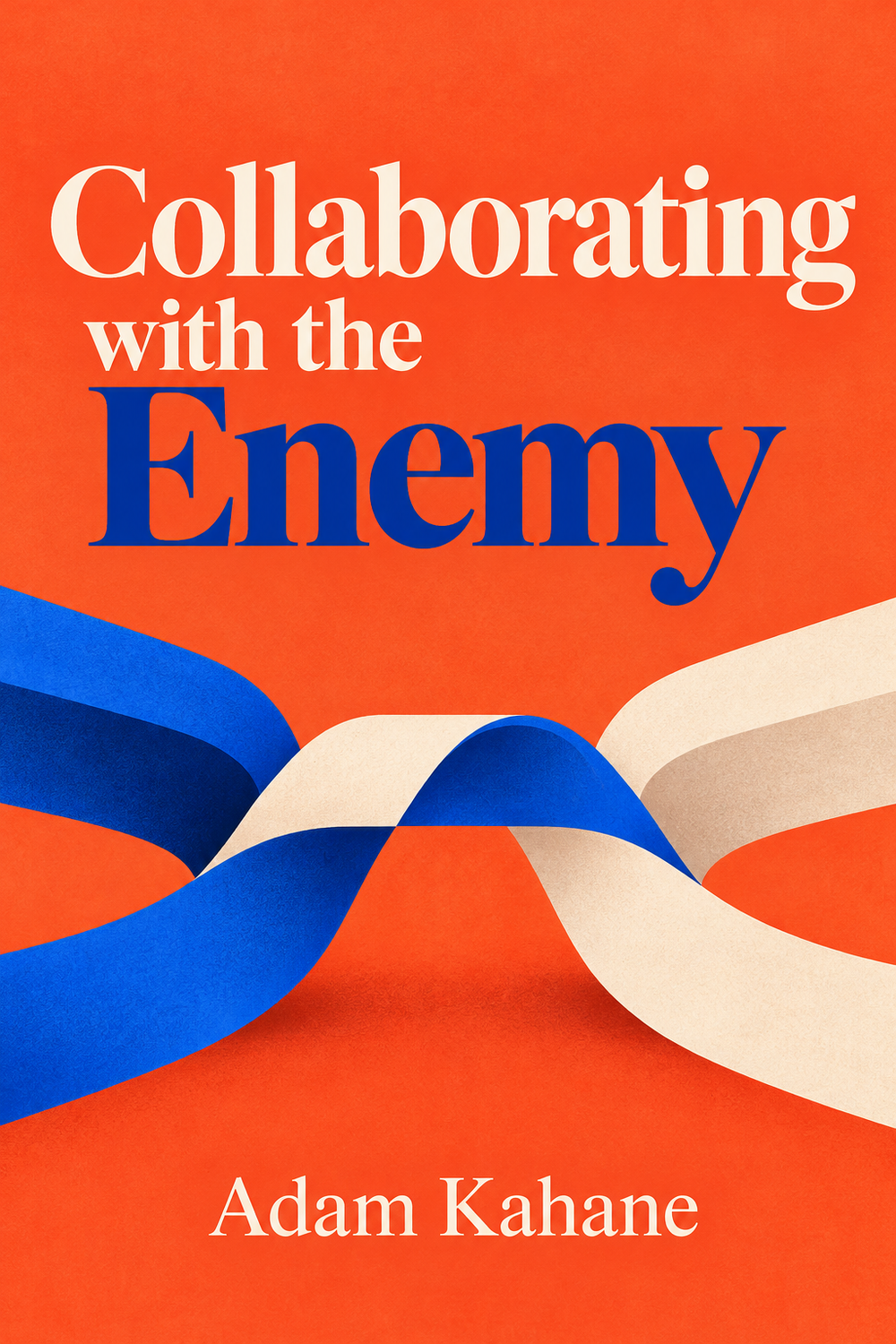
Collaborating with the Enemy Book Summary
This Collaborating with the Enemy Book Summary covers the key ideas, lessons, and takeaways in about 20 minutes.
Short Description:
How to work with people you distrust by changing your own part, not theirs
You don't need to agree with, like, or trust the people you work with to get something meaningful done together. What you need is the willingness to name your differences while still building real connection, to try things out instead of waiting for a perfect plan, and to stop waiting for others to change and look instead at your own part in the problem. You can't control the other side, but you can always change what you bring to the table, and that is often what moves everything else.
Helps with these goals
Preview the Collaborating with the Enemy book summary
Below is a preview of Sumizeit’s comprehensive human-written summary of Collaborating with the Enemy by Adam Kahane. The full summary is 15-20 minutes long and covers the book’s key ideas in text, audio, visual, and video formats. Unlock the full 20 Minute Summary
Working with people you don't agree with, like, or trust used to be a rare problem. Now it's an everyday one. Globalization, technology, and social media put us in constant contact with people whose values and interests differ from ours, at work, in our communities, and in politics. Adam Kahane wrote Collaborating with the Enemy (2017) for exactly this situation.
Kahane has spent more than 30 years as a conflict mediator. He has worked with governments, corporations, and civil society groups, and his cases range from post apartheid South Africa to corporate boardrooms. Across all of it, he noticed the same thing. In messy, contested situations, the way forward is rarely clear or straight. It shows up as people walk it together, even people who start out seeing each other as obstacles.
His answer is a method he calls stretch collaboration. The idea is to embrace conflict, experiment instead of over planning, and change your own behavior instead of trying to change other people. The book never promises harmony or universal agreement. It promises a way to get things done without them.
What stretch collaboration is
Kahane starts with what he calls traditional collaboration, which rests on three assumptions. You should focus on harmony and keep conflict out of the team. You should agree on a detailed plan before anyone acts. And you can change what other people are doing if you try hard enough. These assumptions can work fine when a small group of people think alike. In complex and contentious settings, they fail.
They fail for three reasons. First, demanding harmony between people with truly different interests and worldviews creates a false unity, and it eventually cracks. Second, insisting on a detailed plan up front is impossible when the group can't agree on goals or methods, so you get paralysis or shallow agreements that nobody is committed to. Third, believing you can change others breeds frustration and blame when they don't change.
There's a fourth problem, and it makes the other three worse. We often turn people we disagree with into adversaries, people to be beaten or shut out. Once that happens, collaboration of any kind becomes close to impossible. Seeing someone as different from you is normal. Seeing them as your enemy usually needs extra fuel, such as feeling threatened, competing for resources, believing your values are morally superior, or following leaders who profit from division.
Stretch collaboration asks you to leave your comfort zone in three ways. You acknowledge both differences and connections. You work in an adaptive, iterative way instead of agreeing on a fixed plan. And you focus on changing your own contribution. The approach accepts that you can't control what happens in a complex situation, but you can influence it through how you take part. It also asks you to hold two ideas that seem to pull against each other. You assert your own interests while engaging with others, and you accept the situation as it is while working to change it.
Principle…
Want the complete 20-minute summary?
- Full structured summary
- Video Summary
- Podcast Summary
- Audio summary
- Key takeaways
- Exercises
- Quiz
- Highlights and notes
- Ask the book with AI
Who should read Collaborating with the Enemy?
Collaborating with the Enemy is for anyone who must work with people they fundamentally disagree with—managers navigating diverse teams, community organizers bringing together conflicting groups, negotiators in contentious situations, and leaders facing polarization. If you find yourself in a complex environment where harmony isn't possible but progress is necessary, this book offers a practical framework.
Why does Collaborating with the Enemy matter?
In an increasingly globalized and polarized world, the ability to collaborate across deep disagreements has become essential. Adam Kahane's stretch collaboration method moves beyond the false assumption that agreement is necessary for progress, offering a realistic approach for getting things done in messy, contested situations. Rather than waiting for others to change, this book teaches you to change your own contribution and unlock new possibilities.
What are the key themes in Collaborating with the Enemy?
- Embracing conflict as necessary and creative rather than something to avoid
- Balancing assertion of your own interests with genuine engagement with others
- Learning through experimentation and iteration instead of fixed planning
- Personal responsibility for changing your own behavior as the primary lever for change
- Holding multiple perspectives and truths simultaneously in complex systems
- Building connection without requiring agreement or false harmony
How can you apply ideas from Collaborating with the Enemy?
- Map the power and love drives operating in your current difficult collaboration—identify who is pushing hard on interests and who is prioritizing harmony, then consciously introduce the missing element
- Name one conflict or tension in your team or project openly and honestly, separating what people say they want from why they actually want it
- Design a small pilot or prototype to test a risky assumption before committing full resources, building in feedback loops to track what you learn
- Identify one habitual reaction you have in high-stakes situations and practice a different response in lower-stakes settings first
- Ask one genuine question per meeting where you're genuinely curious about someone's perspective rather than trying to persuade them, and notice what becomes possible
- Audit how much time your team spends in downloading/debating versus dialoguing/presencing conversations, and deliberately shift toward the generative modes
- Make a unilateral move toward the outcome you want without waiting for others to change first—model the behavior or attitude shift you wish to see
What common mistakes do readers make with Collaborating with the Enemy?
- Assuming that detailed planning and agreement on goals must come before action—in complex situations, clarity often emerges through experimentation rather than upfront consensus
- Focusing primarily on changing other people's behavior while ignoring your own contribution—this creates defensiveness and removes your leverage for influence
- Treating disagreement or conflict as a sign that collaboration is failing—real differences are necessary for creative solutions and must be surfaced, not suppressed
- Operating only in one mode (either always asserting your position or always seeking connection)—effectiveness requires switching between power and love depending on what the moment needs
- Waiting for perfect information or certainty before acting—complex systems reveal possibilities only through action and iteration
Sumizeit Exercises Apply what you've learned
Turn ideas from Collaborating with the Enemy into action with a short guided reflection: identify the biggest takeaway, connect it to your life, and commit to one step you can take in the next 24 hours.
What is the expert analysis of Collaborating with the Enemy?
Overview
Collaborating with the Enemy is authored by Adam Kahane, a seasoned conflict mediator with over three decades of experience working across governments, corporations, and civil society worldwide. The book addresses a pressing contemporary challenge: how to collaborate effectively with people whose values, interests, or worldviews are fundamentally different or even opposed to one’s own. Kahane’s extensive practical background, including work in post-apartheid South Africa and complex corporate environments, grounds the book’s insights in real-world complexity. Its significance lies in offering a fresh, pragmatic approach to collaboration that acknowledges conflict as inevitable and even necessary, rather than something to be avoided or superficially managed.
Core Thesis
Kahane’s central argument is that traditional collaboration models—based on assumptions of harmony, fixed planning, and changing others—are inadequate for today’s complex, contentious environments. Instead, he proposes stretch collaboration, a method that embraces conflict, favors adaptive experimentation over rigid planning, and focuses on changing one’s own behavior rather than attempting to control others. This approach requires holding seemingly contradictory ideas simultaneously: asserting one’s own interests while engaging with others, and accepting the current reality while working to change it. The book’s core insight is that meaningful progress emerges not from eliminating differences but from navigating and leveraging them through iterative, self-reflective participation.
Strengths
- Grounded Practicality: Kahane’s framework is deeply informed by decades of high-stakes mediation, lending credibility and nuance to his prescriptions.
- Realistic Embrace of Conflict: Unlike many self-help or management books that seek consensus or harmony, this work acknowledges conflict as an essential and generative force in collaboration.
- Actionable Principles: The three principles—acknowledging both differences and connections, adopting an adaptive iterative approach, and focusing on changing one’s own contribution—are clearly articulated and supported by concrete practices.
- Psychological Sophistication: Kahane’s recognition of the dual human drives for power and love, and the recommendation to alternate between them, offers a psychologically rich lens on interpersonal dynamics.
- Encouragement of Self-Reflection: The emphasis on self-awareness, behavioral experimentation, and ongoing learning empowers readers to take ownership of their role in complex interactions.
Critiques & Counterarguments
- Potential Overemphasis on Individual Agency: While focusing on changing one’s own contribution is empowering, it may understate structural or systemic power imbalances that constrain individual influence, especially in highly hierarchical or politicized contexts.
- Complexity of “Enemy” Dynamics: The book’s encouragement to engage with adversaries may be overly optimistic in situations marked by deep ideological polarization or zero-sum conflicts, where mutual recognition and trust are severely eroded.
- Limited Engagement with Alternative Collaboration Models: Kahane’s critique of traditional collaboration is compelling, but the book could benefit from a more detailed comparison with other contemporary frameworks such as integrative negotiation, deliberative democracy, or conflict transformation theories.
- Empirical Validation: The stretch collaboration method, while intuitively appealing and supported by case examples, lacks rigorous empirical testing or quantitative evidence demonstrating its efficacy across diverse contexts.
- Risk of Ambiguity in Practice: The balance between asserting interests and engaging others, or accepting reality while seeking change, may be difficult for practitioners to operationalize without more concrete decision-making heuristics or conflict resolution tools.
Who Should Read This
This book is ideal for leaders, managers, mediators, and anyone regularly navigating complex, high-stakes collaborations involving diverse or conflicting stakeholders. It is particularly valuable for those working in globalized, multicultural, or politically charged environments where traditional consensus-building approaches falter. Additionally, readers interested in the intersection of psychology, conflict resolution, and organizational behavior will find Kahane’s integration of human drives and adaptive learning both insightful and practical. Finally, those seeking a realistic, humility-infused approach to collaboration—one that accepts imperfection and complexity rather than promising easy harmony—will benefit greatly from this work.
Discussion questions for Collaborating with the Enemy Short questions you can actually use in a conversation
Frequently asked questions about the Collaborating with the Enemy book summary
What is Collaborating with the Enemy about?
Collaborating with the Enemy by Adam Kahane presents a framework called stretch collaboration for working effectively with people you fundamentally disagree with. The book moves beyond the false assumption that harmony or agreement is necessary for progress, instead teaching readers to acknowledge differences while building connection, experiment through iteration rather than fixed planning, and change their own contribution as the primary lever for influence. Kahane draws on 30 years of experience mediating conflicts in government, corporate, and civil society settings to offer practical approaches for getting things done in messy, contested situations.
Who should read Collaborating with the Enemy?
This book is essential for leaders, managers, negotiators, and organizers who must work across deep disagreements—whether in diverse teams, community initiatives, corporate mergers, or political contexts. Anyone frustrated by polarization or stuck in conflicts where agreement seems impossible will find practical tools here. The book also speaks to people who want to move from blame and finger-pointing to personal responsibility for shifting difficult dynamics.
What are the main takeaways from Collaborating with the Enemy?
The core insight is that you don't need agreement, likability, or trust to accomplish meaningful work together. Instead, you need the willingness to name differences openly while building genuine connection, to experiment and adapt rather than wait for perfect plans, and most importantly, to change your own participation instead of waiting for others to change. By controlling what you bring to difficult collaborations, you create new possibilities and incentives that allow others to shift as well.
What is stretch collaboration?
Stretch collaboration is Adam Kahane's framework for working across disagreement and conflict. It rests on three principles: acknowledge both differences and connections by alternating between asserting your interests and engaging with others; use adaptive, iterative approaches that experiment and learn rather than relying on fixed plans; and focus on changing your own contribution as the primary way to influence complex systems. Unlike traditional collaboration that assumes harmony is possible, stretch collaboration accepts disagreement as necessary and uses it productively.
How does Kahane suggest handling conflict in a team or organization?
Kahane argues that conflict should be surfaced and named openly rather than suppressed or smoothed over. He recommends separating positions (what people say they want) from interests (why they want it), telling personal stories that reveal what drives you, and listening closely to understand others' perspectives. The goal is not to resolve conflict through agreement but to maintain both the honesty about differences and the connection between people—alternating between assertion and engagement as needed.
What does Kahane mean by power and love drives?
Kahane describes two fundamental human drives: power (the push toward self-realization and asserting your own interests) and love (the pull toward connection and unity). Most people lean heavily on one and neglect the other, which limits their effectiveness in mixed groups. Power without love creates fragmentation; love without power creates false harmony. The solution is to alternate between the two—sometimes stating your position firmly, other times stepping back to listen and connect.
Why does Kahane criticize detailed upfront planning?
In complex, contested situations, detailed planning fails because nobody knows what will work until it's tried, situations constantly change, different stakeholders want different things, and some possibilities only emerge once people start acting. Kahane argues that the way forward gets discovered by walking it, not by predicting it. Instead of fixing a plan, he advocates for putting multiple possibilities on the table, testing assumptions with small trials, building fast feedback loops, and adjusting based on what you learn.
How can someone change their own contribution in a difficult collaboration?
Kahane offers three pathways: change how you look at the situation by recognizing your blind spots and challenging your assumptions about others; change how you talk and listen by moving into more generative modes like dialoguing and presencing; and change what you do by experimenting with different behaviors and making unilateral moves toward the outcome you want. This requires self-awareness of your triggers, practice with new behaviors in low-stakes situations, and support from colleagues or mentors who can give honest feedback.
About Sumizeit
Sumizeit is a profitable Scomy LLC company based in Miami, Florida. Our founders, Clemens Raemy and Weina Scott, are successful entrepreneurs with several exits. Sumizeit is a popular book summary app / micro learning app used by busy professionals and entrepreneurs with over 2,500 non-fiction book summaries and 10,000 podcast summaries in text, audio, visual, podcast, and video format. We also have stellar retention tools to make ideas stick - such as flashcards with spaced repetition, quizzes, streaks, highlighting and notes, daily challenges, riddles, mini-courses, meditation, and more. You won't only learn the idea, but also remember it. Over 90% of our users change their habits with Sumizeit.
Upgrade Now
Here's why readers love Sumizeit
Join thousands of learners getting smarter every day
"Great experience. Detailed summaries. Loved the gamification feature. Makes learning fun. Good customer service. I recommend Sumizeit to anyone. You'll learn a lot."
"I always felt busy but still wanting to keep up with the book discussion in my friend group. This was a great supplement to help me keep reading the books I find fun while keeping up with important books."
"I love this website. Instead of scrolling social media, I find myself learning a lot. I use it everyday. I recommend this app for anyone who is too busy and wants to get up to speed with their favorite books."
Collaborating with the Enemy Book Summary PDF
Looking for a Collaborating with the Enemy Book Summary PDF you can save and revisit offline? Our Collaborating with the Enemy Book Summary PDF captures the book’s core ideas in a clean, printable format — the key frameworks, takeaways, and structure without the fluff. Download the Collaborating with the Enemy Book Summary PDF when you want a reference you can annotate, share with your team, or review on the go. Get your Collaborating with the Enemy Book Summary PDF from the download page below.
Download Collaborating with the Enemy Book Summary PDFPeople also liked these summaries
Readers who explored Collaborating with the Enemy often enjoyed these titles next.




Ready to read the whole thing?
- Full structured summary
- Video Summary
- Podcast Summary
- Audio summary
- Key takeaways
- Exercises
- Quiz
- Highlights and notes
- Ask the book with AI
Featured Book Titles
Popular Book Summaries at sumizeit, leading book summary app
Atomic Habits Book Summary Rich Dad Poor Dad Book Summary The Four Agreements Book Summary The 48 Laws of Power Book Summary When Breath Becomes Air Book Summary Think and Grow Rich Book Summary