


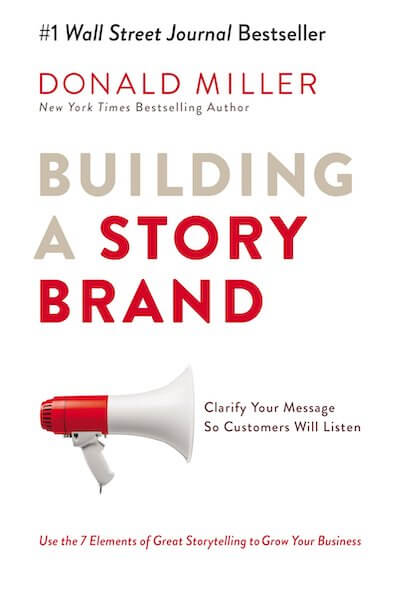
Prefer the print book? Buy on Amazon
As an Amazon Associate, Sumizeit earns from qualifying purchases.
Building a StoryBrand Book Summary
This Building a StoryBrand Book Summary covers the key ideas, lessons, and takeaways in about 20 minutes.
Short Description:
Building a StoryBrand uses storytelling to clarify brand messages and connect.
Helps with these goals
Preview the Building a StoryBrand book summary
Below is a preview of Sumizeit’s comprehensive human-written summary of Building a StoryBrand by Donald Miller. The full summary is 15-20 minutes long and covers the book’s key ideas in text, audio, visual, and video formats. Unlock the full 20 Minute Summary
Stories are all around us.
They are featured in movies, podcasts, comic books, web series, the list goes on and on.
And chances are, stories have helped to shape you into the person you are today.
So, how can you take the power of a story and use it to brand your product?
“Never assume people understand how your brand can change their lives. Tell them.”- Donald Miller
In Donald Miller’s, “Building A StoryBrand”, you will learn how to harness the power of the story and create a unique StoryBrand for your product.
Your newly developed StoryBrand will help you create an irresistible brand and get a leg up on the competition by connecting on a deeper level with your customers.
A Clear Marketing Message
A fancy new website won’t make sales increase all on its own. You need a straight-forward and clear marketing message to accompany it.
“Pretty websites don’t sell things. Words sell things.”- Donald Miller
There cannot be any confusion or the customer will deem the product or brand too complicated. It should be very easy-to-understand for everyone.
The marketing message should tell the consumer three things:
If a customer is confused by your message, they will not stick around to try to figure it out. They will go to another competitor that has a simpler message.
To help you develop your message, you should always think of the customer first. How does your service help them?
To make it easier on yourself, think of Psychologist Abraham Maslow’s Hierarchy of Needs which includes, food and drink, safety and shelter, companionship, and greater needs such as spirituality and self-love.
Use this hierarchy to target how your product helps the consumer.
StoryBrand 7-Part Framework
A good story holds your attention. It can make an hour or two fly by without you even noticing it.
The difference between a story versus video clips, or social media posts, is that it is organized information in a specific structure. There is a beginning, middle, and end. This makes it more memorable and easier for people to retell.
“In every line of copy we write, we’re either serving the customer’s story or descending into confusion; we’re either making music or making noise.”- Donald Miller
A story is like a song. It is easier to remember a song than simple noises such as doors slamming and cars honking. A song can get stuck in your head, just like a story.
To create a catchy story, use the 7-Part StoryBrand Framework which includes 7 aspects of a story: character, problem, guide, plan, calls to action, failure, and success.
Before we break it down more, the rough outline of this module is that the character wants something that is hard to attain. When they are about to give up on what they want, a guide appears. This guide instructs the character what to do. This will allow the character to succeed rather than fail.
With this StoryBrand module, you will develop your StoryBrand Script which will…
Want the complete 20-minute summary?
- Full structured summary
- Video Summary
- Podcast Summary
- Audio summary
- Key takeaways
- Exercises
- Quiz
- Highlights and notes
- Ask the book with AI
Who should read Building a StoryBrand?
Building a StoryBrand is essential for entrepreneurs, marketing professionals, and business owners who struggle to communicate their value clearly. If your website, messaging, or pitch leaves customers confused about how you help them, this book provides a proven framework to fix it. Anyone responsible for brand messaging—from startups to established companies—will benefit from Donald Miller's practical approach to turning complex offerings into compelling narratives.
Why does Building a StoryBrand matter?
In today's noisy digital landscape where customers encounter thousands of advertisements daily, unclear messaging means lost sales. Building a StoryBrand teaches you how to cut through the clutter by centering your customer as the hero and positioning your brand as their guide. This shift from company-focused to customer-focused storytelling directly increases conversion rates and customer loyalty.
What are the key themes in Building a StoryBrand?
- Customer as the protagonist in your brand narrative
- Clarity and simplicity in marketing messaging
- Emotional connection through understanding customer problems
- The power of storytelling structure in business
- Risk reduction and trust-building strategies
- Internal problems matter more than external features
How can you apply ideas from Building a StoryBrand?
- Rewrite your website copy to position your customer as the hero and your brand as their trusted guide
- Identify one internal problem your product solves beyond its external features, then build messaging around that emotional benefit
- Create a direct call-to-action button and a transitional call-to-action offer (like a free resource) to capture customers at different stages
- Audit your current messaging against the 7-Part Framework to identify missing narrative elements
- Gather social proof like testimonials, statistics, and certifications to build authority alongside your empathetic messaging
- Test messaging variations that highlight what customers lose without your solution versus what they gain with it
- Map your product features to Maslow's Hierarchy of Needs to determine which level of human motivation you're addressing
What common mistakes do readers make with Building a StoryBrand?
- Making your brand story about your company's journey instead of the customer's transformation and needs
- Using vague, creative language that sounds good but doesn't clearly explain what you do or how you help
- Listing product features without connecting them to emotional or practical customer outcomes
- Forgetting to include a clear call to action, leaving customers uncertain about the next step to take
- Relying solely on empathy without demonstrating authority through proof, credentials, or social validation
- Focusing only on positive outcomes while ignoring the fear or frustration that motivates purchase decisions
Sumizeit Exercises Apply what you've learned
Turn ideas from Building a StoryBrand into action with a short guided reflection: identify the biggest takeaway, connect it to your life, and commit to one step you can take in the next 24 hours.
What is the expert analysis of Building a StoryBrand?
Overview
Building a StoryBrand is authored by Donald Miller, a prominent figure in the realm of marketing and brand strategy. Miller is renowned for his ability to distill complex marketing concepts into accessible frameworks, and his work with StoryBrand has influenced major companies such as Pantene and Chick-fil-A. This book stands out by marrying the timeless power of narrative with practical business application, offering a structured approach to crafting clear, compelling brand messages that resonate deeply with customers.
Core Thesis
Miller’s central argument is that brands must position their customers as the heroes of their own stories, with the brand acting as the empathetic and authoritative guide. By applying a seven-part storytelling framework—character, problem, guide, plan, calls to action, failure, and success—businesses can clarify their messaging and overcome the confusion that often alienates potential customers. The thesis emphasizes that clarity in communication, grounded in understanding the customer’s internal and external problems, is paramount to successful marketing and brand differentiation.
Strengths
- Practical Framework: The seven-part StoryBrand framework provides a clear, actionable blueprint that marketers and business owners can readily implement.
- Customer-Centric Approach: By casting the customer as the hero, Miller shifts focus away from self-promotion toward genuine empathy and relevance, which aligns with modern consumer expectations.
- Integration of Psychological Insight: The use of Maslow’s Hierarchy of Needs to tailor messaging demonstrates a thoughtful connection between human motivation and marketing strategy.
- Emphasis on Clarity: Miller’s insistence that “words sell things” and that simplicity trumps flashy design addresses a common pitfall in branding—overcomplication.
- Engaging Narrative Style: The book itself models the storytelling principles it teaches, making it both instructive and enjoyable to read.
Critiques & Counterarguments
- Oversimplification of Brand Complexity: While the StoryBrand framework is elegant, some critics argue that it may oversimplify the multifaceted nature of brand identity, which often requires nuance beyond a single narrative arc.
- Limited Empirical Evidence: The book relies heavily on anecdotal examples and Miller’s professional experience rather than rigorous academic research or longitudinal studies validating the framework’s effectiveness across diverse industries.
- Potential Neglect of Brand Authenticity: Critics from the authenticity school of thought caution that framing customers strictly as heroes and brands as guides risks instrumentalizing relationships, potentially undermining genuine brand-consumer connections.
- Competing Marketing Models: Alternative frameworks, such as Simon Sinek’s “Start With Why” or Seth Godin’s emphasis on tribes and permission marketing, offer different lenses that prioritize intrinsic brand purpose or community over narrative structure.
- Changing Media Landscape: Some examples and strategies may feel dated in an era dominated by fast-moving social media trends and influencer marketing, where storytelling is often fragmented and nonlinear.
Who Should Read This
Building a StoryBrand is ideal for marketing professionals, entrepreneurs, and business leaders seeking to sharpen their brand messaging with a customer-focused, narrative-driven approach. It is particularly valuable for those who struggle with communicating their value proposition clearly and want a structured method to engage customers emotionally and intellectually. Additionally, students of marketing and brand strategy will find Miller’s framework a useful complement to more theory-heavy texts, offering practical tools that bridge storytelling and commerce.
Frequently asked questions about the Building a StoryBrand book summary
What is Building a StoryBrand about?
Building a StoryBrand by Donald Miller teaches you how to apply storytelling principles to brand marketing. The book presents a 7-part framework—character, problem, guide, plan, calls to action, failure, and success—that helps businesses craft clear, compelling messages that position customers as heroes and brands as helpful guides. By using structured narrative instead of confusing corporate speak, companies can connect emotionally with customers and dramatically improve sales.
Who should read Building a StoryBrand?
This book is essential for entrepreneurs, small business owners, marketing directors, and anyone responsible for brand messaging who wants to increase conversions and customer loyalty. If your current marketing message confuses customers or fails to explain how you solve their problems, Building a StoryBrand provides the exact framework and language patterns you need to fix it. Both startups and established companies like Chick-fil-A and Pantene have used Donald Miller's methodology successfully.
What are the main takeaways from Building a StoryBrand?
The core takeaways are: (1) make your customer the hero and your brand their guide, (2) clarify your message to answer who you are, what you do, and why someone should choose you, (3) address internal emotional problems alongside external ones, (4) demonstrate both empathy and authority in your messaging, and (5) use the 7-Part StoryBrand Framework to create memorable narratives that drive action. Implementing these principles directly increases brand clarity, customer trust, and sales conversion.
How does the 7-Part StoryBrand Framework work?
The framework structures your brand message like a complete story: the customer (character) faces a challenge (problem), your brand acts as a guide showing the solution (guide), you explain exactly what to expect (plan), you tell them to take action (calls to action), you show what they lose without your help (failure), and finally you paint a picture of the success they'll achieve (success). This narrative structure makes your message memorable and persuasive.
Why should I focus on customer problems instead of my product features?
Customers don't buy products; they buy solutions to problems. When you focus on the customer's struggle—especially their internal emotional struggle—you build empathy and trust, making your message resonate far more powerfully than a feature list ever could. Donald Miller emphasizes that customers feel understood and valued when you acknowledge their pain, which motivates them to buy from you rather than competitors.
What's the difference between direct and transitional calls to action?
A direct call to action explicitly asks customers to buy immediately with buttons like 'Purchase' or 'Sign Up Now.' A transitional call to action offers something free—like a webinar, discount, or guide—to build a relationship and keep your brand top-of-mind for future purchase. Both are necessary: direct calls convert ready-to-buy customers, while transitional calls nurture those still exploring solutions.
How do I demonstrate authority in my marketing without sounding arrogant?
Show, don't tell. Use concrete social proof like customer testimonials, satisfaction statistics, awards, certifications, and case studies to demonstrate your expertise and reliability. Donald Miller emphasizes that authority built on evidence—not claims—builds genuine trust. Combine this evidence-based authority with empathetic language that shows you understand the customer's problem, and you'll be seen as a trustworthy guide rather than a boastful company.
Should I explain the internal or external benefits of my product?
Both matter, but internal benefits—the emotional and psychological transformation—typically drive purchasing decisions more powerfully than external features. While external problems are tangible (needing a soft towel), internal problems are emotional (wanting to feel pampered and cared for). The most effective messaging connects external solutions to internal emotional benefits, showing customers how your product makes them feel better about themselves.
About Sumizeit
Sumizeit is a profitable Scomy LLC company based in Miami, Florida. Our founders, Clemens Raemy and Weina Scott, are successful entrepreneurs with several exits. Sumizeit is a popular book summary app / micro learning app used by busy professionals and entrepreneurs with over 2,500 non-fiction book summaries and 10,000 podcast summaries in text, audio, visual, podcast, and video format. We also have stellar retention tools to make ideas stick - such as flashcards with spaced repetition, quizzes, streaks, highlighting and notes, daily challenges, riddles, mini-courses, meditation, and more. You won't only learn the idea, but also remember it. Over 90% of our users change their habits with Sumizeit.
Upgrade Now
Here's why readers love Sumizeit
Join thousands of learners getting smarter every day
"Great experience. Detailed summaries. Loved the gamification feature. Makes learning fun. Good customer service. I recommend Sumizeit to anyone. You'll learn a lot."
"I always felt busy but still wanting to keep up with the book discussion in my friend group. This was a great supplement to help me keep reading the books I find fun while keeping up with important books."
"I love this website. Instead of scrolling social media, I find myself learning a lot. I use it everyday. I recommend this app for anyone who is too busy and wants to get up to speed with their favorite books."
Building a StoryBrand Book Summary PDF
Looking for a Building a StoryBrand Book Summary PDF you can save and revisit offline? Our Building a StoryBrand Book Summary PDF captures the book’s core ideas in a clean, printable format — the key frameworks, takeaways, and structure without the fluff. Download the Building a StoryBrand Book Summary PDF when you want a reference you can annotate, share with your team, or review on the go. Get your Building a StoryBrand Book Summary PDF from the download page below.
Download Building a StoryBrand Book Summary PDFPeople also liked these summaries
Readers who explored Building a StoryBrand often enjoyed these titles next.


Ready to read the whole thing?
- Full structured summary
- Video Summary
- Podcast Summary
- Audio summary
- Key takeaways
- Exercises
- Quiz
- Highlights and notes
- Ask the book with AI
Featured Book Titles
Popular Book Summaries at sumizeit, leading book summary app