


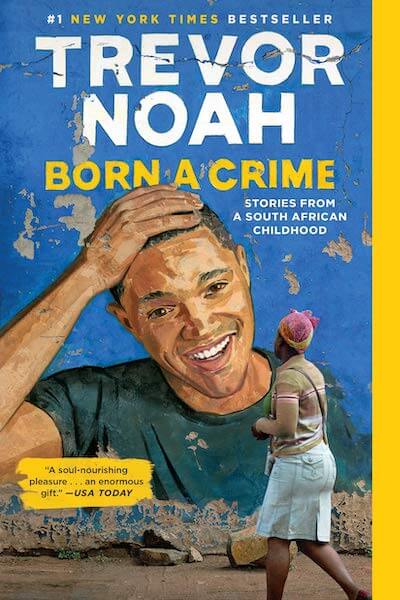
Prefer the print book? Buy on Amazon
As an Amazon Associate, Sumizeit earns from qualifying purchases.
Born a Crime Book Summary
This Born a Crime Book Summary covers the key ideas, lessons, and takeaways in about 20 minutes.
Short Description:
Trevor Noah faced poverty and racism growing up mixed-race during apartheid.
Helps with these goals
Want the complete 20-minute summary?
- Full structured summary
- Video Summary
- Podcast Summary
- Audio summary
- Key takeaways
- Exercises
- Quiz
- Highlights and notes
- Ask the book with AI
Want a Free Weekly Read?
Get a free summary every week straight to your mailbox.
Preview the Born a Crime book summary
Below is a preview of Sumizeit’s comprehensive human-written summary of Born a Crime by Trevor Noah. The full summary is 15-20 minutes long and covers the book’s key ideas in text, audio, visual, and video formats. Unlock the full 20 Minute Summary
You’ve probably heard of the late-night South African comedian, Trevor Noah.
Trevor Noah famously took over Jon Stewart’s, The Daily Show, in September of 2015.
But, there is much more to this satire-loving comic than many people know.
“You want to live in a world where someone is good or bad. Where you either hate them or love them. But that's not how people are.”- Trevor Noah
In, “Born A Crime” by Trevor Noah, you will learn the star’s life story. And, how he was affected by the racist beliefs of his country, where life for a mixed-race person is systematically cruel.
Trevor Noah Was A Crime From Birth
Noah was born during apartheid in South Africa, which was racial segregation that was active between the years of 1948 and 1991.
“Relationships are built in the silences. You spend time with people, you observe them and interact with them, and you come to know them—and that is what apartheid stole from us: time.” - Trevor Noah
This segregation system was set in place in 1948, but the roots stretch much farther. In 1652, the Dutch settled in South Africa and took the people of the land as slaves.
In the 1800s, the British then took control of the land and the people. So, the Dutch decided to high-tail it inland in order to develop their own unique culture. They gained the name Afrikaners.
After the British left, the Afrikaners returned and created a code of laws that oppressed the native black people.
One part of the code made it clear that whites and blacks were not allowed to procreate or have any sexual encounters with each other. This was to keep the races completely separate so that it could not tear apart the racist apartheid system.
People who did intermingle with the other race were put into prison. Men were sent for up to five years and women would serve no more than four.
Keeping the races separate was essential to keeping the racist system intact. And because it was so important, police would peek into windows to try to bust interracial affairs.
On February 20th, 1984, Noah took his first breath. Noah’s mother was black and his father was white, which made Noah the evidence of a serious crime: interracial intercourse.
Noah’s Parents Prove That Opposites Attract
Noah’s parents were different racially, but they were also different in many other ways.
Noah’s father was named Robert. He was of Swiss and German heritage. In the 1970s, he moved to South Africa. Robert was a very quiet man who didn’t quite understand the apartheid system he was living in. Later in his life, he opened the first racially-mixed dining spot in the town Johannesburg.
Unfortunately, Noah wasn’t able to visit his father as much as he’d like to because of the racial system. By the time Noah was 13, they didn’t talk anymore.
But, when Noah turned 24, he was able to visit his father again and was welcomed with…
Want the complete 20-minute summary?
- Full structured summary
- Video Summary
- Podcast Summary
- Audio summary
- Key takeaways
- Exercises
- Quiz
- Highlights and notes
- Ask the book with AI
Who should read Born a Crime?
Born a Crime is essential for anyone seeking to understand the human impact of systemic racism and apartheid through a personal, intimate lens. This memoir resonates with readers interested in memoir, social justice, comedy, and overcoming adversity, as well as those who want to understand post-colonial Africa and the resilience required to build a life under oppressive systems.
Why does Born a Crime matter?
Trevor Noah's Born a Crime offers a rare, unflinching look at life as a mixed-race person in apartheid South Africa, a perspective often missing from mainstream narratives about this dark period of history. The book demonstrates how individuals and families navigate impossible circumstances with humor, determination, and love, making it deeply relevant to contemporary discussions about race, identity, and systemic inequality.
What are the key themes in Born a Crime?
- Identity and belonging in a divided society
- The resilience and power of maternal love
- Navigating racial and social hierarchies
- The long shadow of historical oppression
- Language as a survival tool and bridge
- Poverty and the search for economic opportunity
Want the complete 20-minute summary?
- Full structured summary
- Video Summary
- Podcast Summary
- Audio summary
- Key takeaways
- Exercises
- Quiz
- Highlights and notes
- Ask the book with AI
How can you apply ideas from Born a Crime?
- Use Trevor's example of learning multiple languages to expand your ability to connect with diverse communities and navigate unfamiliar social contexts
- Adopt Patricia's approach to parental involvement by prioritizing intellectual development and critical thinking over material accumulation
- Recognize how systemic barriers (not individual failings) create economic desperation, encouraging empathy when encountering people in difficult circumstances
- Develop humor and storytelling skills as tools for processing trauma and building connection across divides
- Advocate for institutional accountability in cases of domestic violence and protect vulnerable populations from state indifference
- Seek mentorship and opportunities from people outside your immediate circle, as cross-cultural relationships often provide unexpected pathways forward
What common mistakes do readers make with Born a Crime?
- Viewing apartheid as historical and irrelevant, missing its ongoing impact on contemporary South African inequality and global racial structures
- Romanticizing poverty and struggle rather than recognizing it as a system that limits choices and opportunity
- Assuming identity is fixed, when Trevor's experience shows it is contextual, navigated, and sometimes strategic
- Overlooking the role of maternal and community support in overcoming systemic barriers, attributing success solely to individual merit
Sumizeit Exercises Apply what you've learned
Turn ideas from Born a Crime into action with a short guided reflection: identify the biggest takeaway, connect it to your life, and commit to one step you can take in the next 24 hours.
What is the expert analysis of Born a Crime?
Overview
Born a Crime is a compelling memoir by Trevor Noah, the acclaimed South African comedian and host of The Daily Show. This work stands out not only as a personal narrative but as a vivid historical document chronicling the complexities of apartheid and its aftermath through the eyes of a mixed-race child born into a system that criminalized his very existence. Noah’s unique vantage point as both an insider and outsider in South African society lends the book a rare authenticity and emotional depth. Beyond its autobiographical nature, the book serves as a cultural critique and a testament to resilience, narrated with Noah’s characteristic wit and insight.
Core Thesis
The central argument of Born a Crime revolves around the paradox of identity and belonging in a racially segregated society. Noah posits that apartheid’s rigid racial classifications and oppressive laws not only dehumanized individuals but also fractured social and familial bonds. His life story illustrates how systemic racism can shape personal identity, social interactions, and survival strategies. Moreover, Noah asserts that language, culture, and personal relationships are pivotal in navigating and ultimately transcending the imposed racial divides. The memoir suggests that despite institutionalized oppression, hope, humor, and determination can forge paths toward dignity and self-definition.
Strengths
- Authentic Voice and Narrative Style: Noah’s storytelling is both engaging and accessible, blending humor with poignant reflection. This balance makes complex historical and social issues relatable without diminishing their gravity.
- Historical and Cultural Insight: The memoir provides a nuanced exploration of apartheid’s legacy, illuminating its effects on everyday life and interpersonal relationships in South Africa.
- Multidimensional Character Portrayals: The vivid depictions of Noah’s mother, father, and other figures enrich the narrative, offering diverse perspectives on resilience, ambition, and survival.
- Intersection of Personal and Political: By intertwining his personal experiences with broader socio-political contexts, Noah effectively demonstrates how systemic injustice permeates individual lives.
- Exploration of Identity: The book thoughtfully examines the complexities of racial identity, especially the liminal space occupied by mixed-race individuals in a polarized society.
Critiques & Counterarguments
- Selective Historical Scope: While Noah provides valuable insights into apartheid and post-apartheid South Africa, some critics might argue that the memoir focuses predominantly on personal anecdotes at the expense of a more comprehensive socio-political analysis. The broader structural and economic dimensions of apartheid could be more thoroughly interrogated.
- Potential Oversimplification of Race Relations: The book’s narrative occasionally risks simplifying the complexities of racial identities and tensions by framing them primarily through Noah’s individual experiences, which may not fully capture the diversity of perspectives within South Africa’s multifaceted society.
- Limited Engagement with Opposing Perspectives: The memoir largely centers on the victimization and resilience of Noah and his family, with less attention given to the motivations, fears, or experiences of those who upheld apartheid, which could provide a more rounded understanding of the social dynamics.
- Contrasting Research on Post-Apartheid Progress: Some sociological studies suggest that while apartheid officially ended, systemic inequalities persist in more entrenched and complex forms, including economic disparities and institutional biases that the memoir touches on but does not deeply explore.
- Real-World Evidence of Persistent Challenges: The memoir’s hopeful tone about post-apartheid South Africa may contrast with ongoing issues such as political corruption, social unrest, and economic inequality, which complicate the narrative of progress and reconciliation.
Who Should Read This
Born a Crime is essential reading for those interested in memoirs that intersect with history, sociology, and cultural studies. It is particularly valuable for readers seeking to understand the human impact of apartheid beyond abstract political discourse. Scholars and students of race relations, post-colonial studies, and South African history will find Noah’s personal account a compelling complement to academic texts. Additionally, readers drawn to narratives of resilience, identity formation, and the transformative power of humor will appreciate Noah’s unique voice and perspective. Finally, anyone interested in the complexities of navigating identity in a divided society will find this memoir both enlightening and deeply moving.
Frequently asked questions about the Born a Crime book summary
What is Born a Crime about?
Born a Crime is Trevor Noah's memoir about growing up as a mixed-race child in apartheid South Africa, where his very existence was illegal under racist segregation laws. The book chronicles his childhood poverty in Soweto, his mother Patricia's fierce determination to give him a better life, his navigation of post-apartheid South Africa, and his eventual rise to become an internationally successful comedian. It is ultimately a story about identity, resilience, and the long shadow of systemic racism.
Who should read Born a Crime?
Born a Crime appeals to readers interested in memoir, social justice, history, and personal resilience narratives. It is particularly valuable for those seeking to understand apartheid's human impact, contemporary discussions about race and identity, or simply compelling stories of survival and transformation. Comedy fans will also appreciate Noah's wit throughout the narrative.
What are the main takeaways from Born a Crime?
The main takeaways include understanding how systemic racism operates not as abstract policy but as lived trauma affecting families and individuals; recognizing maternal love and education as transformative forces against oppression; appreciating how language, humor, and adaptability enable survival in divided societies; and acknowledging that legal equality does not instantly erase violence or create safety. Noah also illustrates that identity is fluid and multifaceted, shaped by context and choice.
How does Trevor Noah describe his mother Patricia?
Patricia is portrayed as an extraordinarily determined and resilient woman who prioritized Trevor's intellectual development despite living in poverty and facing systemic exclusion. She purchased books and encyclopedias to educate him, attended church regularly, and later escaped an abusive marriage. She is the moral and emotional center of the memoir, representing the power of maternal sacrifice and unwavering belief in her son's potential.
What role did apartheid play in Trevor Noah's childhood?
Apartheid directly shaped every aspect of Trevor's early life: his very existence as a mixed-race child was a criminal act under apartheid law; his family was separated by racial classification; he grew up in the segregated township of Soweto; he experienced poverty resulting from systemic exclusion of Black South Africans; and his access to education and opportunity were restricted by law. Even after apartheid ended, its violent aftermath continued to threaten his safety and that of his family.
How did Trevor Noah's DJ career begin?
Trevor began by selling bootleg CDs that he created by illegally downloading music and burning it to discs at age 16, using a CD burner borrowed from a wealthy white friend at school. This progressed into making his own tracks and DJing at parties, eventually building a thriving business with a dance crew. His DJ career became one of his primary sources of income during his teenage years and helped him develop entrepreneurial skills.
What does Born a Crime reveal about systemic racism in South Africa?
The memoir reveals that apartheid's racism operated through both explicit laws (criminalizing interracial relationships, enforcing residential segregation) and institutional indifference (police refusing to help abuse victims, educators failing marginalized students). Born a Crime shows that racism created cascading disadvantages—poverty, lack of education, vulnerability to crime and violence—that persisted even after legal apartheid ended, demonstrating that structural inequality requires more than legal reform to address.
About Sumizeit
Sumizeit is a profitable Scomy LLC company based in Miami, Florida. Our founders, Clemens Raemy and Weina Scott, are successful entrepreneurs with several exits. Sumizeit is a popular book summary app / micro learning app used by busy professionals and entrepreneurs with over 2,500 non-fiction book summaries and 10,000 podcast summaries in text, audio, visual, podcast, and video format. We also have stellar retention tools to make ideas stick - such as flashcards with spaced repetition, quizzes, streaks, highlighting and notes, daily challenges, riddles, mini-courses, meditation, and more. You won't only learn the idea, but also remember it. Over 90% of our users change their habits with Sumizeit.
Upgrade Now
Want the complete 20-minute summary?
- Full structured summary
- Video Summary
- Podcast Summary
- Audio summary
- Key takeaways
- Exercises
- Quiz
- Highlights and notes
- Ask the book with AI
Here's why readers love Sumizeit
Join thousands of learners getting smarter every day
"Great experience. Detailed summaries. Loved the gamification feature. Makes learning fun. Good customer service. I recommend Sumizeit to anyone. You'll learn a lot."
"I always felt busy but still wanting to keep up with the book discussion in my friend group. This was a great supplement to help me keep reading the books I find fun while keeping up with important books."
"I love this website. Instead of scrolling social media, I find myself learning a lot. I use it everyday. I recommend this app for anyone who is too busy and wants to get up to speed with their favorite books."
Born a Crime Book Summary PDF
Looking for a Born a Crime Book Summary PDF you can save and revisit offline? Our Born a Crime Book Summary PDF captures the book’s core ideas in a clean, printable format — the key frameworks, takeaways, and structure without the fluff. Download the Born a Crime Book Summary PDF when you want a reference you can annotate, share with your team, or review on the go. Get your Born a Crime Book Summary PDF from the download page below.
Download Born a Crime Book Summary PDFPeople also liked these summaries
Readers who explored Born a Crime often enjoyed these titles next.

Want the complete 20-minute summary?
- Full structured summary
- Video Summary
- Podcast Summary
- Audio summary
- Key takeaways
- Exercises
- Quiz
- Highlights and notes
- Ask the book with AI
Featured Book Titles
Popular Book Summaries at sumizeit, leading book summary app