


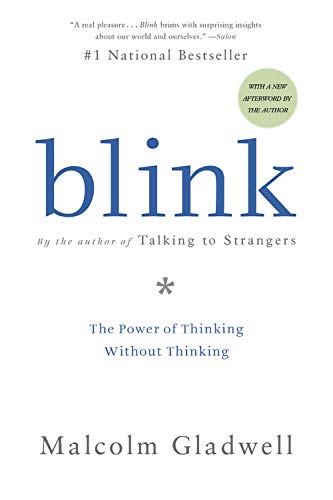
Prefer the print book? Buy on Amazon
As an Amazon Associate, Sumizeit earns from qualifying purchases.
Blink Book Summary
This Blink Book Summary covers the key ideas, lessons, and takeaways in about 20 minutes.
Short Description:
Blink explores how snap judgments can be accurate but also biased and flawed.
Helps with these goals
Preview the Blink book summary
Below is a preview of Sumizeit’s comprehensive human-written summary of Blink by Malcolm Gladwell. The full summary is 15-20 minutes long and covers the book’s key ideas in text, audio, visual, and video formats. Unlock the full 20 Minute Summary
Do you know when to trust your intuition? Do you know the best way to utilize those snap judgments to your benefit?
In Blink by Malcolm Gladwell, you will learn more about how your instincts are being backed up by further analysis of a situation, as well as how important your intuition really is.
Being able to make a decision using your gut feeling can be both a good thing and a bad thing, and it is important to know when it’s good and when it’s bad.
What Blink can show you
Often times, your intuition is a better source of judgment than even a more thorough analysis.
On the one hand, it is important to understand how intuition is able to look past information that is not relevant to the situation. On the other hand, you will also get a look at the drawbacks to this, as internal prejudices and perceptions can have a negative impact on the way you judge something.
With the help of Blink, you will understand how decision making can be impacted by knowing when to follow your intuition and when you need to further analyze a situation.
This is about finding a way to think about a situation without actually thinking about it. While we may think we are making a decision in the blink of an eye, these choices are not as easy as they seem. Beyond all of this, Blink is also a look at how great decision-makers are able to slice through excess details and make a choice in an instant with the help of their fine-tuned intuition.
It’s important to trust your intuition, as those judgments can be superior to your conscious choices
In order to make any decision, our brain typically relies on two different strategies.
The first strategy that our brain uses is recording and processing information, looking at the pros and cons of a situation, and reaching a conclusion that seems rational. However, the problem with this particular strategy is that it can be very slow and not ideal in certain situations where you need to make a snap decision.
The second strategy our brain uses is intuition, meaning we listen to our gut based on a snap judgment. Rather than utilizing complex thought processes, your unconscious mind is doing more of the work to make a decision.
Most people prefer to use their conscious decisions over snap judgments, as it can be an uneasy feeling to decide something without looking at all of the details. However, it seems that many times those unconscious decisions are more accurate than the ones that are made using a lot of rationalizing.
In many situations, there are regularities and patterns that stand out to our unconscious mind that allow us to make those snap judgments.
Our unconscious mind can make a decision about irrelevant and relevant information in mere moments
Being thorough can be seen as a good thing when making a decision.
Want the complete 20-minute summary?
- Full structured summary
- Video Summary
- Podcast Summary
- Audio summary
- Key takeaways
- Exercises
- Quiz
- Highlights and notes
- Ask the book with AI
Who should read Blink?
Blink is ideal for professionals, entrepreneurs, and decision-makers who want to understand the power of intuition in business and life. It's also valuable for anyone curious about cognitive psychology, consumer behavior, or how unconscious biases shape judgment. If you find yourself second-guessing gut feelings or struggling with analysis paralysis, this book offers practical insights into trusting your instincts.
Why does Blink matter?
In today's fast-paced world, the ability to make quick, accurate decisions is increasingly valuable—yet most of us are trained to overanalyze. Malcolm Gladwell's Blink challenges the assumption that more information always leads to better choices, revealing that our unconscious mind often outperforms careful deliberation. Understanding when to trust snap judgments versus when to proceed cautiously is critical for leaders, marketers, and anyone navigating complex decisions with limited time.
What are the key themes in Blink?
- The power of unconscious thought in decision-making
- How intuition filters relevant from irrelevant information
- The role of implicit bias and prejudice in snap judgments
- Stress and pressure reducing our ability to read non-verbal cues
- The gap between what consumers say and what they actually want
- Experience and exposure as tools to overcome prejudice
How can you apply ideas from Blink?
- In hiring, pay attention to your initial gut reaction about candidates, but also commit to reducing stress and distractions during interviews so you can read non-verbal cues accurately
- When launching new products, plan for a longer adoption curve and focus on building familiarity through exposure rather than expecting immediate consumer enthusiasm
- Before making major decisions, explicitly identify and eliminate information that's irrelevant to the choice at hand to reduce bias influence
- Regularly expose yourself to diverse perspectives and experiences to naturally reduce unconscious prejudices that could compromise judgment
- In high-pressure situations, create space to slow down and reduce stress to maintain your ability to recognize subtle but important signals
- Use realistic testing conditions when evaluating products or ideas, mirroring actual use rather than artificial research environments
- Trust your expertise and pattern recognition in domains where you have deep experience, but remain humble about snap judgments outside your area of mastery
What common mistakes do readers make with Blink?
- Assuming that more analysis always leads to better decisions, when sometimes less information carefully selected is superior
- Ignoring your gut reaction in favor of forced rationality, when your unconscious mind may have already detected important patterns
- Making snap judgments while under extreme stress or pressure, when tunnel vision compromises your ability to read the full situation
- Trusting market research findings without considering how artificial testing conditions differ from real-world consumer behavior
Sumizeit Exercises Apply what you've learned
Turn ideas from Blink into action with a short guided reflection: identify the biggest takeaway, connect it to your life, and commit to one step you can take in the next 24 hours.
What is the expert analysis of Blink?
Overview
Blink is a seminal work by Malcolm Gladwell, a Canadian journalist and acclaimed author known for his ability to distill complex psychological and social phenomena into accessible narratives. Published in 2005, the book explores the power and pitfalls of rapid cognition—our ability to make quick judgments and decisions in the blink of an eye. Gladwell’s reputation as a storyteller and his background in investigative journalism lend credibility and engagement to his examination of intuition, making Blink a significant contribution to popular psychology and decision-making literature.
Core Thesis
At the heart of Blink is the argument that snap judgments, or rapid cognition, can often be as accurate—or even more so—than decisions made through deliberate, analytical thought. Gladwell posits that our unconscious mind processes vast amounts of information instantly, filtering out irrelevant details and honing in on critical cues that inform our intuitive responses. However, he also acknowledges the inherent risks, such as unconscious biases and the influence of stress, which can distort these rapid assessments. The book ultimately advocates for a nuanced understanding of when to trust intuition and when to engage in deeper analysis.
Strengths
- Engaging Storytelling: Gladwell’s narrative style transforms scientific research into compelling stories that resonate with a broad audience, making complex cognitive processes accessible and memorable.
- Interdisciplinary Approach: The book draws on psychology, neuroscience, sociology, and business, providing a rich, multifaceted perspective on decision-making.
- Insightful Examples: Through vivid case studies—ranging from art experts’ snap judgments to market research failures—Gladwell illustrates the practical implications of rapid cognition in everyday life and professional contexts.
- Balanced Perspective: While championing intuition, the book does not romanticize it uncritically; it carefully outlines the dangers of prejudice and stress, encouraging readers to be mindful of context.
Critiques & Counterarguments
- Oversimplification of Complex Processes: Critics argue that Gladwell occasionally glosses over the complexity of cognitive science, presenting intuition as more universally reliable than evidence supports.
- Selective Use of Evidence: The book tends to highlight anecdotal and exceptional cases rather than systematic empirical studies, which can skew the perception of how often rapid cognition succeeds versus fails.
- Underestimation of Analytical Thinking: Some scholars contend that Gladwell undervalues the role of deliberate reasoning, especially in domains requiring expertise and sustained reflection.
- Competing Research: Research in behavioral economics and decision theory, such as the work by Daniel Kahneman and Amos Tversky, emphasizes systematic biases and heuristics that often lead to errors in snap judgments, challenging the notion that intuition is frequently superior.
- Contextual Limitations: Real-world decision-making often involves high stakes and complex variables that cannot be adequately addressed by intuition alone; thus, reliance on snap judgments without corroborating evidence can be risky.
Who Should Read This
Blink is ideal for readers interested in psychology, behavioral economics, and decision-making, particularly those who seek to understand the interplay between intuition and analysis. Business leaders, marketers, and professionals who regularly make rapid decisions will find valuable insights into harnessing their unconscious cognition effectively. Additionally, anyone curious about the cognitive mechanisms behind first impressions and gut feelings will appreciate Gladwell’s engaging exposition. However, readers should approach the book as a thought-provoking introduction rather than a definitive scientific treatise.
Frequently asked questions about the Blink book summary
What is Blink about?
Blink by Malcolm Gladwell explores the power of intuition and snap judgments, arguing that your unconscious mind can often make better decisions in seconds than conscious deliberation can in hours. The book examines how we filter information, the dangers of bias, and when to trust—or distrust—your gut instincts in business and life.
Who should read Blink?
Blink is ideal for professionals, entrepreneurs, marketers, and decision-makers who want to understand the psychology behind quick judgments. It's also valuable for anyone curious about cognitive science, consumer behavior, or how unconscious biases shape our choices in everyday situations.
What are the main takeaways from Blink?
The core insights are: your unconscious mind can make accurate decisions in moments, intuition works by filtering out irrelevant information, stress impairs judgment by narrowing perception, and unconscious biases learned from everyday life can be overcome through new experiences. Additionally, consumer research often fails because people's stated preferences differ from actual behavior.
Is intuition more reliable than careful analysis?
Gladwell argues that intuition is often surprisingly accurate because the unconscious mind recognizes patterns faster than conscious thought, but it depends on context. In domains where you have deep expertise, snap judgments can outperform analysis; in unfamiliar areas or under stress, you may need more deliberate reasoning.
How does stress affect decision-making in Blink?
Blink explains that extreme stress causes people to lose the ability to read non-verbal cues and focus narrowly on immediate information, creating a form of cognitive tunnel vision. This stress-induced perceptual narrowing can lead to poor decisions because you miss subtle but important signals.
Can unconscious bias be overcome?
Yes, according to Blink, unconscious biases are learned through everyday observations and cultural patterns rather than being innate. Exposing yourself to diverse people, experiences, and perspectives naturally shifts unconscious attitudes and reduces prejudice over time.
Why do consumers react differently in market research than in real life?
Blink argues that artificial research conditions and the time consumers have to think in studies don't reflect real purchasing behavior, where decisions happen quickly and emotionally. Additionally, consumers often need familiarity with new products before they appreciate them, something lab settings can't replicate.
About Sumizeit
Sumizeit is a profitable Scomy LLC company based in Miami, Florida. Our founders, Clemens Raemy and Weina Scott, are successful entrepreneurs with several exits. Sumizeit is a popular book summary app / micro learning app used by busy professionals and entrepreneurs with over 2,500 non-fiction book summaries and 10,000 podcast summaries in text, audio, visual, podcast, and video format. We also have stellar retention tools to make ideas stick - such as flashcards with spaced repetition, quizzes, streaks, highlighting and notes, daily challenges, riddles, mini-courses, meditation, and more. You won't only learn the idea, but also remember it. Over 90% of our users change their habits with Sumizeit.
Upgrade Now
Here's why readers love Sumizeit
Join thousands of learners getting smarter every day
"Great experience. Detailed summaries. Loved the gamification feature. Makes learning fun. Good customer service. I recommend Sumizeit to anyone. You'll learn a lot."
"I always felt busy but still wanting to keep up with the book discussion in my friend group. This was a great supplement to help me keep reading the books I find fun while keeping up with important books."
"I love this website. Instead of scrolling social media, I find myself learning a lot. I use it everyday. I recommend this app for anyone who is too busy and wants to get up to speed with their favorite books."
Blink Book Summary PDF
Looking for a Blink Book Summary PDF you can save and revisit offline? Our Blink Book Summary PDF captures the book’s core ideas in a clean, printable format — the key frameworks, takeaways, and structure without the fluff. Download the Blink Book Summary PDF when you want a reference you can annotate, share with your team, or review on the go. Get your Blink Book Summary PDF from the download page below.
Download Blink Book Summary PDFPeople also liked these summaries
Readers who explored Blink often enjoyed these titles next.


Ready to read the whole thing?
- Full structured summary
- Video Summary
- Podcast Summary
- Audio summary
- Key takeaways
- Exercises
- Quiz
- Highlights and notes
- Ask the book with AI
Featured Book Titles
Popular Book Summaries at sumizeit, leading book summary app