


As an Amazon Associate, Sumizeit earns from qualifying purchases.
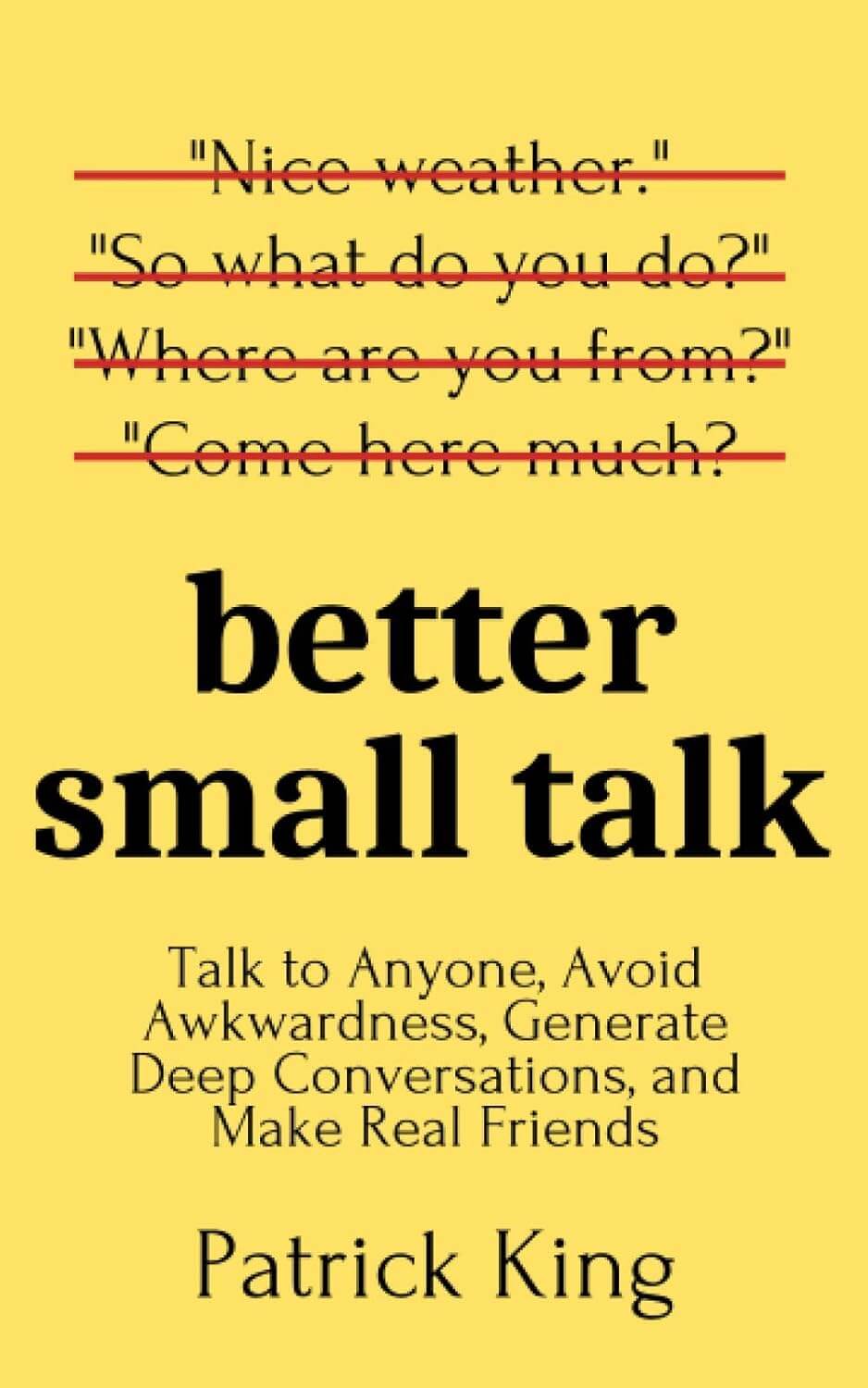
Better Small Talk Book Summary
This Better Small Talk Book Summary covers the key ideas, lessons, and takeaways in about 20 minutes.
By preparing thoughtfully, listening generously, and engaging with curiosity rather than performance, anyone can transform routine exchanges into satisfying interactions. The book’s message is ultimately empowering: You don’t need extraordinary charisma to connect with others—just attention, practice, and a willingness to meet people where they are.
Helps with these goals
Want the complete 20-minute summary?
- Full structured summary
- Video Summary
- Podcast Summary
- Audio summary
- Key takeaways
- Exercises
- Quiz
- Highlights and notes
- Ask the book with AI
What is in the Better Small Talk book summary?
Below is a preview of Sumizeit’s expert-written summary of Better Small Talk by Patrick King. The full summary covers the book’s key ideas in text, audio, and video.
In Better Small Talk, Patrick King challenges the common belief that casual conversation is shallow, pointless, or something to endure until “real” dialogue begins. Instead, he reframes everyday chatter as the essential gateway to meaningful human connection. According to King, no relationship—whether romantic, professional, or platonic—skips the early, lighter exchanges. Attempting to jump straight into deep or emotional topics without first establishing comfort often creates resistance rather than intimacy.
King explains that casual conversation functions as a social handshake. It allows people to assess safety, tone, and compatibility without risk. When two strangers talk about neutral topics like their environment, shared circumstances, or everyday routines, they are subconsciously answering important questions: Is this person friendly? Are they listening? Do they respect boundaries? Only after these questions are answered positively do people feel comfortable revealing opinions, values, or feelings.
He also argues that rejecting casual talk entirely misunderstands how trust develops. Emotional openness is rarely spontaneous—it’s cumulative. Each small exchange builds familiarity, and familiarity creates permission for depth. Seen this way, light conversation is not an obstacle to meaningful dialogue but the only reliable path toward it.
How Modern Distractions Have Raised the Bar for Conversation
King situates his advice within a broader cultural shift. In an era of constant digital stimulation, people have grown less patient with the natural pauses and slower rhythms of face-to-face conversation. Smartphones offer instant entertainment and novelty, training us to expect immediate engagement. As a result, when a conversation momentarily lulls, many people instinctively disengage rather than leaning in.
This shift has made conversational entry points more fragile. If people abandon interactions at the first hint of boredom, conversations never mature into anything substantial. King suggests that improving casual conversation skills is not merely a social advantage but a form of resistance against isolation. Strong social ties, built gradually through repeated low-stakes interactions, contribute to emotional resilience and long-term well-being.
By embracing casual conversation instead of dismissing it, you protect your ability to connect deeply in a world that increasingly fragments attention.
The Natural Progression of Human Dialogue
To explain why skipping early conversation stages backfires, King outlines a rough progression that most interactions follow. Conversations tend to move from neutral to personal in predictable steps, even if we’re not consciously aware of them.
The earliest phase centers on universally accessible topics—situations, surroundings, and shared experiences. From there, people begin exchanging factual information about their lives, such as work, location, or daily routines. As comfort grows, opinions and preferences enter the discussion, allowing participants to test alignment and shared perspectives. Only later do emotions, vulnerabilities, and personal values surface.
King emphasizes that problems arise when someone tries to introduce emotionally charged or opinion-heavy topics too early. Without the foundation of familiarity, such questions can feel invasive or uncomfortable. Understanding this progression helps you calibrate your conversational approach and recognize when it’s appropriate to deepen the exchange.
Warming Up Your Social Muscles Before You Speak
Just as athletes prepare their bodies before physical exertion, King…
Want the complete 20-minute summary?
- Full structured summary
- Video Summary
- Podcast Summary
- Audio summary
- Key takeaways
- Exercises
- Quiz
- Highlights and notes
- Ask the book with AI
Who should read Better Small Talk?
Better Small Talk is for anyone who feels awkward initiating conversations, struggles with small talk, or wants to build deeper connections with others. Whether you're introverted, socially anxious, or simply looking to improve your conversational skills, this book provides practical strategies. Professionals, daters, and people seeking stronger relationships will find actionable guidance that transforms casual exchanges into meaningful interactions.
Why does Better Small Talk matter?
In an era of digital distraction and fragmented attention, the ability to connect through face-to-face conversation has become increasingly rare and valuable. Better Small Talk by Patrick King challenges the dismissal of casual conversation as shallow, revealing it as the essential foundation for all meaningful relationships. Mastering small talk isn't about surface-level charm—it's about building the trust and familiarity that enables genuine human connection and emotional resilience.
What are the key themes in Better Small Talk?
- Small talk as the foundation for deep connection
- The natural progression from neutral to personal dialogue
- Overcoming social anxiety through practice and preparation
- Curiosity and genuine interest as conversational drivers
- Active listening and making others feel valued
- Using stories to create engagement and emotional resonance
What are the key lessons from the Better Small Talk book summary?
Small talk is not shallow—it's essential scaffolding
Casual conversation serves as a social handshake that establishes safety and comfort before deeper topics can emerge. Skipping this stage backfires because trust develops cumulatively through repeated low-stakes interactions.
Conversations follow a predictable progression from neutral to personal
Effective dialogue moves from shared situations and facts toward opinions, preferences, and eventually emotions. Attempting to jump to vulnerable topics too early creates resistance rather than intimacy.
Frequent low-pressure interactions sharpen conversational skills
Brief exchanges with baristas, cashiers, or coworkers keep your social instincts sharp and reduce anxiety around initiating conversations. These micro-interactions normalize the process and build confidence.
Maintain a personal inventory of engaging topics and stories
Awkward silences often occur because nothing readily comes to mind, not because you lack interesting experiences. Mentally cataloging recent events, projects, and perspectives prevents panic and allows natural contribution.
Curiosity expands both your conversational range and connection depth
Learning broadly and living curiously gives you flexible material for discussion and genuine interest in others' ideas. Open-mindedness makes conversations dynamic rather than scripted.
Use situational justifications to overcome initiation anxiety
Practical questions, shared observations, or neutral comments provide socially acceptable entry points without pressure. These approaches respect the other person's autonomy and reduce emotional risk.
Tone and warmth signal safety in conversation
Lightness and subtle humor communicate that an interaction is low-stakes and safe. People unconsciously mirror emotional cues, so a relaxed demeanor invites openness in return.
Know when to pivot without clinging to fading topics
Sustaining conversation requires balance between stagnation and frantic chatter. Sensing when a topic has run its course and gently shifting based on shared interests maintains natural flow.
Multiple mental frameworks prevent conversational dead ends
Drawing from personal experience, asking clarifying questions, widening perspective, or shifting to related topics gives you varied responses. Over time, these frameworks become intuitive rather than mechanical.
Associative thinking unlocks unexpected conversational directions
Allowing your mind to make creative connections—mentioning what a topic reminds you of—can evolve mundane subjects into storytelling and humor. Non-linear conversation often produces more engaging exchanges.
Stories create engagement; statements create distance
Compelling conversation centers on narratives rather than information exchange. Brief, purposeful anecdotes with a single moment and emotional takeaway transform routine interactions into memorable ones.
Prepare short, adaptable mini-stories for common prompts
Having ready anecdotes about work, background, or recent experiences provides depth without overwhelming listeners. These stories offer flexibility across different conversational contexts.
Active listening means resisting the urge to plan your response
Genuine engagement requires giving full attention rather than formulating what you'll say next. This presence makes the other person feel valued and creates richer dialogue.
Equal sharing prevents conversational fatigue
When one person dominates, the exchange becomes draining. Nonverbal cues, affirming responses, and flexibility signal that the other person's contributions are equally important.
Meaningful compliments focus on effort and choice, not fixed traits
Acknowledging what someone has intentionally created or pursued validates their agency better than generic praise. Noticing unique behaviors makes people feel genuinely seen.
Open-ended questions encourage reflection without obligation
Curiosity-driven inquiries allow others to share at their own pace while respecting boundaries. Accepting hesitation creates psychological safety that increases future openness.
Vocal readiness affects how others perceive you
Tone, pace, and expressiveness significantly impact connection. Reading aloud with varied emotion helps prevent monotony and signals warmth and confidence.
Share experiences to relate, not to impress
The intent behind sharing matters—offering stories for connection differs fundamentally from using them for self-promotion. Genuine relating invites reciprocal openness.
Modern distractions have made conversational patience scarcer
Smartphones and instant digital stimulation have trained people to disengage at the first hint of boredom. Maintaining engagement through natural pauses protects conversations from dying prematurely.
Compassionate strategies address poor listeners with empathy
When facing conversation hogs or poor listeners, adjusting settings, setting gentle expectations, or addressing dynamics with empathy produces better results than confrontation.
Want the complete 20-minute summary?
- Full structured summary
- Video Summary
- Podcast Summary
- Audio summary
- Key takeaways
- Exercises
- Quiz
- Highlights and notes
- Ask the book with AI
How can you apply ideas from Better Small Talk?
- Practice brief conversations with service workers daily to keep social skills sharp and reduce initiation anxiety
- Build a mental catalog of recent experiences, projects, and perspectives to draw from during conversations naturally
- Read emotionally varied material aloud to develop vocal expressiveness and prevent monotone delivery
- Prepare 2-3 adaptable short stories about work, background, or recent experiences to share when appropriate
- Use situational observations and practical questions as conversation starters instead of generic openers
- Apply multiple response frameworks—asking details, widening perspective, sharing experiences, or shifting topics—to avoid dead ends
- Make a conscious effort to listen actively without planning your next response mid-sentence
What common mistakes do readers make with Better Small Talk?
- Dismissing small talk as shallow instead of recognizing it as the essential foundation for trust and deeper connection
- Jumping to emotionally charged or opinion-heavy topics before establishing sufficient familiarity and comfort
- Trying to impress through self-promotion rather than genuinely relating through shared experiences and curiosity
- Dominating conversations and not leaving equal space for others' contributions, creating fatigue instead of connection
- Abandoning conversations at the first hint of a lull or awkward pause instead of leaning in with associative thinking
- Treating conversations as scripts to follow rather than allowing organic, non-linear dialogue to emerge naturally
Sumizeit Exercises Apply what you've learned
Turn ideas from Better Small Talk into action with a short guided reflection: identify the biggest takeaway, connect it to your life, and commit to one step you can take in the next 24 hours.
What is the expert analysis of Better Small Talk?
Overview
Better Small Talk by Patrick King emerges as a significant contribution to the literature on interpersonal communication, particularly in an era marked by digital distractions and fragmented attention. King, a seasoned social interaction coach, leverages his expertise in emotional intelligence and conversational dynamics to challenge the widespread dismissal of casual conversation as trivial. Instead, he elevates small talk to a foundational social skill essential for building trust and meaningful relationships across personal and professional domains. The book’s practical orientation and nuanced understanding of dialogue progression position it as a valuable resource for readers seeking to enhance their social fluency in a complex, fast-paced world.
Core Thesis
King’s central argument reframes casual conversation not as a superficial hurdle but as the indispensable gateway to intimacy and connection. He contends that emotional openness and deep dialogue are cumulative processes that rely on a scaffold of lighter, low-stakes exchanges. By respecting the natural progression from neutral topics to personal values and emotions, individuals can foster psychological safety and mutual trust. This thesis challenges the impatience and aversion to small talk prevalent in contemporary culture, suggesting instead that mastering these early conversational stages is critical for authentic human connection and emotional resilience.
Strengths
- Comprehensive Framework: King offers a clear, structured model of conversational progression that demystifies social interactions and provides actionable guidance on when and how to deepen dialogue.
- Practical Tools: The introduction of techniques such as the personal conversational inventory, associative thinking, and mental response frameworks equips readers with concrete strategies to navigate and sustain conversations effectively.
- Cultural Relevance: By situating the book within the context of modern digital distractions, King addresses a timely social challenge, making his advice resonate with contemporary readers.
- Emphasis on Emotional Intelligence: The book’s focus on active listening, empathy, and psychological safety underscores the importance of relational attunement over mere verbal skill.
- Balance of Theory and Practice: King successfully blends conceptual insights with real-world applications, making the book accessible without sacrificing intellectual rigor.
Critiques & Counterarguments
- Potential Oversimplification of Social Dynamics: While the outlined progression from small talk to deep conversation is helpful, human interactions often deviate from linear models. Some cultural or individual differences may render the prescribed stages less universal than implied.
- Limited Engagement with Contrasting Perspectives: The book largely promotes a single communicative approach without deeply addressing alternative theories that prioritize directness or emotional immediacy, such as certain existential or radical honesty frameworks.
- Evidence Base: King’s recommendations, while practical, rely heavily on anecdotal and experiential knowledge rather than extensive empirical research. This may limit the generalizability of some claims.
- Digital Communication Nuances: Although the book critiques digital distractions, it could further explore how small talk translates across virtual platforms, where cues and rhythms differ markedly from face-to-face interaction.
- Risk of Formulaic Interaction: The mental frameworks and inventories, while useful, might inadvertently encourage mechanical or rehearsed conversation, potentially undermining spontaneity and authenticity if applied rigidly.
Who Should Read This
Better Small Talk is ideally suited for readers who recognize the importance of social connection but struggle with initiating or sustaining conversations—whether due to anxiety, introversion, or unfamiliarity with social norms. Professionals in networking, sales, counseling, or leadership roles will find the book’s insights particularly valuable for fostering rapport and trust. Additionally, individuals interested in personal development and emotional intelligence will appreciate King’s emphasis on empathy, curiosity, and psychological safety. Ultimately, the book serves anyone seeking to transform everyday interactions into meaningful relational opportunities without relying on innate charisma or extroversion.
Frequently asked questions about the Better Small Talk book summary
What is Better Small Talk about?
Better Small Talk by Patrick King reframes casual conversation as the essential gateway to meaningful human connection rather than something to tolerate. The book explains how small talk functions as a social handshake that builds familiarity and trust, and provides practical strategies for initiating conversations, maintaining natural flow, listening actively, and using stories to create engagement.
Who should read Better Small Talk?
Better Small Talk is ideal for anyone who feels anxious initiating conversations, struggles with small talk, or wants to deepen their relationships. It's particularly valuable for introverts, socially anxious individuals, professionals seeking stronger networks, people navigating dating, and anyone looking to transform routine exchanges into satisfying interactions.
What are the main takeaways from Better Small Talk?
The main takeaways include: small talk is not shallow but the necessary foundation for all deeper connections; conversations follow a predictable progression from neutral topics to personal ones; frequent low-pressure interactions sharpen social skills; curiosity and genuine interest drive engagement; active listening makes others feel valued; and stories create emotional resonance better than statements. Ultimately, meaningful relationships are built through countless small moments of ease, curiosity, and respect rather than dramatic disclosures.
How can I overcome the fear of starting conversations?
Patrick King recommends using situational justifications—practical questions, shared observations, or neutral comments that provide socially acceptable entry points. He also suggests practicing with low-pressure interactions like brief exchanges with service workers to normalize initiation. Building vocal confidence through reading aloud and maintaining a warm, light tone signal that interactions are safe and low-stakes.
What's the difference between small talk and meaningful conversation?
According to Better Small Talk, there is no barrier between them—small talk is the necessary progression toward meaningful conversation. Dialogue naturally moves from neutral situations and facts toward opinions, preferences, and eventually emotions. Attempting to skip small talk stages backfires because trust develops cumulatively, not spontaneously. Each light exchange builds familiarity, creating permission for depth.
How can I keep conversations from dying out?
King suggests several techniques: maintain a mental inventory of interesting experiences and perspectives to draw from; use associative thinking to make creative connections; ask open-ended questions that encourage reflection; share adaptable stories rather than generic statements; and sense when topics have run their course so you can pivot naturally. Equal sharing and genuine curiosity about the other person also sustain engagement.
Why does Patrick King say stories matter in conversation?
Stories create emotional engagement, reveal personality, and make abstract ideas tangible in ways that statements cannot. Brief, purposeful anecdotes with a single moment and emotional takeaway transform routine interactions into memorable ones. King advises preparing short, adaptable stories related to common prompts like work or recent experiences so you can add depth without overwhelming listeners.
About Sumizeit
Sumizeit is a profitable Scomy LLC company based in Miami, Florida. It has been helping readers learn from nonfiction books for 7 years with expert-written summaries in text, audio, podcast, and video.
Want the complete 20-minute summary?
- Full structured summary
- Video Summary
- Podcast Summary
- Audio summary
- Key takeaways
- Exercises
- Quiz
- Highlights and notes
- Ask the book with AI
Here's why readers love Sumizeit
Join thousands of learners getting smarter every day
"Great experience. Detailed summaries. Loved the gamification feature. Makes learning fun. Good customer service. I recommend Sumizeit to anyone. You'll learn a lot."
"I always felt busy but still wanting to keep up with the book discussion in my friend group. This was a great supplement to help me keep reading the books I find fun while keeping up with important books."
"I love this website. Instead of scrolling social media, I find myself learning a lot. I use it everyday. I recommend this app for anyone who is too busy and wants to get up to speed with their favorite books."
Better Small Talk Book Summary PDF
Looking for a Better Small Talk Book Summary PDF you can save and revisit offline? Our Better Small Talk Book Summary PDF captures the book’s core ideas in a clean, printable format — the key frameworks, takeaways, and structure without the fluff. Download the Better Small Talk Book Summary PDF when you want a reference you can annotate, share with your team, or review on the go. Get your Better Small Talk Book Summary PDF from the download page below.
Download Better Small Talk Book Summary PDFPeople also liked these summaries
Readers who explored Better Small Talk often enjoyed these titles next.



Want the complete 20-minute summary?
- Full structured summary
- Video Summary
- Podcast Summary
- Audio summary
- Key takeaways
- Exercises
- Quiz
- Highlights and notes
- Ask the book with AI
Featured Book Titles
Popular Book Summaries at sumizeit, leading book summary app