


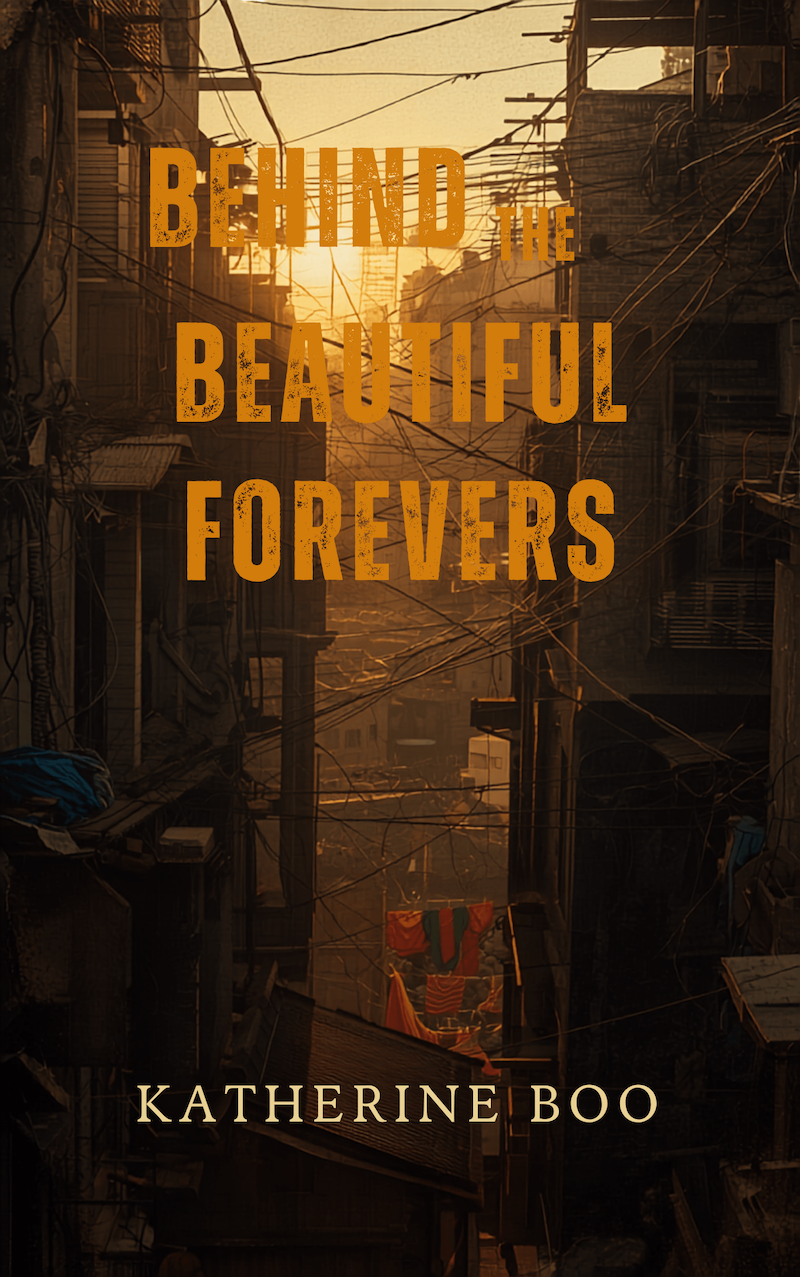
Prefer the print book? Buy on Amazon
As an Amazon Associate, Sumizeit earns from qualifying purchases.
Behind the Beautiful Forevers Book Summary
This Behind the Beautiful Forevers Book Summary covers the key ideas, lessons, and takeaways in about 20 minutes.
Katherine Boo's true story of survival, corruption, and hope in a Mumbai slum
Helps with these goals
Want the complete 20-minute summary?
- Full structured summary
- Video Summary
- Podcast Summary
- Audio summary
- Key takeaways
- Exercises
- Quiz
- Highlights and notes
- Ask the book with AI
Want a Free Weekly Read?
Get a free summary every week straight to your mailbox.
Preview the Behind the Beautiful Forevers book summary
Below is a preview of Sumizeit’s comprehensive human-written summary of Behind the Beautiful Forevers by Katherine Boo. The full summary is 15-20 minutes long and covers the book’s key ideas in text, audio, visual, and video formats. Unlock the full 20 Minute Summary
Katherine Boo's *Behind the Beautiful Forevers: Life, Death, and Hope in a Mumbai Undercity* (2012) is a work of narrative nonfiction that reads like a novel but reports like an investigation. Boo embedded herself for nearly four years — from late 2007 through 2011 — in Annawadi, a makeshift settlement of roughly three thousand people crammed onto a scrap of land beside the Mumbai international airport. Using thousands of interviews, video recordings, and more than three thousand public records obtained through India's right-to-information laws, she reconstructed the intertwined lives of a handful of families as they chased security in one of the most unequal cities on earth. The book's title comes from an advertising wall. Between the settlement and the gleaming airport road stood a long barrier plastered with ads for Italianate floor tiles, their tagline — "Beautiful Forever" — repeating down its length. The people of Annawadi literally lived behind that promise of permanence and polish, invisible to the travelers speeding past. That image becomes the book's organizing irony: a new India of luxury hotels and global capital, and pressed up against its back wall, families deciding whether they can afford both burn cream and drinking water. What elevates the book beyond portraiture is its central question: in an age when global markets have lifted millions out of poverty, why do so many remain stuck — and what does the daily struggle for a slightly better life do to a community's moral fabric? Boo's answer is unsparing. Where opportunity is scarce and institutions are for sale, the poor are pitted less against the rich than against each other.
Annawadi: A City's Leftover Space
Annawadi began in 1991, when laborers brought in from Tamil Nadu to repair an airport runway decided to squat on a soggy patch of land nearby rather than go home. The name honors those founders — "anna" is a Tamil term of respect for an older brother — and the settlement grew hut by hut on ground the residents themselves dried out and packed firm. It was, from the beginning, illegal: every home stood on airport authority land, and every resident lived with the knowledge that bulldozers could arrive at any time. By the late 2000s, the settlement was an island of scarcity inside a sea of wealth. Luxury hotels rose on nearly every side. A fetid maggot-filled lake of sewage sat at its center, its water so contaminated that animals who waded in sometimes emerged dyed strange colors. In lean seasons, the poorest residents trapped rats and frogs at the water's edge or boiled the weeds growing there — not out of custom, but arithmetic. And yet by the brutal math of Indian poverty, Annawadians were not the worst off. Almost no one in the slum was starving outright; most were part of a vast informal economy, one of the hundreds of millions of Indians the era's boom had brushed but not embraced. Boo is careful to show the slum's internal geography and hierarchy.
Want the complete 20-minute summary?
- Full structured summary
- Video Summary
- Podcast Summary
- Audio summary
- Key takeaways
- Exercises
- Quiz
- Highlights and notes
- Ask the book with AI
Who should read Behind the Beautiful Forevers?
Behind the Beautiful Forevers is essential reading for anyone seeking to understand modern poverty, global inequality, and how institutions function in the developing world. Students of economics, sociology, journalism, and public policy will find invaluable case studies here, as will general readers interested in deeply reported narrative nonfiction that challenges comfortable assumptions about development and progress.
Why does Behind the Beautiful Forevers matter?
Katherine Boo's work exposes how the global financial system transmits economic shocks directly into the lives of the world's poorest people, and how corruption within institutions meant to help the poor often becomes another tax on their survival. In an era of expanding wealth alongside persistent poverty, this book offers crucial evidence that the problem is not lack of effort from the poor, but systemic design that actively maintains their disadvantage.
What are the key themes in Behind the Beautiful Forevers?
- Institutional corruption and the weaponization of poverty
- How global markets directly impact the daily survival of the undercity
- The moral corrosion that results from extreme inequality
- The tension between individual aspiration and structural constraint
- The invisible poor in cities of visible wealth
- How power flows through informal networks and leverage
Want the complete 20-minute summary?
- Full structured summary
- Video Summary
- Podcast Summary
- Audio summary
- Key takeaways
- Exercises
- Quiz
- Highlights and notes
- Ask the book with AI
How can you apply ideas from Behind the Beautiful Forevers?
- Use this book to understand how financial crises impact the world's poorest people and why their vulnerability to global shocks makes them economically fragile
- Apply Boo's method of document verification and multi-year observation to evaluate claims about development programs and anti-poverty initiatives in your own research or policy work
- Study how informal power networks operate in institutions—Boo's reporting on Asha and her fixers reveals how real authority flows outside official channels in many developing-world contexts
- Examine your own city's relationship to its poor: where is the beautiful wall that hides them, and what infrastructure invisibly maintains their exclusion
- Consider how market pressure and institutional incentives shape behavior more than individual morality—useful for understanding not just poverty but corporate and governmental ethics broadly
- Recognize administrative systems as potential weapons: learn how bureaucratic procedures can be used to deny access to justice and how to combat this through documentation and transparency
What common mistakes do readers make with Behind the Beautiful Forevers?
- Assuming poverty persists because poor people lack ambition or intelligence—the Husains and Manju disprove this; the system itself extracts and punishes their efforts
- Believing that education or microfinance alone can overcome structural inequality without addressing institutional corruption
- Focusing blame on individual moral failings (Asha's fraud, Fatima's rage) while ignoring the larger systems that make such behavior rational and profitable
- Thinking that visible symbols of progress (development programs, new housing schemes) represent actual improvement when they often become new extraction mechanisms
Sumizeit Exercises Apply what you've learned
Turn ideas from Behind the Beautiful Forevers into action with a short guided reflection: identify the biggest takeaway, connect it to your life, and commit to one step you can take in the next 24 hours.
What is the expert analysis of Behind the Beautiful Forevers?
Overview
Behind the Beautiful Forevers is a profound work of narrative nonfiction by Katherine Boo, a Pulitzer Prize-winning investigative journalist renowned for her meticulous reportage on poverty and institutional failure. Published in 2012, this book stands out for its immersive ethnographic approach, chronicling the lives of residents in Annawadi, a makeshift slum adjacent to Mumbai’s international airport. Boo’s four-year embedded investigation, supported by thousands of interviews and public records, offers an unvarnished window into the human consequences of global economic disparity and urban marginalization. The book’s title, derived from an advertising wall proclaiming “Beautiful Forever,” encapsulates the central irony of the narrative: the stark contrast between Mumbai’s gleaming modernity and the precarious existence of those living just behind its façade.
Core Thesis
Boo’s central argument is that poverty in the context of rapid globalization and urban expansion is not merely a product of individual failings or lack of effort, but a systemic condition actively perpetuated by corrupt institutions, entrenched inequality, and market forces that transmit distant economic shocks directly to the most vulnerable. The moral fabric of the community is eroded as honesty becomes a competitive disadvantage and survival often necessitates complicity in corruption. Through the intimate portrayal of characters like Abdul, who aspires to be “ice” rather than “water,” Boo illustrates how structural forces shape and often constrain personal agency, making ethical striving both heroic and tragically fraught.
Strengths
- Immersive, Grounded Reporting: Boo’s four-year embedded presence and reliance on direct observation, interviews, and official documents lend unparalleled authenticity and depth to the narrative.
- Complex Characterization: The book transcends stereotypes by presenting multidimensional individuals—such as Abdul, Zehrunisa, Asha, and Fatima—whose choices and contradictions evoke empathy and understanding rather than pity.
- Structural Analysis: Boo deftly connects micro-level experiences with macroeconomic phenomena, such as the 2008 financial crisis and its ripple effects on scrap prices and slum livelihoods, demonstrating the global-local nexus of poverty.
- Ethical Nuance: The narrative resists simplistic moral binaries, portraying corruption as both a survival strategy and a systemic pathology, thereby challenging readers to grapple with uncomfortable truths about inequality and governance.
- Literary Craftsmanship: The prose combines investigative rigor with narrative finesse, creating a compelling, novelistic reading experience that brings statistical abstractions to vivid life.
Critiques & Counterarguments
- Potential Overemphasis on Corruption: While Boo convincingly documents pervasive corruption, some critics might argue that the focus risks overshadowing instances of resilience, solidarity, and grassroots activism that also characterize slum life.
- Limited Engagement with Broader Policy Solutions: The book excels in diagnosis but offers less in terms of systemic remedies or the roles of state and civil society beyond corruption, potentially leaving readers with a sense of fatalism.
- Ethnographic Constraints: Despite Boo’s extensive fieldwork, the narrative is necessarily bounded by the perspectives of a small number of families, which may not fully represent the diversity of experiences across Mumbai’s vast informal settlements.
- Competing Research on Poverty Alleviation: Some development economists emphasize the transformative potential of microfinance, education, and formalization of informal economies, suggesting more optimistic pathways than Boo’s depiction of entrenched stagnation.
- Philosophical Debates on Agency: Schools of thought in psychology and philosophy might critique the portrayal of agency as severely constrained, arguing that even within oppressive systems, individuals exercise meaningful choice and can effect change, a nuance that could be more fully explored.
Who Should Read This
This book is essential reading for scholars and practitioners in development studies, urban sociology, and global economics seeking a granular understanding of poverty’s lived realities in rapidly urbanizing contexts. It also appeals to readers interested in ethical philosophy and political economy, as it probes the moral costs of inequality and institutional failure. Moreover, policymakers and activists aiming to design more effective anti-poverty interventions will find Boo’s detailed account a sobering reminder of the complexities and unintended consequences that can arise in marginalized communities. Finally, anyone drawn to narrative nonfiction that combines investigative journalism with literary artistry will find Behind the Beautiful Forevers a compelling and thought-provoking work.
Frequently asked questions about the Behind the Beautiful Forevers book summary
What is Behind the Beautiful Forevers about?
Behind the Beautiful Forevers by Katherine Boo is a narrative nonfiction account of life in Annawadi, an illegal settlement of three thousand people living beside Mumbai's airport. Based on four years of reporting, the book follows several families as they navigate extreme poverty, institutional corruption, and the question of whether striving for a better life is possible when the systems around you are designed to extract your survival as revenue. The title refers to an advertising wall between the slum and the gleaming airport road, representing the sharp contrast between the wealth of modern India and the invisible poor pressed against it.
Who should read Behind the Beautiful Forevers?
This book is essential for anyone interested in understanding poverty, inequality, institutional dysfunction, and global economics. Readers of narrative nonfiction, students of sociology, economics, journalism, and public policy will find rigorous case studies here. More broadly, anyone grappling with why global wealth creation has not eliminated poverty will find Boo's answer—that poverty is actively maintained by systems that profit from it—both persuasive and sobering. It challenges readers to see the global poor not as statistics but as particular people whose choices, under the circumstances, make heartbreaking sense.
What are the main takeaways from Behind the Beautiful Forevers?
The book's core argument is that poverty in unequal cities is not a fate people fail to escape but a system actively maintained by corrupt institutions, markets that transmit global shocks directly to the poor, and inequality so steep that residents fight each other rather than challenge the order above them. Through the story of Abdul's failed resolution to stay honest ('ice') in a corrupting world, Boo shows that the deepest damage of extreme inequality is moral: when honesty is punished and cunning rewarded, hope survives but becomes ethically hollow. Finally, the book demonstrates that understanding how power flows through informal networks and how institutional corruption actually operates requires intensive documentation and long-term engagement rather than survey-based analysis.
How does Katherine Boo document her claims about corruption?
Boo spent nearly four years embedded in Annawadi conducting thousands of interviews, filming video recordings, and obtaining more than three thousand public records through India's right-to-information laws. She uses no composite characters and changes no names; every claim is grounded in either direct observation, recorded testimony, or government documents. Her method involved repeatedly matching residents' accounts against official records to expose where fabrications and falsifications appear, making her narrative simultaneously a work of literary nonfiction and an investigative exposé.
What happens to the Husain family in the book?
The Husains—Abdul, his parents Karam and Zehrunisa, and his sister Kehkashan—rise from extreme poverty through Abdul's skill at trading scrap. Their modest prosperity invites accusations when a neighbor, Fatima, immolates herself and falsely claims they drove her to it. Police and officials, seeing financial opportunity in the accusation, beat Karam and Abdul, suppress evidence, and manipulate testimony. After months in jail, Karam and Kehkashan are acquitted when the court finds no evidence they did anything wrong. Abdul's juvenile case is never properly scheduled, leaving him in permanent limbo—punished indefinitely for a crime the courts agreed never happened. The family's business collapses in his absence, and their modest gains evaporate.
What does the book reveal about how global markets affect the poor?
Boo traces how the 2008 financial crisis and the Mumbai terrorist attacks reach Annawadi through the price of recycled scrap materials. Abdul's business depends on global commodity prices he cannot see or influence; when demand for recycled plastic and metal collapses, families who had climbed slightly out of absolute poverty—who had begun eating vegetables and stopped trapping frogs—slide back down. The book documents precisely how distant macroeconomic shocks transmit into local hunger, showing the poor as tethered to forces entirely beyond their control.
How does Behind the Beautiful Forevers address gender and inequality?
The book renders the lives of women trapped by both poverty and gender constraints. Fatima's story shows how being mocked and diminished her entire life leads to desperation and self-harm. Meena, a brilliant girl, has no mechanism to choose her own life and sees arranged marriage to a distant village as inevitable servitude; she ends her life by her own hand rather than accept this future. Manju becomes the slum's first female college graduate but remains bound to unpaid domestic labor and her mother's schemes. The book illustrates how women's lack of economic independence and social choice compounds the vulnerabilities created by poverty itself.
Why does the slum clearance scheme matter to the book's larger argument?
The promise of tiny apartments (269 square feet with running water) to residents with proof of long tenure becomes valuable enough that investors begin buying huts and forging papers, with fixers like Asha brokering deals. What appears as anti-poverty housing policy becomes a new mechanism for extracting money from the poor and displacing them. Near the book's end, the Beautiful Forever wall is demolished and the sewage lake filled in—the slum's erasure begins with its scenery, suggesting that development schemes are less about improving residents' lives than about clearing visible poverty from the city's global image.
About Sumizeit
Sumizeit is a profitable Scomy LLC company based in Miami, Florida. Our founders, Clemens Raemy and Weina Scott, are successful entrepreneurs with several exits. Sumizeit is a popular book summary app / micro learning app used by busy professionals and entrepreneurs with over 2,500 non-fiction book summaries and 10,000 podcast summaries in text, audio, visual, podcast, and video format. We also have stellar retention tools to make ideas stick - such as flashcards with spaced repetition, quizzes, streaks, highlighting and notes, daily challenges, riddles, mini-courses, meditation, and more. You won't only learn the idea, but also remember it. Over 90% of our users change their habits with Sumizeit.
Upgrade Now
Want the complete 20-minute summary?
- Full structured summary
- Video Summary
- Podcast Summary
- Audio summary
- Key takeaways
- Exercises
- Quiz
- Highlights and notes
- Ask the book with AI
Here's why readers love Sumizeit
Join thousands of learners getting smarter every day
"Great experience. Detailed summaries. Loved the gamification feature. Makes learning fun. Good customer service. I recommend Sumizeit to anyone. You'll learn a lot."
"I always felt busy but still wanting to keep up with the book discussion in my friend group. This was a great supplement to help me keep reading the books I find fun while keeping up with important books."
"I love this website. Instead of scrolling social media, I find myself learning a lot. I use it everyday. I recommend this app for anyone who is too busy and wants to get up to speed with their favorite books."
Behind the Beautiful Forevers Book Summary PDF
Looking for a Behind the Beautiful Forevers Book Summary PDF you can save and revisit offline? Our Behind the Beautiful Forevers Book Summary PDF captures the book’s core ideas in a clean, printable format — the key frameworks, takeaways, and structure without the fluff. Download the Behind the Beautiful Forevers Book Summary PDF when you want a reference you can annotate, share with your team, or review on the go. Get your Behind the Beautiful Forevers Book Summary PDF from the download page below.
Download Behind the Beautiful Forevers Book Summary PDFPeople also liked these summaries
Readers who explored Behind the Beautiful Forevers often enjoyed these titles next.


Want the complete 20-minute summary?
- Full structured summary
- Video Summary
- Podcast Summary
- Audio summary
- Key takeaways
- Exercises
- Quiz
- Highlights and notes
- Ask the book with AI
Featured Book Titles
Popular Book Summaries at sumizeit, leading book summary app