


As an Amazon Associate, Sumizeit earns from qualifying purchases.
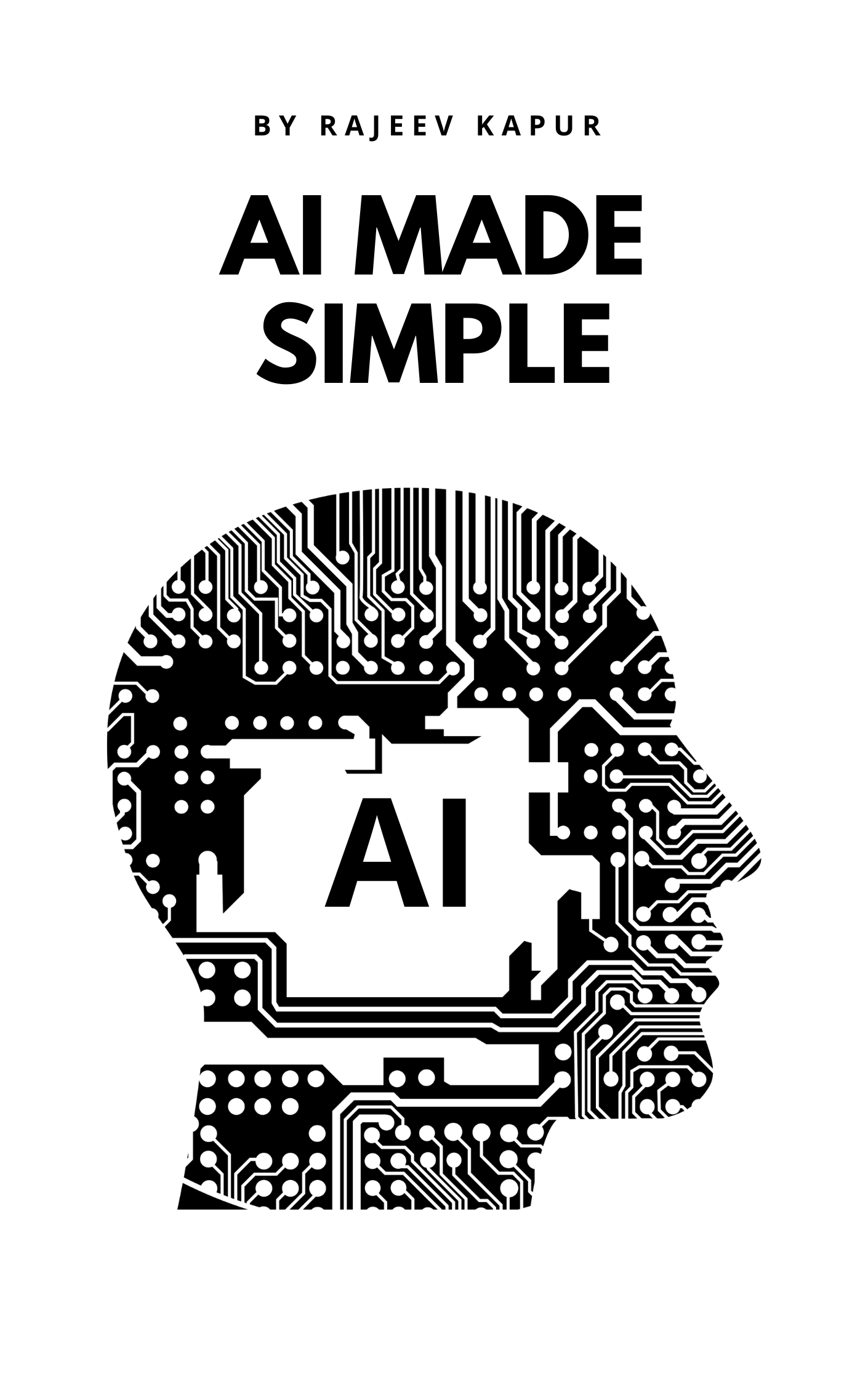
AI Made Simple Book Summary
This AI Made Simple Book Summary covers the key ideas, lessons, and takeaways in about 20 minutes.
Kapur discusses machine learning (ML) and neural networks, as well as ways to tailor your ChatGPT prompts for more accurate and focused responses. Furthermore, Kapur dives into how AI generates media such as images, videos, and music.
The book also focuses on the human side of AI including ethics and privacy, revealing the pros and cons of Generative AI. Kapur stresses to readers to use AI with caution and to practice with it to reap its benefits.
Helps with these goals
Want the complete 20-minute summary?
- Full structured summary
- Video Summary
- Podcast Summary
- Audio summary
- Key takeaways
- Exercises
- Quiz
- Highlights and notes
- Ask the book with AI
What is in the AI Made Simple book summary?
Below is a preview of Sumizeit’s expert-written summary of AI Made Simple by Rajeev Kapur. The full summary covers the book’s key ideas in text, audio, and video.
Long ago, AI may have seemed impossible and something that was only in movies or your favorite sci-fi novel. But now, AI is part of our modern-day technology, and as many movies and books depict, it’s taking over the world in a multitude of ways.
From designing and writing to composing, AI can essentially do the work of a person within seconds, making it an extremely productive helper to people and businesses. But how does it work and what are its full capabilities?
In “AI Made Simple,” Rajeev Kapur breaks down the basics of AI and how it's revolutionizing technology. Kapur explains how to implement ChatGPT, while also diving into the ethical risks and its impact on career.
Key Points:
AI is no longer something of the future; it’s present everywhere, from recommending new shows for you on Netflix based on past watches to writing an email to a client. Generative AI is able to create new content from media such as images, video, music, and text, and anyone can access this technology.
Even when we aren’t actively trying to access it, we come across AI in our daily lives. Some examples of this are FaceID technology on our phones, search engines, and fraud detection systems at banks. Machine learning allows computers to recognize patterns and respond appropriately, similar to how humans and animals learn. And, like a human, AI can learn and then create based on that learning, creating new content.
Businesses have adopted AI to optimize their efficiency and productivity, especially with tasks that are repeated. With new content, AI allows businesses to problem-solve more effectively offering original ideas generated by their machines. Even in the creative fields, AI is used to help compose music!
One of the greatest benefits of AI is its accessibility. People and small businesses have access to information that was once only available to large businesses, making opportunities endless for the masses.
However, with the huge rise in AI, there are some things to consider:
AI is pushing us into a new era in terms of work, creativity, and problem-solving. Now is the time to learn how to use these tools to help reshape the future.
How To Get Started Using AI
One of the easiest ways to use AI is to write using ChatGPT. Here are some easy steps to follow:
It’s important to take note that ChatGPT can’t do everything. It must have internet access to acquire real-time information. It’s also possible that ChatGPT will provide you with inaccurate information. Like humans, AI has flaws too.
AI has settings you can fiddle with that’ll help shape the responses it gives you. For example, there is a “temperature” setting. If you opt for a hotter “temperature,” the responses will be more creative and novel, whereas a cooler “temperature” response will be logical and factual. “Max tokens” is another setting that controls the length of the response.
With ChatGPT’s paid subscription, also known as GPT-4, you can access voice assistance and image recognition.…
Want the complete 20-minute summary?
- Full structured summary
- Video Summary
- Podcast Summary
- Audio summary
- Key takeaways
- Exercises
- Quiz
- Highlights and notes
- Ask the book with AI
Who should read AI Made Simple?
AI Made Simple is for anyone curious about artificial intelligence but intimidated by its complexity—whether you're a business professional, creative, or simply someone wanting to understand the technology shaping our world. If you've heard about ChatGPT and generative AI but aren't sure how to use them or what they mean for your career and creative work, this book is your practical starting point.
Why does AI Made Simple matter?
AI is no longer a distant future technology; it's already transforming how we work, create, and solve problems today. Understanding both the tremendous potential and real risks of AI is essential for anyone who wants to stay relevant and make informed decisions in an increasingly AI-driven world. Rajeev Kapur's AI Made Simple demystifies this powerful technology and shows you how to harness it responsibly.
What are the key themes in AI Made Simple?
- Generative AI is accessible to everyone, not just large corporations
- Prompt engineering and quality prompts dramatically improve AI results
- AI has significant limitations including hallucinations and inaccuracy
- Ethical concerns like copyright, misinformation, and bias require awareness
- AI will reshape careers, creativity, and problem-solving across industries
- Historical technology adoption suggests AI will create more opportunities than it eliminates
What are the key lessons from the AI Made Simple book summary?
Generative AI Creates Content from Patterns
AI learns patterns from massive datasets and generates new content—text, images, music, and video—by predicting what comes next based on those patterns. This is why quality and specificity in your requests matter enormously.
AI Hallucinations Are a Critical Flaw
AI can confidently produce fabricated information that sounds plausible but is completely false. This happened when a lawyer used ChatGPT to cite fake legal precedents, highlighting the danger of treating AI output as fact without verification.
Specificity in Prompts Yields Better Results
Vague prompts generate generic, unusable responses, while detailed prompts with context produce tailored, high-quality outputs. The more you tell AI about your needs and background, the better it serves you.
Temperature Settings Control Creativity vs. Accuracy
AI has adjustable parameters like temperature that shift outputs between creative and imaginative versus logical and factual. Understanding these settings helps you get exactly the type of response you need.
Prompt Chaining Refines AI Output Iteratively
By providing feedback and reworded prompts with additional data, you guide AI toward increasingly customized solutions—similar to working with a human assistant through multiple refinement rounds.
Prompt Engineering Breaks Large Projects Into Steps
Breaking complex tasks into smaller, sequential prompts helps AI deliver more creative and custom content than attempting everything at once.
AI Tools Democratize Access to Professional-Quality Content
Tools like DALL-E, Midjourney, and music generators enable individuals and small businesses to create logos, artwork, music, and videos without hiring expensive designers, photographers, or composers.
AI Cannot Replace Human Judgment and Intuition
AI lacks the human elements necessary for truly meaningful communication and nuanced decision-making. It should augment human capability, not replace human thinking.
Misuse of AI Can Spread Misinformation at Scale
AI can be manipulated to create convincing deepfakes, fake voices, and disinformation—as seen with the Biden robocall incident—posing serious threats to elections, trust, and truth.
AI Training Has Significant Environmental Costs
Training a single AI model produces 284 tons of carbon dioxide, an often-overlooked environmental impact that contributes to air pollution and climate change.
Copyright and Ownership Questions Remain Unresolved
Using AI to generate content raises complex legal questions about who owns the output, whether AI training violates creators' rights, and how intellectual property law applies to generated media.
Open a Fresh Chat Window for New Prompts
Starting new conversations prevents ChatGPT from being confused by previous context, ensuring cleaner and more focused responses to your request.
Real-Time Information Requires Internet Access
ChatGPT cannot access current data without internet connectivity, making it unreliable for questions requiring up-to-date information.
AI Works Best With Detailed Background Context
Providing information about who you are, what you need, and your specific circumstances helps AI tailor responses to your actual situation rather than generic defaults.
Multiple Creative AI Tools Serve Different Media Types
Different platforms excel at different tasks—DALL-E and Midjourney for images, AIVA and Boomy for music, Fliki and Descript for video—so choosing the right tool matters.
AI Can Accelerate Scientific Discovery and Problem-Solving
AI has already helped scientists discover new antibiotics and can tackle complex challenges in healthcare, climate change, and drug development far faster than human researchers alone.
Historical Technology Trends Suggest Net Positive Outcomes
Past technological revolutions created more jobs and opportunities than they eliminated, suggesting AI will likely follow the same pattern despite legitimate concerns about disruption.
Responsible AI Use Requires Caution and Practice
Understanding AI's flaws and limitations while experimenting with tools responsibly helps you capture benefits while avoiding pitfalls like misinformation and ethical violations.
AI Is a Tool Owned by Humans, Not an Autonomous Agent
Despite sci-fi fears, AI doesn't have its own agenda or desire for power; it's ultimately controlled by humans and reflects how we choose to use it.
Want the complete 20-minute summary?
- Full structured summary
- Video Summary
- Podcast Summary
- Audio summary
- Key takeaways
- Exercises
- Quiz
- Highlights and notes
- Ask the book with AI
How can you apply ideas from AI Made Simple?
- Use ChatGPT to brainstorm ideas, create exercise plans, or generate recipes with detailed prompts tailored to your needs
- Create professional logos, marketing materials, and illustrations with DALL-E or Midjourney without hiring designers
- Compose original music tracks and soundtracks using AIVA, Boomy, or Soundraw for projects, content, or personal enjoyment
- Generate scripts and edit videos with user-friendly tools like Fliki or Descript to produce professional-quality video content
- Refine cover letters, resumes, and job application materials by providing ChatGPT with your experience and qualifications for personalized output
- Solve complex scientific and medical problems by leveraging AI's pattern-recognition speed to analyze thousands of data points quickly
- Create custom AI bots through the GPT Store without coding skills to automate specialized tasks for your workflow
What common mistakes do readers make with AI Made Simple?
- Trusting AI output as fact without verification; AI can confidently produce false information that sounds plausible (hallucinations)
- Writing vague prompts and expecting detailed, personalized results; AI needs specific context and background to tailor responses effectively
- Using the same chat window for multiple unrelated prompts, causing AI to become confused by mixed context
- Ignoring the ethical implications of AI use, including copyright concerns, potential for misinformation, and bias in generated content
Sumizeit Exercises Apply what you've learned
Turn ideas from AI Made Simple into action with a short guided reflection: identify the biggest takeaway, connect it to your life, and commit to one step you can take in the next 24 hours.
What is the expert analysis of AI Made Simple?
Overview
AI Made Simple: A Beginner's Guide to Generative Intelligence is authored by Rajeev Kapur, a seasoned technology executive and CEO with deep experience in the tech and business sectors. Kapur’s background, including leadership roles at Dell and involvement with AI-focused companies, lends credibility to his exploration of artificial intelligence (AI) for a general audience. The book aims to demystify AI, particularly generative AI, making it accessible to readers who may feel intimidated by the subject. Its significance lies in bridging the gap between complex AI technologies and practical, everyday applications, while also addressing ethical and societal implications.
Core Thesis
Kapur’s central argument is that AI, especially generative AI, is no longer a futuristic concept but a present-day transformative tool accessible to individuals and businesses alike. He posits that understanding and harnessing AI’s capabilities—ranging from content creation to problem-solving—can empower users to enhance productivity and creativity. However, he also cautions that AI is imperfect, prone to errors such as “hallucinations,” and fraught with ethical challenges including misinformation, data privacy, and environmental impact. Ultimately, Kapur advocates for informed and cautious adoption of AI technologies to leverage their benefits while mitigating risks.
Strengths
- Clarity and Accessibility: Kapur excels at breaking down complex AI concepts into clear, digestible explanations suitable for beginners, making the technology less intimidating.
- Practical Guidance: The book offers actionable steps on how to use tools like ChatGPT, including prompt engineering techniques, which equips readers with hands-on skills.
- Balanced Perspective: It acknowledges both the transformative potential and the ethical dilemmas of AI, encouraging readers to approach the technology thoughtfully.
- Coverage of Creative Applications: By exploring AI’s role in music, image generation, and video editing, Kapur highlights AI’s expanding influence beyond traditional business uses.
- Authoritative Voice: Kapur’s professional background and leadership in tech lend authority and relevance to his insights.
Critiques & Counterarguments
- Oversimplification of AI Limitations: While the book mentions AI’s “hallucinations” and inaccuracies, it may understate the depth and complexity of these issues, including biases embedded in training data and systemic risks.
- Limited Engagement with Competing Views: The optimistic framing of AI’s benefits somewhat downplays critical perspectives from scholars who warn about AI’s potential to exacerbate inequality, surveillance, and job displacement without adequate policy safeguards.
- Ethical and Legal Nuances: The discussion around copyright, data ownership, and misinformation is introductory and might leave readers wanting a more rigorous exploration of ongoing legal debates and regulatory challenges.
- Environmental Impact Underexplored: Although the book notes AI’s carbon footprint, it does not fully engage with the broader sustainability implications or alternative approaches to greener AI development.
- Real-World Evidence on Job Displacement: The assertion that AI will create more opportunities than it destroys aligns with historical tech trends but may be overly optimistic given the rapid pace and scale of AI adoption, which some economists argue could disrupt labor markets in unprecedented ways.
Who Should Read This
This book is ideal for readers who are curious about AI but lack a technical background—professionals, entrepreneurs, creatives, and students seeking an accessible introduction to generative AI and its practical uses. It will also benefit those interested in the ethical and societal dimensions of AI without requiring prior deep knowledge. However, readers looking for a rigorous technical manual or a comprehensive critical analysis of AI’s societal impacts may find this book more introductory than exhaustive.
Frequently asked questions about the AI Made Simple book summary
What is AI Made Simple about?
AI Made Simple by Rajeev Kapur is a beginner's guide that breaks down the often-intimidating world of artificial intelligence and generative AI. The book explains how AI works, provides practical instructions for using tools like ChatGPT and DALL-E, and explores both the tremendous benefits and serious ethical concerns surrounding AI technology.
Who should read AI Made Simple?
Anyone curious about AI but intimidated by its complexity should read this book, including business professionals, creatives, entrepreneurs, and everyday people wanting to understand technology shaping modern life. You don't need a technical background—Kapur's approach is accessible and practical.
What are the main takeaways from AI Made Simple?
The main takeaways are that AI is already accessible to everyone, the quality of your prompts directly determines the quality of AI output, AI has significant limitations including the risk of fabricated information, and responsible use combined with caution can help you harness AI's benefits while avoiding its pitfalls. The book also emphasizes that AI should augment human capability, not replace it.
How do I get started using ChatGPT?
Create an account at chat.openai.com (free or paid tier), then start typing detailed prompts describing what you need and providing relevant context about yourself. If the response isn't what you wanted, rephrase your request with more specific information. The more detailed your prompts, the better ChatGPT's output will be.
What are hallucinations in AI and why do they matter?
Hallucinations are instances where AI confidently generates false information that sounds plausible but is completely made up. They matter because AI doesn't truly know anything—it predicts based on patterns—so it can produce fabricated facts, fake citations, and misinformation while claiming they're accurate, as happened when a lawyer used ChatGPT to cite fake legal cases.
Can AI replace human creativity and decision-making?
No. AI is a powerful tool for generating ideas and creating content, but it lacks the human judgment, intuition, and meaningful communication that's essential for important decisions. AI should augment and enhance human capability, not replace human thinking or creativity.
What ethical concerns does AI raise?
Key ethical concerns include copyright infringement and content ownership questions, potential for spreading misinformation and deepfakes, privacy and data security issues, environmental impact from training models, and the risk of AI being manipulated to create biased or harmful content. These challenges require caution and responsible use.
About Sumizeit
Sumizeit is a profitable Scomy LLC company based in Miami, Florida. It has been helping readers learn from nonfiction books for 7 years with expert-written summaries in text, audio, podcast, and video.
Want the complete 20-minute summary?
- Full structured summary
- Video Summary
- Podcast Summary
- Audio summary
- Key takeaways
- Exercises
- Quiz
- Highlights and notes
- Ask the book with AI
Here's why readers love Sumizeit
Join thousands of learners getting smarter every day
"Great experience. Detailed summaries. Loved the gamification feature. Makes learning fun. Good customer service. I recommend Sumizeit to anyone. You'll learn a lot."
"I always felt busy but still wanting to keep up with the book discussion in my friend group. This was a great supplement to help me keep reading the books I find fun while keeping up with important books."
"I love this website. Instead of scrolling social media, I find myself learning a lot. I use it everyday. I recommend this app for anyone who is too busy and wants to get up to speed with their favorite books."
AI Made Simple Book Summary PDF
Looking for a AI Made Simple Book Summary PDF you can save and revisit offline? Our AI Made Simple Book Summary PDF captures the book’s core ideas in a clean, printable format — the key frameworks, takeaways, and structure without the fluff. Download the AI Made Simple Book Summary PDF when you want a reference you can annotate, share with your team, or review on the go. Get your AI Made Simple Book Summary PDF from the download page below.
Download AI Made Simple Book Summary PDFPeople also liked these summaries
Readers who explored AI Made Simple often enjoyed these titles next.




Want the complete 20-minute summary?
- Full structured summary
- Video Summary
- Podcast Summary
- Audio summary
- Key takeaways
- Exercises
- Quiz
- Highlights and notes
- Ask the book with AI
Featured Book Titles
Popular Book Summaries at sumizeit, leading book summary app
