
Question 1 of 10


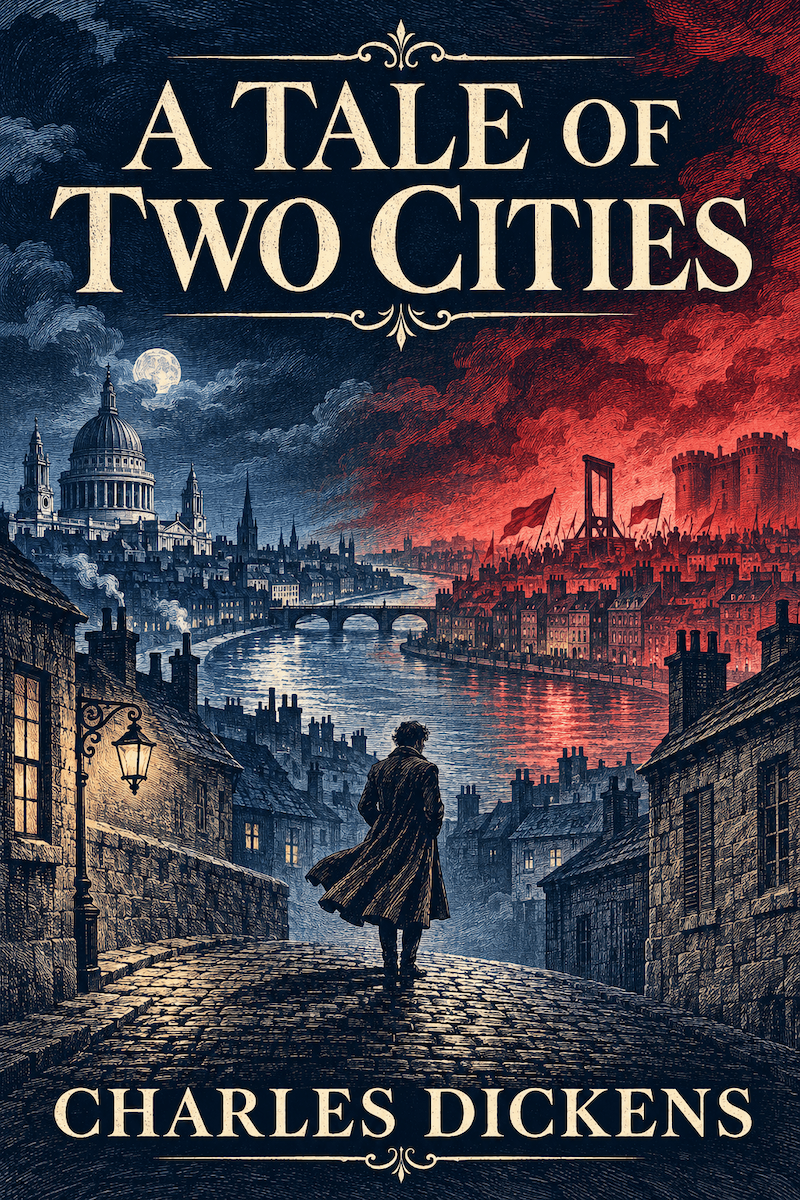
Prefer the print book? Buy on Amazon
As an Amazon Associate, Sumizeit earns from qualifying purchases.
Book Summary
A Tale of Two Cities Book Summary
This A Tale of Two Cities Book Summary covers the key ideas, lessons, and takeaways in about 20 minutes.
Short Description:
Love, revenge and sacrifice in London and Paris during the French Revolution
Dickens argues that cruelty makes its own revenge, and that revenge, when it is left to run, destroys the avengers too. The Evrémondes grind the poor down and the poor eventually take the kingdom apart, but Madame Defarge shows how hate that has no end consumes everything it touches. What saves the story is a smaller idea. A person can break the cycle by choosing to give up something for another person, and Sydney Carton, who thought his life was wasted, proves that it is never too late to turn a life into something that matters.
Helps with these goals
Preview the A Tale of Two Cities book summary
Below is a preview of Sumizeit’s comprehensive human-written summary of A Tale of Two Cities by Charles Dickens. The full summary is 15-20 minutes long and covers the book’s key ideas in text, audio, visual, and video formats. Unlock the full 20 Minute Summary
A Tale of Two Cities follows a small group of people through London and Paris in the years before and during the French Revolution. A French doctor walks out of prison after eighteen years, and his daughter takes him home. Her husband turns out to belong to the very family that locked the doctor away. A wasted English lawyer loves her too, and he is the one who ends up paying the price for everyone else.
Dickens runs three stories side by side. There is a love story, a revenge story, and a picture of a society so cruel that it was bound to crack open. The book has three parts, which Dickens calls Books. I'll go through each one in order. Fair warning that this summary gives away the ending.
Where it starts, 1775 (Book One, Chapter 1)
Dickens opens with the famous lines about the best of times and the worst of times. Then he gets specific. The year is 1775. England and France both have kings and queens who feel sure that God is on their side. In England, highwaymen rob coaches, prisons are packed, and the law hangs people for petty theft. France is worse. A young man was tortured and killed for failing to kneel as a line of monks walked past.
Dickens also slips in a warning. Somewhere in France, a woodcutter is cutting timber for a machine with a blade. Readers in 1859 knew exactly what that machine was.
The mail coach and a strange message (Book One, Chapters 2 to 4)
On a foggy November night, the Dover mail coach crawls up a hill. The passengers walk beside it to spare the tired horses, and everyone is jumpy about robbers. A rider catches up. He is Jerry Cruncher, a messenger for Tellson's Bank, and he has a note for a passenger named Jarvis Lorry. Lorry works for the same bank. The note tells him to wait in Dover for a young woman.
Lorry sends back a reply of three words. Recalled to life. Jerry has no idea what that means and rides off muttering about it. Lorry dozes and dreams of digging a man out of a grave and asking how long he has been buried. Almost eighteen years, the ghost answers.
In Dover, Lorry meets Lucie Manette at a hotel called the Royal George. She is seventeen, golden haired, and she grew up in England believing both her parents were dead. Lorry explains that her father, Doctor Alexandre Manette, is alive. He has been held in Paris all these years with no explanation. Lucie nearly collapses. Her fierce, red haired companion, Miss Pross, takes charge of her, and they agree to cross the Channel together.
The wine shop in Saint Antoine (Book One, Chapter 5)
In the poor Paris district of Saint Antoine, a cask of wine breaks in the street. Everyone rushes to scoop up the wine, lapping it from the cobblestones and licking it off their fingers.
Want the complete 20-minute summary?
- Full structured summary
- Video Summary
- Podcast Summary
- Audio summary
- Key takeaways
- Exercises
- Quiz
- Highlights and notes
- Ask the book with AI
Who should read A Tale of Two Cities?
A Tale of Two Cities appeals to readers interested in historical fiction, moral philosophy, and epic narratives of personal sacrifice. It's ideal for those who appreciate complex characterization, themes of redemption, and vivid portrayals of social upheaval. History enthusiasts and literature students will find Dickens's exploration of the French Revolution particularly valuable. Anyone seeking a story about how love and sacrifice can transform a wasted life will find deep resonance in this novel.
Why does A Tale of Two Cities matter?
Charles Dickens's A Tale of Two Cities remains relevant because it explores timeless questions about justice, revenge, and social inequality that continue to shape societies today. The novel demonstrates how systemic cruelty inevitably provokes violent upheaval, a lesson applicable to understanding revolutions and social movements throughout history. Dickens shows that while institutional change is necessary, personal sacrifice and forgiveness offer paths to redemption that violence alone cannot provide. The book's examination of how ordinary people become caught in historical forces larger than themselves speaks to modern concerns about individual agency within systems of power.
What are the key themes in A Tale of Two Cities?
- Resurrection and redemption through sacrifice
- Cyclical nature of violence and revenge
- Class conflict and social inequality
- Resurrection vs. death as metaphors for transformation
- Loyalty and love as counterforces to hate
- The cost of historical progress
- Individual agency within revolutionary forces
How can you apply ideas from A Tale of Two Cities?
- Examine how your own institutions or practices might create resentment that could lead to future conflict, using the novel as a cautionary tale about the long-term costs of cruelty and inequality.
- Consider how to break cycles of revenge in personal or professional conflicts by choosing compassion over retaliation, as Carton demonstrates.
- Reflect on how small acts of kindness and loyalty can have unexpectedly large consequences across time, encouraging deliberate cultivation of positive relationships.
- Evaluate whether you or your organization are ignoring warning signs of discontent or unrest, as the French aristocracy fails to heed the suffering around them.
- Practice separating individuals from the systems or families they belong to, allowing for moral judgment of persons independent of collective guilt.
- Use historical fiction like this novel to develop empathy for how ordinary people experience extraordinary historical events beyond their control.
- Recognize when silence or quiet work holds more power than loud declarations, valuing behind-the-scenes organizing and influence.
What common mistakes do readers make with A Tale of Two Cities?
- Assuming that Darnay is responsible for his family's crimes simply because he shares their name and wealth, when in fact he actively rejects their legacy.
- Viewing Madame Defarge's revenge as justified closure rather than recognizing how her unlimited hatred becomes self-destructive and threatens innocent people like Lucie and her child.
- Misreading Sydney Carton's final sacrifice as romantic martyrdom rather than understanding it as the culmination of a long spiritual transformation toward meaningful action.
- Overlooking the novel's critique of both the aristocratic cruelty and the revolutionary violence, treating the uprising as purely heroic rather than tragic.
- Failing to appreciate how Doctor Manette's trauma remains active and dangerous long after his physical release, underestimating how institutional violence permanently marks victims.
Sumizeit Exercises Apply what you've learned
Turn ideas from A Tale of Two Cities into action with a short guided reflection: identify the biggest takeaway, connect it to your life, and commit to one step you can take in the next 24 hours.
What is the expert analysis of A Tale of Two Cities?
Overview
A Tale of Two Cities, authored by Charles Dickens and first published in 1859, stands as one of the most enduring historical novels in English literature. Set against the turbulent backdrop of the French Revolution, Dickens crafts a narrative that intertwines personal sacrifice, social injustice, and political upheaval across two iconic cities—London and Paris. The novel’s significance lies not only in its vivid portrayal of a society on the brink of collapse but also in its exploration of timeless human themes such as redemption, resurrection, and the cyclical nature of violence. Dickens, a towering figure in Victorian literature, channels his profound empathy for the oppressed and his keen social critique into this work, making it a cornerstone of both historical and social commentary.
Core Thesis
At its core, A Tale of Two Cities advances the argument that systemic cruelty and social inequities inevitably breed violent retribution, yet it also posits that individual acts of self-sacrifice can interrupt this destructive cycle. Dickens illustrates how the aristocratic Evrémonde family’s callousness sows the seeds of revolution, while Madame Defarge’s relentless vengeance exemplifies the consuming nature of hatred. Contrasting this, Sydney Carton’s ultimate sacrifice embodies the redemptive power of love and personal transformation, suggesting that even in the darkest times, human dignity and hope endure. The novel thus meditates on the duality of destruction and salvation within historical and personal realms.
Strengths
- Complex Interweaving of Personal and Political Narratives: Dickens masterfully balances intimate human dramas with sweeping historical events, allowing readers to grasp the profound impact of societal upheaval on individual lives.
- Rich Symbolism and Imagery: The recurring motifs—such as footsteps echoing the coming revolution, and Madame Defarge’s knitting as a register of vengeance—imbue the narrative with layers of meaning that resonate beyond the immediate plot.
- Characterization and Moral Ambiguity: Characters like Sydney Carton are portrayed with psychological depth, embodying both flaws and virtues, which enriches the novel’s exploration of redemption and sacrifice.
- Historical Contextualization: Drawing on contemporary histories like Carlyle’s, Dickens situates his story within a well-researched framework, lending authenticity and urgency to the depiction of the French Revolution’s complexities.
- Social Critique: The novel incisively critiques class disparities and institutional injustices, reflecting Dickens’s lifelong commitment to social reform and his nuanced understanding of systemic oppression.
Critiques & Counterarguments
- Historical Simplification: While effective as a narrative device, Dickens’s portrayal of the French Revolution tends toward moral binaries—tyrannical aristocrats versus vengeful peasants—that can oversimplify the multifaceted political and social realities of the period.
- Idealization of Sacrifice: Sydney Carton’s self-sacrifice, though powerful, may be read as a romanticized resolution that glosses over the broader structural forces driving historical violence and change.
- Limited Female Agency: Despite Madame Defarge’s prominence, female characters like Lucie Manette often embody traditional Victorian ideals of passive virtue, which may feel restrictive or dated to modern readers seeking more complex female perspectives.
- Competing Historical Interpretations: Marxist and revisionist historians argue that the revolution’s causes and consequences are far more complex than Dickens’s narrative suggests, emphasizing economic factors and class struggle over individual moral failings or virtues.
- Questioning Cycles of Violence: Contemporary scholarship on conflict resolution challenges the inevitability of revenge cycles, proposing instead that structural reforms and dialogue can prevent such destructive repetitions, a nuance less explored in Dickens’s work.
Who Should Read This
A Tale of Two Cities is essential reading for those interested in the interplay between history and literature, particularly readers fascinated by the French Revolution’s social and political upheavals. It appeals to scholars and enthusiasts of Victorian literature who appreciate Dickens’s narrative craftsmanship and social consciousness. Additionally, readers drawn to themes of sacrifice, redemption, and moral complexity will find the novel profoundly moving. While its historical perspective reflects 19th-century sensibilities, the novel’s exploration of human resilience and the costs of societal injustice remains deeply relevant for students of history, philosophy, and social psychology alike.
Discussion questions for A Tale of Two Cities Short questions you can actually use in a conversation
Frequently asked questions about the A Tale of Two Cities book summary
What is A Tale of Two Cities about?
A Tale of Two Cities by Charles Dickens follows interconnected characters through London and Paris during the French Revolution, weaving together a love story, a revenge narrative, and a portrait of social collapse. The novel centers on an innocent man caught between his love for a woman and his dangerous family heritage, a lawyer seeking redemption through sacrifice, and a family whose buried past emerges to condemn them. Dickens explores how systems of cruelty inevitably provoke violent upheaval and how personal sacrifice can offer a path beyond revenge.
Who should read A Tale of Two Cities?
A Tale of Two Cities appeals to anyone interested in historical fiction, moral philosophy, character transformation, and the human dimensions of revolution. History students and enthusiasts will appreciate Dickens's vivid portrayal of the French Revolution and its effects on ordinary people. Readers interested in themes of redemption, love, sacrifice, and second chances will find deep resonance in Sydney Carton's arc. The novel also speaks to those seeking to understand how social inequality and oppression create cycles of violence and revenge.
What are the main takeaways from A Tale of Two Cities?
The novel's central message is that cruelty creates its own reckoning, and unlimited revenge consumes both the victims of injustice and the avengers themselves. Dickens demonstrates that personal sacrifice and love offer redemptive alternatives to cycles of violence and hatred. The story shows that even a wasted life can be transformed into something meaningful through selfless action, and that institutional systems can trap both the guilty and innocent alike. Finally, A Tale of Two Cities illustrates how individual conscience and small acts of kindness can matter profoundly even amid historical forces beyond personal control.
Why does Doctor Manette struggle throughout the novel?
Doctor Manette's eighteen years of imprisonment in the Bastille leave deep psychological scars that resurface when triggered by reminders of his captivity or the Evrémonde name. Although he recovers and builds a life with Lucie, learning of Darnay's true identity as an Evrémonde—the family responsible for his imprisonment—causes him to regress into his old shoemaking ritual, the behavior that sustained his sanity in prison. Dickens shows that trauma from institutional violence cannot be completely erased and that healing requires both time and the support of those who love us.
What does Sydney Carton's final act accomplish?
Sydney Carton's decision to take Charles Darnay's place on the guillotine accomplishes multiple things: it saves Darnay and allows him to escape with his wife and family, it interrupts the cycle of revenge by removing himself from the spiral of violence, and it transforms Carton's entire existence from meaninglessness into purposeful sacrifice. Carton achieves the redemption he has been seeking, proving that it is never too late to make a life matter. His sacrifice breaks the destructive cycle of hatred that Madame Defarge perpetuates and allows love to triumph over revenge.
How does Madame Defarge's knitting connect to the larger plot?
Madame Defarge's knitting is a register of the people destined for death during the French Revolution, with each victim's name encoded in a pattern only she can read. The knitting becomes a symbol of how she transforms grief and rage into organized revenge, making her a powerful figure in the revolutionary movement. Ultimately, her obsessive recording of names to kill—including innocent people like Lucie and her child—demonstrates how unlimited hatred becomes self-destructive and perpetuates violence beyond any rational justice.
Why is the title 'A Tale of Two Cities'?
The title refers to London and Paris, the two cities where the novel's action unfolds and which represent two very different social worlds. London represents stability, legal systems, and relative freedom, while Paris represents upheaval, tyranny, and revolutionary chaos. The dual focus allows Dickens to contrast how the same characters and moral questions play out differently in each setting and to show how the personal (love, sacrifice, redemption) and the historical (revolution, justice, social change) intersect across both cities.
About Sumizeit
Sumizeit is a profitable Scomy LLC company based in Miami, Florida. Our founders, Clemens Raemy and Weina Scott, are successful entrepreneurs with several exits. Sumizeit is a popular book summary app / micro learning app used by busy professionals and entrepreneurs with over 2,500 non-fiction book summaries and 10,000 podcast summaries in text, audio, visual, podcast, and video format. We also have stellar retention tools to make ideas stick - such as flashcards with spaced repetition, quizzes, streaks, highlighting and notes, daily challenges, riddles, mini-courses, meditation, and more. You won't only learn the idea, but also remember it. Over 90% of our users change their habits with Sumizeit.
Upgrade Now
Here's why readers love Sumizeit
Join thousands of learners getting smarter every day
"Great experience. Detailed summaries. Loved the gamification feature. Makes learning fun. Good customer service. I recommend Sumizeit to anyone. You'll learn a lot."
"I always felt busy but still wanting to keep up with the book discussion in my friend group. This was a great supplement to help me keep reading the books I find fun while keeping up with important books."
"I love this website. Instead of scrolling social media, I find myself learning a lot. I use it everyday. I recommend this app for anyone who is too busy and wants to get up to speed with their favorite books."
A Tale of Two Cities Book Summary PDF
Looking for a A Tale of Two Cities Book Summary PDF you can save and revisit offline? Our A Tale of Two Cities Book Summary PDF captures the book’s core ideas in a clean, printable format — the key frameworks, takeaways, and structure without the fluff. Download the A Tale of Two Cities Book Summary PDF when you want a reference you can annotate, share with your team, or review on the go. Get your A Tale of Two Cities Book Summary PDF from the download page below.
Download A Tale of Two Cities Book Summary PDFPeople also liked these summaries
Readers who explored A Tale of Two Cities often enjoyed these titles next.

Ready to read the whole thing?
- Full structured summary
- Video Summary
- Podcast Summary
- Audio summary
- Key takeaways
- Exercises
- Quiz
- Highlights and notes
- Ask the book with AI
Featured Book Titles
Popular Book Summaries at sumizeit, leading book summary app
Atomic Habits Book Summary Rich Dad Poor Dad Book Summary The Four Agreements Book Summary The 48 Laws of Power Book Summary When Breath Becomes Air Book Summary Think and Grow Rich Book Summary