


As an Amazon Associate, Sumizeit earns from qualifying purchases.
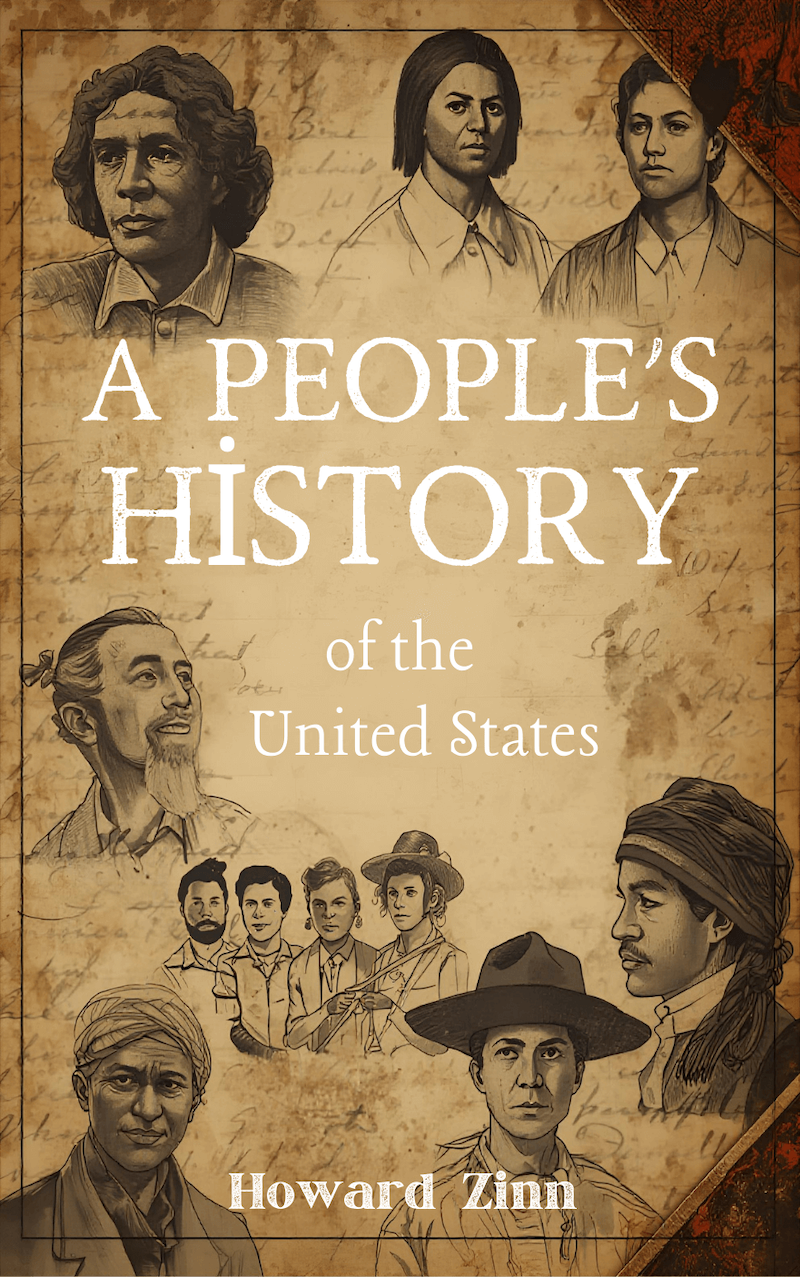
A People’s History of the United States Book Summary
This A People’s History of the United States Book Summary covers the key ideas, lessons, and takeaways in about 20 minutes.
Helps with these goals
Want the complete 20-minute summary?
- Full structured summary
- Video Summary
- Podcast Summary
- Audio summary
- Key takeaways
- Exercises
- Quiz
- Highlights and notes
- Ask the book with AI
What is in the A People’s History of the United States book summary?
Below is a preview of Sumizeit’s expert-written summary of A People’s History of the United States by Howard Zinn. The full summary covers the book’s key ideas in text, audio, and video.
Most U.S. history books center on the powerful: presidents, war generals, wealthy industrialists, and other decision-makers. Howard Zinn rewrites that narrative from the bottom looking up. Rather than treating the masses as background characters to elite ambition, he tells American history through ordinary people—Indigenous nations, enslaved Africans, laborers, immigrants, women, soldiers, activists, and all those whose lives reveal how progress often came from struggle rather than benevolence. His approach questions not only what happened, but who paid the price for those events, and who resisted them. His narrative shows that most turning points in the United States were shaped by conflict between those who had power and those who were denied it.
Zinn’s story is therefore less about heroic founding fathers and more about exploited workers building railroads, enslaved people fueling plantation economies, women agitating for rights, soldiers sent to fight wars they did not choose, and social movements trying to claim dignity. In this telling, America is not a smooth tale of gradual freedom, but a constant negotiation between control and resistance, privilege and rebellion, growth and injustice.
The Colonial Foundation – Conquest, Class Hierarchy, and the Birth of Inequality
The United States begins not with democracy but with conquest. European explorers arrived driven by desire for wealth and expansion. Indigenous societies—organized, communal, linked to land spiritually and economically—were forced into a violent collision with an economic system that valued property and resource extraction above all. Columbus’s arrival marked a period in which European powers enslaved, killed, or displaced Indigenous people on a massive scale, establishing an economy built on their suffering.
Colonial society quickly hardened into hierarchy. A small elite owned land and capital; merchants and plantation owners profited from crops and trade; small farmers and artisans made up a modest middle; and below them were indentured Europeans, enslaved Africans, and Indigenous people with almost no rights. Slavery became the defining labor institution, not only economically but ideologically: racism was cultivated deliberately to justify enslavement and to stop poor whites from joining enslaved Africans in rebellion. After early uprisings threatened elite control, lawmakers strengthened racial divisions to divide the lower classes.
Women lived under patriarchal laws that denied political participation and property ownership. Their labor—raising children, producing household goods, and working informally—was essential yet unseen. Despite silencing, women challenged their condition through writing, protest, and labor actions.
The American Revolution – Freedom for Whom?
Schools often present the American Revolution as a unified colonial struggle for liberty. Zinn paints a more complicated picture. Many wealthy colonists rebelled not out of universal principle but because British taxation and trade restrictions threatened their profits. Poor whites, who faced debt, hunger, and rising inequality, were persuaded to fight through promises of freedom, wages, or patriotism. For elites, war diverted unrest away from inequality at home by focusing anger on Britain.
Enslaved Africans largely sided with the British after being offered emancipation. Indigenous groups often opposed colonial forces because the British restricted westward settlement and colonists constantly invaded their lands.
Want the complete 20-minute summary?
- Full structured summary
- Video Summary
- Podcast Summary
- Audio summary
- Key takeaways
- Exercises
- Quiz
- Highlights and notes
- Ask the book with AI
Who should read A People’s History of the United States?
A People's History of the United States is essential for anyone seeking a complete understanding of American history beyond textbook heroics. This book speaks to students, educators, activists, and citizens who want to understand how ordinary people shaped the nation through resistance and struggle rather than accepting official narratives. It's particularly valuable for those questioning why inequality persists despite centuries of supposed progress.
Why does A People’s History of the United States matter?
Howard Zinn's reframing of American history challenges the dominant narrative by centering the experiences of the exploited rather than the elite, making it urgently relevant to contemporary debates about justice and power. Understanding how racism was deliberately constructed, how labor movements fought for basic rights, and how empire expanded at the expense of ordinary people illuminates patterns still visible today. The book reveals that progress is not automatic or guaranteed—it comes from sustained popular pressure and resistance.
What are the key themes in A People’s History of the United States?
- Power and resistance: the ongoing struggle between those with power and those denied it
- History from below: centering the experiences of ordinary people, workers, and the marginalized
- Manufactured inequality: how racism, class division, and patriarchy were deliberately constructed to maintain control
- Empire and expansion: how territorial and economic expansion was built on displacement and exploitation
- Incomplete progress: how legal victories and reforms often fail to address systemic inequality
- Grassroots change: how social movements and popular pressure drive real transformation
What are the key lessons from the A People’s History of the United States book summary?
Columbus and conquest were not discovery but violent displacement
European arrival in the Americas initiated systematic enslavement, killing, and removal of Indigenous peoples to establish an economy based on their exploitation and resource extraction.
Racism was deliberately engineered to prevent solidarity among the poor
Colonial elites deliberately cultivated racial divisions to prevent poor whites and enslaved Africans from uniting against inequality, making racism a tool of power rather than a natural hierarchy.
The American Revolution benefited elites more than common people
While framed as universal liberation, the Revolution primarily protected wealthy colonists' profits and left the poor unpaid, heavily taxed, and still landless.
Indigenous peoples resisted removal and treaty violations consistently
Tribes fought removal through legal and armed resistance, but governments ignored court victories and forced them westward, showing that rights mean little without enforcement.
The Civil War was both moral struggle and economic competition
Beyond the fight against slavery, the war reflected competing economic systems between industrial capitalism and slave agriculture, with poor soldiers bearing the heaviest costs.
Emancipation without land or resources created new forms of servitude
Despite gaining legal freedom, formerly enslaved people lacked economic independence, making sharecropping a replacement system that kept them exploited and the South economically dependent.
Workers organized collectively and repeatedly despite violent suppression
Strikes, unions, and radical organizations emerged across industries to demand shorter hours, higher pay, and worker democracy, fighting state militias and corporate violence.
The New Deal reformed without transforming fundamental power structures
While New Deal programs prevented economic collapse and legalized unions, they stopped short of redistributing wealth or dismantling elite control, channeling activism into negotiation.
Women's essential labor was systematized and hidden throughout American history
Women's unpaid domestic work and informal labor sustained the economy while patriarchal laws denied them political participation and property ownership, though they still resisted.
Imperial expansion shifted overseas as the western frontier closed
Unable to expand westward, the U.S. intervened in Cuba, annexed the Philippines, and occupied territories to access new markets and resources while justifying it through nationalism.
Wars are often portrayed as moral crusades but driven by material interests
World War I and World War II, though presented as righteous fights, were shaped by financial ties, asset protection, and economic calculation alongside stated moral purposes.
The Cold War created perpetual threat to justify military expansion and intervention
The ideology of constant danger from communism enabled sustained military budgets, foreign interventions, coups, and wars while concentrating power domestically.
Vietnam War resistance showed when popular dissent can force policy change
Mounting casualties, draft resistance, and nationwide protests from students, soldiers, and civil rights leaders eventually made continued war politically untenable, forcing withdrawal.
Civil Rights victories were legal but left economic inequality intact
While legislation like the Civil Rights Act ended formal segregation, deep systemic inequalities in wealth, housing, and opportunity persisted beneath the surface of new freedoms.
Social movements demand structural change, not just symbolic reform
The Black Power Movement, women's liberation, Native resistance, and gay liberation all insisted that legal rights without economic justice and autonomy were incomplete victories.
State power crushes radical movements through assassination and imprisonment
Law enforcement targeted activist leaders for elimination or incarceration while media portrayed them as threats, preventing radical organizations from achieving their full potential.
Both major political parties serve corporate and military interests
By the late 20th century, Zinn argues, partisan divisions masked a deeper consensus that prioritized corporate power and military expansion over redistribution or economic democracy.
Deregulation, incarceration, and surveillance replaced the welfare state
As labor was weakened and wealth inequality widened, systems of control shifted from social provision to policing and imprisonment, costing ordinary people most while benefiting elites.
Crises enable the expansion of state control and reduction of dissent
From economic collapse to terrorism, emergencies justify surveillance growth, military intervention, and suppression of questioning, with costs borne by ordinary citizens.
Freedom comes from below through sustained struggle, not granted from above
American progress has consistently required ordinary people organizing, protesting, striking, and demanding justice rather than waiting for benevolent leaders to grant rights.
Want the complete 20-minute summary?
- Full structured summary
- Video Summary
- Podcast Summary
- Audio summary
- Key takeaways
- Exercises
- Quiz
- Highlights and notes
- Ask the book with AI
How can you apply ideas from A People’s History of the United States?
- Question official historical narratives by researching whose perspectives are centered and whose are excluded in standard accounts
- Examine how division and scarcity narratives are used to prevent solidarity among working people and marginalized groups across lines of race and class
- Study how social movements achieved concrete gains through sustained pressure and organizing rather than relying on individual leaders or electoral politics alone
- Analyze current policies (labor, criminal justice, military spending, welfare) by tracing their historical roots and understanding whom they benefit
- Recognize patterns of state suppression of dissent and the use of crisis to expand control, enabling more critical evaluation of contemporary policy justifications
- Build grassroots movements by studying historical organizing strategies, coalition-building across differences, and persistence despite setbacks
What common mistakes do readers make with A People’s History of the United States?
- Assuming history follows a linear march toward inevitable progress rather than recognizing gains are contested, temporary, and require constant defense
- Treating the founding fathers and presidents as the primary drivers of change instead of recognizing ordinary people's struggle as the real engine of transformation
- Believing that legal or symbolic victories automatically solve systemic problems, when economic and structural inequality can persist beneath formal equality
- Overlooking how divisions of race, gender, and nationality were deliberately constructed to prevent unified resistance among the exploited
Sumizeit Exercises Apply what you've learned
Turn ideas from A People’s History of the United States into action with a short guided reflection: identify the biggest takeaway, connect it to your life, and commit to one step you can take in the next 24 hours.
What is the expert analysis of A People’s History of the United States?
Overview
A People’s History of the United States by Howard Zinn stands as a seminal work in American historiography, notable for its radical reorientation of the national narrative. Rather than celebrating political elites and traditional power holders, Zinn foregrounds the experiences of marginalized groups—Indigenous peoples, enslaved Africans, laborers, women, and activists—whose struggles and resistances have shaped the country’s trajectory. Published in 1980, this book challenged prevailing historical orthodoxies by emphasizing conflict, exploitation, and grassroots agency. Zinn, a historian and activist, brought to this work his deep commitment to social justice and a critical perspective shaped by his own experiences in war and civil rights activism.
Core Thesis
Zinn’s central argument is that American history is best understood from the perspective of those oppressed and exploited by dominant power structures. He contends that the nation’s progress was rarely benevolent or inevitable but was won through persistent struggle against entrenched elites. The traditional celebratory accounts of founding fathers, wars, and political milestones obscure the realities of class conflict, racial oppression, and systemic inequality. By retelling history “from below,” Zinn reveals that freedom and justice have been hard-fought and remain incomplete, shaped by ongoing resistance rather than top-down benevolence.
Strengths
- Innovative Perspective: Zinn’s bottom-up approach revolutionizes the way American history is taught and understood, giving voice to groups often omitted from mainstream narratives.
- Comprehensive Scope: The book covers a vast chronological span, linking colonial conquest, slavery, labor movements, imperialism, and modern political developments into a coherent critique of power.
- Engagement with Social Movements: By highlighting activism and resistance, Zinn connects historical events to contemporary struggles, inspiring readers to consider their own role in social change.
- Accessible and Provocative Style: The narrative is compelling and clear, making complex historical dynamics understandable without sacrificing analytical depth.
- Ethical Commitment: Zinn’s work is grounded in a moral imperative to expose injustice and empower ordinary people, lending the text a passionate urgency.
Critiques & Counterarguments
- Selective Use of Evidence: Critics argue that Zinn sometimes prioritizes anecdotal or activist-friendly sources over a balanced range of evidence, potentially skewing interpretations.
- Oversimplification of Complex Events: The dichotomy of oppressors versus oppressed can flatten nuanced historical realities, underplaying internal divisions within groups and the multiplicity of motives among historical actors.
- Neglect of Institutional Progress: Some historians contend that Zinn underestimates the significance of institutional reforms and legal advances that, while imperfect, contributed to social improvements.
- Opposing Schools of Thought: Traditional political historians emphasize the importance of state-building, diplomacy, and elite decision-making as drivers of historical change, challenging Zinn’s focus on popular resistance as the primary engine.
- Real-World Evidence of Stability: The persistence of American democratic institutions and economic growth can be seen as contradictory to Zinn’s portrayal of a nation in constant conflict and exploitation.
Who Should Read This
This book is essential reading for scholars, students, and engaged readers interested in a critical re-examination of American history. It appeals particularly to those in social sciences, humanities, and activist circles who seek to understand the intersections of power, race, class, and resistance. Educators looking to diversify historical curricula and readers eager to challenge dominant narratives will find Zinn’s work both provocative and enlightening. However, readers should approach the text with an awareness of its interpretive lens and consider it alongside other historiographical perspectives for a fuller understanding of the United States’ complex past.
Frequently asked questions about the A People’s History of the United States book summary
What is A People's History of the United States about?
A People's History of the United States by Howard Zinn retells American history from the perspective of ordinary people—Indigenous nations, enslaved Africans, workers, immigrants, women, and activists—rather than presidents and elites. The book argues that progress came through struggle and resistance rather than benevolence, showing how exploitation and inequality were deliberately constructed and constantly challenged from below.
Who should read A People's History of the United States?
Anyone seeking a complete understanding of American history beyond textbook narratives should read this book, including students, educators, activists, and citizens questioning why inequality persists. It's especially valuable for those wanting to understand how ordinary people have shaped the nation and how social movements drive real change.
What are the main takeaways from A People's History of the United States?
The main takeaways are that freedom was rarely granted from above but pushed upward through protest and rebellion; that racism and inequality were deliberately constructed to prevent solidarity among the poor; that legal victories often fail to address systemic inequality; and that American history is an ongoing struggle rather than a straight march toward equality. Understanding the past requires recognizing both exploitation and achievement, and acknowledging that ordinary people organized for change.
How does Zinn view the American Revolution?
Zinn argues that the American Revolution was more complicated than a unified struggle for liberty. Wealthy colonists rebelled primarily because British taxation threatened their profits, poor soldiers were promised freedom and wages they often didn't receive, and the Constitution that followed protected wealth and suppressed redistribution. For enslaved Africans and Indigenous peoples, the Revolution meant continued oppression rather than liberation.
What does Zinn say about slavery and race in American history?
Zinn argues that racism was deliberately engineered by colonial elites to divide poor whites from enslaved Africans and prevent unified resistance. After early rebellions threatened elite control, lawmakers deliberately strengthened racial divisions, making racism a tool of power rather than a natural hierarchy. This manufactured division persisted through slavery, Reconstruction, Jim Crow, and into the modern era.
How does A People's History of the United States explain labor movements?
Zinn documents how workers repeatedly organized through strikes, unions, and radical organizations to demand shorter hours, higher pay, and worker democracy despite violent suppression by militias and police. The New Deal legalized unions but also channeled activism into negotiation rather than transformation, giving workers protection but not the fundamental restructuring they sought.
What is Zinn's perspective on American imperialism and war?
Zinn argues that American expansion moved overseas when the western frontier closed, with the U.S. intervening in Cuba, annexing the Philippines, and occupying territories to access markets and resources. He contends that wars like World War I and II were portrayed as moral crusades but driven partly by financial interests, and that the Cold War's ideology of perpetual threat justified military expansion and intervention that benefited elites at ordinary people's expense.
Did civil rights victories solve inequality according to Zinn?
Zinn argues that civil rights legislation like the Civil Rights Act ended formal segregation but left deep systemic inequalities in wealth, housing, and opportunity largely intact. Without economic independence and structural change, legal victories proved insufficient, and activism continued through the Black Power Movement and other groups demanding economic justice and autonomy, not just symbolic rights.
About Sumizeit
Sumizeit is a profitable Scomy LLC company based in Miami, Florida. It has been helping readers learn from nonfiction books for 7 years with expert-written summaries in text, audio, podcast, and video.
Want the complete 20-minute summary?
- Full structured summary
- Video Summary
- Podcast Summary
- Audio summary
- Key takeaways
- Exercises
- Quiz
- Highlights and notes
- Ask the book with AI
Here's why readers love Sumizeit
Join thousands of learners getting smarter every day
"Great experience. Detailed summaries. Loved the gamification feature. Makes learning fun. Good customer service. I recommend Sumizeit to anyone. You'll learn a lot."
"I always felt busy but still wanting to keep up with the book discussion in my friend group. This was a great supplement to help me keep reading the books I find fun while keeping up with important books."
"I love this website. Instead of scrolling social media, I find myself learning a lot. I use it everyday. I recommend this app for anyone who is too busy and wants to get up to speed with their favorite books."
A People’s History of the United States Book Summary PDF
Looking for a A People’s History of the United States Book Summary PDF you can save and revisit offline? Our A People’s History of the United States Book Summary PDF captures the book’s core ideas in a clean, printable format — the key frameworks, takeaways, and structure without the fluff. Download the A People’s History of the United States Book Summary PDF when you want a reference you can annotate, share with your team, or review on the go. Get your A People’s History of the United States Book Summary PDF from the download page below.
Download A People’s History of the United States Book Summary PDFPeople also liked these summaries
Readers who explored A People’s History of the United States often enjoyed these titles next.




Want the complete 20-minute summary?
- Full structured summary
- Video Summary
- Podcast Summary
- Audio summary
- Key takeaways
- Exercises
- Quiz
- Highlights and notes
- Ask the book with AI
Featured Book Titles
Popular Book Summaries at sumizeit, leading book summary app
