


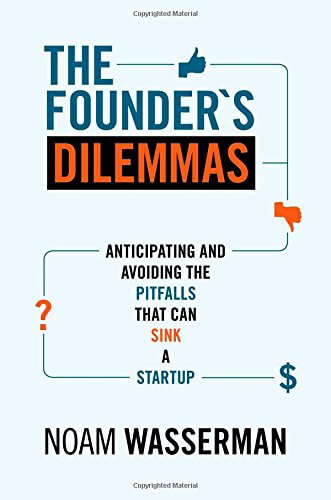
The Founder's Dilemmas Book Summary
This The Founder's Dilemmas Book Summary covers the key ideas, lessons, and takeaways in about 20 minutes.
Helps with these goals
Want the complete 20-minute summary?
- Full structured summary
- Video Summary
- Podcast Summary
- Audio summary
- Key takeaways
- Exercises
- Quiz
- Highlights and notes
- Ask the book with AI
What is in the The Founder's Dilemmas book summary?
Below is a preview of Sumizeit’s expert-written summary of The Founder's Dilemmas by Noam Wasserman. The full summary covers the book’s key ideas in text, audio, and video.
Starting your own company is a big deal, and it's important to make sure it's done right. In The Founder’s Dilemmas, Noah Wasserman has answers to all of the most common questions people have about creating successful startups, and he did his research. His book is comprised of information gathered from roughly ten years of data collecting and 10,000 interviews with business founders. Inside, he chronicles how you can face the problems only an entrepreneur understands. He offers insight from those who have experience not only solving these problems but solving them successfully. Read on to learn why motivation is what separates entrepreneurs from other professionals, whether hiring your best friend will help or hinder your company’s growth, and what singular quality to look for in a new hire.
Let what motivates you to determine your path
Some people enjoy routine work, with a guaranteed paycheck at the end of the day. Others find the consistency draining, dull, and exhausting. If you fall into the second group, it's likely you’d farewell as an entrepreneur, and you’re not alone. When Genevieve Thiers was working at IBM, she felt stifled, like a cog in a machine. She ended up founding Sittercity, her own company, later. Feeling stifled or bored at your job can be an indicator of what motivates you. In men, those who enjoyed normal jobs were driven by security, prestige, financial gain, and affiliation. All of these motivations can be met outside of entrepreneurship. Men who become founders were motivated by financial gain and control, two needs that aren’t readily met by your average working environment. Women were motivated a bit differently. Those who preferred entrepreneurial careers were driven by autonomy, power, influence, managing people, and altruism. Those who preferred nonentrepreneurial careers were motivated by recognition, affiliation, security, and lifestyle: needs that a normal office job can usually meet. If you can’t relate to the motivations of those who enjoy regular office jobs, you’re in the right place.
Find Human Capital
Now that you’re sure you’ve got the right motivation to have a career as an entrepreneur, does that mean you’re ready to start your own business? Absolutely not. You’ll need a few things first. One of them is known as human capital. This concept refers to an understanding of the field that you’re going into, and it's essential to developing a successful business. Just ask baseball star, Curt Schilling. He knew what it took to be a skilled athlete, and had a background in leadership. However, he didn’t have any experience running a business. When he launched a massive gaming startup, he was ill-prepared to manage people in a workplace environment. He couldn’t understand why his employees didn’t want to work weekends, for instance: and this lack of awareness caused problems in his startup. Conversely, Barry Nalls, the founder of Masergy, had worked roughly 25 years at a telecommunications company before launching his startup.
Want the complete 20-minute summary?
- Full structured summary
- Video Summary
- Podcast Summary
- Audio summary
- Key takeaways
- Exercises
- Quiz
- Highlights and notes
- Ask the book with AI
Who should read The Founder's Dilemmas?
The Founder's Dilemmas is essential reading for entrepreneurs launching their first startup, co-founders navigating early-stage decisions, and anyone considering whether they have the right motivation and capabilities for business ownership. It's particularly valuable for those who want to avoid costly mistakes by learning from the experiences of thousands of founders who came before them.
Why does The Founder's Dilemmas matter?
Most startups fail not because of a bad idea, but because founders make preventable strategic and interpersonal mistakes during critical early decisions. Noam Wasserman's decade of research and 10,000 founder interviews reveal patterns that can mean the difference between a thriving company and a failed venture. Understanding these common dilemmas helps founders make informed choices about partnerships, hiring, equity, and investor relationships before problems become irreversible.
What are the key themes in The Founder's Dilemmas?
- Understanding your personal motivation for entrepreneurship
- Building and leveraging human capital before launching
- Developing social capital through strategic networking
- Co-founder selection and complementary skill sets
- Defining clear roles and responsibilities among founders
- Equity distribution and fair compensation decisions
- Hiring strategy: known contacts versus outside talent
- Evaluating investor capital versus bootstrapping
What are the key lessons from the The Founder's Dilemmas book summary?
Motivation separates entrepreneurs from employees
People driven by autonomy, control, and independence are more likely to succeed as founders than those motivated by security and affiliation. Understanding what drives you personally can indicate whether entrepreneurship is the right path.
Human capital is non-negotiable for startup success
Deep knowledge of your industry and proven business management experience dramatically increase success rates. Founders without this background face substantially higher failure rates than those with relevant expertise.
Social capital opens doors investors won't
A well-developed network of advisors, clients, employees, and investors smooths your transition into a new venture. These relationships become invaluable resources that money alone cannot replicate.
Balance career development with avoiding overspecialization
Staying too long in one role builds deep expertise but limits your adaptability and perspective. Strategic job changes before launching a startup broaden your knowledge while building diverse connections.
Find a co-founder who complements your gaps
Identify what you lack—whether human, social, or financial capital—and seek a partner who excels in those areas. The right co-founder makes the overwhelming burden of launching a company manageable.
Clearly defined roles prevent accountability confusion
When co-founder responsibilities are distinct and non-overlapping, accountability becomes obvious and conflicts are easier to resolve. Ambiguous role boundaries lead to finger-pointing and resentment.
Equity arrangements must adapt as roles change
Initial equity splits often become unfair as founder contributions shift over time. Founders who address equity adjustments proactively avoid tension and team dissolution.
Hiring known contacts has real trade-offs
Friends and relatives improve investor valuations but create emotional barriers to performance management and termination. Your hiring strategy should align with your company's immediate needs and culture goals.
Generalists outperform specialists in early-stage roles
Employees with diverse skill sets and flexibility handle the shifting priorities of startups better than specialists. Prioritize candidates with small-business experience who understand self-directed teamwork.
Experience at large corporations doesn't transfer well to startups
Skills valuable at established companies—like managing within structured systems—often become liabilities in resource-constrained startup environments. Small-company veterans adapt faster and contribute immediately.
Investor capital comes with hidden costs
Beyond equity dilution, venture capital demands time for reporting, board meetings, and compliance with investor requirements. Some founders spend 25% of their time managing investor relations rather than building the business.
Bootstrapping preserves control but limits speed
Self-funding allows you to maintain full ownership and decision-making authority but may force you to move slowly relative to well-funded competitors. The right choice depends on your market dynamics and personal priorities.
Market competition determines capital strategy
When competitors are growing rapidly through investment, staying bootstrapped becomes increasingly risky. Your funding decision should reflect competitive pressures, not just personal preference.
Founder motivation should align with chosen path
If you're driven by autonomy and control, investor oversight may frustrate you; if you value rapid scaling, external capital may be necessary. Matching your motivation to your funding strategy prevents burnout.
Prevent co-founder conflict by discussing expectations early
Explicit conversations about roles, equity, commitment level, and future changes prevent the resentment that derails partnerships. Ambiguity about these issues is the root of many founder separations.
Success requires balancing breadth and depth of experience
The strongest founders combine deep industry knowledge with exposure to different company sizes, roles, and business practices. Varied career experience better prepares you for startup complexity.
Your founding team's composition shapes your company's DNA
The people you choose as co-founders and early hires establish cultural norms and strategic capabilities that persist for years. Careful selection at the beginning prevents painful restructuring later.
Investor alignment on business objectives reduces friction
When investors share your long-term vision and operational philosophy, the relationship enhances rather than constrains your startup. Misalignment creates ongoing tension and decision paralysis.
No single hiring quality guarantees success
Rather than seeking a mythical perfect employee, evaluate candidates on whether they're generalists, have small-company experience, and can work both independently and collaboratively. These indicators reliably predict startup adaptation.
Your founding decisions compound over time
Early choices about co-founders, hiring philosophy, and capital structure create path dependencies that become increasingly difficult to change. Getting these foundational decisions right matters disproportionately.
Want the complete 20-minute summary?
- Full structured summary
- Video Summary
- Podcast Summary
- Audio summary
- Key takeaways
- Exercises
- Quiz
- Highlights and notes
- Ask the book with AI
How can you apply ideas from The Founder's Dilemmas?
- Assess your core motivation before committing to entrepreneurship to ensure you're pursuing the right path for the right reasons
- Audit your industry knowledge and business management experience; identify gaps and plan ways to fill them before launching
- Build your professional network strategically by rotating through roles and companies to diversify connections and expertise
- Create a specific, written job description for each co-founder role clarifying decision authority, responsibilities, and success metrics
- Document initial equity splits with provisions for adjusting them if founder contributions change materially
- Establish a hiring profile for your startup that specifies whether you're prioritizing team loyalty or operational speed
- Interview candidates with explicit questions about their experience scaling in resource-constrained environments
- Model the financial and time commitment of managing investors before deciding whether to raise venture capital
What common mistakes do readers make with The Founder's Dilemmas?
- Pursuing entrepreneurship without recognizing that it requires specific motivations different from corporate employment
- Launching a startup in an industry you don't deeply understand, overestimating how quickly you can acquire expertise
- Waiting until after launch to address co-founder role clarity, leading to authority conflicts that destabilize the company
- Assuming equity fairness at founding will remain fair over time without revisiting terms as actual contributions diverge
- Hiring exclusively from your network without considering whether you're building the team composition your business needs
- Bringing on someone with impressive credentials from a large corporation without assessing whether they can operate in a startup context
Sumizeit Exercises Apply what you've learned
Turn ideas from The Founder's Dilemmas into action with a short guided reflection: identify the biggest takeaway, connect it to your life, and commit to one step you can take in the next 24 hours.
What is the expert analysis of The Founder's Dilemmas?
Overview
The Founder's Dilemmas by Noam Wasserman stands as a seminal work in the entrepreneurship literature, distinguished by its empirical rigor and practical insights. Drawing on a decade of research and over 10,000 interviews with startup founders, Wasserman offers a comprehensive examination of the critical decisions that shape startup success or failure. His academic pedigree—anchored in organizational behavior and entrepreneurship at Harvard Business School—lends the book both scholarly depth and pragmatic relevance. This work fills a vital niche by addressing the nuanced human and organizational challenges founders face, beyond mere business strategy or innovation.
Core Thesis
Wasserman’s central argument is that the early decisions founders make regarding motivation, team composition, equity splits, and capital acquisition fundamentally determine the trajectory of their startups. He posits that understanding and anticipating these "founder’s dilemmas"—often rooted in human, social, and financial capital—is essential to avoid pitfalls that commonly sink new ventures. The book emphasizes that success is not merely about having a great idea or technical skill, but about navigating complex interpersonal dynamics, role definitions, and strategic trade-offs with foresight and intentionality.
Strengths
- Empirical Foundation: The book’s insights are grounded in extensive data collection and interviews, providing a robust evidence base that elevates it above anecdotal entrepreneurship advice.
- Multidimensional Analysis: Wasserman integrates psychological motivations, organizational behavior, and financial considerations, offering a holistic perspective on startup challenges.
- Practical Frameworks: The delineation of human, social, and financial capital as critical resources, along with concrete examples from well-known founders, equips readers with actionable guidance.
- Nuanced Treatment of Equity and Roles: The discussion on equity splits and role clarity addresses a frequently overlooked source of startup conflict, providing founders with tools to preempt tension.
- Balanced View on Hiring and Funding: By weighing pros and cons of hiring friends versus outsiders and self-funding versus venture capital, the book encourages strategic decision-making tailored to individual circumstances.
Critiques & Counterarguments
- Contextual Limitations: While the data set is large, it primarily reflects startups in the U.S. and Western contexts, potentially limiting applicability in diverse cultural or economic environments where entrepreneurial dynamics differ.
- Overemphasis on Founders’ Control: The book tends to privilege founder agency and decision-making, sometimes underplaying external factors such as market volatility, regulatory changes, or technological disruption that can override even the best-laid plans.
- Potential Oversimplification of Motivation: The categorization of motivations by gender, though insightful, risks reinforcing stereotypes and may not capture the full spectrum of entrepreneurial drives across demographics.
- Alternative Theories of Team Dynamics: Competing research in organizational psychology suggests that emergent leadership and fluid role assignments can outperform rigid role definitions, especially in highly innovative or agile startups.
- Venture Capital Critique: Wasserman’s caution regarding investor influence is valid, but some scholars argue that strategic investor involvement can catalyze growth and governance improvements, challenging the notion that investor demands are primarily burdensome.
Who Should Read This
The Founder's Dilemmas is essential reading for aspiring entrepreneurs, startup founders, and early-stage investors seeking a nuanced understanding of the interpersonal and strategic challenges inherent in launching a company. It is equally valuable for business educators and organizational scholars interested in the micro-foundations of startup success. Those who appreciate data-driven, psychologically informed analysis of human capital and team dynamics will find Wasserman’s work particularly illuminating. However, readers should complement this book with broader market and innovation-focused studies to fully grasp the multifaceted nature of entrepreneurial ventures.
Frequently asked questions about the The Founder's Dilemmas book summary
What is The Founder's Dilemmas about?
The Founder's Dilemmas by Noam Wasserman is a research-based guide that examines the critical decisions entrepreneurs face when starting a company. Drawing on a decade of research and interviews with 10,000 founders, the book addresses common mistakes in areas like co-founder selection, hiring strategy, equity distribution, and investor relationships—issues that can make or break a startup.
Who should read The Founder's Dilemmas?
The book is essential for anyone considering launching a startup, current founders navigating early-stage decisions, and co-founders working through partnership dynamics. It's also valuable for investors and mentors who want to understand the challenges founders face and help them avoid costly mistakes.
What are the main takeaways from The Founder's Dilemmas?
Key takeaways include: understanding your personal motivation for entrepreneurship, building human and social capital before launching, choosing co-founders who complement your weaknesses, defining clear roles to prevent conflict, hiring generalists over specialists, and carefully weighing the trade-offs of investor capital versus bootstrapping. The book emphasizes that early foundational decisions compound significantly over time.
Does The Founder's Dilemmas recommend hiring friends and family?
The book presents both benefits and drawbacks of hiring people you know. While such hires boost investor valuations and create loyalty, they create emotional barriers to performance management and firing. Wasserman recommends aligning your hiring strategy with your specific business objectives: hire from your network if you want loyalty, but hire outsiders if speed and efficiency are priorities.
How does Noam Wasserman define human and social capital?
Human capital refers to deep knowledge and experience in your industry plus proven business management skills. Social capital is your network of valuable contacts including advisors, clients, employees, and investors. Wasserman emphasizes that both are critical for startup success, with founders lacking these capitals experiencing significantly higher failure rates.
What qualities should founders look for when hiring?
The Founder's Dilemmas recommends prioritizing generalists over specialists, as they adapt better to the shifting priorities of early-stage companies. Wasserman also emphasizes hiring people with small-business experience rather than those who've only worked at large corporations, since corporate experience often doesn't translate to resource-constrained startup environments.
Should I raise investor capital or bootstrap my startup?
Wasserman presents this as dependent on your market dynamics, competitive pressures, and personal motivation. Bootstrapping preserves control and decision-making authority but may slow your growth; investor capital accelerates growth but demands time for reporting and requires accepting investor influence. The right choice aligns with your competitive situation and what drives you as a founder.
About Sumizeit
Sumizeit is a profitable Scomy LLC company based in Miami, Florida. It has been helping readers learn from nonfiction books for 7 years with expert-written summaries in text, audio, podcast, and video.
Want the complete 20-minute summary?
- Full structured summary
- Video Summary
- Podcast Summary
- Audio summary
- Key takeaways
- Exercises
- Quiz
- Highlights and notes
- Ask the book with AI
Here's why readers love Sumizeit
Join thousands of learners getting smarter every day
"Great experience. Detailed summaries. Loved the gamification feature. Makes learning fun. Good customer service. I recommend Sumizeit to anyone. You'll learn a lot."
"I always felt busy but still wanting to keep up with the book discussion in my friend group. This was a great supplement to help me keep reading the books I find fun while keeping up with important books."
"I love this website. Instead of scrolling social media, I find myself learning a lot. I use it everyday. I recommend this app for anyone who is too busy and wants to get up to speed with their favorite books."
The Founder's Dilemmas Book Summary PDF
Looking for a The Founder's Dilemmas Book Summary PDF you can save and revisit offline? Our The Founder's Dilemmas Book Summary PDF captures the book’s core ideas in a clean, printable format — the key frameworks, takeaways, and structure without the fluff. Download the The Founder's Dilemmas Book Summary PDF when you want a reference you can annotate, share with your team, or review on the go. Get your The Founder's Dilemmas Book Summary PDF from the download page below.
Download The Founder's Dilemmas Book Summary PDFPeople also liked these summaries
Readers who explored The Founder's Dilemmas often enjoyed these titles next.



Want the complete 20-minute summary?
- Full structured summary
- Video Summary
- Podcast Summary
- Audio summary
- Key takeaways
- Exercises
- Quiz
- Highlights and notes
- Ask the book with AI
Featured Book Titles
Popular Book Summaries at sumizeit, leading book summary app
