
Question 1 of 10


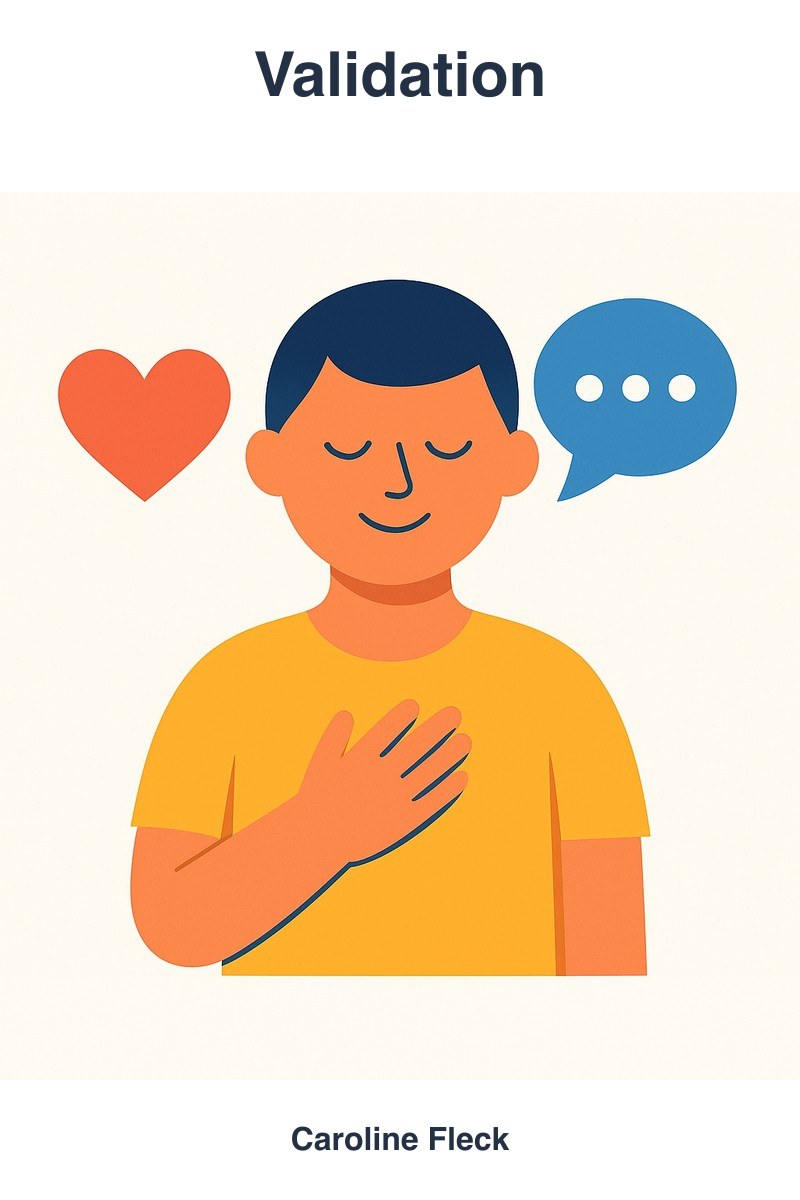
Prefer the print book? Buy on Amazon
As an Amazon Associate, Sumizeit earns from qualifying purchases.
Book Summary
Validation Book Summary
This Validation Book Summary covers the key ideas, lessons, and takeaways in about 20 minutes.
Short Description:
A plain guide to Fleck’s eight skills for making people feel seen and accepted
People change, connect, and heal when they feel seen and accepted, and that's a skill anyone can learn. Fleck breaks it into eight moves, which are engaging, echoing, comparing favorably, acknowledging why, assuming perspective, sharing feelings, relating, and helping directly. Used sincerely, they calm conflict, strengthen relationships, and make hard moments feel less lonely. The same moves work on yourself. Before you can change anything, in yourself or anyone else, you have to acknowledge it, and validation is what makes that feel safe enough to do.
Helps with these goals
Want a Free Weekly Read?
Get a free summary every week straight to your mailbox.
Preview the Validation book summary
Below is a preview of Sumizeit’s comprehensive human-written summary of Validation by Caroline Fleck. The full summary is 15-20 minutes long and covers the book’s key ideas in text, audio, visual, and video formats. Unlock the full 20 Minute Summary
Most of us never learned how to make another person feel understood. School taught us fractions and grammar. Nobody showed us what to say when a friend is falling apart or a partner is furious. Clinical psychologist Caroline Fleck wrote Validation to fill that hole. Her argument is simple. Validation is a set of eight learnable skills, and they can change how people behave, how close you feel to them, and how meaningful your own life feels. That includes your relationship with yourself.
What validation actually is
Fleck defines validation as responding to someone in a way that makes them feel seen and accepted. You do that by doing one or more of three things. You show up fully for them, you affirm something about their experience, or you offer them support.
It only counts when you mean it. If you fake it, people usually sense the act. And even if they don't, you've stopped validating and started manipulating. So you can only validate what you honestly see some sense in. The good news is that this covers far more ground than you'd expect. You can validate someone you disagree with, can't relate to, or don't much like. Say a coworker gives you feedback in a rude way. You don't have to approve of the rudeness. You can still recognize the stress or frustration that made them sharp.
Fleck also points out that we throw the word around all the time without pinning down what it means. That's part of why so few people use it well.
Where the idea comes from
The one group that does get trained in validation is therapists, and the story starts with Marsha Linehan. In the 1990s she developed dialectical behavior therapy, or DBT, for people with self harm and suicidal behavior, which are some of the hardest problems in mental health to treat. Linehan had been taught to push clients toward change, and many of them shut down. She tried plain acceptance instead, and that didn't work either. After studying with Zen Buddhists, she put the two together. Accept people as they are, and help them change.
Fleck says decades of research show she was right. DBT helps people whose symptoms resisted other treatments. The lesson Fleck draws from it is big. Personal growth always starts with validation, whether it comes from another person or from you. The logic is easy to follow once you see it. You can't change something you won't look at. When pain is overwhelming, people look away. Validation makes it safe enough to look.
What validation can do for you
You don't need a therapy license to use any of this. Fleck lays out four payoffs.
The first is changing behavior. Your brain treats validation as a reward and gives you a small hit of pleasure. So if you validate someone right after they do something you'd like to see again, they link that behavior with feeling good, and they're more likely to repeat it.
Want the complete 20-minute summary?
- Full structured summary
- Video Summary
- Podcast Summary
- Audio summary
- Key takeaways
- Exercises
- Quiz
- Highlights and notes
- Ask the book with AI
Who should read Validation?
Validation is for anyone who wants to improve their relationships and communication skills—whether you're a parent navigating conflict with your kids, a partner seeking deeper connection, a manager building team trust, or simply someone who wants to feel less isolated. This book teaches practical skills that work whether you're supporting a friend through crisis, resolving workplace tensions, or learning to treat yourself with compassion.
Why does Validation matter?
Most people never learned how to make others feel truly understood, yet this skill profoundly shapes how we connect, communicate, and heal. In a world of constant conflict and disconnection, Caroline Fleck's Validation offers evidence-based techniques that calm arguments, strengthen relationships, and create psychological safety—backed by decades of research in therapy and behavioral science. Learning to validate both others and yourself can transform not just your relationships, but your sense of meaning and resilience.
What are the key themes in Validation?
- Validation as a learnable skill set, not an innate trait
- The connection between feeling seen and behavioral change
- Presence and genuine engagement as the foundation of human connection
- Self-validation as a prerequisite for validating others
- The role of validation in resolving conflict and building trust
- Psychological safety and its impact on performance and wellbeing
How can you apply ideas from Validation?
- Use engagement and echoing during tough conversations to show you're truly listening and help the other person feel understood
- Practice comparing favorably when someone you care about struggles with guilt or perfectionism to normalize their difficulty
- Apply the seven-step self-validation routine when you're angry, sad, or struggling to build self-compassion instead of self-judgment
- Build psychological safety at work by pairing praise for work output with validation of the person, recognizing both effort and difficulty
- Run a postmortem conversation after conflict to validate each other, apologize where wrong, and agree on better patterns going forward
- Use assuming perspective to show people you understand them without requiring them to explain everything
- Share relevant parts of your own story strategically to help others feel less alone, then redirect focus back to them
What common mistakes do readers make with Validation?
- Faking validation, which people sense and which becomes manipulation rather than genuine connection
- Echoing anger or distress, which amplifies emotions rather than calming them—comfort is the better choice
- Offering unsolicited direct help, which can undermine confidence and rob people of learning opportunities
- Hijacking conversations by sharing your own experience at too much length instead of keeping focus on the other person
Sumizeit Exercises Apply what you've learned
Turn ideas from Validation into action with a short guided reflection: identify the biggest takeaway, connect it to your life, and commit to one step you can take in the next 24 hours.
What is the expert analysis of Validation?
Overview
Validation by Caroline Fleck emerges as a pivotal contribution to contemporary psychological and interpersonal literature, addressing a fundamental yet often overlooked human skill: making others feel truly understood. Fleck, a clinical psychologist trained at Duke University, leverages her extensive clinical experience alongside personal challenges to illuminate how validation can transform relationships and individual well-being. This book is significant because it distills complex therapeutic concepts into accessible, practical skills for a broad audience, bridging the gap between clinical psychology and everyday life.
Core Thesis
At its heart, Validation argues that the ability to validate—defined as responding to others in ways that make them feel seen, accepted, and understood—is a learnable set of eight concrete skills that can profoundly alter behavior, deepen connection, and foster meaning. Fleck posits that validation is the essential precursor to change, both interpersonal and intrapersonal, because it creates the psychological safety necessary for individuals to confront difficult emotions and experiences. Drawing from the origins of validation in dialectical behavior therapy (DBT), Fleck extends its application beyond therapy rooms into everyday interactions, self-relationship, conflict resolution, and organizational dynamics.
Strengths
- Clarity and Practicality: Fleck excels at translating a nuanced psychological concept into eight actionable skills, complete with concrete examples and step-by-step guidance that readers can immediately apply.
- Integration of Research and Practice: The book effectively synthesizes empirical findings, such as those from DBT and psychological safety research, with real-world applications, enhancing its credibility and relevance.
- Holistic Approach: Fleck’s inclusion of self-validation alongside interpersonal validation broadens the scope, addressing a critical but neglected aspect of mental health and self-compassion.
- Emphasis on Emotional Presence: The focus on being fully present and nonjudgmental taps into contemporary mindfulness and relational psychology trends, reinforcing the importance of emotional attunement.
- Applicability Across Contexts: The book’s insights extend beyond personal relationships to workplace culture and leadership, making it valuable for diverse readers including parents, partners, therapists, and managers.
Critiques & Counterarguments
- Potential Oversimplification: While the eight skills provide a useful framework, the complexity of human emotions and relationships may resist such neat categorization. Critics might argue that real-life validation often requires more nuanced, context-sensitive judgment than the book suggests.
- Limited Engagement with Cultural Variability: The book largely assumes Western norms of emotional expression and validation. Cross-cultural research indicates that validation practices and their effects can differ significantly across societies, which the book does not deeply explore.
- Risk of Misapplication: The emphasis on sincerity is crucial, yet readers might struggle to authentically apply validation without adequate emotional intelligence or self-awareness, potentially leading to superficial or manipulative interactions.
- Competing Psychological Models: Schools of thought such as cognitive-behavioral therapy (CBT) or acceptance and commitment therapy (ACT) emphasize different mechanisms for change, such as cognitive restructuring or mindfulness-based acceptance, which may challenge the primacy of validation as the foundational step.
- Empirical Evidence Scope: Although Fleck references DBT and psychological safety research, the direct empirical validation of the eight specific skills as a comprehensive intervention outside clinical settings remains limited, inviting further scientific scrutiny.
Who Should Read This
Validation is ideally suited for readers seeking to enhance their emotional intelligence and relational skills across personal and professional domains. It is particularly valuable for:
- Therapists, counselors, and coaches looking to integrate practical validation techniques into their practice.
- Individuals striving for deeper, more authentic connections with partners, family, and friends.
- Leaders and managers aiming to cultivate psychologically safe and high-performing teams.
- Anyone interested in self-improvement through cultivating self-compassion and emotional resilience.
- Readers curious about the intersection of psychology, communication, and meaningful human connection.
Fleck’s accessible yet profound treatment of validation makes this book a compelling resource for those committed to fostering empathy, reducing conflict, and nurturing growth in themselves and others.
Discussion questions for Validation Short questions you can actually use in a conversation
Frequently asked questions about the Validation book summary
What is Validation about?
Validation by Caroline Fleck is a guide to eight learnable communication skills that make people feel seen and accepted. The book shows how validating others—through engagement, echoing, legitimizing, and support—can change behavior, deepen relationships, and build psychological safety, while also teaching readers how to validate themselves to counteract harmful self-criticism.
Who should read Validation?
Validation is for anyone seeking to improve relationships and communication—parents, partners, managers, therapists, and anyone who wants to feel more connected and help others feel less alone. It's especially valuable for people struggling with conflict, self-criticism, or feeling emotionally isolated.
What are the main takeaways from Validation?
The core message is that people change, connect, and heal when they feel seen and accepted, and that validation is a skill anyone can learn. Fleck's eight techniques—engaging, echoing, comparing favorably, acknowledging why, assuming perspective, sharing feelings, relating, and helping directly—calm conflict, strengthen relationships, and make hard moments feel less lonely when used sincerely.
Can you validate someone you disagree with?
Yes. Validation doesn't require agreement or full relatability. You can recognize the legitimate stress, frustration, or reasoning behind someone's thoughts or behavior even if you don't approve of their actions. This softens judgment and keeps dialogue open.
How does validation change behavior?
When you validate someone right after a desired behavior, their brain treats validation as a reward and creates a link between that behavior and feeling good, making them more likely to repeat it. This principle works on yourself too through building pride and momentum in habit formation.
What is the difference between validation and agreement?
Validation is acknowledging that someone's feelings, thoughts, or actions make sense given their circumstances—not agreeing that they're right. You can see why someone acts as they do, understand their perspective, and still disagree with their behavior or choices.
How do you validate yourself?
Fleck offers a seven-step routine: relax your body, engage with your feelings without judgment, echo them by putting them into words, acknowledge why you feel this way, compare favorably by treating yourself as you would a loved one, remind yourself you're worthy of care, and help yourself directly through comfort or meaningful action.
Why does validation matter in the workplace?
Validation builds psychological safety—the sense that people can raise concerns, ask questions, and fail without punishment or judgment. Research shows psychologically safe teams perform better financially and innovate more effectively. Leaders can pair praise for work output with validation of the person doing it.
About Sumizeit
Sumizeit is a profitable Scomy LLC company based in Miami, Florida. Our founders, Clemens Raemy and Weina Scott, are successful entrepreneurs with several exits. Sumizeit is a popular book summary app / micro learning app used by busy professionals and entrepreneurs with over 2,500 non-fiction book summaries and 10,000 podcast summaries in text, audio, visual, podcast, and video format. We also have stellar retention tools to make ideas stick - such as flashcards with spaced repetition, quizzes, streaks, highlighting and notes, daily challenges, riddles, mini-courses, meditation, and more. You won't only learn the idea, but also remember it. Over 90% of our users change their habits with Sumizeit.
Upgrade Now
Here's why readers love Sumizeit
Join thousands of learners getting smarter every day
"Great experience. Detailed summaries. Loved the gamification feature. Makes learning fun. Good customer service. I recommend Sumizeit to anyone. You'll learn a lot."
"I always felt busy but still wanting to keep up with the book discussion in my friend group. This was a great supplement to help me keep reading the books I find fun while keeping up with important books."
"I love this website. Instead of scrolling social media, I find myself learning a lot. I use it everyday. I recommend this app for anyone who is too busy and wants to get up to speed with their favorite books."
Validation Book Summary PDF
Looking for a Validation Book Summary PDF you can save and revisit offline? Our Validation Book Summary PDF captures the book’s core ideas in a clean, printable format — the key frameworks, takeaways, and structure without the fluff. Download the Validation Book Summary PDF when you want a reference you can annotate, share with your team, or review on the go. Get your Validation Book Summary PDF from the download page below.
Download Validation Book Summary PDFPeople also liked these summaries
Readers who explored Validation often enjoyed these titles next.




Ready to read the whole thing?
- Full structured summary
- Video Summary
- Podcast Summary
- Audio summary
- Key takeaways
- Exercises
- Quiz
- Highlights and notes
- Ask the book with AI
Featured Book Titles
Popular Book Summaries at sumizeit, leading book summary app
Atomic Habits Book Summary Rich Dad Poor Dad Book Summary The Four Agreements Book Summary The 48 Laws of Power Book Summary When Breath Becomes Air Book Summary Think and Grow Rich Book Summary