New users get 3 free summaries! Upgrade for unlimited access to 2,500+ book summaries.

Upgrade Now

Get the Sumizeit app

Book Summary

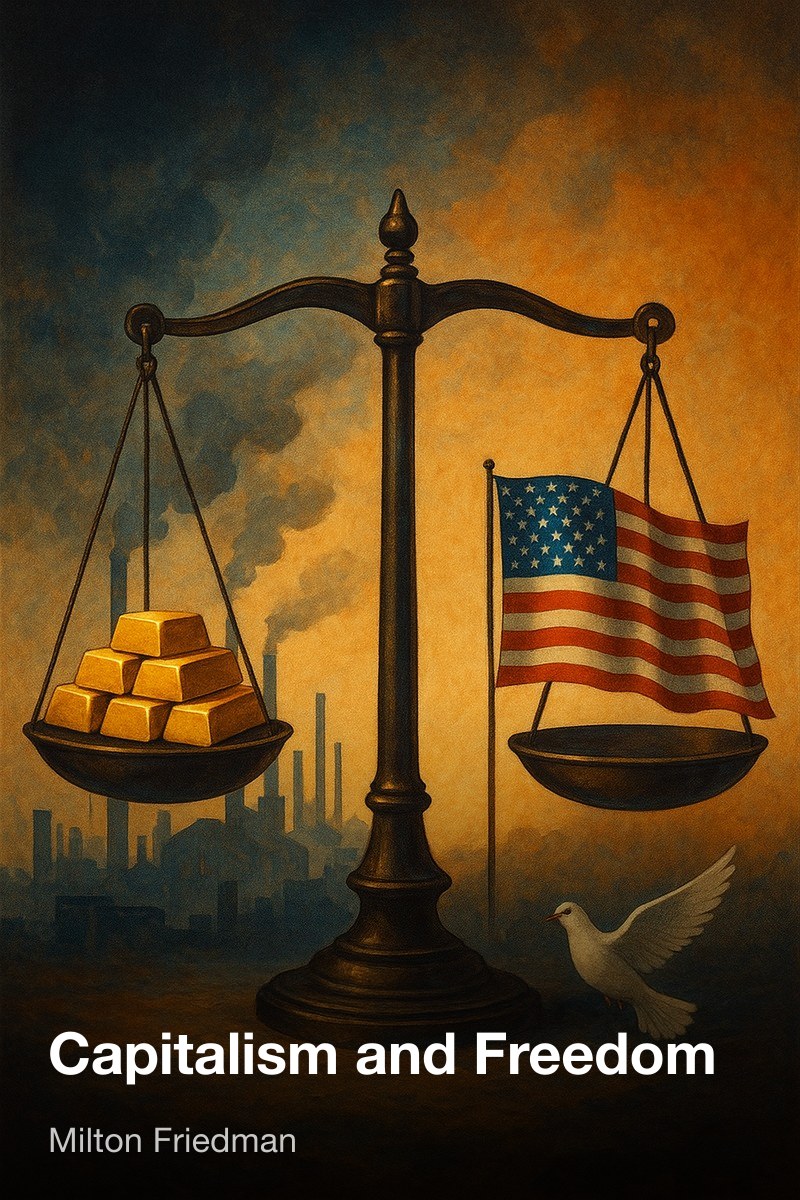
Capitalism and Freedom Book Summary

By Milton Friedman


This Capitalism and Freedom Book Summary covers the key ideas, lessons, and takeaways in about 20 minutes.

20 min read Audio available
Strip away the specific policy debates and Capitalism and Freedom is really making one argument over and over in different settings. Voluntary exchange between free individuals produces better outcomes, and more real freedom, than decisions made for people by a government, no matter how well meaning that government is. Friedman doesn't ask you to trust markets because they're perfect. He asks you to notice that concentrated power is dangerous by nature, and that a market economy is the one system that keeps power spread out among millions of separate decisions instead of piled up in one place. Whether or not you end up agreeing with where he lands on vouchers, licensing, or the income tax, the book pushes you toward a question worth asking about any government program. Who gets to choose, and what happens to the people who would have chosen differently.

Helps with these goals

4.8

Stars

Average ratings on iOS and Google Play

100,000+

Users

On all platforms

6+

Years

Experience igniting personal growth

Want the complete 20-minute summary?

  • Full structured summary
  • Video Summary
  • Podcast Summary
  • Audio summary
  • Key takeaways
  • Exercises
  • Quiz
  • Highlights and notes
  • Ask the book with AI

Want a Free Weekly Read?

Get a free summary every week straight to your mailbox.

Preview the Capitalism and Freedom book summary

Below is a preview of Sumizeit’s comprehensive human-written summary of Capitalism and Freedom by Milton Friedman. The full summary is 15-20 minutes long and covers the book’s key ideas in text, audio, visual, and video formats. Unlock the full 20 Minute Summary

Milton Friedman published Capitalism and Freedom in 1962, at a moment when almost nobody in American public life wanted to hear it. The dominant view held that government should actively manage the economy, smooth out its swings, and redistribute wealth toward more even outcomes. Friedman, a University of Chicago economist who would later win the Nobel Prize, argued the opposite. He believed a market left mostly alone does more for ordinary people, including the ones government programs claim to help, than any amount of central planning. And he made a bolder claim than that. He argued that political freedom cannot survive without economic freedom, that the two rise and fall together, and that a government with enough control over jobs, wages, and prices eventually controls everything else too. The book reads today like it's just describing normal life. That's because a lot of what Friedman argued for actually happened.

Why economic freedom protects political freedom

Friedman opens with a claim that still surprises people. He says economic freedom isn't just nice to have alongside political freedom. It's the thing that makes political freedom possible at all. His reasoning goes like this. In a market economy, no single person or institution controls the means people use to make a living. Millions of buyers and sellers make separate decisions about what to buy, what to sell, and who to work for. That scattering of decisions is a form of protection. Power divided among millions of people is hard to abuse. Power concentrated in one government agency is not.

Friedman points to the writers blacklisted in Hollywood during the 1950s as proof this actually works. Studios refused to buy scripts from anyone suspected of Communist sympathies, under pressure from anti Communist politicians. On paper, those writers had lost their ability to earn a living from their craft. But the market found a way around the blacklist. Studios still needed good scripts to make money, and eventually the appeal of a strong script outweighed the political risk of buying it. Writers worked under pseudonyms, sold scripts through intermediaries, and slowly clawed back their livelihoods, not because anyone in government changed the rules, but because the profit motive gave someone a reason to ignore them.

Now compare that to what happens under socialism, where the state owns the print shops, the factories, and the media outlets. Friedman asks you to imagine someone trying to organize opposition to a Communist government from inside that system. She would need money to print pamphlets and rent halls, but the government controls every job and every source of income. She would need a printing press, but the government owns every printing press. Her political speech depends entirely on the goodwill of the people she is speaking against. That, Friedman says, is why no country has ever combined a state controlled economy with lasting political freedom. Without an independent economic base, dissent has nowhere to stand.

What government is actually for

Friedman was not an anarchist.

The full structured summary is available after upgrading

Want the complete 20-minute summary?

  • Full structured summary
  • Video Summary
  • Podcast Summary
  • Audio summary
  • Key takeaways
  • Exercises
  • Quiz
  • Highlights and notes
  • Ask the book with AI

Who should read Capitalism and Freedom?

Capitalism and Freedom is essential for policymakers, students of economics, and anyone curious about the philosophical foundations of free markets and individual liberty. It appeals to readers who question whether government intervention actually solves the problems it claims to address, and to those seeking a rigorous intellectual case for economic freedom as a prerequisite for political freedom.

Why does Capitalism and Freedom matter?

Milton Friedman's 1962 masterpiece remains strikingly relevant today, offering a counterargument to widespread assumptions that government should actively manage economies and redistribute wealth. His insights on monetary policy, occupational licensing, education vouchers, and the relationship between economic and political freedom have shaped real policy decisions and provide a vital framework for evaluating modern government programs.

What are the key themes in Capitalism and Freedom?

  • Economic freedom as the foundation of political freedom
  • The dangers of concentrated governmental power
  • Markets as mechanisms for dispersing power across millions of individual decisions
  • Government's legitimate but limited role in society
  • How voluntary exchange produces better outcomes than centralized planning

Want the complete 20-minute summary?

  • Full structured summary
  • Video Summary
  • Podcast Summary
  • Audio summary
  • Key takeaways
  • Exercises
  • Quiz
  • Highlights and notes
  • Ask the book with AI

How can you apply ideas from Capitalism and Freedom?

  • Evaluate any government program by asking who chooses the outcome and what happens to those who would have chosen differently
  • Use monetary policy insights to understand how central bank actions affect employment, inflation, and business investment
  • Apply market-based thinking to occupational licensing in your field—consider whether restrictions genuinely protect consumers or primarily benefit existing practitioners
  • Design education systems around student choice rather than residential assignment, using mechanisms like vouchers to fund education without controlling where it happens
  • Assess tax policy by examining whether marginal rates create incentives to avoid earning rather than paying taxes
  • Replace categorical welfare programs with streamlined income-based support that respects individual choice in spending
  • Evaluate corporate policies against the principle that companies serve society best by doing their actual job well rather than pursuing social causes with shareholder money

What common mistakes do readers make with Capitalism and Freedom?

  • Assuming government intervention is beneficial simply because it claims good intentions, rather than examining whether it actually produces better outcomes than market alternatives
  • Overlooking how regulations intended to protect consumers often function primarily to restrict competition and protect existing industry players
  • Believing that economic freedom and political freedom can be separated, rather than recognizing them as interdependent
  • Trusting that government spending creates net economic growth through the multiplier effect, when most government spending redirects rather than creates new demand

Sumizeit Exercises Apply what you've learned

Turn ideas from Capitalism and Freedom into action with a short guided reflection: identify the biggest takeaway, connect it to your life, and commit to one step you can take in the next 24 hours.

Unlock book-specific exercises with a Sumizeit membership

Unlock Exercises

What is the expert analysis of Capitalism and Freedom?

Overview

Capitalism and Freedom, written by Nobel laureate Milton Friedman and published in 1962, stands as a seminal work in the canon of economic and political thought. Friedman, a leading figure of the Chicago School of economics, crafted this book during a period when Keynesian interventionism dominated American policy discourse. The book’s significance lies in its bold and systematic defense of economic freedom as the indispensable foundation for political liberty. Friedman's arguments not only challenged prevailing orthodoxies of his time but also anticipated many policy shifts that have since reshaped global economic governance. His influence extends beyond academia into practical policy, making this work both intellectually rigorous and historically consequential.

Core Thesis

At the heart of Capitalism and Freedom is the assertion that political freedom cannot endure without economic freedom. Friedman posits that decentralized market mechanisms, characterized by voluntary exchanges among individuals, serve as a bulwark against the concentration of power inherent in government control of the economy. He argues that economic freedom disperses power among millions of actors, thereby protecting individuals from coercion and enabling genuine political liberty. Moreover, Friedman delineates a limited but crucial role for government—to provide national defense, enforce contracts, break up monopolies, and supply public goods—while cautioning against expansive government intervention, which he views as a threat to both economic efficiency and individual freedom.

Strengths

  • Clarity and Coherence: Friedman’s lucid prose and structured argumentation make complex economic and political concepts accessible without sacrificing intellectual depth.
  • Integration of Economics and Political Philosophy: The book uniquely bridges economic theory with normative claims about freedom, enriching debates on the relationship between markets and democracy.
  • Prescient Policy Insights: Friedman's advocacy for floating exchange rates, school vouchers, and a negative income tax anticipated and influenced later policy innovations.
  • Historical Examples: The use of concrete cases, such as the Hollywood blacklist and the Great Depression’s monetary mismanagement, effectively illustrates abstract principles and grounds theory in real-world experience.
  • Consistency and Intellectual Honesty: Friedman’s willingness to challenge popular policies on both the political left and right, such as opposing equal employment laws and right-to-work laws alike, demonstrates a principled commitment to freedom rather than partisan ideology.

Critiques & Counterarguments

  • Oversimplification of Market Outcomes: Friedman’s faith in markets to self-correct issues like discrimination and monopoly power may underestimate systemic biases and market failures documented by subsequent research in behavioral economics and institutional theory.
  • Limited Attention to Power Dynamics: Critics argue that the assumption that dispersed economic power naturally protects political freedom overlooks how economic inequalities can translate into political inequalities, thereby undermining democratic processes.
  • Questionable Assumptions about Government Efficiency: While Friedman rightly warns against government overreach, his skepticism sometimes discounts the potential for well-designed public policies to address market externalities and social welfare more effectively than markets alone.
  • Contested Views on Corporate Social Responsibility: The dismissal of corporate social responsibility as a form of “quiet taxation” neglects evolving perspectives that view corporations as embedded in social and environmental contexts, with responsibilities beyond shareholder profit.
  • Alternative Economic Theories: Keynesian economics and modern welfare economics provide competing frameworks that emphasize the role of government spending and redistribution in stabilizing economies and reducing inequality, challenging Friedman’s minimalist state model.

Who Should Read This

Capitalism and Freedom is essential reading for economists, political philosophers, policymakers, and intellectually curious readers interested in the foundations of liberal democracy and market economies. It offers a rigorous, historically grounded argument for economic liberty that remains deeply relevant amidst contemporary debates over globalization, regulation, and the role of the state. Readers seeking to understand the philosophical and economic underpinnings of free-market capitalism, as well as those grappling with the tensions between state power and individual freedom, will find Friedman’s work both provocative and enlightening. While some may contest his conclusions, engaging with this text is crucial for anyone aiming to participate meaningfully in discussions about economic policy and political rights.

Test yourself on Capitalism and Freedom 5 sample questions from the summary quiz

Try a few questions from the Capitalism and Freedom quiz. Unlock the full summary for the full quiz and answers that will help the ideas stick.

Question 1 of 5

What central claim does Friedman make about the relationship between economic and political freedom?

Question 2 of 5

Which historical example does Friedman use to illustrate how markets can protect individuals from political pressure?

Question 3 of 5

Which of the following is NOT listed by Friedman as a legitimate job of government?

Question 4 of 5

How does Friedman rank types of monopolies from least to most harmful?

Question 5 of 5

What criticism does Friedman make about the Federal Reserve's actions at the start of the Great Depression?

Frequently asked questions about the Capitalism and Freedom book summary

What is Capitalism and Freedom about?

Capitalism and Freedom by Milton Friedman argues that economic freedom is essential to political freedom and that markets left mostly alone produce better outcomes for ordinary people than government central planning. Published in 1962, the book makes the case that when economic decisions are distributed across millions of independent individuals rather than concentrated in government, power stays dispersed and freedom survives. Friedman explores how this principle applies to monetary policy, education, employment, taxation, and welfare programs.

Who should read Capitalism and Freedom?

Anyone interested in the philosophical foundations of free markets, the relationship between economic and political freedom, or how government should approach policy should read this book. It appeals to policymakers, economics students, business leaders, and general readers who question whether government intervention actually solves the problems it claims to address. The book is valuable both for those who will agree with Friedman and those who will disagree, as it lays out a rigorous intellectual case that forces readers to examine their own assumptions about the proper role of government.

What are the main takeaways from Capitalism and Freedom?

The central takeaway is that voluntary exchange between free individuals produces better outcomes and protects freedom more effectively than government decisions made on people's behalf. Friedman argues that government should focus on core functions—defense, law enforcement, courts, and funding goods with neighborhood effects—while leaving economic decisions to markets. He also shows how concentrated power is structurally dangerous regardless of intent, how regulations often protect existing businesses rather than consumers, and how individuals should have choice in education, employment, taxation, and welfare rather than being bound by government's one-size-fits-all programs.

Why does Friedman think economic freedom is necessary for political freedom?

Friedman argues that when government controls jobs, wages, prices, and the means of production, it can suppress political opposition simply by controlling people's ability to earn a living. In a market economy, economic power is distributed among millions of buyers and sellers, making it impossible for any single authority to block dissent through economic control. He contrasts this with socialist systems where the state owns printing presses, factories, and media outlets, leaving dissidents with no independent economic base from which to organize opposition.

What does Friedman propose instead of traditional welfare programs?

Friedman proposes a negative income tax that would replace the existing patchwork of categorical welfare programs. Rather than separate agencies managing assistance for veterans, the elderly, widows, and other groups, the government would simply give money to anyone whose income falls below a set threshold, with payments shrinking as earned income rises. This approach would reduce bureaucracy, simplify administration, and restore individual choice about how to address personal circumstances instead of forcing everyone into programs designed by government.

How does Friedman respond to the idea that markets naturally lead to discrimination?

Friedman argues that free markets actually discourage discrimination because profit creates an incentive to set prejudice aside. A business owner who refuses to hire, serve, or buy from people of a particular group is leaving money on the table—turning away paying customers and narrowing job applicants. He uses historical examples like Jewish merchants in medieval Europe gradually gaining Christian commercial partners to show that profit motive can overcome systematic prejudice over time, though he acknowledges this differs from many readers' views on what government should do to address discrimination.

What is Friedman's criticism of occupational licensing?

Friedman argues that occupational licensing, presented as consumer protection, actually functions to restrict competition and keep prices artificially high. Licensing boards are typically controlled by people who already hold licenses, and they have strong incentives to limit new entrants to protect their own earning power. The result is that consumers pay more for services not because quality improved but because supply was artificially restricted. He sees this as an example of how an industry can use government power to protect itself rather than to genuinely protect the public.

Why is the Federal Reserve's role during the Great Depression important to Friedman's argument?

Friedman uses the Federal Reserve's failure to act during the early Great Depression as proof that handing institutions enormous power over the economy is dangerous whether they use it or neglect to use it. When worried depositors began withdrawing savings in 1930, the Fed could have pumped money into the banking system to stop the panic but instead did essentially nothing, contributing to the worst economic contraction in U.S. history. This example supports his broader argument that concentrated power, even when created for good reasons, poses structural risks regardless of who wields it.

About Sumizeit

Sumizeit is a profitable Scomy LLC company based in Miami, Florida. It has been helping readers learn from nonfiction books for 7 years with expert-written summaries in text, audio, podcast, and video.

Want the complete 20-minute summary?

  • Full structured summary
  • Video Summary
  • Podcast Summary
  • Audio summary
  • Key takeaways
  • Exercises
  • Quiz
  • Highlights and notes
  • Ask the book with AI

Here's why readers love Sumizeit

Join thousands of learners getting smarter every day

"Great experience. Detailed summaries. Loved the gamification feature. Makes learning fun. Good customer service. I recommend Sumizeit to anyone. You'll learn a lot."

Chen, TrustPilot

"I always felt busy but still wanting to keep up with the book discussion in my friend group. This was a great supplement to help me keep reading the books I find fun while keeping up with important books."

Daniel, TrustPilot

"I love this website. Instead of scrolling social media, I find myself learning a lot. I use it everyday. I recommend this app for anyone who is too busy and wants to get up to speed with their favorite books."

Erica, TrustPilot

Capitalism and Freedom Book Summary PDF

Looking for a Capitalism and Freedom Book Summary PDF you can save and revisit offline? Our Capitalism and Freedom Book Summary PDF captures the book’s core ideas in a clean, printable format — the key frameworks, takeaways, and structure without the fluff. Download the Capitalism and Freedom Book Summary PDF when you want a reference you can annotate, share with your team, or review on the go. Get your Capitalism and Freedom Book Summary PDF from the download page below.

Download Capitalism and Freedom Book Summary PDF

People also liked these summaries

Readers who explored Capitalism and Freedom often enjoyed these titles next.

Browse all books →

Want the complete 20-minute summary?

  • Full structured summary
  • Video Summary
  • Podcast Summary
  • Audio summary
  • Key takeaways
  • Exercises
  • Quiz
  • Highlights and notes
  • Ask the book with AI


View Full Summary