


As an Amazon Associate, Sumizeit earns from qualifying purchases.
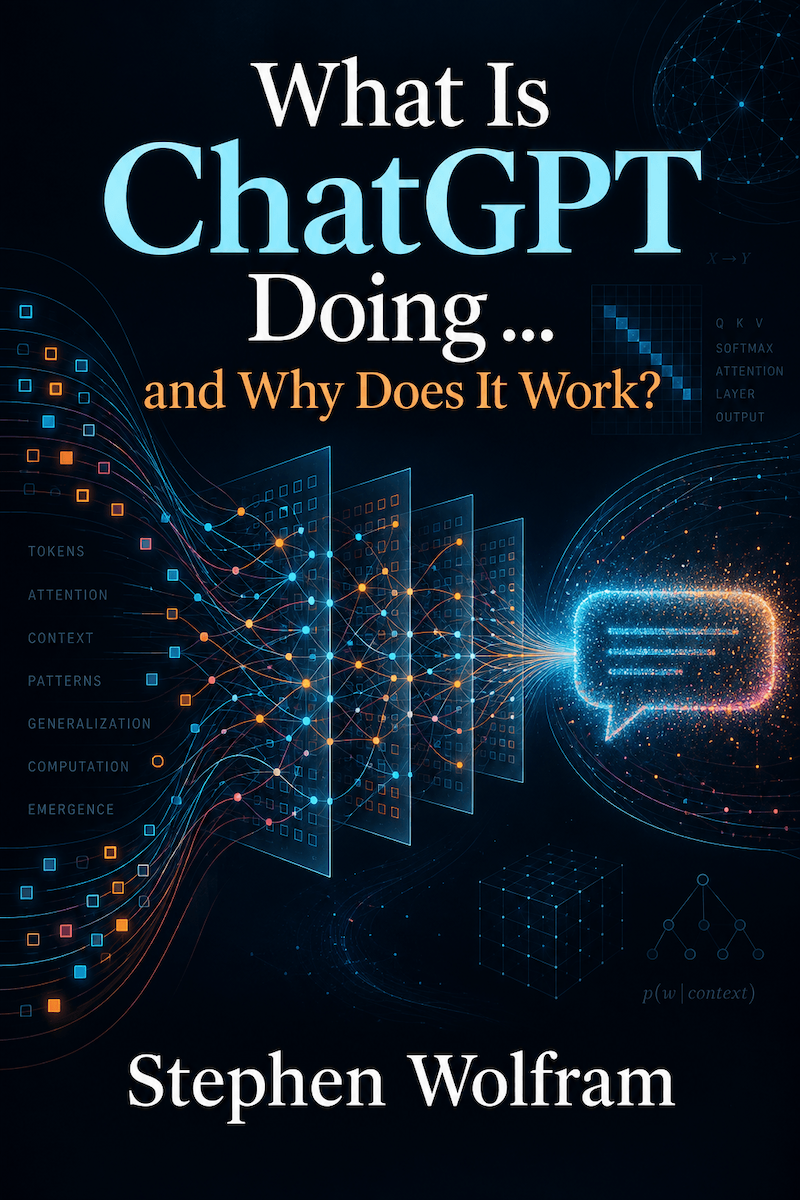
What Is ChatGPT Doing ... and Why Does It Work? Book Summary
This What Is ChatGPT Doing ... and Why Does It Work? Book Summary covers the key ideas, lessons, and takeaways in about 20 minutes.
Helps with these goals
Want the complete 20-minute summary?
- Full structured summary
- Video Summary
- Podcast Summary
- Audio summary
- Key takeaways
- Exercises
- Quiz
- Highlights and notes
- Ask the book with AI
What is in the What Is ChatGPT Doing ... and Why Does It Work? book summary?
Below is a preview of Sumizeit’s expert-written summary of What Is ChatGPT Doing ... and Why Does It Work? by Stephen Wolfram. The full summary covers the book’s key ideas in text, audio, and video.
Stephen Wolfram wrote "What Is ChatGPT Doing... and Why Does It Work?" right after ChatGPT exploded into public view in early 2023, and his goal was simple. He wanted to open the hood and show, in plain terms, what is actually happening when you type a question and a wall of coherent text appears in response. Wolfram is uniquely suited for this. He built Mathematica and the Wolfram Language, created Wolfram Alpha, and spent decades studying how simple computational rules can produce complicated behavior. So when he looks at ChatGPT, he is not awed into mysticism. He wants the mechanism.
His answer, stripped to its core, is almost embarrassingly simple. ChatGPT writes by guessing one word at a time. It looks at everything written so far, asks itself what word is statistically likely to come next, picks one, adds it to the text, and repeats. That is the entire trick. Everything else in the book is Wolfram explaining how a machine could possibly get so good at that one narrow task that the result reads like a person wrote it.
Guessing one word at a time
Start with the obvious question. If the system is just picking the "most probable" next word over and over, wouldn't that produce something bland and repetitive? Wolfram says yes, and this turns out to matter a lot. If you always take the single highest probability word, the output degrades into dull, looping text. So the system does not always take the top pick. It uses a setting called temperature to occasionally choose a less likely word on purpose.
Wolfram is refreshingly honest that nobody has a tidy theory for why this works. Engineers found through trial and error that a temperature setting around 0.8 tends to produce the most natural sounding writing. Push it too low and the text turns stiff and repetitive. Push it too high and it falls apart into nonsense. There is no formula that predicts the right number in advance. It was discovered the way you discover a good recipe, by tasting a lot of versions and writing down what worked.
To make this concrete, Wolfram walks through the actual computation using a smaller cousin of ChatGPT called GPT2, since it is light enough to run and inspect on an ordinary computer. At every single step, the network does not spit out one word. It spits out a ranked list of every plausible next word or word fragment, each with a probability attached. The final word you see on screen is drawn from that list, tilted by the temperature setting toward the likely choices but not locked to only the top one.
Where the guesses have to come from
Here is where the puzzle gets interesting. You could imagine building a next word predictor just by counting. Scan a huge pile of text, and for every pair or triple of words, tally what tends to come next. Wolfram points out why that brute counting approach collapses almost immediately.
Want the complete 20-minute summary?
- Full structured summary
- Video Summary
- Podcast Summary
- Audio summary
- Key takeaways
- Exercises
- Quiz
- Highlights and notes
- Ask the book with AI
Who should read What Is ChatGPT Doing ... and Why Does It Work??
This book is for anyone curious about how ChatGPT actually works beneath the surface. Whether you use AI tools daily, work in tech, or simply want to understand the technology reshaping communication and knowledge work, Stephen Wolfram's explanation makes the mechanics accessible without requiring a machine learning background.
Why does What Is ChatGPT Doing ... and Why Does It Work? matter?
ChatGPT emerged as a cultural phenomenon almost overnight, sparking both utopian and dystopian predictions about AI's future. Understanding what it actually does—and equally important, what it cannot do—is essential for making informed decisions about where this technology fits in our lives and institutions. Wolfram cuts through both hype and fear to reveal the surprising simplicity underlying the apparent sophistication.
What are the key themes in What Is ChatGPT Doing ... and Why Does It Work??
- Statistical pattern completion vs. genuine understanding
- The power of scale in neural networks
- Limitations of systems trained only on text prediction
- Semantic grammar and meaning space
- The role of human feedback in AI alignment
- Computational irreducibility and what AI cannot do
- The hidden structure of language
What are the key lessons from the What Is ChatGPT Doing ... and Why Does It Work? book summary?
One Word at a Time
ChatGPT generates text by repeatedly predicting the statistically most likely next word, with occasional randomness built in via a temperature setting. This simple mechanism, iterated billions of times, produces remarkably coherent output.
Generalization Over Memorization
Rather than storing examples of every possible word sequence, neural networks compress linguistic patterns into learned weights distributed across billions of parameters. This enables handling novel sentences the network has never encountered before.
The Embedding Space
Words are converted into long lists of numbers arranged so that semantically similar words sit mathematically close together. This invisible numerical geometry is where all pattern matching happens.
Attention as Long-Range Memory
The transformer architecture's attention mechanism allows the network to identify which earlier words matter for predicting each new word, solving the problem of tracking meaning across distant parts of text.
Training Is Tuning, Not Programming
The network starts with random weights and is adjusted billions of times by comparing predictions to actual text, with each adjustment nudging toward better accuracy. Nobody hand-codes the weights or rules.
Scale Paradoxically Helps Training
Larger networks with more adjustable parameters often train more smoothly than smaller ones because they have more degrees of freedom to escape suboptimal solutions and continue improving.
Temperature Controls Creativity
Setting temperature too low produces repetitive, bland text; too high produces nonsense. The optimal value was discovered through trial and error rather than derived from theory, exemplifying the empirical nature of deep learning.
Statistical Patterns Versus Exact Computation
Language models excel at pattern continuation but cannot reliably perform tasks requiring step-by-step exact calculation or logical verification. This is why ChatGPT confidently generates false facts.
Semantic Grammar Is Learned, Not Taught
ChatGPT has absorbed an implicit map of which ideas go together—what Wolfram calls semantic grammar—purely from exposure to billions of sentences, without explicit instruction on the rules.
The Meaning Space Analogy
The network operates by plotting a plausible path through an internal space where related concepts cluster together, generating text one word at a time as it navigates this abstract semantic landscape.
Computational Irreducibility as a Hard Limit
Some processes cannot be shortcut; you must work through every step to reach the answer. Language pattern matching cannot overcome this barrier, explaining why AI fails at certain logical or arithmetic tasks.
Reinforcement Learning from Human Feedback
A secondary tuning stage uses human preference data to train a rating predictor that nudges the main network toward outputs humans actually like, teaching politeness and coherence on top of raw fluency.
The Hologram Principle
The rough 1-to-1 ratio between network parameters and training words suggests the network is not storing sentences verbatim but distributing a compressed, statistical pattern across all weights simultaneously.
Language as Humanity's Informal Specification
Natural language may be an ancient, statistically encoded version of how humans represent and share ideas—similar in function to formal computational languages but evolved rather than designed.
The Pattern Completion Mirror
ChatGPT's success does not prove machines think like humans; it demonstrates that human language itself is more statistical, patterned, and learnable than previously assumed.
The Limits of Pattern-Based Intelligence
The same property enabling fluent generalization—compressing patterns rather than storing rules—inherently prevents the system from handling tasks requiring irreducible computation or truth verification.
Training Data at Staggering Scale
ChatGPT absorbed several hundred billion words from the internet and books. One person's lifetime output is thousands of times smaller, yet the network learned it all in a fraction of that time.
No Shortcut in Inference
Every single word generation passes through all 175 billion parameters of GPT3 with no reuse or shortcuts, which is why generating long text requires real computational time even on powerful hardware.
Pairing with Exact Tools
Rather than forcing the language model to become better at math and facts internally, pairing it with a system like Wolfram Alpha lets each tool handle what it does best while covering the other's blind spots.
A Scientific Finding About Language Itself
ChatGPT's success is not just an engineering triumph but a genuine scientific discovery: human language is learnable from statistical exposure, suggesting fewer secrets than once believed.
Want the complete 20-minute summary?
- Full structured summary
- Video Summary
- Podcast Summary
- Audio summary
- Key takeaways
- Exercises
- Quiz
- Highlights and notes
- Ask the book with AI
How can you apply ideas from What Is ChatGPT Doing ... and Why Does It Work??
- Understand why ChatGPT makes up plausible-sounding but false information, enabling better judgment about when to verify its outputs
- Recognize that AI fluency does not equal understanding, useful for evaluating claims about AI capabilities in business and research contexts
- Design hybrid systems combining language models with computational tools for tasks requiring both natural fluency and precise accuracy
- Set appropriate expectations for what language models can reliably do versus tasks requiring step-by-step logic or real-time fact verification
- Interpret AI-generated text more skillfully by recognizing it as pattern completion rather than conscious reasoning
- Advocate for responsible AI development by understanding the genuine limitations rather than relying on either utopian or dystopian narratives
- Improve prompts and interactions with AI by grasping how the system finds patterns in prior text rather than reasoning about intent
What common mistakes do readers make with What Is ChatGPT Doing ... and Why Does It Work??
- Assuming that coherent text from ChatGPT implies genuine understanding or reasoning capability on the system's part
- Treating ChatGPT as a reliable source for facts, calculations, or any task requiring irreducible computational steps rather than pattern matching
- Expecting that scaling up language models will eventually make them good at math and logic without additional tools or architectural changes
- Believing that the system 'knows' what it is talking about or has any separate mechanism for checking truth against reality
Sumizeit Exercises Apply what you've learned
Turn ideas from What Is ChatGPT Doing ... and Why Does It Work? into action with a short guided reflection: identify the biggest takeaway, connect it to your life, and commit to one step you can take in the next 24 hours.
What is the expert analysis of What Is ChatGPT Doing ... and Why Does It Work??
Overview
What Is ChatGPT Doing ... and Why Does It Work? is authored by Stephen Wolfram, a preeminent figure in computational science and software development. Wolfram’s extensive background—creator of Mathematica, the Wolfram Language, and Wolfram Alpha—uniquely positions him to demystify the inner workings of ChatGPT shortly after its public emergence in 2023. The book stands out for its lucid, accessible explanation of a complex technology, stripping away mysticism to reveal the elegant simplicity beneath one of the most advanced language models to date. Wolfram’s work bridges the gap between deep technical insight and broad intellectual curiosity, making it a significant contribution to understanding AI’s rapid evolution and its implications.
Core Thesis
The central argument Wolfram advances is that ChatGPT’s remarkable fluency arises from an essentially straightforward mechanism: predicting the next word in a sequence based on statistical likelihood. This process—repeated billions of times—leverages massive training data and a sophisticated neural architecture to generate coherent, contextually appropriate language without genuine understanding or reasoning. Wolfram emphasizes that the model’s success reveals profound truths about human language itself, suggesting that linguistic communication is fundamentally a learnable statistical pattern rather than a mysterious, irreducible cognitive feat. The book also highlights the inherent limitations of this approach, particularly its inability to perform exact computations or verify factual accuracy, and proposes hybrid solutions pairing language models with computational engines.
Strengths
- Clarity and Accessibility: Wolfram excels at translating intricate AI concepts into plain language, making the mechanics of ChatGPT comprehensible to readers without deep technical backgrounds.
- Authoritative Perspective: Drawing on decades of computational research, Wolfram situates ChatGPT within a broader scientific and historical context, enriching the discussion beyond mere engineering.
- Balanced Honesty: The book candidly acknowledges both the capabilities and the fundamental limitations of language models, avoiding hype and offering a nuanced view.
- Interdisciplinary Insight: By connecting AI’s statistical learning to linguistic theory, philosophy of language, and cognitive science, Wolfram provides a rare synthesis that invites reflection on human cognition.
- Practical Implications: The proposal to integrate ChatGPT with specialized computational tools like Wolfram Alpha exemplifies a pragmatic approach to overcoming current AI shortcomings.
Critiques & Counterarguments
- Oversimplification of “Understanding”: While Wolfram rightly stresses the statistical nature of ChatGPT’s output, some scholars argue that this perspective underestimates emergent forms of contextual and pragmatic understanding that large language models exhibit, challenging a strict dichotomy between pattern matching and comprehension.
- Limited Engagement with Alternative AI Paradigms: The book focuses primarily on transformer-based models and statistical learning, with little discussion of symbolic AI, hybrid neuro-symbolic approaches, or embodied cognition theories that offer competing visions of machine intelligence.
- Potential Underestimation of Semantic Depth: Wolfram’s analogy of “semantic grammar” is compelling but remains somewhat speculative; critics might point out that the model’s “meaning space” is not yet fully understood and may not capture the richness of human semantic networks or pragmatic inference.
- Reliance on Trial-and-Error Heuristics: The admission that key parameters like temperature are tuned empirically rather than derived from theory highlights a gap in foundational understanding, which some researchers see as a limitation for scaling or improving language models systematically.
- Ethical and Social Dimensions Absent: The analysis is largely technical and philosophical, with minimal attention to the societal impacts, biases, or ethical challenges posed by deploying language models at scale—areas that many contemporary critics emphasize as crucial.
Who Should Read This
This book is ideal for readers who seek a rigorous yet accessible introduction to how state-of-the-art language models like ChatGPT operate beneath the surface hype. It will particularly appeal to:
- Technologists and AI enthusiasts who want a clear, foundational understanding of the mechanics and training of large language models.
- Philosophers and cognitive scientists interested in the implications of AI for theories of language, meaning, and human thought.
- Educated general readers curious about the nature of AI-generated text and the scientific insights it offers into human language patterns.
- Practitioners and policymakers looking for a balanced perspective on what current AI can and cannot do, helping ground expectations and inform decisions.
Overall, Wolfram’s book is a thoughtful, timely contribution that transcends the technical to provoke deeper reflection on language, cognition, and the evolving relationship between humans and machines.
Frequently asked questions about the What Is ChatGPT Doing ... and Why Does It Work? book summary
What is What Is ChatGPT Doing ... and Why Does It Work? about?
Stephen Wolfram's book explains the mechanics of ChatGPT in clear terms: how it generates text one word at a time using statistical prediction, why this works at scale, and what it reveals about language and the limits of this approach. The book strips away both hype and mystification to show the actual engineering underneath, along with the genuine constraints and surprising discoveries about how human language itself is structured.
Who should read What Is ChatGPT Doing ... and Why Does It Work??
Anyone curious about how ChatGPT actually functions will benefit from this book, including educators, software engineers, business leaders, and AI enthusiasts. You do not need a machine learning background; Wolfram is careful to explain concepts accessibly. Readers seeking to cut through hype or make informed decisions about AI's role in their work will find it especially valuable.
What are the main takeaways from What Is ChatGPT Doing ... and Why Does It Work??
The key takeaways include: ChatGPT works by predicting the next most likely word repeatedly, scaled across 175 billion parameters trained on hundreds of billions of words. The system has no genuine understanding and cannot reliably perform computation or verify facts, yet produces fluent text because language itself is more statistical and patterned than assumed. These limitations are fundamental, not bugs waiting to be fixed, and they reveal that much of human language use may also be pattern completion rather than deep reasoning.
Does ChatGPT understand what it is saying?
No, according to Wolfram's analysis. ChatGPT is a sophisticated pattern-matching system, not a reasoning engine. It produces coherent text because it has learned statistical patterns about which words and ideas tend to go together, but it has no internal mechanism for verifying truth, checking logic, or conscious understanding. The fact that its output can seem thoughtful is a reflection of how much human language itself relies on pattern, not evidence of machine cognition.
Why does ChatGPT confidently give wrong answers?
ChatGPT generates text by continuing patterns in the most statistically satisfying way. If false information appears plausibly in its training data, the network may produce it as the most likely continuation. The system has no separate faculty for truth checking and no ability to distinguish between accurate and inaccurate statements based on checking against reality. It is doing exactly what it was designed to do; sometimes that produces falsehoods.
Can ChatGPT be fixed to reliably do math and logic?
Wolfram argues that the core approach has a fundamental trade-off built in. The same property that lets the network generalize and produce fluent creative text—compressing patterns rather than storing rules—prevents it from reliably handling tasks requiring exact, irreducible computation. Rather than fixing the language model itself, the better solution is pairing it with a tool built for precision, like Wolfram Alpha, so each handles what it does best.
What does ChatGPT's success reveal about human language and thinking?
Wolfram argues it is a genuine scientific finding that human language, despite feeling infinitely complex, is learnable from statistical exposure without requiring irreducible computational depth. This suggests that much of how humans use language may also be pattern completion—similar to how children learn speech by absorbing patterns rather than studying grammar rules. The success does not mean humans think like ChatGPT, but it does reveal language is more patterned than once believed.
About Sumizeit
Sumizeit is a profitable Scomy LLC company based in Miami, Florida. It has been helping readers learn from nonfiction books for 7 years with expert-written summaries in text, audio, podcast, and video.
Want the complete 20-minute summary?
- Full structured summary
- Video Summary
- Podcast Summary
- Audio summary
- Key takeaways
- Exercises
- Quiz
- Highlights and notes
- Ask the book with AI
Here's why readers love Sumizeit
Join thousands of learners getting smarter every day
"Great experience. Detailed summaries. Loved the gamification feature. Makes learning fun. Good customer service. I recommend Sumizeit to anyone. You'll learn a lot."
"I always felt busy but still wanting to keep up with the book discussion in my friend group. This was a great supplement to help me keep reading the books I find fun while keeping up with important books."
"I love this website. Instead of scrolling social media, I find myself learning a lot. I use it everyday. I recommend this app for anyone who is too busy and wants to get up to speed with their favorite books."
What Is ChatGPT Doing ... and Why Does It Work? Book Summary PDF
Looking for a What Is ChatGPT Doing ... and Why Does It Work? Book Summary PDF you can save and revisit offline? Our What Is ChatGPT Doing ... and Why Does It Work? Book Summary PDF captures the book’s core ideas in a clean, printable format — the key frameworks, takeaways, and structure without the fluff. Download the What Is ChatGPT Doing ... and Why Does It Work? Book Summary PDF when you want a reference you can annotate, share with your team, or review on the go. Get your What Is ChatGPT Doing ... and Why Does It Work? Book Summary PDF from the download page below.
Download What Is ChatGPT Doing ... and Why Does It Work? Book Summary PDFPeople also liked these summaries
Readers who explored What Is ChatGPT Doing ... and Why Does It Work? often enjoyed these titles next.



Want the complete 20-minute summary?
- Full structured summary
- Video Summary
- Podcast Summary
- Audio summary
- Key takeaways
- Exercises
- Quiz
- Highlights and notes
- Ask the book with AI
Featured Book Titles
Popular Book Summaries at sumizeit, leading book summary app
