


As an Amazon Associate, Sumizeit earns from qualifying purchases.
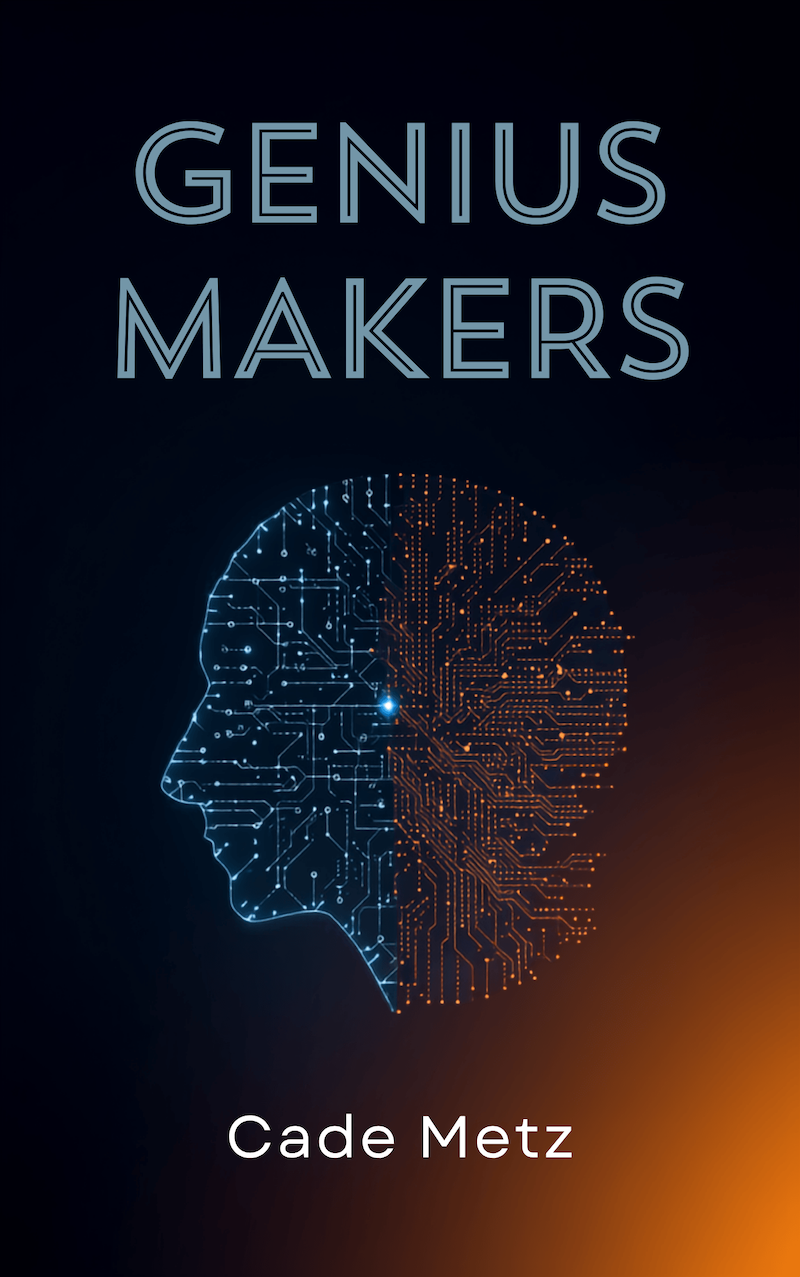
Genius Makers Book Summary
This Genius Makers Book Summary covers the key ideas, lessons, and takeaways in about 20 minutes.
Helps with these goals
Want the complete 20-minute summary?
- Full structured summary
- Video Summary
- Podcast Summary
- Audio summary
- Key takeaways
- Exercises
- Quiz
- Highlights and notes
- Ask the book with AI
What is in the Genius Makers book summary?
Below is a preview of Sumizeit’s expert-written summary of Genius Makers by Cade Metz. The full summary covers the book’s key ideas in text, audio, and video.
Genius Makers tells the story of how a rejected idea became the most valuable technology of our time. Cade Metz follows a small group of researchers who spent decades working on artificial neural networks while almost everyone in computer science told them they were wasting their lives. Then the world changed, and those same researchers found themselves at the center of a hiring war, a moral argument, and a race that now shapes what your phone does, what your doctor sees, and what your government buys. The book works because Metz treats this as a human story first. He is a reporter who covered these people for years, so he knows what they eat, how they argue, who they resent, and what they say when the recording stops. You get the science, but you get it through the personalities. And the personalities are strange.
Frank Rosenblatt and the First Big Promise
The story starts in the late 1950s with a Cornell psychologist named Frank Rosenblatt. He built a machine called the Perceptron. The concept borrowed loosely from biology. A network of artificial units took in signals, weighted them, and produced an answer. When the answer was wrong, the machine adjusted its own weights so it would do better next time. Nobody programmed the rules. The machine found them by trial and error. Rosenblatt demonstrated a Perceptron that learned to tell simple shapes apart, and the press went wild. Newspapers predicted machines that would walk, talk, see, and eventually become conscious. Rosenblatt did little to cool the excitement. The backlash came from Marvin Minsky at MIT, who had known Rosenblatt in high school. Minsky and his colleague Seymour Papert published a book in 1969 that laid out the mathematical limits of a single layer Perceptron. The critique was technically narrow but its cultural effect was enormous. Funding dried up. Graduate students moved to other topics. The field entered what people later called an AI winter, and the neural network idea sat in the basement of computer science for roughly fifteen years. Metz uses this early collapse to set up his real theme. Progress in this field never moved in a straight line. It moved in surges of belief followed by long periods where almost everyone decided the believers were fools.
The Holdouts
Three men kept working anyway. Geoff Hinton is the center of gravity in this book. He came from a family of British scientists, studied psychology and then artificial intelligence, and settled on one stubborn conviction. The brain learns from experience, so a machine that copies that basic mechanism should be able to learn too. Everything else in AI at the time relied on humans writing explicit rules, and Hinton thought that approach would eventually hit a wall. Metz gives you Hinton the person, not just Hinton the researcher. He has a back condition that makes sitting unbearable, so he stands at his desk, lies down in cars, and stretches out on the floor of airplanes.
Want the complete 20-minute summary?
- Full structured summary
- Video Summary
- Podcast Summary
- Audio summary
- Key takeaways
- Exercises
- Quiz
- Highlights and notes
- Ask the book with AI
Who should read Genius Makers?
Genius Makers is essential reading for anyone trying to understand how artificial intelligence became the most important technology of our time. Whether you work in tech, policy, journalism, or simply want to grasp the human forces shaping AI's future, this book combines rigorous technical history with compelling personal narratives that reveal how individual researchers and corporate decisions created today's AI landscape.
Why does Genius Makers matter?
Artificial intelligence now mediates hiring, lending, medical diagnosis, and military targeting, yet most people don't understand how it actually developed or who controls it. Cade Metz's Genius Makers reveals that this transformation wasn't inevitable—it depended on a tiny group of researchers who survived decades of professional exile, corporate competition, and billion-dollar auctions. Understanding this history is crucial because the same patterns of concentration and power are unfolding right now with large language models and next-generation systems.
What are the key themes in Genius Makers?
- How conviction and patience drive scientific breakthroughs across decades
- The concentration of AI expertise and computing power in a handful of corporations
- The gap between research intent and real-world deployment consequences
- The critical role of hardware progress in enabling algorithmic breakthroughs
- Bias and fairness as structural problems rooted in training data and team composition
- The tension between open research and safety concerns in powerful systems
What are the key lessons from the Genius Makers book summary?
Being Early and Being Wrong Look Identical
Geoffrey Hinton defended neural networks for 30 years while the field dismissed him as delusional. Success required institutional support, a small circle of allies, and personal tolerance for being ignored—advantages not everyone possesses.
Progress Depends on Forces Outside Your Control
Neural networks didn't succeed because researchers had a new insight in 2012; they succeeded because graphics processing units became fast enough and the internet produced massive labeled datasets. The idea was ready decades earlier.
Scarce Expertise Commands Extreme Premiums—Briefly
When DeepMind, Google, Microsoft, and Baidu competed for three researchers' knowledge, a $44 million acquisition for a company with no product became rational. Such windows close quickly once universities train the next generation.
Personal Relationships Shape Institutional Direction
Hinton's choice to move to Canada for ethical reasons, LeCun's insistence on academic freedom at Facebook, and Altman's vision for OpenAI show how individual values redirect the flow of talent and resources.
Technical Solutions Cannot Solve Political Problems
Facial recognition bias traced to underrepresented training data seems like a data problem, but the real issue is institutional: teams that don't reflect the affected population make deployment decisions without fully understanding downstream harms.
Computing Power Creates Concentration, Not Competition
The requirement for enormous hardware budgets means progress increasingly belongs to well-funded corporations rather than universities or startups, fundamentally reshaping who controls AI development.
Builders Rarely Control What Gets Built
Researchers who spent careers trying to understand intelligence found themselves creating surveillance systems, military targeting tools, and recommendation algorithms that reshape politics—outcomes they did not choose or want.
Timing Matters More Than Perfection
AlexNet's 2012 breakthrough flipped the entire field not because the algorithm was fundamentally new, but because GPUs and ImageNet's labeled data finally made the old idea practical.
Institutional Support Is Your Oxygen
When Bell Labs shifted priorities, Yann LeCun's breakthrough work lost support overnight despite real-world commercial success. Individual brilliance needs structural backing to survive.
Underground Networks Keep Ideas Alive During Winters
While mainstream conferences ignored neural networks, Hinton, LeCun, and Bengio cited each other, hired each other's students, and organized their own workshops—creating the infrastructure for eventual resurgence.
Rebranding Can Resurrect Discredited Ideas
The underground researchers renamed their work 'deep learning' to escape the stigma of 'neural networks,' showing how language and framing matter in scientific credibility.
Hiring Wars Signal Approaching Shifts
When major corporations begin aggressive recruiting and bidding wars erupt over talent, it signals that a previously niche field is about to reshape markets and power structures.
Researchers Are a Power Center When They're Scarce
The Google Project Maven revolt showed that thousands of researchers could refuse unethical work, exercise veto power over contracts, and hold companies accountable—but only while expertise remains concentrated.
Skeptics Improve Science More Than Cheerleaders
Gary Marcus's critique that deep learning lacks true understanding, combined with Hinton's own doubts about backpropagation, ensures the field questions its assumptions rather than declaring victory.
The Frame of 'Race' Justifies Almost Anything
Once AI development is described as a competition between nations, arguments for caution sound like arguments for losing, conveniently eliminating ethical pushback that might otherwise slow deployment.
Open Publishing Conflicts With Genuine Safety Concerns
OpenAI's evolution from nonprofit transparency to proprietary models with restricted access reflects the uncomfortable reality that powerful capabilities create genuine risks that open release might amplify.
Hardware Innovation Often Matters More Than Algorithmic Innovation
Custom processors like Google's TPUs enabled progress as much as better neural network designs, showing that capability breakthroughs require advances in both software and infrastructure.
Deploying Systems at Scale Reveals Problems Research Missed
Google's facial recognition failures, content moderation disasters, and translation errors only became visible when millions of users encountered them—problems that didn't show up in controlled lab settings.
Good Intentions at Research Don't Survive Deployment
Every researcher in this book wanted to understand intelligence; what they got was surveillance systems, targeting algorithms, and recommendation engines reshaping politics—outcomes disconnected from original intent.
The Question of Understanding Remains Open
Language models write fluent, confident text while inventing facts, sharpening the philosophical question: can systems produce intelligence without consciousness, understanding, or reliable beliefs about the world?
Want the complete 20-minute summary?
- Full structured summary
- Video Summary
- Podcast Summary
- Audio summary
- Key takeaways
- Exercises
- Quiz
- Highlights and notes
- Ask the book with AI
How can you apply ideas from Genius Makers?
- Assess whether your early-stage conviction can survive a 20-30 year waiting period before validation—if not, question whether you're solving the right problem
- Identify the external factors (hardware, data, market) required to make your technical solution viable, and monitor whether conditions are maturing
- Build alliances and institutional relationships during lean years, because solo survival is nearly impossible when your field falls out of favor
- Document how your technology might be misused at scale, and establish red lines before corporate deployment pressure makes ethical discussions uncomfortable
- Ensure your team composition reflects the population affected by your systems, since homogeneous teams systematically miss harms that diverse perspectives would catch
What common mistakes do readers make with Genius Makers?
- Assuming technical solutions can solve problems that are fundamentally structural or political in nature
- Failing to anticipate how tools built for one purpose will be repurposed for military, surveillance, or discriminatory applications
- Treating historical patterns in data as neutral inputs rather than as embedded records of past injustices that systems will amplify
- Believing that being first or best with a technology guarantees long-term control over how it's used
Sumizeit Exercises Apply what you've learned
Turn ideas from Genius Makers into action with a short guided reflection: identify the biggest takeaway, connect it to your life, and commit to one step you can take in the next 24 hours.
What is the expert analysis of Genius Makers?
Overview
Genius Makers, authored by Cade Metz, is a seminal narrative chronicling the rise of artificial intelligence through the lens of deep learning pioneers. Metz, a seasoned technology correspondent for The New York Times, leverages his extensive firsthand access to key figures and institutions to weave a compelling human story behind one of the most transformative technologies of our era. Published in 2021, the book stands out not merely as a technical history but as a richly textured exploration of the personalities, rivalries, and ethical dilemmas that have shaped AI’s trajectory. Its significance lies in connecting the dots between decades of scientific perseverance, the sudden commercial and geopolitical race for AI supremacy, and the profound societal implications that follow.
Core Thesis
At its core, Genius Makers argues that the modern AI revolution was not a product of a singular breakthrough or visionary plan but rather the culmination of decades of dogged commitment by a small cadre of researchers who championed neural networks despite widespread skepticism. Metz contends that the eventual success of deep learning was contingent on external factors—primarily the advent of powerful computing hardware and vast datasets—rather than solely on novel algorithms. Furthermore, the book emphasizes that the development of AI is inseparable from the human dynamics of loyalty, competition, and moral ambiguity, highlighting that the creators of these technologies often lose control over their applications once deployed at scale.
Strengths
- Humanizing the Science: Metz excels at portraying the eccentricities, motivations, and personal sacrifices of AI pioneers like Geoff Hinton, Yann LeCun, and Yoshua Bengio, transforming abstract scientific progress into a gripping human drama.
- Comprehensive Historical Context: The narrative deftly traces AI’s cyclical fortunes—from Rosenblatt’s Perceptron hype and subsequent AI winter to the resurgence catalyzed by backpropagation and deep learning—providing readers with a nuanced understanding of the field’s non-linear evolution.
- Balanced Ethical Examination: The book does not shy away from difficult topics such as bias in AI systems, military applications, and corporate concentration, presenting multiple perspectives without resorting to simplistic judgments.
- Insider Access and Detail: Metz’s journalistic rigor and access to key figures and events, such as the AlphaGo match and the bidding war for DNNresearch, enrich the narrative with vivid, behind-the-scenes insights rarely available in popular accounts.
- Clear Articulation of Technical Concepts: Complex ideas like backpropagation, convolutional networks, and reinforcement learning are explained through storytelling that remains accessible without sacrificing depth.
Critiques & Counterarguments
- Potential Overemphasis on Individual Agency: While the book foregrounds the personalities behind AI’s breakthroughs, it may understate the broader systemic and institutional forces—such as government funding patterns, global economic shifts, and international competition—that also critically shaped AI’s development.
- Limited Engagement with Alternative AI Paradigms: The focus on deep learning sidelines other AI approaches, including symbolic AI, hybrid models, and emergent research in causal reasoning, which remain relevant and challenge the notion that deep learning alone will achieve general intelligence.
- Ethical and Social Implications Explored but Not Resolved: Although Metz highlights issues of bias, surveillance, and military use, the treatment sometimes feels descriptive rather than prescriptive, leaving readers with an acute awareness of problems but limited guidance on solutions or governance frameworks.
- Technological Determinism Risk: The narrative’s emphasis on hardware and data availability as the decisive factors risks implying an inevitability to AI’s current trajectory, potentially downplaying the role of human choice, policy interventions, and alternative innovation pathways.
- Competing Intellectual Views: The book acknowledges critics like Gary Marcus who argue deep learning lacks true understanding, but the counterarguments presented—such as LeCun’s claim that critics keep moving the goalposts—may oversimplify ongoing debates about AI’s epistemological and cognitive limits.
Who Should Read This
Genius Makers is ideal for readers who seek a sophisticated yet accessible account of AI’s rise that goes beyond technical manuals or speculative futurism. It appeals to:
- Technology professionals and researchers interested in the historical and human context behind deep learning’s breakthroughs.
- Policy makers and ethicists who want to understand the complex interplay between innovation, corporate power, and societal impact in AI development.
- Business leaders and strategists aiming to grasp how AI talent, funding, and competition shape technological advantage and market dynamics.
- General readers with a curiosity about science and technology who appreciate narrative-driven explorations of how ideas evolve and influence the world.
Frequently asked questions about the Genius Makers book summary
What is Genius Makers about?
Genius Makers by Cade Metz tells the story of how artificial intelligence became the most valuable technology on earth through the lens of the researchers who defended neural networks during decades when the field ignored them. The book combines technical history with intimate portraits of Geoffrey Hinton, Yann LeCun, Yoshua Bengio, Demis Hassabis, and others, chronicling their journey from professional exile through corporate bidding wars to the moment AI began reshaping society—and raising urgent questions about bias, surveillance, and control.
Who should read Genius Makers?
Anyone seeking to understand how AI actually developed and who controls it should read Genius Makers. Technology professionals, policy makers, journalists, and engaged citizens will all find essential context here. The book works equally well for readers with technical backgrounds and those approaching AI primarily as a social and economic force.
What are the main takeaways from Genius Makers?
The main takeaways include: conviction without institutional support rarely survives, progress depends heavily on forces outside researchers' control (hardware and data), scarce expertise commands temporary but extreme premiums, builders rarely control what their creations become, and the hardest AI problems are political and ethical, not merely mathematical. Metz also shows how concentration of computing power consolidates control among a handful of corporations, and how teams that don't reflect affected populations systematically miss harms.
How did neural networks go from rejected to revolutionizing technology?
Neural networks were dismissed as fundamentally limited after Marvin Minsky's 1969 critique, triggering an AI winter that lasted roughly 15 years. Geoffrey Hinton and a small underground community kept working anyway. Progress resumed in the mid-1980s with backpropagation, but the real breakthrough came in 2012 when Alex Krizhevsky's AlexNet dramatically outperformed competitors—not because the algorithm was new, but because GPUs were fast enough and labeled training data finally existed at scale.
What happened at the AlphaGo match in Seoul in 2016?
DeepMind's AlphaGo defeated Lee Sedol, one of the world's strongest Go players, 4-1 in a televised match. In the second game, AlphaGo played a move on the fifth line that professional commentators initially called a mistake—until they realized it was a brilliant move that human intuition had missed for centuries. The victory demonstrated that machines could produce creative insights that human experts could not anticipate.
Why did Google, Microsoft, Facebook, and other companies launch a talent war?
After AlexNet's breakthrough in 2012 and AlphaGo's victory in 2016, it became clear that deep learning expertise was extraordinarily scarce and the companies controlling it would dominate AI's future. The hiring wars intensified after Geoffrey Hinton auctioned his three-person team to Google for $44 million—a transaction that signaled to every major technology company that they could not sit out AI's development. Scarce expertise commands extreme premiums when demand suddenly spikes.
What does Genius Makers say about bias and fairness in AI?
Cade Metz shows that bias emerges from training data that overrepresents some faces and underrepresents others, not from malicious design. However, the deeper problem is structural: homogeneous research teams with decision-making power over deployment rarely recognize harms that affect different populations. When facial recognition tools show dramatically higher error rates for darker-skinned women, the solution isn't purely technical—it requires institutional change in hiring, team composition, and who has voice in deployment decisions.
About Sumizeit
Sumizeit is a profitable Scomy LLC company based in Miami, Florida. It has been helping readers learn from nonfiction books for 7 years with expert-written summaries in text, audio, podcast, and video.
Want the complete 20-minute summary?
- Full structured summary
- Video Summary
- Podcast Summary
- Audio summary
- Key takeaways
- Exercises
- Quiz
- Highlights and notes
- Ask the book with AI
Here's why readers love Sumizeit
Join thousands of learners getting smarter every day
"Great experience. Detailed summaries. Loved the gamification feature. Makes learning fun. Good customer service. I recommend Sumizeit to anyone. You'll learn a lot."
"I always felt busy but still wanting to keep up with the book discussion in my friend group. This was a great supplement to help me keep reading the books I find fun while keeping up with important books."
"I love this website. Instead of scrolling social media, I find myself learning a lot. I use it everyday. I recommend this app for anyone who is too busy and wants to get up to speed with their favorite books."
Genius Makers Book Summary PDF
Looking for a Genius Makers Book Summary PDF you can save and revisit offline? Our Genius Makers Book Summary PDF captures the book’s core ideas in a clean, printable format — the key frameworks, takeaways, and structure without the fluff. Download the Genius Makers Book Summary PDF when you want a reference you can annotate, share with your team, or review on the go. Get your Genius Makers Book Summary PDF from the download page below.
Download Genius Makers Book Summary PDFPeople also liked these summaries
Readers who explored Genius Makers often enjoyed these titles next.

Want the complete 20-minute summary?
- Full structured summary
- Video Summary
- Podcast Summary
- Audio summary
- Key takeaways
- Exercises
- Quiz
- Highlights and notes
- Ask the book with AI
Featured Book Titles
Popular Book Summaries at sumizeit, leading book summary app
