


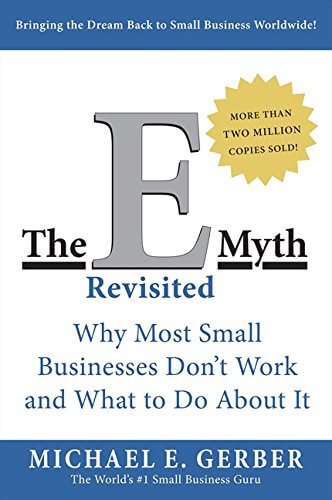
The E-Myth Revisited Book Summary
This The E-Myth Revisited Book Summary covers the key ideas, lessons, and takeaways in about 20 minutes.
Small business owners have three conflicting perspectives: the Technician, the Entrepreneur, and the Manager. The Technician’s perspective is focused on daily tasks related to the business owner’s old job. The Entrepreneur is the big thinker who takes on the job of being a leader. Entrepreneurs dream about the future. The Manager is the organizer who figures out how to implement all the Entrepreneur’s big ideas. To become a successful small business owner, it’s necessary to balance the work of the Technician, the Entrepreneur, and the Manager.
Helps with these goals
Want the complete 20-minute summary?
- Full structured summary
- Video Summary
- Podcast Summary
- Audio summary
- Key takeaways
- Exercises
- Quiz
- Highlights and notes
- Ask the book with AI
What is in the The E-Myth Revisited book summary?
Below is a preview of Sumizeit’s expert-written summary of The E-Myth Revisited by Michael Gerber. The full summary covers the book’s key ideas in text, audio, and video.
The E-Myth Revisited: Why Most Small Businesses Don’t Work and What to Do About It (2001) by Michael E. Gerber explores the question of why so many small businesses don’t survive. The answer is simple, yet profound: most business owners have no clue as to how to run a business. Most small business owners start as employees who possess some sort of technical skill. After working as employees for a while, they falsely believe they’re ready to be the boss. Being a worker and being an entrepreneur requires two entirely different skill sets. Suddenly, people realize that being their own boss isn’t a privilege. It’s a terrible chore.
Small business owners have three conflicting perspectives: the Technician, the Entrepreneur, and the Manager. The Technician’s perspective is focused on daily tasks related to the business owner’s old job. The Entrepreneur is the big thinker who takes on the job of being a leader. Entrepreneurs dream about the future. The Manager is the organizer who figures out how to implement all the Entrepreneur’s big ideas. To become a successful small business owner, it’s necessary to balance the work of the Technician, the Entrepreneur, and the Manager.
Chapter 1: The Entrepreneurial Myth
Michael Gerber says that many people who get into business do so because they don’t want a boss. They believe that because they succeed as workers, they know how to run their own business.
The Fatal Assumption about business is that any person with technical skills can achieve success. This is false and many “technicians” end up failing in business.
Not everybody who starts a business is an entrepreneur. This is similar to saying everybody who can cook is a chef.
Chapter 2: Entrepreneur, Manager & Technician
Michael Gerber shows that most small businesses fail because the owners lack managerial and entrepreneurial qualities. In essence, they are technicians and not managers.
Technicians start a business after getting tired of working for others.
Entrepreneurs are visionaries who may not have all of the resources to make their ideas a reality.
Managers are concerned with planning and organizing.
Chapter 3: Infancy, The Technician Phase
At the infancy stage of a business, the business and the owners are one and the same.
The infancy state ends when the business starts to grow and requires more than the abilities of the owner.
If a business only depends on the existing skillsets of its owner, it is not a business, but a job. Most people don’t own businesses but jobs.
Chapter 4: Adolescence, Getting Some Help
At the adolescent stage, a business starts hiring and the “the technician” who is the owner becomes a manager.
The most common mistakes of early managers are known as Management by Abdication: delegating too much without supervising the quality of work.
Additionally, managers can do the opposite and not delegate or teach workers how to complete jobs successfully. The manager then winds up doing most of the work himself.
Chapter 5: Beyond The Comfort Zone
At the Comfort Zone, business…
Want the complete 20-minute summary?
- Full structured summary
- Video Summary
- Podcast Summary
- Audio summary
- Key takeaways
- Exercises
- Quiz
- Highlights and notes
- Ask the book with AI
Who should read The E-Myth Revisited?
This book is essential for small business owners, aspiring entrepreneurs, and anyone working in a business they feel trapped by. If you're a skilled technician who recently started a business or are considering it, The E-Myth Revisited reveals why technical ability alone doesn't guarantee business success. It's also valuable for managers and leaders who want to build scalable, systems-driven organizations.
Why does The E-Myth Revisited matter?
Most small businesses fail because owners confuse technical skill with entrepreneurial ability—a gap that Michael Gerber's framework directly addresses. In today's competitive landscape, the ability to build a business that runs without you is the difference between a job and a true asset. This book provides the strategic blueprint for transforming a struggling operation into a scalable enterprise that serves your life goals rather than consuming them.
What are the key themes in The E-Myth Revisited?
- The distinction between Technician, Manager, and Entrepreneur perspectives
- Building systems and processes that eliminate dependence on the owner
- Viewing your business as a replicable product, not just a job
- Creating a Primary Aim that aligns business goals with life vision
- Strategic delegation and management without micromanagement
- Customer-centric innovation based on quantifiable data
What are the key lessons from the The E-Myth Revisited book summary?
Technical skill does not equal business ownership
Being excellent at doing the work (technician) is fundamentally different from managing others and leading a business forward. Most small business failures stem from this confusion.
Balance the three business perspectives
Successful business owners develop the Technician (execution), Manager (organization), and Entrepreneur (vision) perspectives equally rather than leaning heavily on one.
Your business should not depend solely on you
If your business only works when you're present, you own a job, not a business. True ownership means building systems that function independently.
The infancy stage ends when the business outgrows the owner
A business transitions from infancy to growth when it demands more than the owner's individual skill set can provide—this is when systems become critical.
Avoid management by abdication or micromanagement
Delegating without oversight creates chaos; refusing to delegate creates burnout. Effective management requires clear systems and reasonable supervision.
Work ON your business, not IN it
Owners must shift focus from daily operational tasks to building the systems, processes, and structure that make the business run without constant intervention.
Design your business like a franchise prototype
McDonald's success demonstrates that a strong business system—not just a brand name—allows replication and independent operation across multiple locations or scenarios.
Define your Primary Aim before building systems
Your business should serve your life vision, not the reverse. Start by clarifying your personal goals, values, and ideal lifestyle, then build the business to support it.
Quantify everything to make informed decisions
Innovation and improvement require measurable data: customer numbers, revenue, peak hours, and performance metrics. Numbers guide strategic choices.
Hire based on attitude and culture fit, not just skill
You can train technical skills, but you cannot train character. Build a people strategy that creates an environment where employees want to contribute, not just comply.
Create manuals and scripts for consistency
Documented processes, decision-making rules, and employee scripts ensure that your business operates consistently whether you're present or not.
Your management system should not depend on exceptional people
If your business only works with highly skilled managers or key individuals, it's not scalable. Effective systems function even with average employees.
Know your target customers and their preferences
Effective marketing begins with clarity about who you serve and what they actually want. Ask customers directly and use their feedback to shape offerings.
Implement three types of systems: Hard, Soft, and Information
Hard systems solve immediate problems, Soft systems (like sales scripts) create consistency, and Information systems track data—all three are necessary for scalability.
Your strategic objective bridges Primary Aim and daily operations
Define how often you need to be present and under what circumstances, then design your business structure to meet those parameters.
Business development is continuous innovation, quantification, and orchestration
Successful businesses systematically gather customer insights, measure performance, and refine their operations based on data-driven learning.
Gradually move out of your comfort zone through smart hiring
Hiring employees and building systems is a step-by-step process; resist the temptation to retreat to doing everything yourself when challenges arise.
Your organizational strategy defines all future roles before you need them
Map out every job position your grown business will need and document the requirements—this clarity allows you to hire and train systematically.
Lead with humanity and mentor employees holistically
Effective people strategies recognize that employees have lives beyond work; leaders who operate with full awareness of employee humanity create loyalty and commitment.
See your business as a product competing in the market
Entrepreneurs view their business itself as the product to improve and scale, not just a vehicle for delivering their technical services.
Want the complete 20-minute summary?
- Full structured summary
- Video Summary
- Podcast Summary
- Audio summary
- Key takeaways
- Exercises
- Quiz
- Highlights and notes
- Ask the book with AI
How can you apply ideas from The E-Myth Revisited?
- Document every process in your business so it can be executed by someone other than you, starting with your most time-consuming tasks
- Create a written Primary Aim statement that defines your ideal lifestyle and use it to evaluate whether your current business strategy supports it
- Implement a quarterly data review where you measure key metrics (customers served, revenue, peak hours, employee performance) to guide strategic decisions
- Design job descriptions and decision-making guides for every position in your business, including the role of manager, so decisions can be made consistently without your input
- Interview your top customers to identify their unmet needs and preferences, then use that data to refine your marketing and service offerings
- Schedule 20% of your time for strategic business development (working ON the business) and protect that time from daily operational demands (working IN the business)
- Audit your current delegation practices and identify tasks you're doing that should be handled by others, then create a timeline for training replacements
What common mistakes do readers make with The E-Myth Revisited?
- Starting a business because you're good at the technical work, then being surprised when managing people and finances feels overwhelming and unfamiliar
- Failing to document processes and expecting employees to figure things out through observation or intuition, leading to inconsistency and quality issues
- Getting trapped in the day-to-day operations of the business and never stepping back to build systems, leaving yourself unable to grow or take time off
- Delegating tasks without clear guidelines or follow-up, assuming employees will understand expectations and perform at the standard you'd set yourself
Sumizeit Exercises Apply what you've learned
Turn ideas from The E-Myth Revisited into action with a short guided reflection: identify the biggest takeaway, connect it to your life, and commit to one step you can take in the next 24 hours.
What is the expert analysis of The E-Myth Revisited?
Overview
The E-Myth Revisited, authored by Michael E. Gerber, stands as a seminal work in the realm of small business literature. Gerber, hailed by Inc. Magazine as “the World’s #1 Small Business Guru,” leverages over four decades of experience to dissect the persistent failures of small enterprises. His influence extends beyond this single volume, with a prolific output of related works addressing leadership, management, and industry-specific challenges. This book’s significance lies in its practical framework that demystifies entrepreneurship for a broad audience of current and aspiring small business owners, providing a roadmap to sustainable success.
Core Thesis
Gerber’s central argument challenges the widespread misconception that technical skill alone suffices to run a successful business. He posits that most small business owners are technicians who mistakenly believe their craft expertise translates into entrepreneurial acumen. The book introduces a tripartite model of business owner roles: the Technician, the Manager, and the Entrepreneur. Success, Gerber argues, demands a deliberate balance among these roles, alongside the creation of replicable systems that enable a business to operate independently of its founder’s direct involvement. This systemic approach transforms a mere job into a scalable enterprise.
Strengths
- Clarity and Accessibility: Gerber’s writing distills complex business concepts into accessible language, making the book valuable for readers without formal business training.
- Practical Framework: The delineation of the Technician, Manager, and Entrepreneur roles provides a diagnostic tool for self-assessment and strategic development.
- Systemization Emphasis: The focus on building business systems anticipates modern operational best practices and aligns with franchise models, exemplified by the McDonald’s case study.
- Holistic Business Development: Gerber’s inclusion of innovation, quantification, orchestration, and detailed strategies across organizational, management, people, marketing, and systems dimensions offers a comprehensive blueprint.
- Psychological Insight: The book addresses the emotional and identity challenges faced by business owners, emphasizing the importance of a primary aim that transcends the business itself.
Critiques & Counterarguments
- Overgeneralization of Roles: The tripartite model, while useful, may oversimplify the fluid and overlapping nature of entrepreneurial roles, especially in dynamic or innovative startups where roles are less clearly defined.
- Limited Empirical Evidence: Gerber’s arguments are largely anecdotal and prescriptive, lacking rigorous empirical validation or engagement with contemporary business research methodologies.
- Potential Neglect of External Factors: The book focuses heavily on internal business mechanics but underemphasizes external market forces, economic conditions, and technological disruptions that critically impact small business viability.
- Contrasting Views on Entrepreneurship: Contemporary entrepreneurship scholarship often highlights the importance of adaptability, network effects, and lean startup methodologies, which may conflict with Gerber’s emphasis on replicable, systematized processes.
- Real-World Variability: Some successful businesses thrive precisely because they resist systemization, relying on artisanal, bespoke, or highly personalized approaches that defy replication but create unique value.
Who Should Read This
The E-Myth Revisited is essential reading for small business owners, nascent entrepreneurs, and professionals contemplating the leap from skilled labor to business leadership. It serves as a cautionary guide for technicians tempted by entrepreneurship without adequate preparation and as a strategic manual for those seeking to professionalize and scale their ventures. Additionally, business educators and coaches may find Gerber’s frameworks valuable pedagogical tools for illustrating the multifaceted demands of small business management.
Frequently asked questions about the The E-Myth Revisited book summary
What is The E-Myth Revisited about?
The E-Myth Revisited by Michael Gerber explains why most small businesses fail and how to fix them. The core insight is that most business owners are skilled technicians who lack the managerial and entrepreneurial skills needed to build a scalable business. Gerber provides a practical framework for building systems, defining your vision, and creating a business that runs independently of your daily involvement.
Who should read The E-Myth Revisited?
This book is essential for small business owners, aspiring entrepreneurs, and anyone considering starting a business. If you feel trapped in your business, constantly working long hours, or struggling to grow beyond your own capacity, this book directly addresses your situation. It's also valuable for managers and leaders who want to build scalable, systems-driven organizations.
What are the main takeaways from The E-Myth Revisited?
The main takeaways include: (1) Technical skill alone doesn't ensure business success—you must develop Technician, Manager, and Entrepreneur perspectives; (2) Build systems and processes so your business runs without you; (3) Define your Primary Aim (life vision) first, then design your business to support it; (4) Document everything to ensure consistency and enable delegation; (5) Use data to make informed decisions and improve continuously.
What is the difference between working IN your business versus working ON it?
Working IN your business means handling daily operational tasks—serving customers, performing technical work, and managing day-to-day issues. Working ON your business means stepping back to build systems, train staff, refine processes, and plan growth. Most struggling business owners spend all their time working IN their business and never develop the strategic perspective needed to scale.
What does Gerber mean by the Primary Aim?
Your Primary Aim is your personal vision for how you want to live your life—your goals, values, and ideal lifestyle. Rather than letting your business consume your life, you define your Primary Aim first, then design your business to support and serve that vision. This prevents business ownership from becoming a trap.
Why does Gerber use McDonald's as an example?
McDonald's demonstrates that a business system—not just a brand or product—is the key to scalability and success. McDonald's succeeds because it has documented processes, standardized training, and systems that allow the business to operate consistently across thousands of locations without dependence on any single person or exceptional talent.
How do you know if you're a Technician, Manager, or Entrepreneur?
A Technician focuses on doing the work and completing daily tasks. A Manager enjoys planning, organizing, and implementing systems. An Entrepreneur thinks strategically, dreams about the future, and sees the big picture. Most small business owners start as Technicians and must develop the other two perspectives to succeed. Gerber argues you need balance among all three.
What is the Business Development Process that Gerber describes?
Gerber's Business Development Process involves three continuous activities: Innovation (gathering customer feedback about their needs), Quantification (measuring your business through numbers and data), and Orchestration (implementing reliable, repeatable systems). These three activities working together create a scalable, customer-focused business that continuously improves.
About Sumizeit
Sumizeit is a profitable Scomy LLC company based in Miami, Florida. It has been helping readers learn from nonfiction books for 7 years with expert-written summaries in text, audio, podcast, and video.
Want the complete 20-minute summary?
- Full structured summary
- Video Summary
- Podcast Summary
- Audio summary
- Key takeaways
- Exercises
- Quiz
- Highlights and notes
- Ask the book with AI
Here's why readers love Sumizeit
Join thousands of learners getting smarter every day
"Great experience. Detailed summaries. Loved the gamification feature. Makes learning fun. Good customer service. I recommend Sumizeit to anyone. You'll learn a lot."
"I always felt busy but still wanting to keep up with the book discussion in my friend group. This was a great supplement to help me keep reading the books I find fun while keeping up with important books."
"I love this website. Instead of scrolling social media, I find myself learning a lot. I use it everyday. I recommend this app for anyone who is too busy and wants to get up to speed with their favorite books."
The E-Myth Revisited Book Summary PDF
Looking for a The E-Myth Revisited Book Summary PDF you can save and revisit offline? Our The E-Myth Revisited Book Summary PDF captures the book’s core ideas in a clean, printable format — the key frameworks, takeaways, and structure without the fluff. Download the The E-Myth Revisited Book Summary PDF when you want a reference you can annotate, share with your team, or review on the go. Get your The E-Myth Revisited Book Summary PDF from the download page below.
Download The E-Myth Revisited Book Summary PDFPeople also liked these summaries
Readers who explored The E-Myth Revisited often enjoyed these titles next.




Want the complete 20-minute summary?
- Full structured summary
- Video Summary
- Podcast Summary
- Audio summary
- Key takeaways
- Exercises
- Quiz
- Highlights and notes
- Ask the book with AI
Featured Book Titles
Popular Book Summaries at sumizeit, leading book summary app
