


As an Amazon Associate, Sumizeit earns from qualifying purchases.
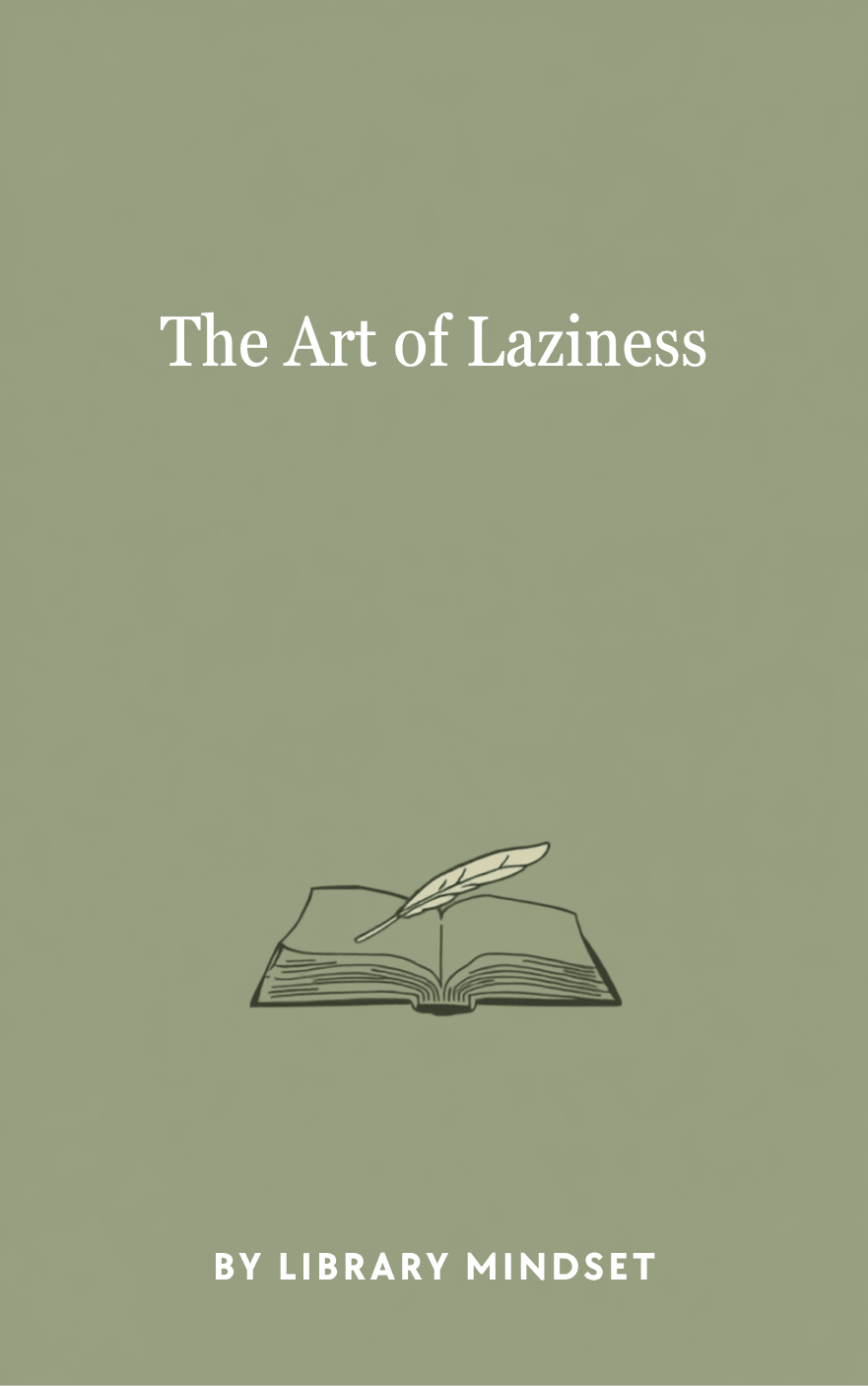
The Art of Laziness Book Summary
This The Art of Laziness Book Summary covers the key ideas, lessons, and takeaways in about 20 minutes.
Taken together, the book argues that a good life isn't built from a single dramatic overhaul but from a series of honest, repeatable choices. You accept that your time is limited and let that awareness sharpen your priorities instead of paralyzing you. You take ownership of your choices instead of waiting for circumstances to change on their own. You surround yourself with people who pull you forward rather than hold you back. You build a daily structure around your real energy patterns instead of someone else's ideal schedule, protect your attention from constant distraction, and treat setbacks as information to learn from rather than proof that you should quit. None of this requires becoming a different person overnight. It just requires paying closer attention to how you're already spending your one limited stock of time, and making small, steady adjustments in the direction you actually want to go.
Want the complete 20-minute summary?
- Full structured summary
- Video Summary
- Podcast Summary
- Audio summary
- Key takeaways
- Exercises
- Quiz
- Highlights and notes
- Ask the book with AI
What is in the The Art of Laziness book summary?
Below is a preview of Sumizeit’s expert-written summary of The Art of Laziness by Library Mindset. The full summary covers the book’s key ideas in text, audio, and video.
Most productivity books assume you already have discipline and just need better tools. This one starts somewhere different. It assumes you're tired, distracted, and maybe a little lazy by nature, and it builds a system around that reality instead of pretending you'll suddenly become a different person. Library Mindset argues that laziness isn't a character flaw you need to punish out of yourself. It's a signal. Pay attention to it, work with it, and you'll get more done with less internal fighting than you would by gritting your teeth through every task.
The book pulls together ideas on mindset, daily habits, focus, and resilience, then backs each one with a mix of psychology, business history, and plain observation about how people actually behave. What follows is a walk through the core arguments, restructured and explained in plain terms.
Your time is the one thing you can't get back
The book opens with a blunt reminder. You have a limited number of days, and no one knows the exact count. That sounds obvious, almost too obvious to write down, but the author points out that most people live as if they have unlimited time. You put off the hard conversation, the creative project, the career change, because there will always be a "later." Library Mindset wants you to stop believing in that later.
To make the point concrete, the book introduces an exercise sometimes called a life calendar. Picture a grid of small circles, one for each month of an assumed eighty year life. Fill in the circles that represent the months you've already lived. What's left is what remains, and seeing it drawn out tends to hit harder than just thinking about it abstractly. The exercise isn't meant to scare you. It's meant to cut through the noise of daily distractions and remind you which things actually matter to you.
The book also brings up Steve Jobs' 2005 commencement speech at Stanford, where he talked about starting each morning by asking whether he'd be happy doing that day's plans if it turned out to be his last day alive. Jobs said that thinking about death regularly helped him let go of fear, expectations, and pride, because all of that fades away in the face of mortality, leaving only what truly matters. Library Mindset uses this as evidence that facing your own limited time isn't morbid. It's clarifying.
There's also a story about ancient Roman generals. After a major military victory, a general would ride through the city in a triumphant parade while crowds cheered. Standing behind him in the chariot, a servant would repeat a phrase reminding him that he was still mortal, still human, no matter how much praise he received that day. The point of the ritual was to keep success from going to his head and to keep him grounded in the fact that his time, like everyone's, was limited.
Want the complete 20-minute summary?
- Full structured summary
- Video Summary
- Podcast Summary
- Audio summary
- Key takeaways
- Exercises
- Quiz
- Highlights and notes
- Ask the book with AI
Who should read The Art of Laziness?
This book is for anyone who feels stuck between knowing what they should do and actually doing it. If you're tired of productivity systems that demand superhuman discipline, struggle with constant distractions, or feel like your time slips away without meaningful progress, The Art of Laziness by Library Mindset offers a different approach. It's designed for people ready to work smarter by accepting their own nature rather than fighting it.
Why does The Art of Laziness matter?
In a world of infinite tasks and constant notifications, most productivity advice assumes you'll magically transform into a different person. The Art of Laziness matters because it starts with reality: you're human, you get tired, and you have limited time. By treating laziness as useful information rather than a character flaw, this book helps you build a life aligned with how you actually work, not how you think you should work.
What are the key themes in The Art of Laziness?
- Mortality as clarity
- Personal responsibility over blame
- Environment shapes behavior
- Quality over quantity in relationships
- Focus through elimination
- Energy rhythms and natural patterns
- Failure as information
- Saying no protects priorities
What are the key lessons from the The Art of Laziness book summary?
Time is your scarcest resource
Recognizing that your time is finite and irreplaceable cuts through daily distractions and forces honest decisions about what actually matters to you.
You own your outcomes
Blaming circumstances keeps you stuck; redirecting that energy toward what you can control is where power actually lives.
Your mindset shapes your experience
The same situation looks different depending on your perspective; changing how you interpret events changes which opportunities you notice.
The five people around you influence who you become
You absorb the habits, attitudes, and ambitions of those you spend the most time with, making your social circle a crucial part of your trajectory.
Growth requires discomfort
The anticipation of difficulty is usually worse than the actual experience; starting small removes the barrier to beginning.
Eighty percent of results come from twenty percent of effort
Identifying your highest-impact activities and protecting them fiercely, while cutting or delegating the rest, multiplies your effectiveness.
Multitasking costs more time than it saves
Every switch between tasks requires your brain to reorient; singular focus on one task before moving to the next produces better results faster.
Your energy has natural rhythms
Fighting when you naturally focus is a losing battle; designing your schedule around your peak hours dramatically improves output.
Every yes is a hidden no
Saying yes to something outside your priorities means saying no to something that matters more; protecting time requires deliberate refusal.
Your environment is a force, not background
Clutter, noise, and interruptions chip away at focus even when you don't consciously notice; a dedicated, clean work area signals your brain to concentrate.
Failure is feedback, not verdict
People who succeed aren't those who never fail but those who treat each failure as data, adjust quickly, and move forward.
Resilience is about repetition, not talent
The willingness to absorb hits and get back up matters far more than raw ability; the feedback loop of trying, adjusting, and trying again is where progress lives.
Worry consumes energy better spent on action
Most feared disasters never materialize; redirecting the mental energy that worry uses toward things you can influence frees up real capacity.
Celebrate progress, not just the finish line
Acknowledging smaller wins reinforces the habits that created them and prevents motivation from running dry before bigger goals arrive.
Missing one day is temporary, missing two starts a pattern
A single skip from a habit is recoverable, but letting it turn into two missed days cascades into abandonment; catch yourself after one and restart immediately.
Time tracking reveals hidden patterns
How you actually spend time usually differs sharply from how you think you spend it; real data lets you rebuild your schedule around your true rhythms.
Capture stray thoughts without chasing them
Writing down random ideas that interrupt focused work, then dealing with them later, keeps small distractions from derailing deep concentration.
Batching similar tasks multiplies efficiency
Grouping related work into dedicated blocks prevents constant context-switching that forces your brain to reload what it just set down.
Basic health underlies productivity
Sleep, movement, decent food, and genuine downtime aren't luxuries competing with work; they're the foundation that makes sustained output possible.
Focus means saying no to many good things
Commitment to what matters most requires politely but firmly declining good opportunities that fall outside your priorities.
Want the complete 20-minute summary?
- Full structured summary
- Video Summary
- Podcast Summary
- Audio summary
- Key takeaways
- Exercises
- Quiz
- Highlights and notes
- Ask the book with AI
How can you apply ideas from The Art of Laziness?
- Track your time hour-by-hour for seven days to reveal where it actually goes versus where you think it goes, then rebuild your schedule around discovered patterns
- Keep a dedicated list for stray thoughts during focused work sessions, capturing ideas without abandoning the task at hand
- Batch similar administrative tasks into a single weekly block instead of scattering them, freeing remaining days for deeper work
- Audit your task list regularly using the Pareto Principle to identify your top 20% of activities producing 80% of results, then cut or delegate the rest
- Experiment with different work interval lengths using the Pomodoro Technique, adjusting based on your actual focus capacity rather than a standard timer
- Build a dedicated, clutter-free work area with notifications disabled and distractions minimized to activate focus automatically
- Identify one person whose future earnings, health, and trajectory you wouldn't invest in, then honestly assess whether that relationship is pulling you forward or backward
- Start your day with your most important task while energy and focus are freshest, rather than saving it for whenever you get around to it
What common mistakes do readers make with The Art of Laziness?
- Assuming you need discipline to become a different person rather than building systems around how you actually work and what genuinely motivates you
- Staying busy with low-impact tasks that feel productive while neglecting the 20% of activities that actually drive your results
- Taking life advice from people whose own lives aren't going the direction they want, regardless of their good intentions
- Waiting for the right moment, better circumstances, or external permission to start rather than taking ownership of moving forward with what you have now
Sumizeit Exercises Apply what you've learned
Turn ideas from The Art of Laziness into action with a short guided reflection: identify the biggest takeaway, connect it to your life, and commit to one step you can take in the next 24 hours.
What is the expert analysis of The Art of Laziness?
Overview
The Art of Laziness is a distinctive contribution to the productivity and self-improvement genres, authored by Library Mindset, a collective identity known for producing concise, actionable guides synthesizing psychology, business, and philosophy. Unlike traditional productivity manuals that presuppose discipline and relentless effort, this book pivots toward embracing human nature’s inherent tendencies—particularly laziness—as a strategic asset rather than a flaw. Its significance lies in reframing laziness from a moral failing into a signal worthy of attention, thereby offering a more compassionate and realistic approach to productivity that resonates with readers fatigued by conventional, willpower-centric advice.
Core Thesis
The central argument advanced by Library Mindset is that true productivity and meaningful progress emerge not from forcing oneself into an idealized model of relentless discipline but from working with one’s natural rhythms, limitations, and inclinations. Laziness is reframed as a meaningful indicator of where energy and focus should be allocated, rather than something to be suppressed. The book advocates for a mindful, intentional approach to time management, responsibility, social environment, and habit formation—one that respects human psychology and leverages principles such as the Pareto Principle and focused work sprints to maximize output with less internal conflict.
Strengths
- Human-Centered Realism: The book’s foundational acceptance of laziness as a natural state rather than a defect offers a refreshing departure from the often punitive tone of productivity literature, fostering self-compassion alongside effectiveness.
- Integration of Diverse Disciplines: By weaving together psychology, business history, and philosophy with practical anecdotes and thought experiments, the book creates a multidimensional framework that is both intellectually satisfying and pragmatically useful.
- Concrete, Adaptable Tools: The inclusion of specific techniques such as the Pomodoro method, habit consistency rules, and time tracking exercises grounds abstract concepts in actionable steps, enhancing the book’s utility for readers.
- Balanced View on Responsibility and Environment: The nuanced discussion of personal accountability alongside the influence of social circles and physical workspace acknowledges complexity without resorting to simplistic blame or determinism.
- Emphasis on Flexibility and Individuality: Encouraging readers to experiment with schedules aligned to their unique energy patterns rather than imposing rigid routines respects individual differences and promotes sustainable productivity.
Critiques & Counterarguments
- Potential Oversimplification of Structural Barriers: While emphasizing personal responsibility is empowering, the book’s approach may underplay systemic and socio-economic factors that constrain individual agency, a critique well-documented in social psychology and critical theory.
- Mortality Focus Risks Anxiety: The repeated invocation of mortality as a motivational tool, inspired by figures like Steve Jobs and ancient rituals, could induce anxiety or existential distress in some readers rather than clarity, a phenomenon explored in thanatology and existential psychology.
- Echo Chamber Effect in Social Curation: The advice to surround oneself with ambitious, positive individuals risks fostering homogeneity of thought and diminishing exposure to diverse perspectives, which cognitive diversity research identifies as crucial for creativity and resilience.
- Procrastination and Downtime Nuance: The framing of procrastination as an adversary to productivity may overlook the nuanced roles of rest, incubation, and subconscious processing in creative and cognitive performance, as supported by research in neuroscience and creativity studies.
- Evidence Base and Depth: The book’s reliance on anecdotal stories and well-known figures, while engaging, may lack the rigorous empirical support or depth found in more scholarly works, potentially limiting its appeal to readers seeking robust scientific validation.
Who Should Read This
The Art of Laziness is ideally suited for readers who feel overwhelmed or disillusioned by traditional productivity advice that demands relentless discipline and self-denial. It appeals to those seeking a more humane, psychologically informed approach to managing time and energy—particularly individuals who recognize their own tendencies toward distraction or procrastination and want to harness these traits constructively. Professionals, creatives, and students who appreciate practical tools grounded in relatable narratives will find this book a valuable addition to their personal development library. Additionally, readers interested in the intersection of mindset, habit formation, and sustainable productivity will benefit from its balanced and flexible guidance.
Frequently asked questions about the The Art of Laziness book summary
What is The Art of Laziness about?
The Art of Laziness by Library Mindset is about building a productive life by working with your nature rather than against it. Instead of treating laziness as a character flaw to overcome through sheer willpower, the book frames it as useful information about how you actually work and helps you design systems around your real energy patterns, priorities, and limitations.
Who should read The Art of Laziness?
This book is for anyone caught between knowing what they should do and actually doing it. If you've tried traditional productivity systems that feel unsustainable, struggle with constant distractions, feel like your time disappears without progress, or simply want a more honest approach to building habits, The Art of Laziness offers a practical alternative rooted in how people actually behave.
What are the main takeaways from The Art of Laziness?
The main takeaways include: your time is limited and recognizing this sharpens priorities; you own your outcomes and blaming keeps you stuck; the people around you shape who you become; focus requires protecting your time through strategic no's and eliminating low-impact tasks; and your natural energy rhythms matter more than arbitrary routines. Success comes from small, consistent choices aligned with how you actually work, not from dramatic transformation.
Does The Art of Laziness offer practical techniques I can use immediately?
Yes. The book provides concrete, actionable techniques including time tracking exercises, the Pomodoro Technique adapted to your natural rhythm, task batching strategies, the one-miss rule for habit consistency, and environmental design principles. These aren't complicated or expensive; their value comes from consistent application rather than sophistication.
How does The Art of Laziness differ from other productivity books?
Most productivity books assume you already have discipline and just need better tools or routines. The Art of Laziness starts differently: it assumes you're tired, distracted, and perhaps naturally inclined toward ease, then builds a system around that reality. Instead of asking you to become someone else, it helps you design a life that works with your actual nature.
Does the book address setbacks and failure?
Yes, extensively. The Art of Laziness treats failure as information rather than a verdict on your potential. It emphasizes that resilience comes from a willingness to absorb hits and keep moving, adjusting your approach based on feedback, rather than from raw talent. The book includes numerous examples of well-known figures who faced serious setbacks before succeeding.
Is The Art of Laziness suitable for people with busy or unpredictable schedules?
Yes. The book's core message is that you should design your schedule around your actual energy patterns and circumstances, not fit yourself into a predetermined routine. It encourages experimentation to discover when you naturally focus best, how to protect deep work in short bursts, and how to make the most of whatever time you actually have available.
About Sumizeit
Sumizeit is a profitable Scomy LLC company based in Miami, Florida. It has been helping readers learn from nonfiction books for 7 years with expert-written summaries in text, audio, podcast, and video.
Want the complete 20-minute summary?
- Full structured summary
- Video Summary
- Podcast Summary
- Audio summary
- Key takeaways
- Exercises
- Quiz
- Highlights and notes
- Ask the book with AI
Here's why readers love Sumizeit
Join thousands of learners getting smarter every day
"Great experience. Detailed summaries. Loved the gamification feature. Makes learning fun. Good customer service. I recommend Sumizeit to anyone. You'll learn a lot."
"I always felt busy but still wanting to keep up with the book discussion in my friend group. This was a great supplement to help me keep reading the books I find fun while keeping up with important books."
"I love this website. Instead of scrolling social media, I find myself learning a lot. I use it everyday. I recommend this app for anyone who is too busy and wants to get up to speed with their favorite books."
The Art of Laziness Book Summary PDF
Looking for a The Art of Laziness Book Summary PDF you can save and revisit offline? Our The Art of Laziness Book Summary PDF captures the book’s core ideas in a clean, printable format — the key frameworks, takeaways, and structure without the fluff. Download the The Art of Laziness Book Summary PDF when you want a reference you can annotate, share with your team, or review on the go. Get your The Art of Laziness Book Summary PDF from the download page below.
Download The Art of Laziness Book Summary PDFPeople also liked these summaries
Readers who explored The Art of Laziness often enjoyed these titles next.




Want the complete 20-minute summary?
- Full structured summary
- Video Summary
- Podcast Summary
- Audio summary
- Key takeaways
- Exercises
- Quiz
- Highlights and notes
- Ask the book with AI
Featured Book Titles
Popular Book Summaries at sumizeit, leading book summary app
