


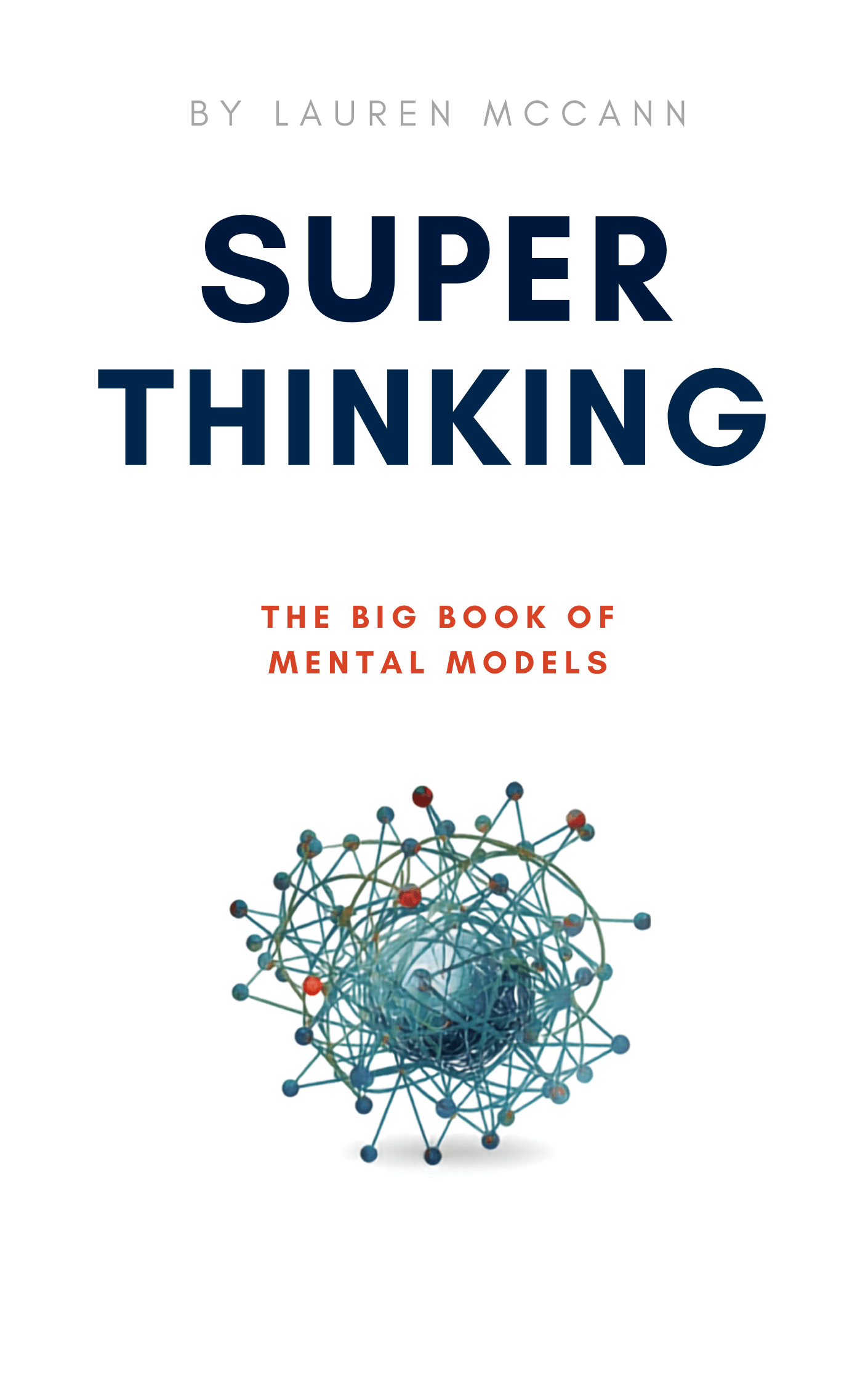
Prefer the print book? Buy on Amazon
As an Amazon Associate, Sumizeit earns from qualifying purchases.
Super Thinking Book Summary
This Super Thinking Book Summary covers the key ideas, lessons, and takeaways in about 20 minutes.
Short Description:
How mental models help you think clearly and decide better in work and life
Want a Free Weekly Read?
Get a free summary every week straight to your mailbox.
Preview the Super Thinking book summary
Below is a preview of Sumizeit’s comprehensive human-written summary of Super Thinking by Lauren McCann. The full summary is 15-20 minutes long and covers the book’s key ideas in text, audio, visual, and video formats. Unlock the full 20 Minute Summary
Gabriel Weinberg and Lauren McCann wrote Super Thinking for people who want to think better without earning five different degrees first. Their claim is plain. The people who consistently make good calls are not the ones who memorized more facts. They are the ones carrying a big toolbox of mental models, and they know which tool to grab when a problem shows up.
A mental model is a repeatable pattern that explains how some slice of the world behaves. Supply and demand is a model. Natural selection is a model. Compound interest is a model. Each one was born inside a single field, then turned out to explain far more than the field that produced it.
The authors care most about models that travel well. They call these super models. Critical mass started in nuclear physics, where it describes the point at which a chain reaction takes off. Now it explains why a dating app sits dead for eighteen months and then explodes, why a neighborhood suddenly becomes the place everyone wants to live, and why a rumor spreads through a company in one afternoon. Same pattern, different costumes.
Stack enough of these patterns in your head and something useful happens. You stop treating every new problem as a stranger. You recognize the shape of it. That recognition is what Weinberg and McCann mean by super thinking, and the book gathers more than three hundred models to build toward it.
The two authors bring different halves of the toolkit. Weinberg founded and runs DuckDuckGo, so the business chapters read like field notes from someone who has actually fought a giant for market share. McCann spent years as a statistician doing research in the pharmaceutical world, which is why the sections on data and evidence go deeper than the usual pop science treatment.
Start by Being Wrong Less Often
The book opens with a modest goal. Forget being brilliant. Just be wrong less often than you were last year. Most bad outcomes trace back to a flawed assumption nobody bothered to check.
The first culprit is conventional thinking. Doctors drained blood out of sick patients for roughly three thousand years because the practice fit an accepted theory about bodily fluids. The theory was wrong, the treatment was wrong, and the whole system stayed locked in place because nobody questioned the foundation. Conventional wisdom is comfortable precisely because you never have to defend it.
The antidote is reasoning from first principles. Strip a problem down to what you actually know is true, then rebuild from there. Copernicus did this with the solar system. He accepted one principle, that the cleanest mathematical description of planetary motion is probably the right one, and followed it straight past the church and the university consensus. Elon Musk gets cited for the same move with rocket costs. You ignore what everyone charges and calculate what the raw materials cost.
First principles have a catch. Your foundational assumptions can be wrong too, and they feel so obvious that…
Want the complete 20-minute summary?
- Full structured summary
- Video Summary
- Podcast Summary
- Audio summary
- Key takeaways
- Exercises
- Quiz
- Highlights and notes
- Ask the book with AI
Who should read Super Thinking?
Super Thinking is for anyone who wants to make better decisions without needing advanced degrees in multiple fields. Whether you're an entrepreneur, manager, professional, or someone navigating complex personal choices, this book teaches you the mental patterns that consistently successful people use to think more clearly.
Why does Super Thinking matter?
In a world of constant information overload and competing priorities, clear thinking has become a rare advantage. Super Thinking by Gabriel Weinberg and Lauren McCann shows that better decision-making isn't about being smarter—it's about recognizing recurring patterns across disciplines and applying the right mental model at the right time. The frameworks in this book help you avoid costly mistakes, spot opportunities others miss, and multiply the impact of your effort.
What are the key themes in Super Thinking?
- Mental models as transferable thinking tools
- First principles reasoning over conventional wisdom
- Understanding your blind spots and biases
- Second-order consequences and unintended outcomes
- Leverage and multiplying your effort
- Building teams that compound success
- Finding and protecting competitive advantage
- Decision-making frameworks matched to complexity
How can you apply ideas from Super Thinking?
- Use first principles reasoning to question one company or personal process you've accepted without examination
- Run a cheap test on your next major assumption before committing significant resources
- Build a decision tree for your next significant choice that involves uncertain outcomes
- Name your organization or personal north star and use it to filter requests for the next week
- Identify one high-leverage activity you could start and one low-leverage time drain you could eliminate
- Apply Hanlon's razor the next time someone frustrates you instead of assuming bad intent
- Map second-order consequences for a policy or decision you're considering implementing
- Interview five people outside your field and ask what counts as common knowledge in their world that surprises your industry
What common mistakes do readers make with Super Thinking?
- Treating every new problem as unique when the underlying pattern is one you've seen before in different contexts
- Making decisions based on availability bias—what you saw most recently feels most likely and most important
- Ignoring second and third-order consequences because first-order outcomes look good
- Hiring only high performers without building culture first, which breeds resentment that erodes team performance
- Confusing a better decision with a more satisfying one, then spending excessive time deliberating when quick action would have been superior
Sumizeit Exercises Apply what you've learned
Turn ideas from Super Thinking into action with a short guided reflection: identify the biggest takeaway, connect it to your life, and commit to one step you can take in the next 24 hours.
What is the expert analysis of Super Thinking?
Overview
Super Thinking, co-authored by Gabriel Weinberg and Lauren McCann, stands out as a comprehensive compendium of mental models designed to enhance decision-making across diverse domains. Weinberg, founder of DuckDuckGo, brings entrepreneurial and strategic insights from the trenches of business competition, while McCann, a statistician with a deep background in pharmaceutical research and operations, contributes rigorous analytical frameworks and a nuanced understanding of evidence and probability. Together, they craft a volume that transcends typical self-improvement fare by blending practical business acumen with scientific precision, making the book a significant contribution to literature on cognitive tools, critical thinking, and applied rationality.
Core Thesis
The central argument of Super Thinking is that superior decision-making is not a function of raw intelligence or accumulated facts, but rather the ability to wield a diverse and well-understood toolkit of mental models—repeatable, cross-disciplinary patterns that illuminate how the world works. By internalizing and applying these “super models,” individuals can recognize familiar problem structures in novel situations, reduce errors rooted in faulty assumptions, anticipate unintended consequences, and allocate effort where it yields multiplicative returns. The authors emphasize that thinking better is a learnable skill, cultivated by layering models from physics, biology, economics, psychology, and more, and by consciously naming and testing assumptions rather than relying on conventional wisdom or intuition alone.
Strengths
- Interdisciplinary Breadth: The book’s strength lies in its synthesis of over three hundred mental models drawn from a wide array of fields, providing readers with a versatile cognitive arsenal.
- Practical Orientation: Unlike abstract philosophical treatises, the models are grounded in real-world application, illustrated by Weinberg’s entrepreneurial experience and McCann’s statistical rigor.
- Balanced Perspective on Decision-Making: The authors skillfully navigate the tension between over-deliberation and impulsivity, advocating for tested assumptions, calibrated risk-taking, and awareness of cognitive biases.
- Clear Articulation of Cognitive Biases and Blind Spots: The book offers accessible explanations of biases such as availability heuristic and fundamental attribution error, paired with actionable strategies like Hanlon’s razor and framing awareness.
- Focus on Team Dynamics and Organizational Culture: It extends beyond individual cognition to address how to build and sustain high-functioning teams, emphasizing culture, motivation, and role alignment.
Critiques & Counterarguments
- Overwhelming Scope and Depth: While the breadth of models is impressive, the sheer volume risks diluting focus. Readers may struggle to internalize so many concepts without more targeted guidance on prioritization beyond the authors’ suggestion to start with a handful.
- Potential Oversimplification: Some models, like the boiling frog or tragedy of the commons, are presented in ways that may gloss over complex empirical debates or contextual nuances, potentially leading to misapplication.
- Limited Engagement with Competing Theories: The book largely promotes mental models as universally applicable tools but gives less attention to critiques from cognitive science that highlight the limits of model transferability or the role of emotion and social context in decision-making.
- Reliance on Anecdotal and Historical Examples: While illustrative, many examples (e.g., Blockbuster’s failure, Tesla’s battery strategy) are well-worn case studies that may not fully capture the evolving complexity of contemporary markets or organizational dynamics.
- Philosophical and Ethical Dimensions Underexplored: The treatment of value judgments and moral assumptions is pragmatic but somewhat cursory, leaving open questions about how mental models intersect with ethical reasoning in ambiguous or contested domains.
Who Should Read This
Super Thinking is ideal for readers who seek to enhance their cognitive toolkit for better decision-making without delving into overly technical or academic texts. It appeals to entrepreneurs, managers, policymakers, and professionals across disciplines who face complex, multifaceted problems and want practical frameworks to navigate uncertainty and bias. Additionally, intellectually curious readers interested in the intersection of business strategy, psychology, and philosophy will find the book’s interdisciplinary approach enriching. However, those looking for a deep dive into any single mental model or a rigorous philosophical treatise on rationality may find the book’s breadth challenging. Ultimately, it serves best as a reference and a starting point for cultivating a habit of reflective, model-based thinking in everyday life and work.
Frequently asked questions about the Super Thinking book summary
What is Super Thinking about?
Super Thinking by Gabriel Weinberg and Lauren McCann is about building a mental toolkit of recurring patterns—called mental models—that help you think more clearly and make better decisions. The core claim is that people who consistently make good decisions aren't smarter or more informed; they simply recognize familiar patterns across different contexts and know which thinking tool to apply when. The book presents over 300 models borrowed from physics, biology, economics, statistics, and strategy, showing how the same underlying patterns explain everything from startup failures to market shifts to personal relationships.
Who should read Super Thinking?
Super Thinking is for anyone who wants to improve their decision-making without needing advanced degrees in multiple fields. Entrepreneurs and business leaders benefit from real-world examples of how these models apply to startups and competition. Managers and team leaders learn how to build culture and multiply team effectiveness. Individual professionals, students, and anyone facing complex decisions will find frameworks for clearer thinking. The authors, one a founder of DuckDuckGo and the other a statistician from the pharmaceutical industry, bring complementary expertise that makes the book useful across business, science, and personal life.
What are the main takeaways from Super Thinking?
The main takeaways include: clear thinking is learnable and built from borrowed patterns rather than innate talent; most bad outcomes trace to unchecked assumptions rather than lack of intelligence; first principles reasoning cuts through conventional wisdom; your perspective is filled with blind spots you must actively fight; leverage multiplies effort while task-switching wastes it; teams compound when people are matched to roles that highlight their strengths; and the mental models that travel well across contexts—from physics to business to relationships—become your most reliable thinking tools. The practical approach is to pick five or six models that address your actual mistakes, use them until automatic, then add more over time.
How does Super Thinking help with decision-making?
Super Thinking provides a ladder of decision tools matched to how complicated your choice is. For simple decisions, a pro-and-con list works. For consequential decisions, cost-benefit analysis with assigned values gives honesty. For uncertain outcomes, decision trees with probabilities reveal expected value—the average result if you ran the decision a thousand times. The book also teaches you to catch hidden assumptions before they cost you money, trace second and third-order consequences others miss, and apply models like leverage and north star thinking to align effort with what actually matters.
What is a mental model and why do they matter?
A mental model is a repeatable pattern that explains how some part of the world behaves—supply and demand, natural selection, compound interest, or critical mass are all models that began in one field then proved useful everywhere. The most useful models travel well across contexts and are called super models in the book. Mental models matter because stacking enough of them in your head lets you recognize the shape of unfamiliar problems, matching the pattern to a thinking tool you've already refined. This recognition is what Weinberg and McCann call super thinking—the ability to stop treating every new problem as a stranger.
Does Super Thinking provide a method for finding competitive advantages?
Super Thinking borrows Peter Thiel's concept of secrets—information almost nobody has, or information everybody has and nobody acts on—as a source of competitive advantage. The book acknowledges there's no formula for finding secrets, but habits that help include: believing undiscovered secrets exist; taking seriously the questions serious people dismiss; accepting you'll look foolish sometimes because real secrets sound wrong initially; and spending time outside your field since what's revolutionary in one industry is common knowledge in another. The book uses Bob Voulgaris' basketball betting success and Tesla's revival of electric cars as examples of both types of secrets.
How does Super Thinking address the problem of biases?
Super Thinking identifies specific biases that distort thinking and offers practical counters to each. Availability bias makes recent events feel more likely than they are—the counter is recognizing your frame of reference. Fundamental attribution error causes you to blame character for others' behavior while excusing your own with circumstances—the counter is Hanlon's razor and the most respectful interpretation. Anchoring bias exploits the first number you hear—the counter is recognizing when you're being anchored. The book emphasizes that naming the bias out loud interrupts the automatic response and creates the mental space for better thinking.
What role do time and leverage play in Super Thinking?
Time and leverage are central to the book because clear thinking only matters if it leads to action. The book teaches you to pick a north star so time-consuming requests answer themselves, to prioritize deep work over task-switching since context-switching has hidden costs, and to identify leverage—activities that produce outsized results from ordinary effort. Examples of leverage include writing documentation once that saves fifty people an hour each, fixing a process instead of fixing outputs repeatedly, or hiring well instead of managing poorly. The core insight is that most people spend their days on activities with no multiplier, then wonder why effort doesn't compound.
About Sumizeit
Sumizeit is a profitable Scomy LLC company based in Miami, Florida. Our founders, Clemens Raemy and Weina Scott, are successful entrepreneurs with several exits. Sumizeit is a popular book summary app / micro learning app used by busy professionals and entrepreneurs with over 2,500 non-fiction book summaries and 10,000 podcast summaries in text, audio, visual, podcast, and video format. We also have stellar retention tools to make ideas stick - such as flashcards with spaced repetition, quizzes, streaks, highlighting and notes, daily challenges, riddles, mini-courses, meditation, and more. You won't only learn the idea, but also remember it. Over 90% of our users change their habits with Sumizeit.
Upgrade Now
Here's why readers love Sumizeit
Join thousands of learners getting smarter every day
"Great experience. Detailed summaries. Loved the gamification feature. Makes learning fun. Good customer service. I recommend Sumizeit to anyone. You'll learn a lot."
"I always felt busy but still wanting to keep up with the book discussion in my friend group. This was a great supplement to help me keep reading the books I find fun while keeping up with important books."
"I love this website. Instead of scrolling social media, I find myself learning a lot. I use it everyday. I recommend this app for anyone who is too busy and wants to get up to speed with their favorite books."
Super Thinking Book Summary PDF
Looking for a Super Thinking Book Summary PDF you can save and revisit offline? Our Super Thinking Book Summary PDF captures the book’s core ideas in a clean, printable format — the key frameworks, takeaways, and structure without the fluff. Download the Super Thinking Book Summary PDF when you want a reference you can annotate, share with your team, or review on the go. Get your Super Thinking Book Summary PDF from the download page below.
Download Super Thinking Book Summary PDFPeople also liked these summaries
Readers who explored Super Thinking often enjoyed these titles next.



Ready to read the whole thing?
- Full structured summary
- Video Summary
- Podcast Summary
- Audio summary
- Key takeaways
- Exercises
- Quiz
- Highlights and notes
- Ask the book with AI
Featured Book Titles
Popular Book Summaries at sumizeit, leading book summary app