


As an Amazon Associate, Sumizeit earns from qualifying purchases.
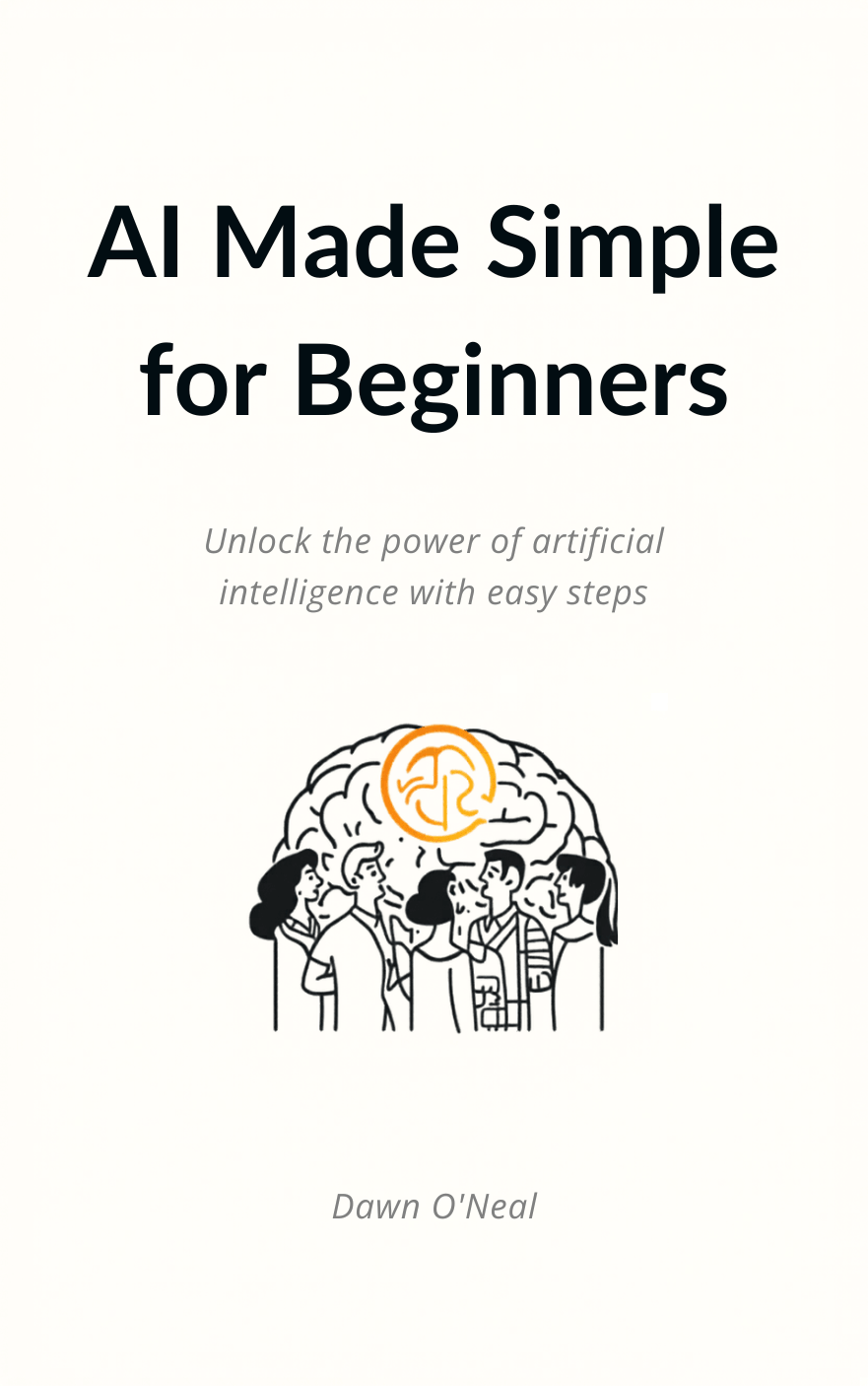
AI Made Simple for Beginners Book Summary
This AI Made Simple for Beginners Book Summary covers the key ideas, lessons, and takeaways in about 20 minutes.
At the same time, the responsible use of AI is just as important as its technical development. Issues like bias, privacy, and transparency must be addressed to ensure that these systems serve society fairly. The future of AI depends not only on innovation but also on thoughtful design, continuous learning, and collaboration between people and machines. By embracing both its potential and its limitations, individuals can confidently navigate and benefit from an increasingly AI-driven world.
Helps with these goals
Want the complete 20-minute summary?
- Full structured summary
- Video Summary
- Podcast Summary
- Audio summary
- Key takeaways
- Exercises
- Quiz
- Highlights and notes
- Ask the book with AI
What is in the AI Made Simple for Beginners book summary?
Below is a preview of Sumizeit’s expert-written summary of AI Made Simple for Beginners by Dawn O'Neal. The full summary covers the book’s key ideas in text, audio, and video.
AI Made Simple for Beginners by Dawn O'Neal opens by removing the mystery around artificial intelligence and presenting it as a practical, human-centered tool rather than something abstract or intimidating. The book frames AI as a set of technologies designed to mimic certain aspects of human thinking—such as recognizing patterns, making decisions, and learning from experience—without suggesting that machines possess awareness or emotions.
At its core, AI is portrayed as a way to assist humans, not replace them. The emphasis is on augmentation: helping people handle complex information, automate repetitive work, and make better decisions. Instead of competing with human intelligence, AI is positioned as a powerful partner that enhances what people can already do.
The author carefully builds a foundation for beginners by explaining that AI is not one single technology but a broad field made up of different methods and approaches. This distinction becomes essential later, as readers begin to understand how various techniques—like machine learning and deep learning—fit into the bigger picture.
From Early Ideas to Modern Systems
The book traces the development of AI from its philosophical beginnings to its modern applications. One of the earliest milestones discussed is the question posed by Alan Turing: whether machines could exhibit behavior that resembles human thinking. This idea laid the groundwork for decades of research and experimentation.
Initially, AI systems relied on strict rules. These early programs could only perform tasks they were explicitly told how to do. For example, a system designed to play chess would need detailed instructions for every possible move. While effective in limited contexts, these systems lacked flexibility.
The evolution toward machine learning marked a turning point. Instead of being told exactly what to do, machines began to learn from data. This shift allowed systems to improve over time, much like a student who becomes more skilled through practice. Later, deep learning emerged as a more advanced approach, using layered structures inspired by the human brain to process large amounts of information.
This progression—from rigid rules to adaptive learning—explains why modern AI can perform tasks like recognizing speech, identifying images, and recommending products. These capabilities are not the result of intelligence in a human sense, but of sophisticated pattern recognition and data processing.
The Building Blocks of Artificial Intelligence
To make AI understandable, the author breaks it down into its essential components. One of the most important concepts is the algorithm, which can be thought of as a set of instructions for solving a problem. Just as a recipe outlines steps for cooking a meal, an algorithm provides a structured approach for a machine to follow.
Another key concept is the neural network. These systems are designed to identify patterns by connecting many small processing units, somewhat similar to how neurons are connected in the human brain. While far simpler than biological systems, neural networks can handle tasks that require recognizing complex relationships, such as identifying objects in photos.
Machine learning is introduced as a method that allows systems to improve through experience.…
Want the complete 20-minute summary?
- Full structured summary
- Video Summary
- Podcast Summary
- Audio summary
- Key takeaways
- Exercises
- Quiz
- Highlights and notes
- Ask the book with AI
Who should read AI Made Simple for Beginners?
AI Made Simple for Beginners is for anyone curious about artificial intelligence but intimidated by technical jargon or complex theory. Whether you're a student, professional in a non-tech field, or simply someone wanting to understand the AI-powered tools in your daily life, this book meets you where you are. You don't need a background in computer science or mathematics to benefit from Dawn O'Neal's clear, accessible explanations.
Why does AI Made Simple for Beginners matter?
Artificial intelligence is no longer a distant concept—it's already woven into everyday life through smart devices, recommendation algorithms, healthcare applications, and autonomous systems. Understanding how AI actually works helps you make more informed decisions about the technology you use and prepare for a rapidly evolving job market. In an increasingly AI-driven world, this foundational knowledge is essential for anyone wanting to navigate, contribute to, and benefit from technological progress responsibly.
What are the key themes in AI Made Simple for Beginners?
- AI as a tool for human augmentation, not replacement
- The evolution from rule-based systems to adaptive machine learning
- Demystifying technical jargon through relatable analogies
- Ethical responsibility in AI design and deployment
- Privacy, bias, and fairness in data-driven systems
- Practical, hands-on learning over abstract theory
- AI's real-world applications across healthcare, transport, and daily life
- The importance of continuous learning in an AI-powered economy
What are the key lessons from the AI Made Simple for Beginners book summary?
AI is fundamentally about pattern recognition
Modern AI systems excel at identifying complex patterns in large datasets, which is the core skill underlying everything from image recognition to medical diagnosis. This capability makes AI powerful for processing information humans alone cannot handle at scale.
Understand the AI hierarchy to grasp how different technologies relate
Artificial intelligence is the broadest category, machine learning sits within it, and deep learning sits within machine learning. This layered structure helps explain why different tools are chosen for different tasks.
Machine learning succeeds through training on data, not explicit programming
Unlike early AI systems that required detailed instructions for every scenario, machine learning allows systems to improve through experience and examples. This flexibility is what enables adaptation and personalization.
Three types of machine learning solve different problem categories
Supervised learning learns from labeled examples, unsupervised learning finds patterns without guidance, and reinforcement learning improves through trial and error with rewards. Each approach is suited to specific real-world challenges.
Neural networks mimic biological inspiration without replicating human consciousness
Neural networks process information through layered connections inspired by the brain but operate through mathematical functions, not awareness. They excel at complex pattern recognition but lack actual understanding.
Algorithms provide the structured instructions that enable AI systems to function
Think of algorithms as step-by-step recipes that guide machines through problem-solving. They form the backbone of every AI system, whether simple or complex.
Bias in AI often originates from data, design choices, or human assumptions
AI systems reflect the data they're trained on and the decisions made during their creation. Addressing bias requires diverse perspectives, careful evaluation, and ongoing monitoring throughout an AI system's lifetime.
AI's greatest strength is processing vast data faster than humans can manage
By analyzing enormous datasets to identify patterns and trends, AI systems can support better decision-making in healthcare, business, finance, and other fields. This capability multiplies human analytical power.
Privacy protections and ethical practices must be built in from the start
Ethical AI is not an afterthought—it requires intentional design choices around transparency, fairness, and accountability from the beginning. Techniques like anonymization and decentralized learning help balance innovation with individual rights.
AI works best when paired with human judgment and oversight
Rather than replacing human decision-making, AI augments it by handling information processing, pattern recognition, and preliminary analysis. Humans remain essential for context, ethics, and final choices.
Natural language processing enables machines to understand human communication
This AI technique allows systems to interpret text and speech, making interactions more intuitive and accessible. It underlies digital assistants and chatbots that increasingly mediate human-computer interaction.
Computer vision systems recognize and analyze images through deep learning
By processing visual data through layered neural networks, these systems can identify objects, analyze medical images, and monitor environments—applications that seem intuitive to humans but require sophisticated mathematical processing.
Learning AI requires hands-on experimentation, not just theoretical study
Beginners gain deeper understanding by actually working with AI tools and building small projects rather than only reading about concepts. Active engagement accelerates learning and builds practical competency.
Recommendation systems learn from user behavior to personalize experiences
These AI-powered systems analyze patterns in how people interact with content or products, then suggest what they might enjoy next. Over time, they adapt to individual preferences, creating increasingly personalized digital experiences.
AI enhances human skills rather than negating the need for human expertise
In fields like healthcare, AI helps doctors analyze data and identify conditions faster, but clinical judgment and human compassion remain irreplaceable. The most effective applications combine machine capability with human wisdom.
The future job market will value skills that complement AI capabilities
As AI handles routine data processing and analysis, creativity, critical thinking, emotional intelligence, and adaptability become increasingly valuable. Continuous learning and skill development are essential for career longevity.
Emerging technologies like quantum computing could exponentially expand AI capabilities
Future advancements in processing power could unlock new possibilities for AI while also raising fresh ethical questions. Proactive planning now can help shape these developments responsibly.
Transparency in AI decision-making builds trust and accountability
When people can understand how an AI system arrived at a decision, they're better equipped to evaluate its fairness and spot errors. Explainable AI is crucial for responsible deployment in high-stakes domains.
AI is already embedded in everyday technology but often invisible to users
Smart home devices, voice assistants, recommendation algorithms, and safety features in cars all rely on AI. Recognizing this presence helps people appreciate both the technology's value and its implications.
Responsible AI development requires collaboration across technology, ethics, and domain expertise
Creating fair, effective AI systems demands input from engineers, ethicists, domain experts, and affected communities. No single perspective can address the full complexity of ensuring AI serves society well.
Want the complete 20-minute summary?
- Full structured summary
- Video Summary
- Podcast Summary
- Audio summary
- Key takeaways
- Exercises
- Quiz
- Highlights and notes
- Ask the book with AI
How can you apply ideas from AI Made Simple for Beginners?
- Start experimenting with beginner-friendly AI platforms and tools to build intuition through hands-on projects rather than abstract study alone
- Evaluate the AI systems you already use daily—smart devices, recommendation algorithms, voice assistants—to recognize how they enhance your life and what data they collect
- Develop complementary skills like critical thinking, creativity, and adaptability that become more valuable as AI handles routine analytical tasks
- Learn to ask critical questions about AI systems: Where does the training data come from? Who designed it? What biases might it contain? How are decisions explained?
- Participate in online communities and forums where you can ask questions, share projects, and learn from others navigating AI concepts for the first time
- Apply AI-powered tools in your current role or hobby—whether using recommendation systems for decision support, automation tools to reduce repetitive work, or data analysis to identify patterns
- Stay informed about AI developments and ethical discussions in your industry so you can anticipate how AI will transform your field and prepare accordingly
What common mistakes do readers make with AI Made Simple for Beginners?
- Assuming AI possesses human-like consciousness, emotions, or true understanding—it's fundamentally a pattern-recognition tool that mimics certain cognitive functions without awareness
- Treating ethics as a separate concern rather than integrating fairness, transparency, and accountability into AI systems from the design phase
- Overlooking bias in training data and assuming that AI is inherently objective—machines amplify the prejudices present in their data and design choices
- Fearing AI as a job destroyer rather than recognizing it as a tool that eliminates repetitive tasks and creates new roles requiring complementary human skills
- Ignoring privacy implications of data collection and assuming personal information used by AI systems is adequately protected without understanding the safeguards in place
Sumizeit Exercises Apply what you've learned
Turn ideas from AI Made Simple for Beginners into action with a short guided reflection: identify the biggest takeaway, connect it to your life, and commit to one step you can take in the next 24 hours.
What is the expert analysis of AI Made Simple for Beginners?
Overview
AI Made Simple for Beginners by Dawn O'Neal stands out as a comprehensive and accessible introduction to artificial intelligence, crafted specifically for novices. O'Neal, a skilled educator and writer, leverages her expertise to demystify a complex and rapidly evolving field, positioning AI not as an esoteric or intimidating domain but as a practical, human-centered toolkit. The book’s significance lies in its balanced approach: it bridges foundational theory, historical context, and contemporary applications while emphasizing ethical considerations and real-world impact. By doing so, it serves as both an educational primer and a thoughtful guide to the promises and challenges of AI.
Core Thesis
The central argument of the book is that artificial intelligence should be understood as a collection of tools designed to augment human capabilities rather than replace human intelligence. O'Neal stresses that AI systems function primarily through sophisticated pattern recognition and data processing, lacking consciousness or emotional awareness. The book advocates for a perspective that sees AI as a collaborative partner—one that assists in managing complexity, automates routine tasks, and enhances decision-making. Importantly, the author underscores that responsible AI development requires integrating ethical principles such as fairness, transparency, and privacy from the outset, ensuring technology serves society equitably.
Strengths
- Clarity and Accessibility: O'Neal excels at translating technical jargon into relatable analogies, making challenging concepts like algorithms, neural networks, and machine learning approachable for beginners without oversimplifying their complexity.
- Comprehensive Scope: The book covers a broad spectrum—from AI’s philosophical roots and historical evolution to practical applications across healthcare, transportation, and consumer technology—providing readers with a well-rounded understanding.
- Ethical Engagement: Unlike many introductory texts, this work foregrounds ethical challenges, including bias, privacy, and accountability, encouraging readers to consider the societal implications of AI alongside its technical aspects.
- Encouragement of Active Learning: The emphasis on hands-on experimentation and community involvement promotes deeper engagement, aligning with contemporary pedagogical best practices in technology education.
- Balanced Optimism: The author neither succumbs to techno-utopianism nor dystopian fearmongering, instead offering a nuanced view that highlights AI’s potential while acknowledging its limitations and risks.
Critiques & Counterarguments
- Depth vs. Breadth: While the book covers many topics, some advanced areas such as reinforcement learning and natural language processing are introduced with limited depth, which may leave readers seeking more rigorous technical understanding wanting.
- Evidence and Examples: The reliance on general examples and analogies, though helpful for beginners, sometimes glosses over the complexity and variability of AI systems in practice. More empirical case studies or data-driven insights could strengthen the argument.
- Oversimplification of AI’s Limitations: The portrayal of AI as primarily augmentative may understate scenarios where automation displaces jobs or where AI’s decision-making opacity leads to unintended harm, issues extensively debated in contemporary research.
- Competing Perspectives on AI Consciousness: The book dismisses machine awareness outright, but some philosophical and cognitive science schools argue for emergent forms of machine cognition or consciousness, suggesting a more open-ended discussion could enrich the narrative.
- Ethical Frameworks Diversity: The ethical discussion, though commendable, could benefit from integrating a wider range of perspectives, including non-Western ethical traditions and critiques from AI justice movements that highlight systemic inequalities reinforced by AI.
Who Should Read This
This book is ideal for readers who are new to artificial intelligence and seek a clear, well-structured introduction that balances technical fundamentals with ethical reflection. It is particularly suited for students, educators, professionals in non-technical fields, and curious lifelong learners who want to understand AI’s capabilities, applications, and societal implications without prior expertise. Additionally, those interested in the intersection of technology and ethics will find valuable insights that encourage critical engagement rather than passive consumption. Overall, O'Neal’s work serves as a thoughtful starting point for anyone aiming to navigate the AI-driven future with informed confidence and responsibility.
Frequently asked questions about the AI Made Simple for Beginners book summary
What is AI Made Simple for Beginners about?
AI Made Simple for Beginners by Dawn O'Neal is a foundational guide that demystifies artificial intelligence for readers without technical backgrounds. The book explains how AI actually works, traces its evolution from rule-based systems to modern machine learning, explores real-world applications from healthcare to transportation, and addresses critical ethical considerations like bias, privacy, and fairness. It emphasizes that AI is a tool designed to augment human capabilities rather than replace them.
Who should read AI Made Simple for Beginners?
This book is ideal for anyone curious about AI but intimidated by technical jargon—students, professionals outside tech fields, and general readers wanting to understand the AI-powered tools in their daily lives. You don't need a background in computer science or mathematics. The book meets you where you are with clear explanations, relatable analogies, and practical examples that make complex concepts approachable.
What are the main takeaways from AI Made Simple for Beginners?
The key takeaways include: AI is fundamentally about pattern recognition and data processing, not consciousness; it's best understood as a hierarchy where machine learning and deep learning sit within the broader AI category; AI works best when paired with human judgment rather than replacing it; ethical considerations around bias, privacy, and transparency must be built in from the start; and continuous learning is essential because AI is rapidly transforming every industry. Understanding these fundamentals empowers you to navigate an AI-driven world confidently.
How does machine learning differ from other types of AI?
Machine learning is a subset of artificial intelligence where systems improve through experience with data rather than following explicit instructions for every scenario. Unlike early rule-based AI that needed detailed programming for each task, machine learning systems learn patterns from examples and adapt over time. There are three main types: supervised learning (learning from labeled examples), unsupervised learning (finding patterns without guidance), and reinforcement learning (improving through trial and error with rewards).
What are some real-world applications of AI discussed in the book?
AI Made Simple for Beginners covers diverse applications including healthcare (diagnosis assistance and personalized medicine), transportation (autonomous vehicles and safety features), smart home devices that adjust lighting and temperature, digital assistants responding to voice commands, recommendation systems that suggest products and content, customer service chatbots, and consumer decision-making tools. These examples demonstrate that AI is already embedded in daily life, not a distant future technology.
Why does the book emphasize ethics in AI?
Dawn O'Neal stresses that responsible AI development is as important as technical innovation. Key ethical concerns include bias (which can arise from data, algorithms, or design choices), privacy risks in data-driven systems, and the need for transparency so AI decisions can be understood and evaluated. The book argues that ethical considerations should be integrated from the beginning of system design, not treated as an afterthought, to ensure AI serves society fairly.
Will AI eliminate jobs, and how should I prepare for the future?
Rather than fearing wholesale job loss, AI Made Simple for Beginners encourages focusing on how AI augments human work by automating repetitive tasks while creating new opportunities. The book emphasizes developing skills that complement AI—creativity, critical thinking, emotional intelligence, and adaptability—which become increasingly valuable as routine analytical work becomes automated. Continuous learning and willingness to evolve your skill set are presented as essential for thriving in an AI-driven economy.
About Sumizeit
Sumizeit is a profitable Scomy LLC company based in Miami, Florida. It has been helping readers learn from nonfiction books for 7 years with expert-written summaries in text, audio, podcast, and video.
Want the complete 20-minute summary?
- Full structured summary
- Video Summary
- Podcast Summary
- Audio summary
- Key takeaways
- Exercises
- Quiz
- Highlights and notes
- Ask the book with AI
Here's why readers love Sumizeit
Join thousands of learners getting smarter every day
"Great experience. Detailed summaries. Loved the gamification feature. Makes learning fun. Good customer service. I recommend Sumizeit to anyone. You'll learn a lot."
"I always felt busy but still wanting to keep up with the book discussion in my friend group. This was a great supplement to help me keep reading the books I find fun while keeping up with important books."
"I love this website. Instead of scrolling social media, I find myself learning a lot. I use it everyday. I recommend this app for anyone who is too busy and wants to get up to speed with their favorite books."
AI Made Simple for Beginners Book Summary PDF
Looking for a AI Made Simple for Beginners Book Summary PDF you can save and revisit offline? Our AI Made Simple for Beginners Book Summary PDF captures the book’s core ideas in a clean, printable format — the key frameworks, takeaways, and structure without the fluff. Download the AI Made Simple for Beginners Book Summary PDF when you want a reference you can annotate, share with your team, or review on the go. Get your AI Made Simple for Beginners Book Summary PDF from the download page below.
Download AI Made Simple for Beginners Book Summary PDFPeople also liked these summaries
Readers who explored AI Made Simple for Beginners often enjoyed these titles next.




Want the complete 20-minute summary?
- Full structured summary
- Video Summary
- Podcast Summary
- Audio summary
- Key takeaways
- Exercises
- Quiz
- Highlights and notes
- Ask the book with AI
Featured Book Titles
Popular Book Summaries at sumizeit, leading book summary app