


As an Amazon Associate, Sumizeit earns from qualifying purchases.
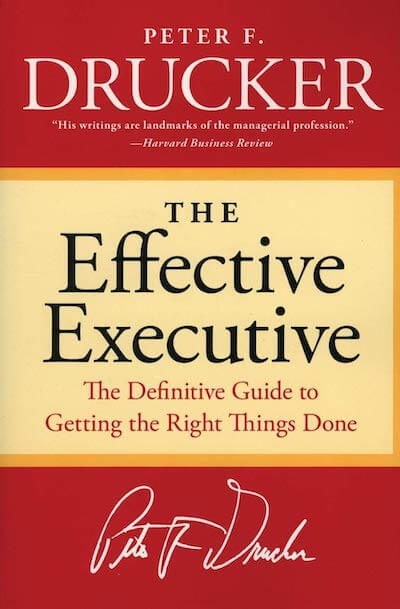
The Effective Executive Book Summary
This The Effective Executive Book Summary covers the key ideas, lessons, and takeaways in about 20 minutes.
Helps with these goals
Want the complete 20-minute summary?
- Full structured summary
- Video Summary
- Podcast Summary
- Audio summary
- Key takeaways
- Exercises
- Quiz
- Highlights and notes
- Ask the book with AI
What is in the The Effective Executive book summary?
Below is a preview of Sumizeit’s expert-written summary of The Effective Executive by Peter F. Drucker. The full summary covers the book’s key ideas in text, audio, and video.
Many of us work for big corporations today, where it’s easy to get lost in a pool of nameless co-workers.
So, how do you make yourself stand out?
How do you find success as a small fish in a big pond?
In “The Effective Executive” Peter F. Drucker will help you to navigate your way to success within a big company and become an effective executive.
He will explain how the effective executive works to support his team, encourages the development of skills among employees, and how that benefits the entire team.
“Efficiency is doing the thing right. Effectiveness is doing the right thing.”- Peter F. Drucker
Get ready to become the most effective executive with Drucker’s advice.
The Road to Being an Effective Executive
First things first, effective executives are made not born. Though it might look like they’re naturally good at what they do, it took a lot of work to get there. So, you can do it too!
If you have a management position, you must start to think of it from a different perspective. These positions are not about transforming others, it’s really about transforming yourself, which will then result in you leading by example. Your employees will see what you are doing and mirror it to gain respect and improve their skills.
An effective executive sees the overall picture of what needs to happen in order to be more productive and successful. He also encourages accountability amongst his employees and makes sure that everyone feels a responsibility to the company and to each other.
For example, if an employee makes a mistake, they will own up to it and feel the responsibility to fix it for the sake of the team.
President Harry Truman is a superb effective executive example. When he began his term in 1945, though he wanted to put attention to the issues of the US, he understood that issues oversea needed attention from him more. Truman knew that he had the responsibility to interfere. By, paying attention to the chaos that was happening in Europe, he became known for his effective decisions regarding foreign policy.
But, these decisions only result in outcomes like Truman’s if you are consciously making an effort to improve. You must want to do good for your company and be a role model for your employees.
Performance reviews are a good tool to help you decipher where your downfalls are. For example, you may have a decision bias, which is the habit of taking the loudest and most-discussed option within a decision, rather than looking at the facts and delving deep into the issue.
When you discover your weaknesses during performance reviews, it will help you to delegate jobs to different employees. If you know you are not good with something, it’s best to hand it over to someone who is.
Plotting Your Path
Our world is full of organizations. And, learning how to navigate them is the only way we can become successful.
Want the complete 20-minute summary?
- Full structured summary
- Video Summary
- Podcast Summary
- Audio summary
- Key takeaways
- Exercises
- Quiz
- Highlights and notes
- Ask the book with AI
Who should read The Effective Executive?
The Effective Executive is essential reading for managers, team leaders, and knowledge workers who want to maximize their impact within organizations. Whether you're in an entry-level position or leading a department, this book shows how to navigate corporate structures and become a decision-maker who delivers results. It's particularly valuable for anyone feeling lost in a large organization and seeking a clear path to professional success.
Why does The Effective Executive matter?
In today's complex organizational landscape, the ability to make sound decisions, manage time wisely, and develop talent is more critical than ever. Peter F. Drucker's timeless principles help executives cut through the noise of corporate life and focus on what truly drives performance. His framework for effectiveness has shaped modern management thinking and remains highly relevant for leaders who want to stand out and create meaningful impact in their roles.
What are the key themes in The Effective Executive?
- Effectiveness versus efficiency in decision-making
- Self-transformation as the foundation of leadership
- The role of knowledge workers in modern organizations
- Time management as a non-negotiable resource
- Building strong collaborative teams
- Accountability and responsibility culture
- Continuous self-development and feedback
- Strength-based delegation
What are the key lessons from the The Effective Executive book summary?
Effectiveness Is Doing the Right Thing
Drucker distinguishes between efficiency (doing things right) and effectiveness (doing the right things). True executive success comes from identifying and acting on what matters most, not just working harder.
Executives Are Made, Not Born
Effective leadership is a learnable skill developed through conscious effort and practice, not an innate talent. Anyone willing to work at it can become an effective executive.
Transform Yourself to Lead by Example
The foundation of executive effectiveness is personal transformation, not trying to change others. Employees mirror what they see, so modeling the behavior you expect is more powerful than directives alone.
Know Your Weaknesses to Delegate Effectively
Performance reviews and self-reflection reveal your blind spots and decision biases. Use this awareness to delegate tasks to those better equipped to handle them, freeing you to focus on your strengths.
Understand Boundary Conditions Before Deciding
Effective executives identify the constraints and conditions that frame a decision before moving forward. Recognizing when boundary conditions change is crucial to adapting your approach.
Ask the Right Questions Before Deciding
Before committing to a major decision, ask whether inaction would be worse and whether the benefits outweigh the costs. Not every issue requires a decision in the moment.
Implementation Matters as Much as Decision
A decision without a plan and enforcement is just a policy on paper. Effective executives drive implementation, assign responsibility, and ensure decisions translate into action.
Seek Diverse Opinions to Reduce Bias
Surrounding yourself with people who think differently and actively soliciting their input helps you avoid decision bias and make more balanced choices.
Time Is Your Only Non-Renewable Resource
Unlike budget or staffing, you cannot create more time. Ruthlessly eliminate time-wasting activities and meetings to focus on decisions and work that truly matter.
Keep Meetings Focused and Selective
Only invite people who need to be present and keep discussions focused and brief. Productive meetings respect everyone's time rather than filling a calendar slot.
Knowledge Workers Are Executives
Anyone who makes decisions affecting the organization—marketers, scientists, teachers, specialists—is effectively an executive, even without the title. Understanding this empowers professionals to act with greater responsibility.
Build Accountability Across Teams
Effective executives foster a culture where everyone feels responsibility to the team. When employees own their mistakes and work toward shared goals, the entire organization performs better.
Collaborate, Don't Dominate, as a Leader
Leaders who think 'we' instead of 'I' and focus on making the team function create trust and enable better execution. Sharing credit and accepting responsibility builds stronger organizations.
Develop Your Employees Continuously
Great employees are made through intentional development, not hired fully formed. Companies that invest in employee growth outperform those that don't, and employees thrive with this support.
Match Hiring to Results, Not Just Credentials
Focus on whether a candidate can deliver the results you need rather than relying on degrees or certifications. Look for flexible skills and cultural fit alongside capability.
Invest in Your Relationship with Your Boss
Strong upward relationships mean your boss doesn't need to micromanage you, saving time and creating a more collaborative environment that benefits the entire team.
Focus on Your Core Contribution
As an executive, identify what only you can do well and concentrate your efforts there. Don't spread yourself thin trying to do everything, especially things others do better.
Review Past Decisions to Improve Future Ones
Looking back at what worked and what didn't in previous decisions informs better judgment going forward. Feedback and reflection are essential tools for executive growth.
Clear Job Descriptions Attract the Right Talent
A well-written job description attracts candidates with the right mindset and skills. Clarity about needs prevents hiring mismatches and sets new employees up for success.
Communication Between Teams Drives Organization Success
Cross-team communication ensures all parts of the organization work toward shared goals and no gaps exist. Effective executives facilitate and guide this essential coordination.
Want the complete 20-minute summary?
- Full structured summary
- Video Summary
- Podcast Summary
- Audio summary
- Key takeaways
- Exercises
- Quiz
- Highlights and notes
- Ask the book with AI
How can you apply ideas from The Effective Executive?
- Keep a time diary for one week to identify where hours disappear and eliminate non-productive activities like unnecessary meetings or executive dinners
- Conduct a personal performance review to identify your decision biases and weaknesses, then delegate those responsibilities to team members with stronger capabilities
- Before making a major decision, document the boundary conditions and revisit them if circumstances change to ensure your decision remains sound
- Create a list of your top three strengths and redesign your role to spend 80% of your time on work that leverages only those strengths
- Institute a practice of soliciting diverse opinions from team members with different perspectives before finalizing important decisions
- Rewrite job descriptions to focus on measurable results and required skillsets rather than credentials, then hire based on demonstrated ability to deliver those results
- Schedule 30-minute one-on-ones with direct reports to understand their strengths and create personalized development plans aligned with organizational needs
- Audit your meeting calendar and cut any meeting where attendees don't directly contribute to the decision or outcome
What common mistakes do readers make with The Effective Executive?
- Confusing activity with effectiveness—staying busy does not mean you are accomplishing what matters most for your organization
- Trying to fix weaknesses instead of delegating to those with strengths in those areas, wasting time and energy on personal development that doesn't serve the role
- Making decisions without clearly understanding the boundary conditions or asking whether the decision is even necessary in the moment
- Failing to follow through on implementation, leaving policies and decisions as paper exercises without real-world impact or accountability
Sumizeit Exercises Apply what you've learned
Turn ideas from The Effective Executive into action with a short guided reflection: identify the biggest takeaway, connect it to your life, and commit to one step you can take in the next 24 hours.
What is the expert analysis of The Effective Executive?
Overview
Peter F. Drucker’s The Effective Executive stands as a seminal work in management literature, authored by one of the most influential thinkers in the field of modern management. Drucker, often hailed as the “founder of modern management,” brings decades of experience as a consultant, educator, and author to bear on the challenge of executive effectiveness. This book distills his insights into practical guidance for leaders navigating the complexities of organizational life, making it a cornerstone text for anyone seeking to understand what it truly means to be an effective executive in a corporate or institutional setting.
Core Thesis
The central argument of The Effective Executive is that effectiveness in executive roles is not an innate talent but a set of learnable practices and disciplined habits. Drucker emphasizes that effectiveness hinges on doing the right things—prioritizing tasks that contribute meaningfully to organizational goals—rather than merely doing things efficiently. He argues that executives must cultivate self-awareness, focus on strengths (both their own and those of their teams), make sound decisions, manage time rigorously, and foster collaborative environments. The executive’s role is fundamentally about decision-making and responsibility, with a strong emphasis on accountability and continuous self-improvement.
Strengths
- Timeless Practicality: Drucker’s insights transcend eras, offering actionable advice that remains relevant in today’s fast-evolving corporate landscape.
- Focus on Self-Management: The book’s insistence that executives must first transform themselves before leading others is a profound psychological and philosophical insight that elevates leadership beyond mere technique.
- Clear Distinction Between Effectiveness and Efficiency: This conceptual clarity helps readers reorient their priorities toward impact rather than busyness.
- Use of Historical Examples: The incorporation of figures like Presidents Truman and Roosevelt grounds abstract principles in concrete, high-stakes decision-making contexts.
- Emphasis on Teamwork and Communication: Drucker’s recognition of the executive’s role in fostering collaboration anticipates contemporary organizational theories emphasizing collective intelligence and shared leadership.
Critiques & Counterarguments
- Oversimplification of Complex Dynamics: While Drucker’s principles are elegant, the book sometimes glosses over the nuanced realities of organizational politics, power struggles, and cultural factors that can impede effectiveness.
- Limited Empirical Evidence: The book relies heavily on anecdotal and historical examples rather than rigorous empirical research, which may limit its applicability across diverse industries and modern organizational structures.
- Potential Underestimation of Emotional Intelligence: Contemporary leadership theories emphasize emotional intelligence and empathy more explicitly than Drucker, whose framework is more task- and decision-oriented.
- Changing Nature of Work: Drucker’s distinction between knowledge workers and manual workers, while insightful for its time, may feel dated given the rise of hybrid roles and the digital economy where boundaries blur.
- Competing Schools of Thought: Approaches such as transformational leadership, servant leadership, and agile management offer alternative paradigms that emphasize adaptability, empowerment, and innovation over the structured decision-making focus Drucker advocates.
Who Should Read This
The Effective Executive is essential reading for mid- to senior-level managers, aspiring leaders, and professionals who seek a foundational understanding of effective leadership and management practices. It is particularly valuable for those operating within large organizations who must navigate complexity, delegate effectively, and balance strategic decision-making with operational execution. Additionally, scholars and students of management theory will find Drucker’s work a critical historical and conceptual touchstone that informs much of contemporary leadership thought.
Frequently asked questions about the The Effective Executive book summary
What is The Effective Executive about?
The Effective Executive by Peter F. Drucker is a foundational management book that teaches executives how to make sound decisions, manage time wisely, develop talent, and lead by example within organizations. Drucker emphasizes that effectiveness—doing the right things—matters more than efficiency, and that executives are made, not born, through deliberate practice and self-awareness.
Who should read The Effective Executive?
The Effective Executive is essential for managers, team leaders, knowledge workers, and anyone who makes decisions affecting their organization. It's valuable for those seeking to advance in corporate environments, improve their leadership impact, or understand how to navigate and succeed within large organizations.
What are the main takeaways from The Effective Executive?
The core takeaways include: effectiveness requires doing the right things, not just working efficiently; executives must transform themselves before leading others; time is your only non-renewable resource; delegate based on others' strengths while focusing on your own; make decisions by understanding boundary conditions and seeking diverse perspectives; and build collaborative teams where accountability is shared and continuous development is valued.
How does Drucker define the difference between efficiency and effectiveness?
Drucker's famous distinction is that efficiency means doing things right—executing tasks correctly—while effectiveness means doing the right things—choosing and prioritizing what actually matters for organizational success. An executive can be highly efficient but ineffective if focusing on the wrong priorities.
What does Drucker say about decision-making for executives?
Drucker emphasizes that effective executives must first determine whether a decision is necessary by asking what happens if they do nothing, and whether the benefits outweigh the costs. They must understand the boundary conditions framing the decision, seek diverse opinions to avoid bias, and crucially, ensure implementation rather than leaving decisions as policies on paper.
Why does Drucker emphasize time management for executives?
Drucker argues that time is the only resource an executive cannot create more of—unlike budget or staff. He advocates ruthlessly eliminating time-wasting activities such as unnecessary meetings and obligatory dinners, and keeping actual meetings short, focused, and selective about attendance to maximize productivity.
What is Drucker's advice on delegation and strengths?
Drucker recommends delegating only to those who are better at a task than you and have the time and tools to do it efficiently. Executives should identify their core strengths, focus their efforts there, and delegate their weaknesses to others better suited to those tasks. This requires honest self-assessment through feedback and performance reviews.
How should organizations approach hiring according to The Effective Executive?
Drucker advises writing clear job descriptions that attract the right people and focusing on a candidate's ability to deliver results rather than their credentials or degrees. He recommends seeking people with flexible skill sets who can fill multiple roles and then investing in their continuous development once hired.
About Sumizeit
Sumizeit is a profitable Scomy LLC company based in Miami, Florida. It has been helping readers learn from nonfiction books for 7 years with expert-written summaries in text, audio, podcast, and video.
Want the complete 20-minute summary?
- Full structured summary
- Video Summary
- Podcast Summary
- Audio summary
- Key takeaways
- Exercises
- Quiz
- Highlights and notes
- Ask the book with AI
Here's why readers love Sumizeit
Join thousands of learners getting smarter every day
"Great experience. Detailed summaries. Loved the gamification feature. Makes learning fun. Good customer service. I recommend Sumizeit to anyone. You'll learn a lot."
"I always felt busy but still wanting to keep up with the book discussion in my friend group. This was a great supplement to help me keep reading the books I find fun while keeping up with important books."
"I love this website. Instead of scrolling social media, I find myself learning a lot. I use it everyday. I recommend this app for anyone who is too busy and wants to get up to speed with their favorite books."
The Effective Executive Book Summary PDF
Looking for a The Effective Executive Book Summary PDF you can save and revisit offline? Our The Effective Executive Book Summary PDF captures the book’s core ideas in a clean, printable format — the key frameworks, takeaways, and structure without the fluff. Download the The Effective Executive Book Summary PDF when you want a reference you can annotate, share with your team, or review on the go. Get your The Effective Executive Book Summary PDF from the download page below.
Download The Effective Executive Book Summary PDFPeople also liked these summaries
Readers who explored The Effective Executive often enjoyed these titles next.



Want the complete 20-minute summary?
- Full structured summary
- Video Summary
- Podcast Summary
- Audio summary
- Key takeaways
- Exercises
- Quiz
- Highlights and notes
- Ask the book with AI
Featured Book Titles
Popular Book Summaries at sumizeit, leading book summary app