


As an Amazon Associate, Sumizeit earns from qualifying purchases.
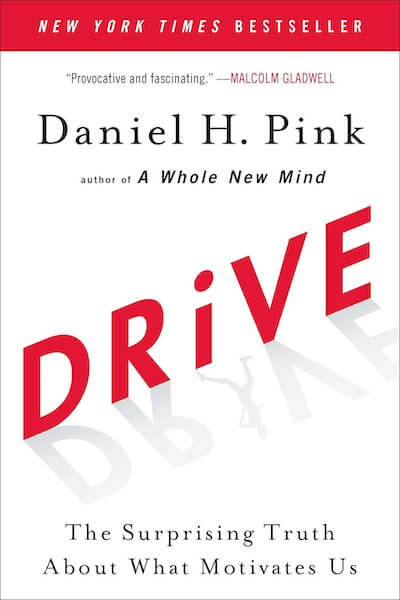
Drive Book Summary
This Drive Book Summary covers the key ideas, lessons, and takeaways in about 20 minutes.
Helps with these goals
Want the complete 20-minute summary?
- Full structured summary
- Video Summary
- Podcast Summary
- Audio summary
- Key takeaways
- Exercises
- Quiz
- Highlights and notes
- Ask the book with AI
What is in the Drive book summary?
Below is a preview of Sumizeit’s expert-written summary of Drive by Daniel Pink. The full summary covers the book’s key ideas in text, audio, and video.
Drive: The Surprising Truth About What Motivates Us (2011) explores the topic of human motivation. Daniel argues that most people are driven by extrinsic motivation—decisions based on external rewards and punishments. The author proposes that people should replace extrinsic motivation with intrinsic motivation. Daniel shows that intrinsic motivation has to do with the innate pleasure humans derive from completing or mastering an activity. People and organizations should adopt intrinsic motivation as a challenge to improve their abilities and not simply for material reward. Daniel proposes that restructuring work and aligning jobs with intrinsic motivation, organizations will be more successful and employees will lead happier, more rewarding, and fulfilling lives.
Chapter 1: The Rise and Fall of Motivation 2.0
Daniel starts by showing that civilization was driven by our survival needs: eating and surviving. He refers to them as “Motivation 1.0”.
The industrial revolution brought about Motivation 2.0. We have gone beyond basic needs. The world now works using a ‘carrots and stick’ system of rewards and punishments.
Extrinsic Motivation works on a rewards and punishment mentality. Intrinsic Motivation produces results from an internal desire to accomplish something even if there is no material reward.
Chapter 2: 7 Reasons Why Carrots and Sticks Don’t Work
Psychology shows that carrots and sticks system does not work. Extrinsic motivation “crowds out” intrinsic motivation and the joy of accomplishing a task; it also diminishes performance and discourages creativity in the long-term.
Extrinsic motivation encourages cheating.
It motivates people to engage in immoral behavior in order to get ahead in life. What happened at ENRON is a good example of extrinsically motivated behavior.
Extrinsic behavior is addictive and produces negative effects once it’s stopped. People tend to get depressed when there is no reward and start to feel like work is a punishment
Extrinsic motivation encourages short-term thinking. This affects long-term growth.
Chapter 3: Type I and Type X
There are two types of people: Type X (Extrinsic) who are driven by a desire for fame, status, money, etc. Such people are materialistic and always seek to gain more. They are also highly successful.
Type I’s (Intrinsic) are motivated from within. They seek to accomplish something meaningful and take pleasure in the task and not the reward.
Type I have higher self-esteem and establish better relationships. They are motivated by purpose, autonomy and a desire to master their lives.
Chapter 4: Autonomy
Autonomy or the desire to be in control of one’s life is one of the three basic human needs. However, it should not be confused with independence. One can be autonomous but not independent.
Most people thrive when they are presented with a problem and asked to provide solutions. There is greater creativity when one people work in an environment of autonomy
In the workplace, people desire to have autonomy in; time, tasks, teams, and techniques. Autonomy encourages Type I personality to develop and flourish.
Chapter 5: Mastery
The path to achieve Mastery is to attain what is referred to as “flow: when…
Want the complete 20-minute summary?
- Full structured summary
- Video Summary
- Podcast Summary
- Audio summary
- Key takeaways
- Exercises
- Quiz
- Highlights and notes
- Ask the book with AI
Who should read Drive?
Drive is essential for managers, entrepreneurs, and anyone seeking to understand what truly motivates human behavior beyond paychecks and punishments. If you're struggling with employee engagement, personal productivity, or want to build a more fulfilling career, this book provides a science-backed framework for rethinking motivation.
Why does Drive matter?
In an economy increasingly focused on knowledge work and creativity, outdated carrot-and-stick motivation models actively undermine performance and well-being. Daniel Pink's research reveals that understanding intrinsic motivation—autonomy, mastery, and purpose—is essential for organizations and individuals to thrive in the modern world.
What are the key themes in Drive?
- Intrinsic vs. extrinsic motivation
- The limitations of rewards and punishments
- Autonomy as a fundamental human need
- Mastery through deliberate practice and flow
- Purpose-driven work and meaning
What are the key lessons from the Drive book summary?
Motivation 2.0 is obsolete
The industrial-era system of carrots and sticks worked for routine tasks but fails in creative, knowledge-based work that defines modern careers.
Extrinsic rewards crowd out intrinsic joy
Paying people purely for outcomes can actually diminish their love of the work itself and undermine long-term performance and creativity.
Type X vs. Type I personalities
While extrinsically motivated Type X individuals chase status and wealth, intrinsically motivated Type I people derive satisfaction from meaningful accomplishment and build stronger relationships.
Autonomy drives engagement
People thrive when given control over their time, tasks, team composition, and methods—autonomy fuels creativity and commitment far more than external control.
Mastery requires embracing the long view
True mastery is an asymptote—an endless pursuit—requiring a mindset shift that views improvement as boundless rather than a destination to reach quickly.
Flow state accelerates learning
Optimal learning and performance occur when challenges match skill levels—not too easy, not too hard—creating the focused state researchers call flow.
Purpose multiplies productivity
Employees motivated by contributing to something larger than themselves deliver superior work quality and engagement than those chasing bonuses alone.
Money matters, but differently
Compensation must meet a baseline to eliminate financial stress, but beyond that threshold, additional money has minimal motivational impact on performance.
Extrinsic systems encourage unethical behavior
When people are conditioned to pursue external rewards at all costs, they're more likely to cut corners, cheat, or engage in immoral conduct—as seen in corporate scandals.
Short-term thinking undermines growth
Reward-and-punishment systems incentivize quick wins over sustainable improvement, damaging long-term organizational and individual development.
Autonomy differs from independence
True autonomy means having control and choice within a structure or community; you can be autonomous while collaborating or part of a team.
Intrinsic motivation builds resilience
People driven by purpose and mastery maintain motivation through setbacks, while those dependent on external rewards collapse when rewards disappear.
Language shapes motivation
Words of encouragement and recognition trigger intrinsic motivation more effectively than financial incentives in building sustainable engagement.
Purpose converts profit pressure
Organizations that prioritize employee purpose and meaningful contribution naturally generate better products and profits than those chasing financial metrics directly.
Mastery requires deliberate effort
Achieving mastery is painful and demands consistent practice; shortcuts undermine the deep competence and satisfaction that true mastery delivers.
Extrinsic motivation is addictive
Once people become accustomed to external rewards, removing them creates a depressive crash—the very opposite of sustainable motivation.
Autonomy fosters Type I development
Creating environments where people control their work conditions naturally cultivates intrinsic motivation and the self-esteem characteristic of Type I personalities.
Mindset shapes mastery outcomes
Viewing abilities as fixed versus improvable dramatically affects whether people pursue mastery or settle for performance—psychology influences achievement more than talent.
Want the complete 20-minute summary?
- Full structured summary
- Video Summary
- Podcast Summary
- Audio summary
- Key takeaways
- Exercises
- Quiz
- Highlights and notes
- Ask the book with AI
How can you apply ideas from Drive?
- Audit your compensation and incentive systems to ensure base pay eliminates financial anxiety without over-relying on performance bonuses
- Grant employees control over when, where, and how they work—implement flexible scheduling and collaborative goal-setting instead of micromanagement
- Frame company mission and individual roles around meaningful contribution to causes larger than profit maximization
- Create learning-focused environments with stretch assignments calibrated to develop mastery through flow-state challenge levels
- Replace generic praise with specific, substantive recognition that acknowledges progress toward mastery and alignment with purpose
What common mistakes do readers make with Drive?
- Assuming higher pay automatically boosts motivation—compensation must meet baseline needs first, but increases beyond that point show diminishing returns
- Treating all work as routine and applying carrot-and-stick systems to creative, knowledge-based roles where they backfire
- Confusing autonomy with chaos—providing autonomy still requires clear goals, feedback, and organizational structure
- Rushing mastery development—many abandon pursuits because they expect faster progress, not understanding mastery as a lifelong asymptotic journey
Sumizeit Exercises Apply what you've learned
Turn ideas from Drive into action with a short guided reflection: identify the biggest takeaway, connect it to your life, and commit to one step you can take in the next 24 hours.
What is the expert analysis of Drive?
Overview
Drive: The Surprising Truth About What Motivates Us is a seminal work by Daniel H. Pink, a distinguished author and thinker in the fields of human behavior and business. Published in 2011, the book challenges traditional paradigms of motivation rooted in extrinsic rewards and punishments, proposing instead a nuanced framework centered on intrinsic motivation. Pink’s background—as a former speechwriter for Vice President Al Gore and a recognized management thinker—lends credibility and depth to his exploration of what truly drives human performance and satisfaction in contemporary society.
Core Thesis
Pink’s central argument is that the dominant “carrots and sticks” model of motivation, which he terms Motivation 2.0, is outdated and counterproductive in the modern world. Instead, he advocates for a shift toward Motivation 3.0, grounded in intrinsic factors: autonomy, mastery, and purpose. According to Pink, intrinsic motivation—stemming from internal satisfaction and engagement with meaningful tasks—yields superior creativity, performance, and well-being compared to extrinsic motivators such as monetary rewards or punishments. This reorientation has profound implications for organizational management, education, and personal fulfillment.
Strengths
- Interdisciplinary Synthesis: Pink adeptly weaves insights from psychology, economics, and management science, making complex research accessible and compelling for a broad audience.
- Clear Conceptual Framework: The triad of autonomy, mastery, and purpose provides a memorable and actionable model that resonates with both individuals and organizations seeking sustainable motivation strategies.
- Practical Application: The book offers concrete guidance on restructuring workplaces and educational environments to foster intrinsic motivation, moving beyond abstract theory.
- Engaging Narrative: Pink’s use of real-world examples, such as the Enron scandal to illustrate the pitfalls of extrinsic incentives, enriches the argument and grounds it in observable phenomena.
Critiques & Counterarguments
- Oversimplification of Motivation: While the intrinsic-extrinsic dichotomy is compelling, human motivation is often more complex and context-dependent than Pink acknowledges. Some individuals may respond positively to extrinsic rewards without detrimental effects, especially in routine or less creative tasks.
- Limited Empirical Rigor: Although Pink references psychological studies, critics argue that the book sometimes relies on selective evidence and anecdotal examples rather than comprehensive meta-analyses or longitudinal research.
- Neglect of Cultural and Socioeconomic Factors: The framework may not fully account for cultural differences in motivational drivers or the realities faced by individuals in economically constrained environments where extrinsic rewards remain critical.
- Competing Research: Behavioral economists and psychologists have documented scenarios where extrinsic incentives effectively enhance performance, especially in tasks requiring straightforward compliance or quantity-based output, challenging the universality of Pink’s claims.
- Real-World Organizational Constraints: Implementing autonomy and fostering mastery can be difficult in hierarchical or highly regulated industries, raising questions about the scalability of Pink’s prescriptions across all sectors.
Who Should Read This
Drive is essential reading for managers, educators, policymakers, and anyone interested in understanding the evolving dynamics of human motivation in the 21st century. Those seeking to cultivate more engaged, innovative, and satisfied teams will find Pink’s insights invaluable. Additionally, individuals pursuing personal growth or leadership development will benefit from the book’s emphasis on aligning work with intrinsic values. However, readers should approach the text as a thought-provoking framework rather than a definitive manual, supplementing it with additional research and contextual considerations.
Frequently asked questions about the Drive book summary
What is Drive about?
Drive by Daniel Pink explores the science of human motivation, arguing that traditional extrinsic reward systems (money, punishment) fail in modern work environments. The book proposes that intrinsic motivation—driven by autonomy, mastery, and purpose—is what truly drives performance, satisfaction, and well-being in knowledge-based careers.
Who should read Drive?
Drive is essential for managers, business leaders, HR professionals, and anyone interested in peak performance. It's also valuable for individuals seeking career fulfillment, parents wanting to motivate their children effectively, and anyone frustrated with ineffective incentive systems in their organization.
What are the main takeaways from Drive?
The core takeaways are: (1) Abandon Motivation 2.0's carrot-and-stick model for knowledge work, (2) Focus on three intrinsic drivers—autonomy (control), mastery (improvement), and purpose (meaning), (3) Ensure baseline compensation to remove financial stress, then redirect effort toward enabling meaningful work, and (4) Recognize that intrinsic motivation produces higher performance, creativity, and well-being than external rewards.
What is the difference between Type X and Type I personalities?
Type X personalities are extrinsically motivated, seeking wealth, status, and fame as primary drivers. Type I personalities are intrinsically motivated, finding satisfaction in meaningful accomplishment and personal mastery. Type I individuals typically report higher self-esteem, better relationships, and more sustainable success than Type X personalities.
How can managers apply Drive principles in the workplace?
Managers can apply Drive by: granting employees autonomy over time, tasks, and methods; calibrating work to challenge skill levels and enable flow; connecting roles to larger organizational purpose; ensuring fair baseline compensation; and using substantive recognition rather than financial incentives to reinforce intrinsic motivation.
Why do rewards and punishments fail in modern work?
Extrinsic rewards and punishments crowd out intrinsic motivation, diminish creativity in complex problem-solving, encourage short-term thinking and unethical behavior, and create unhealthy dependency—when rewards disappear, motivation collapses. They work only for routine, mechanical tasks, not the creative, knowledge-based work that dominates today's economy.
What is flow and why does it matter for mastery?
Flow is the optimal state of focus and engagement when challenge level matches skill level—not too easy, not too hard. Flow accelerates learning, boosts performance, and builds mastery faster than any other condition. Creating flow-inducing work environments is key to developing intrinsic motivation and genuine expertise.
Can intrinsic motivation work in for-profit organizations?
Yes—in fact, Daniel Pink argues that companies prioritizing employee purpose and meaningful contribution naturally generate superior products and profits. When employees are motivated by contributing to something larger than themselves, they create exceptional value that translates directly to business success, making purpose-driven cultures both ethical and profitable.
About Sumizeit
Sumizeit is a profitable Scomy LLC company based in Miami, Florida. It has been helping readers learn from nonfiction books for 7 years with expert-written summaries in text, audio, podcast, and video.
Want the complete 20-minute summary?
- Full structured summary
- Video Summary
- Podcast Summary
- Audio summary
- Key takeaways
- Exercises
- Quiz
- Highlights and notes
- Ask the book with AI
Here's why readers love Sumizeit
Join thousands of learners getting smarter every day
"Great experience. Detailed summaries. Loved the gamification feature. Makes learning fun. Good customer service. I recommend Sumizeit to anyone. You'll learn a lot."
"I always felt busy but still wanting to keep up with the book discussion in my friend group. This was a great supplement to help me keep reading the books I find fun while keeping up with important books."
"I love this website. Instead of scrolling social media, I find myself learning a lot. I use it everyday. I recommend this app for anyone who is too busy and wants to get up to speed with their favorite books."
Drive Book Summary PDF
Looking for a Drive Book Summary PDF you can save and revisit offline? Our Drive Book Summary PDF captures the book’s core ideas in a clean, printable format — the key frameworks, takeaways, and structure without the fluff. Download the Drive Book Summary PDF when you want a reference you can annotate, share with your team, or review on the go. Get your Drive Book Summary PDF from the download page below.
Download Drive Book Summary PDFPeople also liked these summaries
Readers who explored Drive often enjoyed these titles next.


Want the complete 20-minute summary?
- Full structured summary
- Video Summary
- Podcast Summary
- Audio summary
- Key takeaways
- Exercises
- Quiz
- Highlights and notes
- Ask the book with AI
Featured Book Titles
Popular Book Summaries at sumizeit, leading book summary app