


Prefer the print book? Buy on Amazon
As an Amazon Associate, Sumizeit earns from qualifying purchases.
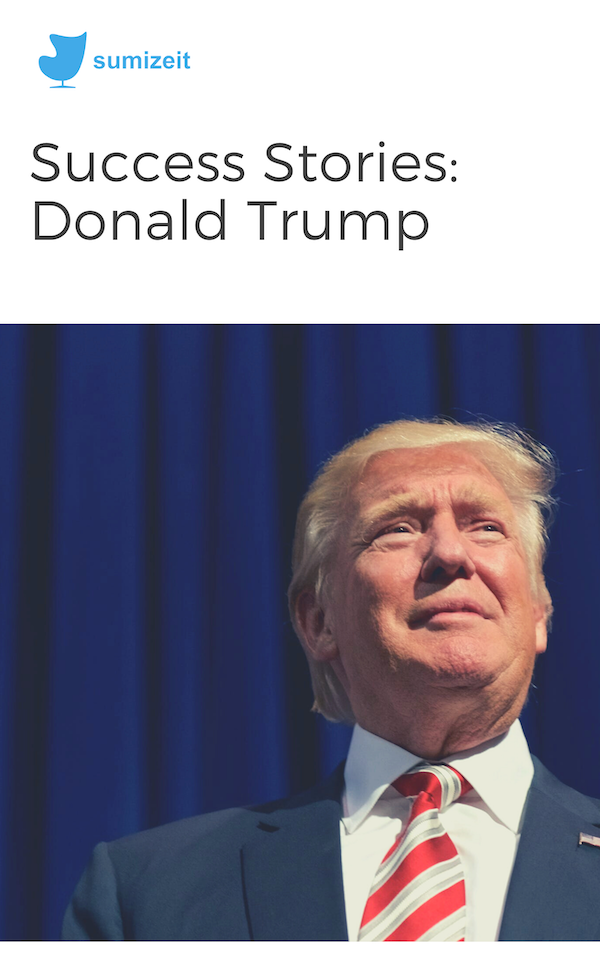
Donald Trump Book Summary
This Donald Trump Book Summary covers the key ideas, lessons, and takeaways in about 20 minutes.
Short Description:
Donald Trump’s path to success involved challenges and persistence.
Helps with these goals
Want a Free Weekly Read?
Get a free summary every week straight to your mailbox.
Preview the Donald Trump book summary
Below is a preview of Sumizeit’s comprehensive human-written summary of Donald Trump by Sumizeit Team. The full summary is 15-20 minutes long and covers the book’s key ideas in text, audio, visual, and video formats. Unlock the full 20 Minute Summary
Donald Trump may be a contentious public figure, but there’s no doubt he’s found great success since his early years in real estate in New York City. So how does a man with no previous government or military experience become the president of one of the most powerful nations in the world? Trump’s unique career in business, real estate, and American politics offers a lesson on the world-altering power of a distinctive personal brand.
A Real Estate Dynasty
Donald Trump Jr. didn’t make his fortune by his own accord - he was born into a family of powerful real estate moguls. His grandmother, Elizabeth Trump, was a German immigrant who took over her late husband’s properties when he died unexpectedly in 1918. From those properties, Elizabeth founded E. Trump and Son, a real estate development company that would soon lead the family to fame and fortune.
Donald Trump’s father Fred continued the family legacy in real estate and development. Alongside his mother, E. Trump and Sons began to rent out single-family homes and apartments in Queens, including Navy barracks along the East Coast. At one point, E. Trump-owned more than 27,000 apartments. As they gained wealth, they also gained notoriety. Fred Trump was investigated for profiteering twice, once in 1954 and once in 1966. After Donald took over the company in 1971, the family was sued for violating the Fair Housing Act.
Trump took his family fortune and ran with it. Most of the properties owned by E. Trump and Sons were in Queens when he took over and renamed it The Trump Organization. He made the brazen decision to move into the Manhattan market. His first renovation was the Commodore Hotel, which got a $400 million property tax cut from the city thanks to Fred Trump. It reopened as the Grand Hyatt Hotel in 1980, the same year Trump began construction on Trump Tower.
From there The Trump Organization kept growing. By 2016, when Trump was elected president of the United States, he owned sixteen golf courses, half a dozen casinos, an estate in Mar-a-Lago, a house in Beverly Hills, a winery in Virginia, and a carousel and skating rink in Central Park. Trump owns buildings in Israel, Turkey, India, Brazil, and Seoul, South Korea.
But not every real estate developer becomes an A-list celebrity. Trump’s fascination with reality TV led him down a unique path -- one that would take him all the way to the Oval Office.
Life in the Public Eye
It was Trump’s 1987 book, The Art of the Deal, that transformed him from a New York City developer to a world-renowned deal-maker and business tycoon. The book was co-authored by Tony Schwartz, who later admitted he ghost-wrote the book. The Art of the Deal spent nearly a year on the New York Times best-seller list -- by the end of that year, Trump was a household name.
Trump’s best-selling book got him slots on talk shows, cameos in movies, and more.
Want the complete 20-minute summary?
- Full structured summary
- Video Summary
- Podcast Summary
- Audio summary
- Key takeaways
- Exercises
- Quiz
- Highlights and notes
- Ask the book with AI
Who should read Donald Trump?
This book is essential for entrepreneurs, political analysts, and anyone interested in understanding how personal branding shapes modern business and politics. Whether you're studying real estate development, presidential campaigns, or the mechanics of building a powerful public persona, Donald Trump by the Sumizeit Team offers valuable insights into how unconventional strategies can reshape industries and influence millions.
Why does Donald Trump matter?
Understanding Donald Trump's rise from real estate developer to U.S. President provides crucial lessons about brand power, media influence, and political strategy in the 21st century. His trajectory challenges traditional assumptions about qualifications for high office and demonstrates how effectively targeting a specific audience can disrupt established systems. In an era of polarized politics and personal branding, Trump's story remains relevant for anyone seeking to understand modern American success and controversy.
What are the key themes in Donald Trump?
- Personal branding as a business and political tool
- Real estate as a foundation for wealth and influence
- Media and celebrity culture's role in politics
- Connecting with disenfranchised voter demographics
- Unconventional paths to power and success
- The relationship between business expertise and political leadership
How can you apply ideas from Donald Trump?
- Conduct extensive market research and audience analysis before launching a major business or political initiative to ensure your message resonates with your target demographic
- Develop a consistent visual and verbal brand identity across all platforms—from social media to physical products—to create recognition and community
- Identify underserved audiences or market gaps where competitors are weak, then position your offering as the solution they've been seeking
- Use simple, emotionally resonant messaging that connects to audiences' core values and grievances rather than complex policy details
- Build multiple revenue streams and geographic diversification to protect your business from market downturns and expand your influence globally
- Leverage celebrity status and media appearances to build personal brand recognition before attempting major business or political ventures
- Create merchandise and symbols that allow supporters to publicly display their allegiance and form community with others who share your brand
What common mistakes do readers make with Donald Trump?
- Assuming that controversial statements will hurt your brand without understanding your audience—for some demographics, strong rhetoric can build loyalty rather than destroy it
- Relying solely on inherited wealth without developing a clear personal brand or strategic vision that differentiates you from competitors
- Underestimating the political power of disenfranchised voters or dismissing their concerns as irrational rather than responding to genuine economic anxiety
- Failing to invest in media training and public relations before entering high-stakes business or political competitions where perception shapes reality
Sumizeit Exercises Apply what you've learned
Turn ideas from Donald Trump into action with a short guided reflection: identify the biggest takeaway, connect it to your life, and commit to one step you can take in the next 24 hours.
What is the expert analysis of Donald Trump?
Overview
This summary, produced by the Sumizeit Team, encapsulates the multifaceted life and career of Donald Trump, a figure whose trajectory from real estate magnate to the presidency of the United States has been both extraordinary and polarizing. The book’s significance lies in its attempt to distill Trump’s complex persona and career into lessons about personal branding, business acumen, and political strategy. It offers insight into how a businessman leveraged media, celebrity, and populist rhetoric to ascend to one of the most powerful political offices globally.
Core Thesis
The central argument presented is that Donald Trump’s success—across business and politics—stems primarily from his mastery of personal branding and his ability to identify and exploit niche markets, whether in real estate or the political landscape. The author posits that Trump’s rise is a testament to the power of a distinctive personal brand combined with strategic audience targeting and an opportunistic mindset.
Strengths
- Comprehensive Chronology: The summary effectively traces Trump’s evolution from inheriting a real estate empire to becoming a global political figure, providing a clear timeline of key milestones.
- Focus on Branding: The analysis highlights an often underexplored aspect of Trump’s success—the deliberate cultivation of a personal brand that transcended traditional business and political boundaries.
- Balanced Presentation of Controversies: It acknowledges the scandals, legal challenges, and public backlash that accompanied Trump’s career, lending a degree of nuance to the portrayal.
- Connection Between Business and Politics: The text insightfully connects Trump’s business strategies with his political tactics, illustrating how skills in one arena translated to another.
Critiques & Counterarguments
- Oversimplification of Political Dynamics: The summary attributes Trump’s electoral success largely to branding and niche targeting but underplays the complex socio-political factors, such as economic dislocation, media fragmentation, and institutional distrust, which scholars argue were equally decisive.
- Limited Engagement with Opposition Perspectives: While controversies are mentioned, the summary does not deeply explore the substantive critiques of Trump’s policies or governance style, which many political scientists and historians view as undermining democratic norms.
- Questionable Emphasis on Personal Branding: Competing research in political psychology suggests that while branding is important, voter behavior is influenced by broader ideological, cultural, and identity-based factors that the summary glosses over.
- Neglect of Broader Historical Context: The narrative isolates Trump’s rise as a unique phenomenon without sufficiently situating it within longer-term trends in American populism, media evolution, or global political realignments.
- Potential Bias in Source Material: Given that the summary is produced by Sumizeit, a platform known for condensing books into digestible formats, there is an inherent risk of reductionism and loss of critical depth.
Who Should Read This
This summary is ideal for readers seeking a concise introduction to Donald Trump’s career through the lens of personal branding and business strategy. It will appeal to business professionals, political enthusiasts, and students of media and communication who wish to understand how celebrity culture intersects with political power. However, readers looking for a rigorous political analysis or a comprehensive critique of Trump’s policies and their societal impact may find this overview insufficiently detailed.
Frequently asked questions about the Donald Trump book summary
What is Donald Trump about?
Donald Trump by the Sumizeit Team is a biographical exploration of Donald Trump's rise from a real estate heir to a global business mogul and ultimately the 45th U.S. President. The book examines how Trump built his personal brand across real estate, entertainment, and politics, demonstrating the power of unconventional strategies and audience targeting in achieving unprecedented success.
Who should read Donald Trump?
This book is ideal for entrepreneurs seeking to understand brand-building strategies, political analysts studying modern campaign tactics, business students examining real estate development, and anyone interested in how personal branding influences politics and culture. It's valuable for those who want to understand the mechanics behind Trump's rise, regardless of their political views.
What are the main takeaways from Donald Trump?
The key takeaways from Donald Trump include the critical importance of identifying and targeting your specific audience, the power of consistent personal branding across multiple platforms, the value of recognizing market gaps and unmet voter needs, and how strategic use of media and celebrity can reshape traditional industries. The book also illustrates how diversifying your portfolio and understanding electoral mechanics can lead to surprising success.
How did Donald Trump succeed in real estate?
Trump inherited a successful real estate company from his family but transformed it through bold strategic moves, such as expanding from Queens into competitive Manhattan markets and negotiating major tax incentives like the $400 million cut on the Commodore Hotel. He diversified into hotels, casinos, golf courses, and international properties, building a global real estate empire that made him one of the world's wealthiest businessmen.
What role did media and entertainment play in Trump's rise?
Trump's bestselling book The Art of the Deal made him a household name and led to appearances on talk shows, movie cameos, WWE wrestling events, and most significantly, his role as producer and judge on The Apprentice and Celebrity Apprentice. These media platforms built his celebrity status and reinforced his image as a powerful deal-maker, skills he later leveraged in his 2016 presidential campaign.
How did Trump appeal to his political base?
Trump identified disenfranchised voters in historically red states who felt economically abandoned and politically ignored, then positioned himself as an outsider who would challenge the political establishment and 'drain the swamp.' His simple, emotionally resonant messaging and promises to build walls on the Mexican border and renegotiate trade deals spoke directly to their economic anxieties and desire for change.
What business lessons can be learned from Donald Trump's success?
Key business lessons include the importance of personal branding across multiple platforms, understanding your target audience deeply before competing for their attention, diversifying across industries and geographies to reduce risk, and recognizing that challenging conventional wisdom can make you memorable. Trump's success also demonstrates how inheriting a foundation can be amplified through bold strategic pivots and consistent reinforcement of your core brand identity.
About Sumizeit
Sumizeit is a profitable Scomy LLC company based in Miami, Florida. Our founders, Clemens Raemy and Weina Scott, are successful entrepreneurs with several exits. Sumizeit is a popular book summary app / micro learning app used by busy professionals and entrepreneurs with over 2,500 non-fiction book summaries and 10,000 podcast summaries in text, audio, visual, podcast, and video format. We also have stellar retention tools to make ideas stick - such as flashcards with spaced repetition, quizzes, streaks, highlighting and notes, daily challenges, riddles, mini-courses, meditation, and more. You won't only learn the idea, but also remember it. Over 90% of our users change their habits with Sumizeit.
Upgrade Now
Here's why readers love Sumizeit
Join thousands of learners getting smarter every day
"Great experience. Detailed summaries. Loved the gamification feature. Makes learning fun. Good customer service. I recommend Sumizeit to anyone. You'll learn a lot."
"I always felt busy but still wanting to keep up with the book discussion in my friend group. This was a great supplement to help me keep reading the books I find fun while keeping up with important books."
"I love this website. Instead of scrolling social media, I find myself learning a lot. I use it everyday. I recommend this app for anyone who is too busy and wants to get up to speed with their favorite books."
Donald Trump Book Summary PDF
Looking for a Donald Trump Book Summary PDF you can save and revisit offline? Our Donald Trump Book Summary PDF captures the book’s core ideas in a clean, printable format — the key frameworks, takeaways, and structure without the fluff. Download the Donald Trump Book Summary PDF when you want a reference you can annotate, share with your team, or review on the go. Get your Donald Trump Book Summary PDF from the download page below.
Download Donald Trump Book Summary PDFPeople also liked these summaries
Readers who explored Donald Trump often enjoyed these titles next.



Ready to read the whole thing?
- Full structured summary
- Video Summary
- Podcast Summary
- Audio summary
- Key takeaways
- Exercises
- Quiz
- Highlights and notes
- Ask the book with AI
Featured Book Titles
Popular Book Summaries at sumizeit, leading book summary app