Question 1 of 5
Where did Samuel Langhorne Clemens (Mark Twain) spend his childhood, according to the summary?
The summary opens with Clemens as a child in Hannibal, Missouri, where the river and the town shaped his early life.


Prefer the print book? Buy on Amazon
As an Amazon Associate, Sumizeit earns from qualifying purchases.
This Mark Twain Book Summary covers the key ideas, lessons, and takeaways in about 20 minutes.
Helps with these goals
Want a Free Weekly Read?
Get a free summary every week straight to your mailbox.
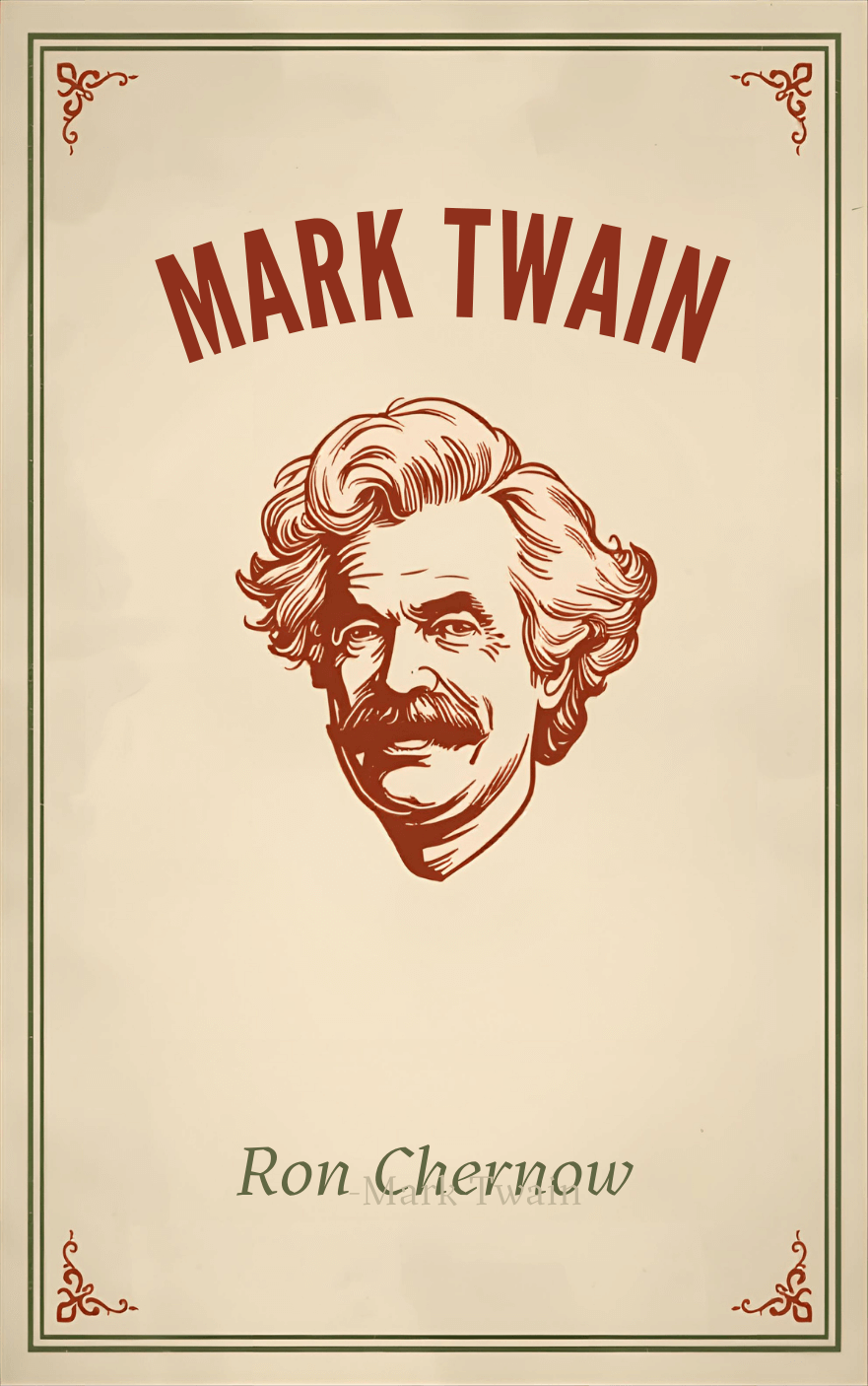
Below is a preview of Sumizeit’s expert-written summary of Mark Twain by Ron Chernow. The full summary covers the book’s key ideas in text, audio, visual, and video formats.
Ron Chernow’s Mark Twain opens with Samuel Langhorne Clemens as a child in Hannibal, Missouri, a town whose limits felt tight, moralistic, and financially precarious. The Clemens household lived with recurring money stress, and young Sam grew up with the awareness that security could vanish overnight. Yet the book’s earliest emotional center is not hardship but escape: the Mississippi River.
The river functioned as Hannibal’s great corridor to elsewhere. It brought steamboats, cargo, gamblers, merchants, drifters, preachers, and every manner of loud personality into view. For the boy who would become Twain, this moving world offered a kind of permission. He could slip out of ordinary expectations and watch life in a rawer, more improvisational form. Chernow treats the river not simply as scenery but as a formative force—an early education in language, drama, deception, risk, and spectacle.
In those years, Sam’s strongest feeling of freedom lived near the docks. The river promised mobility and reinvention: the ability to become someone other than the anxious son of a struggling family. Long before he understood literature as a vocation, he understood performance. He also understood that stories—especially the kind told by adults who had seen more than Hannibal—could rearrange reality. The river fed him character, dialect, and a sense that the world was not a single stable place but a series of shifting stages.
Chernow presents this as Twain’s first paradise, and also as the first thing he would spend the rest of his life mourning. Even when fame and wealth arrived, the river years remained his internal measure of joy. The tragedy, which the book returns to repeatedly, is that the paradise was temporary. The river would change, and so would Sam. Time would not cooperate with nostalgia.
Among all of Twain’s identities—printer, reporter, lecturer, novelist, investor, celebrity—Chernow shows the steamboat pilot as the one that gave him the purest sense of competence. Becoming a pilot wasn’t a casual ambition. In the river’s hierarchy, pilots represented elite knowledge. They were expected to memorize the Mississippi’s shifting hazards, its sandbars and currents, its tricks and moods. Their expertise was practical, immediate, and life-or-death. It was also publicly admired.
Sam pursued that role with intensity. Chernow describes the apprenticeship as brutal training: an exhausting demand to internalize details that never stayed the same. But once Clemens mastered it, the effect was transformative. He wasn’t merely working; he belonged to a “floating kingdom” with its own language, status, and pride. The river became a living text he could read better than most.
This period didn’t last long. The Civil War disrupted steamboat life, and the culture that shaped him began to fade. Yet in Chernow’s telling, that short career became Twain’s emotional reference point. The pilot years represented a version of himself that felt unshakable: self-reliant, sharp-eyed, and uncorrupted by compromise.
Decades later, when Twain returned to the Mississippi as a famous but exhausted man, he discovered what he had feared: the…
Mark Twain is essential for anyone interested in American literature, biography, or the psychology of genius. It appeals to readers fascinated by how artists navigate fame, financial pressure, and personal tragedy, as well as those seeking to understand how a writer evolves from entertainer to moral voice.
Ron Chernow's Mark Twain reveals how one of America's greatest writers was shaped by contradiction, loss, and reinvention. In an age of celebrity and performance, the book illuminates how Twain mastered public image while privately wrestling with despair, offering insight into the cost of sustained fame and the gap between the persona and the person.
Turn ideas from Mark Twain into action with a short guided reflection: identify the biggest takeaway, connect it to your life, and commit to one step you can take in the next 24 hours.
Ron Chernow’s Mark Twain stands as a monumental biographical work that delves deeply into the complexities of one of America’s most iconic literary figures. Chernow, a celebrated biographer known for his meticulous research and narrative prowess, brings to life Samuel Langhorne Clemens not merely as a humorist but as a man shaped by profound contradictions—freedom and loss, public acclaim and private despair, moral evolution and financial folly. This biography transcends a simple recounting of events, offering a textured psychological and cultural portrait that situates Twain within the turbulent social and political currents of 19th-century America.
Chernow’s central argument posits that Twain’s genius and enduring legacy arose from the persistent tension between his formative experiences and the relentless pressures of his later life. The Mississippi River, the frontier West, his marriage, financial misadventures, and personal tragedies each contributed to a layered identity that fused humor with moral critique. Twain’s life was a continual act of reinvention, yet always shadowed by loss and disillusionment. Chernow suggests that Twain’s voice—simultaneously comedic, satirical, and deeply skeptical—emerged from this friction, producing a uniquely American literary sensibility that remains resonant.
This biography is essential reading for scholars and serious readers interested in American literature, cultural history, and the interplay between personal experience and public persona. It appeals to those fascinated by the construction of literary celebrity and the moral complexities of iconic figures. Additionally, readers drawn to the intersections of history, psychology, and social critique will find Chernow’s work both illuminating and thought-provoking. While accessible to a broad audience, the book’s depth and nuance reward readers who appreciate detailed biographical scholarship that challenges simplistic narratives.
Try a few questions from the Mark Twain quiz. Unlock the full summary for the full quiz and answers that will help the ideas stick.
Question 1 of 5
The summary opens with Clemens as a child in Hannibal, Missouri, where the river and the town shaped his early life.
Question 2 of 5
Chernow treats the Mississippi River as a formative force that taught Twain character, dialect, and a sense of shifting stages.
Question 3 of 5
The summary emphasizes that the pilot role gave Twain a sense of mastery, elite knowledge of the Mississippi, pride, and belonging to a floating kingdom.
Question 4 of 5
The summary states Clemens became a writer because he needed to survive; accidental immersion in print shops trained his ear and led to journalism.
Question 5 of 5
Chernow presents the pen name as borrowing river language to honor the river self while providing distance from his past and freedom to perform a new role.
Ron Chernow's Mark Twain is a comprehensive biography of Samuel Clemens that traces his life from a boyhood in Hannibal, Missouri to his death as a celebrated American icon. The book examines how Twain's genius emerged from transformative experiences—the Mississippi River, frontier Nevada, financial ruin, personal loss, and marriage to Livy Langdon—and how he evolved from a young performer into a moral voice critiquing imperialism, racism, and religious hypocrisy.
This book is essential for literary enthusiasts, biography readers, and anyone interested in American history and culture. It appeals to those fascinated by how artists manage fame, navigate moral complexity, and balance public success with private suffering. Readers seeking insight into 19th-century America, celebrity psychology, or the relationship between experience and artistic genius will find the book deeply rewarding.
The main takeaways include: Twain's greatness arose from contradiction and friction between his need for freedom and his desire for stability; his evolution from inherited prejudice to moral outspokenness came through lived experience rather than abstract principle; financial anxiety repeatedly undermined his judgment despite his success; and his public persona, while a tool of influence, became increasingly difficult to separate from his private despair. Ultimately, Chernow shows how Twain transformed personal pain into art that still resonates.
Chernow presents the river as Twain's first and most formative education, teaching him vivid detail, human variety, drama, and the possibility of reinvention. The river symbolized escape from Hannibal's constraint and poverty, offering him a living text to read and a sense of performance. His later career as a steamboat pilot gave him the purest feeling of mastery, and the memory of the river years remained his internal measure of happiness and authenticity throughout his life.
Livy functioned as far more than a spouse; she was Twain's stabilizer, confidante, editor, and moral compass. Her editing refined his work, her presence anchored his chaotic temperament, and her family's abolitionist worldview pushed his conscience toward greater empathy. Their Hartford years represented Twain's peak happiness, and her death left him fundamentally unmoored, accelerating his descent into pessimism and despair.
Despite witnessing his father's failures, Twain repeatedly invested in speculative ventures like the Paige typesetter and various other schemes, draining his finances and forcing him into exhausting lecture tours to recover losses. Chernow shows how this pattern reflected an unresolved hunger for security born from childhood poverty, and how money anxiety—even amid success—drove decisions that compromised his health, family time, and artistic focus.
Twain evolved from absorbing the slaveholding attitudes of his Missouri upbringing to becoming an outspoken critic of racial violence and imperial conquest. Chernow credits this transformation to lived experience—exposure to human diversity on the river, Livy's influence, and witnessing the hypocrisy of American imperialism in the Philippines. His later writings attacked lynching, championed Black advancement, condemned anti-Chinese policies, and critiqued European colonialism with moral ferocity.
Sumizeit is a profitable Scomy LLC company based in Miami, Florida. It has been helping readers learn from nonfiction books for 7 years with expert-written summaries in text, audio, podcast, and video.
Join thousands of learners getting smarter every day
"Great experience. Detailed summaries. Loved the gamification feature. Makes learning fun. Good customer service. I recommend Sumizeit to anyone. You'll learn a lot."
"I always felt busy but still wanting to keep up with the book discussion in my friend group. This was a great supplement to help me keep reading the books I find fun while keeping up with important books."
"I love this website. Instead of scrolling social media, I find myself learning a lot. I use it everyday. I recommend this app for anyone who is too busy and wants to get up to speed with their favorite books."
Looking for a Mark Twain Book Summary PDF you can save and revisit offline? Our Mark Twain Book Summary PDF captures the book’s core ideas in a clean, printable format — the key frameworks, takeaways, and structure without the fluff. Download the Mark Twain Book Summary PDF when you want a reference you can annotate, share with your team, or review on the go. Get your Mark Twain Book Summary PDF from the download page below.
Download Mark Twain Book Summary PDFReaders who explored Mark Twain often enjoyed these titles next.
Popular Book Summaries at sumizeit, leading book summary app