


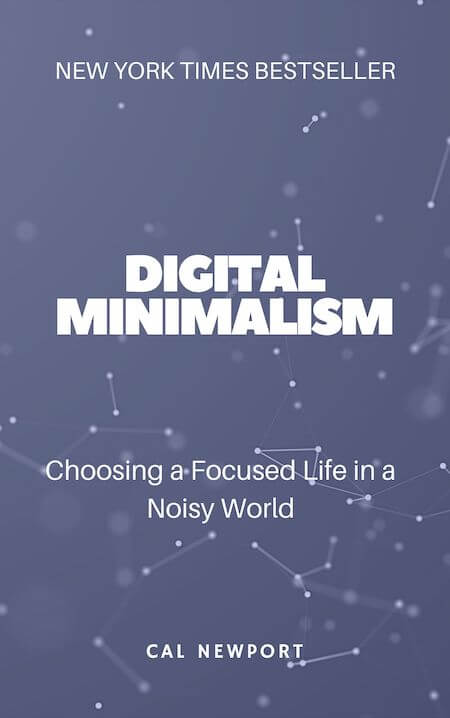
Digital Minimalism Book Summary
This Digital Minimalism Book Summary covers the key ideas, lessons, and takeaways in about 20 minutes.
Helps with these goals
Want the complete 20-minute summary?
- Full structured summary
- Video Summary
- Podcast Summary
- Audio summary
- Key takeaways
- Exercises
- Quiz
- Highlights and notes
- Ask the book with AI
What is in the Digital Minimalism book summary?
Below is a preview of Sumizeit’s expert-written summary of Digital Minimalism by Cal Newport. The full summary covers the book’s key ideas in text, audio, and video.
Over the past 10 years, people have become increasingly dependent on their smartphones spending large parts of their days swiping through their phones. Newport argues that this preoccupation with digital media has turned into behavioral addiction, costing its users more than it benefits them. Newport’s solution is called Digital Minimalism, or an organized way to resist automatic uses of this technology which has to lead to increased loneliness and depression. He advises taking a 30-day break from the digital activity and replacing this time with activities that bring meaning, purpose, and focus, and then only reintroducing the digital activities that remain essential.
Our smartphones weren’t intended to be addictive. They have evolved to profit from our attention and away from being positive tools.
When cellphones first hit the market, no one suspected they’d evolve into personal and portable computers. As technology changed, smartphones started adding more and more features making them increasingly attractive all-in-one tools. But as people started using the phones for more than phone calls and short text messages, a new incentive emerged for tech and media companies: keep people using our products for increasing amounts of time.
The tech industry has flourished as a result of keeping our attention. The more they can do this, the more money they get from advertising companies. Google and Facebook have ballooned into a billion-dollar powerhouse for its skill at delivering advertisements to its users who return to the service multiple times a day. Users should be aware that companies profit from their attention, and they prioritize this profit over the well-being of their users.
Companies maintain this attention by tapping into our primal need for rewards and social approval. Getting many “likes” on a post or lots of positive comments on an opinion produces a buzz of excitement. We develop a reflexive urge to check for more notifications and post things that will garner attention, a simple way to satisfy these primal feelings. But because digital media is so accessible, we begin to scroll mindlessly on the most pleasurable and instantly rewarding applications. Increasingly, behavior becomes addictive we fill spare moments with continuous scrolling.
Life can be improved by removing distractions and embracing the things that support our values.
Newport’s digital minimalism comes from the broader concept of lifestyle minimalism, or the idea that living with less can improve your life. According to minimalism, the things we most value can bring high reward, and removing distractions can help us live more intentionally. You can consider: which things support your values as no other thing can?
When this thinking is applied to our technology we can ask: what technology can support my values? Is it distracting me from what is most important by taking time and energy away from meaningful pursuits? How can I use technology to maximize the value I get from the time spent on it?
Newport presents three principles that explain the benefits of minimalism in economic terms. The first principle states that clutter is costly.
Want the complete 20-minute summary?
- Full structured summary
- Video Summary
- Podcast Summary
- Audio summary
- Key takeaways
- Exercises
- Quiz
- Highlights and notes
- Ask the book with AI
Who should read Digital Minimalism?
Digital Minimalism is ideal for anyone feeling overwhelmed by constant smartphone use and social media notifications. Whether you're experiencing anxiety, loneliness, or a sense that technology controls your time rather than serves your needs, this book offers practical strategies to reclaim your attention and well-being.
Why does Digital Minimalism matter?
In an age where tech companies profit from your attention and smartphones are engineered to be addictive, Digital Minimalism by Cal Newport provides a timely antidote to behavioral addiction and digital distraction. The book addresses rising rates of depression and loneliness while offering a science-backed framework for using technology intentionally instead of compulsively.
What are the key themes in Digital Minimalism?
- Technology designed for addiction rather than human flourishing
- Intentionality and values-driven decision-making
- The cost of constant digital distraction
- Solitude and contemplation as essential for self-knowledge
- Real conversation versus shallow online interaction
- High-quality leisure and meaningful activity
What are the key lessons from the Digital Minimalism book summary?
Smartphones evolved from tools into attention-harvesting machines
Tech companies profit directly from keeping you engaged, making addictiveness a business model rather than a side effect. Understanding this incentive misalignment is the first step toward resistance.
Digital clutter carries real life costs
Just as physical clutter consumes space and resources, digital distractions consume your time, energy, and mental bandwidth. Calculating the true cost of each technology reveals what's actually worth keeping.
More technology doesn't equal more value
The Law of Diminishing Returns applies to digital tools: your first smartphone was transformative, but a second one adds almost nothing. Accumulation doesn't improve life quality.
A 30-day digital sabbatical resets your baseline
Cutting non-essential technology for a month allows you to discover what you genuinely miss versus what you only thought you needed, creating clarity for intentional reintroduction.
Three-question filter determines if technology deserves a comeback
Ask: Does it support something I deeply value? Is it the best way to support that value? How do I use it to maximize benefits and minimize harms? Only proceed if all answer yes.
Solitude and self-reflection are under attack
Always-on connectivity has eliminated unavoidable alone time, leaving many people unable to think without distraction or understand their own feelings and preferences.
Solitude builds stronger identity and better relationships
When you know yourself through contemplation, you become less vulnerable to groupthink, more confident in decisions, and better equipped for meaningful human connection.
Online interaction is a poor substitute for real conversation
Liking a post or texting feels social but lacks the energy, body language, emotional depth, and lasting impact of face-to-face or even voice conversation.
Designated conversation times create space for deep connection
Offering standing invitations for calls or coffee at specific times removes friction and makes real relationships easier to maintain than scrolling through feeds.
High-quality leisure is more satisfying than low-quality scrolling
Activities requiring physical or mental effort—hiking, building, writing, playing sports—deliver lasting satisfaction and pride that passive digital consumption cannot match.
Scheduling digital use contained limits compulsive behavior
Rather than quitting cold turkey, designating specific times for low-quality activities makes them feel like earned rewards and prevents them from colonizing your entire day.
The transition to meaningful leisure takes deliberate practice
High-quality activities feel harder at first, so pairing them with digital rewards initially helps retrain your brain to find satisfaction in deeper pursuits.
Single-purpose devices eliminate distraction architecture
A flip phone for calls, a paper journal for planning, or an e-reader without apps separate essential functions from the psychological manipulation baked into smartphones.
Essential versus non-essential technology is contextual
A phone for emergencies or a computer for remote work may be essential, but the apps and notifications attached to them rarely are—they can be stripped away.
Intentionality feels more rewarding than autopilot
Deliberately choosing which tools support your values creates a sense of control and satisfaction that defaulting to whatever's convenient cannot provide.
Digital minimalism extends broader minimalism principles to tech
Just as living with less stuff improves physical spaces, keeping only intentional technology creates mental clarity and frees resources for what truly matters.
Group dynamics on social media reward conformity
Without solitude to reflect on your own views, you default to popular opinions online to chase social approval, surrendering authentic thinking.
Walking without your phone reconnects you to your thoughts
Simple practices like leaving your device behind during errands or walks rebuild your capacity for uninterrupted contemplation and present-moment awareness.
Notifications hijack attention through primal reward systems
Likes and comments trigger the same dopamine response as social approval did for our ancestors, making scrolling compulsive even when unfulfilling.
Want the complete 20-minute summary?
- Full structured summary
- Video Summary
- Podcast Summary
- Audio summary
- Key takeaways
- Exercises
- Quiz
- Highlights and notes
- Ask the book with AI
How can you apply ideas from Digital Minimalism?
- Take a 30-day technology fast, keeping only essential devices and removing distracting apps to reset your relationship with screens
- Leave your phone at home or in your car during walks, errands, and downtime to practice solitude and reconnect with your thoughts
- Replace scrolling time with high-quality hobbies like reading, writing, sports, crafting, or hiking that provide lasting satisfaction
- Schedule specific times for digital media use rather than allowing constant access, treating low-quality activities as earned rewards
- Switch to single-purpose devices like flip phones, paper journals, or dedicated e-readers for specific tasks to eliminate distraction
- Create standing invitations for real conversations—weekly coffee dates, phone call hours, or drop-in community gatherings—to replace online interaction
- Evaluate each app, website, and device using the three-question filter: Does it support my values? Is it the best way? How do I minimize its harms?
What common mistakes do readers make with Digital Minimalism?
- Trying to quit all technology at once without a plan, leading to burnout and reverting to old habits within days
- Assuming any digital interaction counts as maintaining relationships, neglecting the deeper connection that only real conversation provides
- Keeping apps that don't pass the values test simply because they're convenient or because everyone else uses them
- Ending the 30-day detox without a reintroduction strategy, allowing old patterns to immediately resume rather than building intentional habits
Sumizeit Exercises Apply what you've learned
Turn ideas from Digital Minimalism into action with a short guided reflection: identify the biggest takeaway, connect it to your life, and commit to one step you can take in the next 24 hours.
What is the expert analysis of Digital Minimalism?
Overview
Digital Minimalism by Cal Newport is a timely and influential work that addresses the pervasive impact of digital technology on modern life. Newport, a computer science professor at Georgetown University and a respected author in the self-improvement and productivity genres, leverages his academic background and cultural observations to critique the addictive nature of smartphones and social media. His book stands out for its practical philosophy aimed at reclaiming intentionality and meaning in an age dominated by digital distractions.
Core Thesis
Newport’s central argument is that the ubiquitous presence of digital technology—especially smartphones and social media—has evolved into a behavioral addiction that undermines users’ well-being by fostering loneliness, distraction, and superficial social interactions. He proposes the concept of “digital minimalism,” a deliberate and organized approach to technology use that emphasizes intentionality, value alignment, and the elimination of non-essential digital engagement. Through a structured 30-day digital detox followed by a careful reintroduction of technology, Newport argues individuals can regain control over their attention and cultivate more meaningful offline experiences.
Strengths
- Interdisciplinary Insight: Newport effectively integrates economic principles such as the cost of clutter, diminishing returns, and intentionality to frame digital usage in a novel and accessible way.
- Practical Framework: The 30-day “technical sabbatical” offers a concrete, actionable method grounded in empirical experimentation with over 1,600 volunteers, lending credibility and applicability.
- Focus on Psychological Well-being: The book highlights the importance of solitude, contemplation, and face-to-face social interaction, emphasizing their irreplaceable role in mental health and self-understanding.
- Balanced Perspective: Newport does not call for wholesale rejection of technology but advocates for selective, value-driven use, acknowledging the utility of digital tools when aligned with personal priorities.
- Encouragement of High-Quality Leisure: By contrasting passive digital consumption with active, rewarding hobbies, Newport elevates the discourse on leisure and its role in a fulfilling life.
Critiques & Counterarguments
- Evidence Limitations: While Newport’s 30-day experiment is compelling, it relies heavily on self-reported outcomes and lacks longitudinal data to confirm sustained behavioral change or psychological benefits.
- Oversimplification of Digital Engagement: The book tends to generalize all digital use as potentially harmful, which risks overlooking the nuanced and positive roles that social media and digital platforms play in community building, activism, and professional networking.
- Technological Determinism: Newport’s framing sometimes implies that technology companies are monolithically manipulative, discounting user agency and the diversity of digital experiences across cultures and demographics.
- Competing Research: Studies in digital psychology suggest that moderate, mindful use of social media can enhance social capital and emotional support, challenging the blanket assertion that digital interaction is inferior to face-to-face communication.
- Practical Constraints: For many, especially those in remote work or marginalized communities, digital tools are essential lifelines rather than distractions, complicating the feasibility of a strict digital detox or minimalism approach.
Who Should Read This
Digital Minimalism is ideal for readers who feel overwhelmed by their digital lives and seek a structured, philosophical, and pragmatic approach to regaining control over their attention. It will resonate with professionals, students, and anyone interested in productivity, mental health, and lifestyle design. Additionally, those curious about the intersection of technology, psychology, and economics will find Newport’s synthesis insightful. However, readers looking for a purely technical guide or those deeply embedded in digital culture without the desire for reduction may find the book’s prescriptions challenging or idealistic.
Frequently asked questions about the Digital Minimalism book summary
What is Digital Minimalism about?
Digital Minimalism by Cal Newport is about reclaiming your attention and well-being from technology designed to addict you. The book presents a practical framework—including a 30-day digital sabbatical—for removing distracting apps and devices, then intentionally reintroducing only the technology that serves your deepest values. It argues that solitude, real conversation, and meaningful leisure are more important to happiness than constant digital connectivity.
Who should read Digital Minimalism?
Anyone struggling with smartphone addiction, constant notifications, or the feeling that technology controls their time should read this book. It's especially valuable for people experiencing anxiety, loneliness, or depression linked to social media use, and for those who want to reclaim focus for work, relationships, or personal growth. Parents worried about their children's screen time will also find practical guidance.
What are the main takeaways from Digital Minimalism?
The core takeaways are: tech companies profit from your addiction, so constant engagement isn't accidental; a 30-day break from non-essential technology resets your perspective; only reintroduce tools that support your values using a three-question filter; solitude and real conversation are irreplaceable; and high-quality leisure—activities requiring effort—provides deeper satisfaction than passive scrolling. The ultimate message is that technology should serve your life, not the reverse.
What is the 30-day digital detox in Digital Minimalism?
Newport recommends a 30-day break from all non-essential technology—removing social media apps, news sites, and other distracting tools while keeping essential devices like phones for emergencies or computers for work. During this period, you replace digital activities with engaging alternatives like hobbies, exercise, or in-person socializing. After 30 days, you evaluate each technology using three questions to decide if and how to reintroduce it intentionally.
How does Digital Minimalism define essential versus non-essential technology?
According to Newport, essential technology is what you genuinely need for work, safety, or critical communication—like a work computer or phone for emergencies. Non-essential technology is what's merely convenient but not necessary, such as social media apps, news feeds, or entertainment apps that keep you scrolling. The key is distinguishing true necessity from habit or convenience.
What does Digital Minimalism say about real versus online friendship?
Newport argues that online interaction—liking posts, texting, commenting—feels social but lacks the emotional depth, body language, and lasting impact of real conversation. Phone calls and face-to-face time deliver genuine connection and relationship development, while social media creates an illusion of maintaining friendships without the investment required for true intimacy. He recommends scheduling real conversations as a core practice.
How does solitude feature in Digital Minimalism?
Newport emphasizes that constant smartphone access has eliminated unavoidable alone time, preventing people from developing self-knowledge, defending against groupthink, and understanding their own feelings. He recommends practicing solitude by leaving your phone behind on walks, removing headphones during errands, or simply sitting without a device. Regular solitude strengthens your identity and makes you less vulnerable to toxic online dynamics.
About Sumizeit
Sumizeit is a profitable Scomy LLC company based in Miami, Florida. It has been helping readers learn from nonfiction books for 7 years with expert-written summaries in text, audio, podcast, and video.
Want the complete 20-minute summary?
- Full structured summary
- Video Summary
- Podcast Summary
- Audio summary
- Key takeaways
- Exercises
- Quiz
- Highlights and notes
- Ask the book with AI
Here's why readers love Sumizeit
Join thousands of learners getting smarter every day
"Great experience. Detailed summaries. Loved the gamification feature. Makes learning fun. Good customer service. I recommend Sumizeit to anyone. You'll learn a lot."
"I always felt busy but still wanting to keep up with the book discussion in my friend group. This was a great supplement to help me keep reading the books I find fun while keeping up with important books."
"I love this website. Instead of scrolling social media, I find myself learning a lot. I use it everyday. I recommend this app for anyone who is too busy and wants to get up to speed with their favorite books."
Digital Minimalism Book Summary PDF
Looking for a Digital Minimalism Book Summary PDF you can save and revisit offline? Our Digital Minimalism Book Summary PDF captures the book’s core ideas in a clean, printable format — the key frameworks, takeaways, and structure without the fluff. Download the Digital Minimalism Book Summary PDF when you want a reference you can annotate, share with your team, or review on the go. Get your Digital Minimalism Book Summary PDF from the download page below.
Download Digital Minimalism Book Summary PDFPeople also liked these summaries
Readers who explored Digital Minimalism often enjoyed these titles next.


Want the complete 20-minute summary?
- Full structured summary
- Video Summary
- Podcast Summary
- Audio summary
- Key takeaways
- Exercises
- Quiz
- Highlights and notes
- Ask the book with AI
Featured Book Titles
Popular Book Summaries at sumizeit, leading book summary app
