


As an Amazon Associate, Sumizeit earns from qualifying purchases.
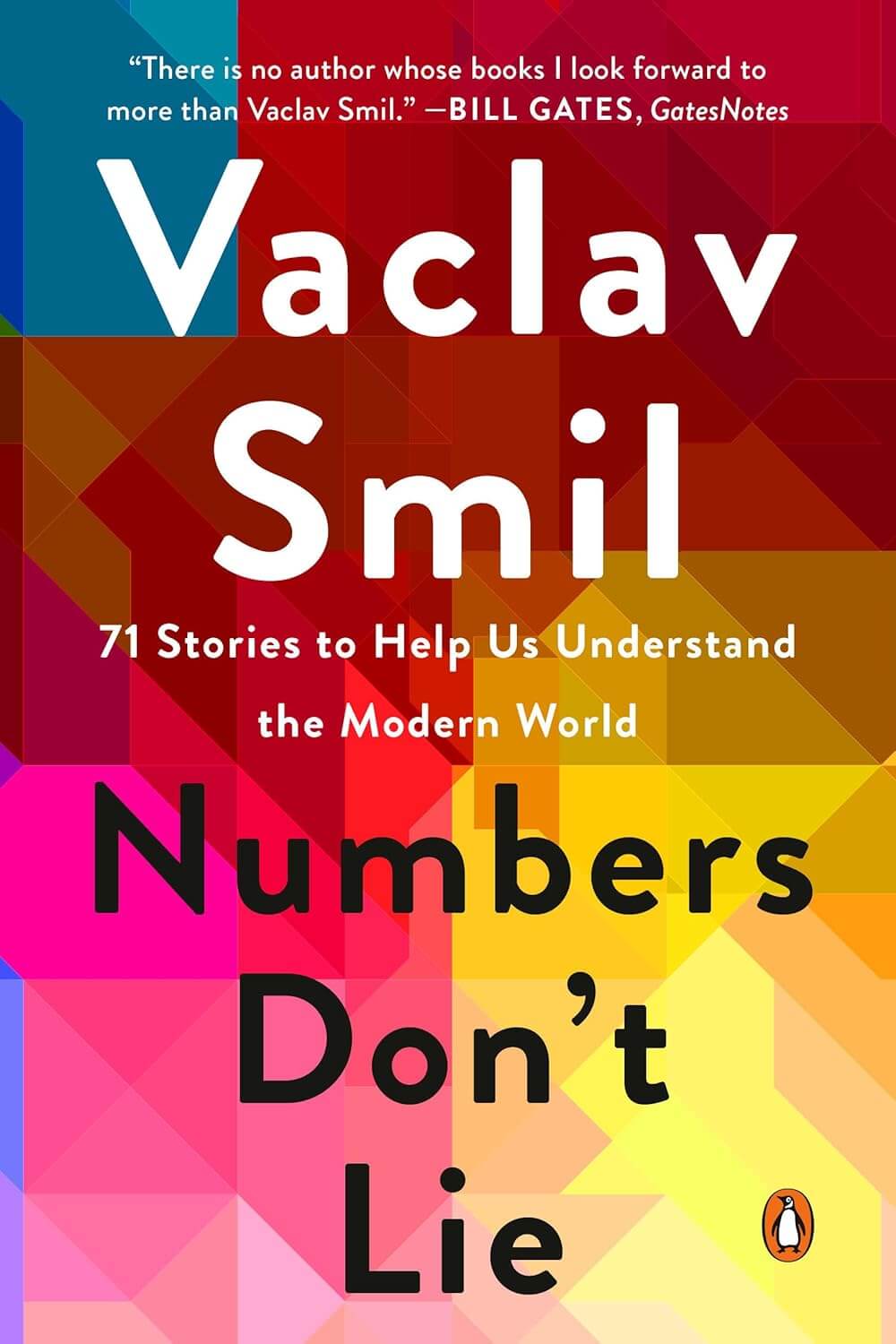
Numbers Don’t Lie Book Summary
This Numbers Don’t Lie Book Summary covers the key ideas, lessons, and takeaways in about 20 minutes.
Across economics, demography, energy, transport, and food, Smil urges readers to think in scale, context, and systems. The numbers behind climate, energy transitions, shipping, aviation, and industrial agriculture show that decarbonization is not a simple tech swap—it’s a civilization-sized rebuild that will take time, materials, and uncomfortable tradeoffs. But his message isn’t despair. It’s realism: progress starts when we measure correctly, compare honestly, admit constraints, and choose practical actions that can accumulate—like expanding vaccines, improving public health, building efficient rail, reducing food waste, and making dietary shifts with outsized impact.
In Smil’s view, the world doesn’t become clearer by collecting more data. It becomes clearer when we interpret data with discipline: asking what a number truly measures, what it hides, and what it demands of us if we take it seriously.
Helps with these goals
Want the complete 20-minute summary?
- Full structured summary
- Video Summary
- Podcast Summary
- Audio summary
- Key takeaways
- Exercises
- Quiz
- Highlights and notes
- Ask the book with AI
What is in the Numbers Don’t Lie book summary?
Below is a preview of Sumizeit’s expert-written summary of Numbers Don’t Lie by Vaclav Smil. The full summary covers the book’s key ideas in text, audio, and video.
Vaclav Smil’s central point is simple: careful measurement is one of humanity’s greatest inventions, but people routinely treat metrics like slogans instead of tools. Numbers can clarify reality, reveal tradeoffs, and show what’s improving and what’s failing. Yet the same figures can also mislead when they’re ripped from context, compared incorrectly, or used to imply certainty where none exists.
Smil argues that the modern world is saturated with statistics—GDP figures, unemployment rates, “happiness” rankings, emissions totals, energy shares, productivity curves—and most public conversations treat these numbers as self-explanatory. In reality, every metric is a constructed lens. It highlights certain features and hides others. To learn from numbers instead of being fooled by them, we have to ask patient questions: What exactly is being measured? How was it calculated? What’s excluded? What assumptions or definitions shape the result? What comparisons are valid, and which are nonsense?
Most importantly, Smil says that understanding numbers is not mainly about memorizing formulas. It’s about habits of mind: skepticism, attention to scale, and the willingness to do a little work before accepting a neat headline. Good numeracy means refusing to let a single statistic substitute for a full story.
How to Read a Statistic Without Being Tricked by It
Smil’s worldview begins with a discipline: never treat a single figure as a final answer. A number becomes meaningful only when you supply its frame.
One crucial frame is definition. Many metrics sound straightforward but are built from choices that can change the outcome. Another is comparison: numbers are often compared across countries or across time periods without adjusting for population size, price levels, currency valuations, or changes in measurement methods. A third is distribution. National averages can hide deep inequality—two societies can share the same “average” while living completely different realities on the ground.
Smil’s method is to slow down and interrogate a number the way a scientist would. He wants readers to notice what gets counted, what doesn’t, and what the number can and cannot legitimately claim. When a statistic is used as a stand-in for something it only partially captures—like using GDP as a synonym for “well-being”—confusion becomes guaranteed.
This kind of careful reading isn’t just a technical skill. Smil presents it as a civic necessity. A society that can’t interpret its own metrics is easily manipulated by propaganda, marketing, and lazy journalism.
Why “Happiness Rankings” Sound Scientific but Aren’t as Solid as They Look
Smil highlights how seductive it is to quantify something as slippery as happiness. A global report can rank countries, generate headlines, and create the impression that well-being has been measured cleanly. But Smil argues that happiness is difficult to standardize because it depends heavily on subjective responses and cultural context.
He takes particular issue with widely cited happiness indices that blend variables like income, social support, life expectancy, freedom, generosity, and corruption perceptions. Even if some of these inputs correlate with quality of life, the bundle still mixes hard data with personal interpretation.
Want the complete 20-minute summary?
- Full structured summary
- Video Summary
- Podcast Summary
- Audio summary
- Key takeaways
- Exercises
- Quiz
- Highlights and notes
- Ask the book with AI
Who should read Numbers Don’t Lie?
Numbers Don't Lie is essential for policymakers, journalists, business leaders, and informed citizens who encounter statistics daily but want to avoid being misled by them. If you care about understanding climate change, economic health, quality of life, or any major public issue beyond the headlines, this book teaches you to interrogate the numbers behind the claims. Anyone tired of seeing contradictory statistics weaponized in arguments will find a practical framework for separating signal from noise.
Why does Numbers Don’t Lie matter?
In an era drowning in data and competing statistics, Vaclav Smil argues that careful interpretation of numbers is a civic necessity, not a luxury. Modern debates about climate, jobs, healthcare, and national success are won or lost based on which metrics people accept as truth—yet most people treat statistics as slogans rather than tools requiring context and skepticism. Without the discipline to read numbers honestly, societies become vulnerable to propaganda, poor policy decisions, and missed opportunities for genuine progress.
What are the key themes in Numbers Don’t Lie?
- The power and peril of metrics when stripped of context
- Why single statistics often hide more than they reveal
- Physical constraints and time scales that defeat optimistic forecasts
- The gap between aggregate wealth and actual living conditions
- How definitions and comparisons shape what numbers appear to show
- The arithmetic of systems change: energy transitions, demographics, and infrastructure
What are the key lessons from the Numbers Don’t Lie book summary?
Never accept a single number as a complete story
Every metric highlights certain features while hiding others. Understanding what is measured, how it is calculated, and what is excluded is essential before drawing conclusions.
Definition matters more than you think
Seemingly straightforward metrics like unemployment or GDP are built from choices that can dramatically change outcomes. Dig into how something is defined before comparing it across time or countries.
Comparisons across populations must adjust for scale
Large countries naturally have larger totals. Per-capita measures, purchasing power parity adjustments, and accounting for cost-of-living differences are essential for honest comparison.
National averages can mask deep inequality
Two societies with identical average income or happiness can have radically different distributions, meaning prosperity for some and hardship for others. Always ask what the distribution looks like.
Happiness rankings are less scientific than they appear
Blending subjective responses like 'freedom to make life choices' with hard data introduces cultural bias and interpretation bias. Such rankings signal something but cannot claim the precision their rankings imply.
GDP is an output measure, not a well-being meter
Rising GDP does not automatically mean rising living standards. It ignores inequality, unpaid work, environmental damage, and whether prosperity is broadly translated into security and health.
Official unemployment rates can erase discouraged workers
People who have stopped looking for work vanish from unemployment statistics, creating an illusion of labor market health while workforce participation may actually be declining.
Infant mortality is a surprisingly honest indicator of well-being
Unlike GDP, infant mortality reflects a blend of medical care, public health, education, sanitation, and resource distribution—outcomes that are hard to fake and deeply anchored in human reality.
Vaccines represent exceptionally high-return quality-of-life investments
The health and economic benefits of vaccination—prevented disease, reduced deaths, preserved productivity—compound over time, making immunization one of the most cost-effective interventions societies can make.
Demographic trends move slowly but reshape civilizations
Falling fertility rates and aging populations alter labor supply, healthcare demand, pension systems, and economic growth for decades. Societies ignoring these trends face structural stress later.
Energy transitions take generations, not news cycles
Past energy system shifts from wood to coal to oil took roughly a century. Current fossil fuel dependence is so deeply embedded in industry and logistics that rapid replacement is physically unrealistic.
Technology improvement follows different curves depending on the domain
Computing progress (Moore's Law) moved dramatically fast, but crop yields, fuel efficiency, and physical infrastructure turn over slowly. Extrapolating silicon-speed change to physical systems is fantasy.
Efficiency gains don't automatically reduce total consumption
When technologies become cheaper or more capable, demand often rises, potentially offsetting environmental benefits. Understanding the full system effect requires tracking actual use, not just per-unit improvement.
Renewable energy sources still sit on fossil-fueled industrial bases
Wind turbines, solar panels, and batteries require massive amounts of steel, concrete, and components whose production depends on fossil fuels. The transition is circular, not a clean swap.
Storage is the overlooked constraint in renewable energy systems
Sun and wind are intermittent, and today's battery technology still cannot store enough energy to support large cities through prolonged calm or cloud cover. This is where the arithmetic gets unforgiving.
Heavy transport decarbonization requires breakthroughs in energy density
Diesel dominates freight because it is efficient, durable, and energy-dense. Electric alternatives exist in limited form but cannot yet match the capability required to move global supply chains.
Cars are inefficient moving humans relative to the energy they consume
A vehicle's mass often consumes more energy than the payload it carries. This inefficiency worsens with heavier batteries and solo commutes, suggesting behavioral and systemic solutions beyond engine swaps.
Life-cycle thinking reveals hidden environmental costs
Judge technologies by their full impact—production, energy sources, maintenance, and disposal—not just by what happens during use. Electric vehicles are cleaner than fossil cars only if you account for the whole picture.
Aviation is the hardest transport sector to decarbonize
Planes require energy-dense liquid fuels and cannot carry heavy batteries. Biofuels may help but introduce new environmental conflicts. The most direct path is flying less, yet demand trends move opposite.
Food systems hide enormous climate impact that transcends cars and power plants
Synthetic fertilizer production, meat consumption, and food waste together represent major emissions sources. Small dietary and waste-reduction changes, multiplied across billions of people, function as climate policy.
Want the complete 20-minute summary?
- Full structured summary
- Video Summary
- Podcast Summary
- Audio summary
- Key takeaways
- Exercises
- Quiz
- Highlights and notes
- Ask the book with AI
How can you apply ideas from Numbers Don’t Lie?
- When reading economic headlines, automatically ask: Is this per-capita or total? What is excluded? How does it compare to previous years using the same definition?
- Evaluate a country's success by looking at infant mortality, life expectancy, and health outcomes alongside GDP—not instead of GDP, but as a reality check on whether prosperity translates to actual well-being.
- In climate and energy discussions, demand to see material requirements, construction timelines, and energy sources for 'solutions,' not just headlines about growth percentages.
- Reduce food waste in your household and business operations, recognizing that waste reduction is both environmentally impactful and economically sensible without requiring lifestyle revolution.
- Make dietary shifts toward less beef and more efficient protein (poultry, plant-based)—incremental changes across billions of people accumulate into significant climate impact.
- Support high-speed rail and public transit expansion as proven, efficient, low-carbon alternatives that work immediately rather than betting entirely on futuristic technologies.
- When evaluating policy proposals, insist on clarity about time scales, physical constraints, and realistic timelines for infrastructure turnover rather than accepting optimistic promises disconnected from engineering realities.
What common mistakes do readers make with Numbers Don’t Lie?
- Treating a single statistic (GDP, happiness score, unemployment rate) as a complete picture of reality rather than asking what is measured, excluded, and hidden.
- Comparing numbers across countries or time periods without adjusting for population size, currency values, cost of living, or changes in measurement methodology.
- Assuming that technology improvements will arrive on convenient timelines or scale rapidly when historical evidence shows infrastructure and physical systems change slowly.
- Believing that a rising national average means rising conditions for everyone, ignoring how inequality can grow while average figures improve.
Sumizeit Exercises Apply what you've learned
Turn ideas from Numbers Don’t Lie into action with a short guided reflection: identify the biggest takeaway, connect it to your life, and commit to one step you can take in the next 24 hours.
What is the expert analysis of Numbers Don’t Lie?
Overview
Numbers Don’t Lie is a rigorous and insightful work by Vaclav Smil, a renowned scholar whose expertise spans energy, environment, technology, and societal systems. Smil’s reputation for grounding grand narratives in empirical realities and physical constraints lends this book a distinctive authority. His methodical approach to statistics as tools rather than slogans challenges readers to develop a disciplined numeracy essential for understanding complex global issues. The book’s significance lies in its timely critique of how numbers are often misused in public discourse and policy, urging a more nuanced and skeptical engagement with data amidst an age saturated by metrics.
Core Thesis
Smil’s central argument is that numbers, while among humanity’s greatest inventions, are frequently misinterpreted or misapplied when stripped of context. Metrics such as GDP, unemployment rates, and happiness indices are not self-explanatory truths but constructed lenses that highlight certain realities while obscuring others. To truly understand what numbers reveal, one must interrogate their definitions, assumptions, and limitations. Good numeracy is less about formulaic knowledge and more about cultivating skepticism, attention to scale, and a willingness to look beyond headlines. This disciplined interpretation is not merely academic but a civic imperative to resist manipulation and support informed decision-making.
Strengths
- Comprehensive and Interdisciplinary Scope: Smil bridges economics, demography, energy, environment, and public health, illustrating how numbers function across diverse domains.
- Clarity in Complexity: The book excels at unpacking complicated metrics like GDP and happiness rankings, exposing their construction and inherent biases without oversimplification.
- Real-World Relevance: By grounding abstract numbers in concrete societal outcomes—such as infant mortality or vaccine efficacy—Smil connects data to lived human experiences.
- Balanced Realism: Smil neither descends into pessimism nor blind optimism; instead, he advocates for pragmatic, incremental progress informed by sober assessments of scale and feasibility.
- Critical Examination of Energy and Environmental Transitions: His detailed analysis of energy systems, infrastructure inertia, and material demands provides a sobering counterpoint to techno-utopian narratives.
Critiques & Counterarguments
- Potential Overemphasis on Skepticism: While skepticism is vital, an overly cautious stance might underplay the utility of some composite indices that, despite imperfections, can guide policy and comparative analysis.
- Limited Engagement with Alternative Metrics: Smil critiques GDP and happiness indices but offers less exploration of emerging multidimensional measures like the Human Development Index or Genuine Progress Indicator, which attempt to integrate broader well-being factors.
- Technological Pessimism Challenged: Some scholars argue that Smil underestimates the pace and potential of innovation, particularly in renewable energy and battery technology, where recent breakthroughs suggest more rapid transitions may be feasible.
- Demographic Determinism: Smil’s emphasis on demographic trends as largely deterministic could be contested by those highlighting the role of policy, migration, and social innovation in mitigating aging population challenges.
- Complexity of Behavioral Change: While advocating dietary shifts and waste reduction, Smil’s analysis might benefit from deeper integration of behavioral economics and cultural factors influencing adoption of sustainable practices.
Who Should Read This
This book is essential reading for policymakers, economists, environmental scientists, and informed citizens seeking a grounded understanding of how to interpret and apply statistics responsibly. It is particularly valuable for those engaged in public discourse on climate change, economic development, and social policy who require a sober appraisal of data’s power and pitfalls. Additionally, students and professionals in interdisciplinary fields will find Smil’s emphasis on systems thinking and physical realities a crucial corrective to overly simplistic narratives. Ultimately, anyone interested in cultivating a more discerning and critical approach to the numbers that shape our world will benefit from Smil’s measured and insightful guidance.
Frequently asked questions about the Numbers Don’t Lie book summary
What is Numbers Don't Lie about?
Numbers Don't Lie by Vaclav Smil argues that statistics are powerful tools for understanding reality, but only if we read them carefully and with skepticism. Smil shows how metrics like GDP, unemployment, happiness rankings, and environmental indicators routinely mislead when stripped of context, compared incorrectly, or used to imply certainty where none exists. The book teaches readers how to interrogate numbers—asking what is measured, what is excluded, and what the full story actually is—across economics, demography, energy, transportation, and food systems.
Who should read Numbers Don't Lie?
Anyone who encounters statistics in news, policy, or business decisions will benefit from this book. It is essential for journalists, policymakers, business leaders, and informed citizens tired of contradictory numbers being weaponized in debates about climate change, jobs, healthcare, and national success. Even people without technical backgrounds can apply Smil's framework to avoid being misled by headlines and to engage more honestly with data in everyday life.
What are the main takeaways from Numbers Don't Lie?
The core lesson is that statistics become dangerous when treated as shortcuts or slogans. Smil demonstrates that nearly every headline metric—happiness scores, GDP, unemployment rates, environmental progress claims—hides crucial information when you ask what is measured and what is excluded. Across domains from energy to food, he emphasizes that major transformations require understanding scale, accepting physical constraints, and thinking in terms of time scales and material flows rather than wishful timelines. Progress comes from measuring honestly, admitting tradeoffs, and choosing practical actions that accumulate.
How does Smil explain the gap between economic growth and quality of life?
Smil shows that GDP measures economic output but misses whether prosperity translates into actual security, health, and well-being. A country can have rising GDP while struggling with poor infant mortality, weak healthcare access, high inequality, and environmental damage. He argues that metrics anchored in human outcomes—like infant mortality or life expectancy—often reveal a truer picture of national success than financial totals. Wealth and health are related but not identical, and some very rich countries fail to distribute security and care reliably.
What does Numbers Don't Lie say about climate and energy transitions?
Smil argues that decarbonization is not a simple technology swap but a civilization-sized rebuild requiring generations, not news cycles. He explains that fossil fuels are embedded in everything—electricity, steel, cement, shipping, aviation—and past energy transitions took roughly a century. Current renewable sources like wind and solar still depend on fossil-fueled industrial production, storage technology remains inadequate for continuous grid supply, and heavy transport alternatives cannot yet match diesel capability. His message is not despair but realism: progress requires honest accounting of constraints and practical actions that can accumulate.
Why does Smil criticize happiness rankings and GDP as measures of national success?
Smil shows that happiness rankings blend subjective responses with cultural bias, making them appear scientific while hiding inequality and variability. GDP measures output but ignores income distribution, unpaid work, leisure, and environmental damage. Both metrics can rise while actual living conditions stagnate or deteriorate for large populations. He argues that metrics anchored in human outcomes—like infant mortality, health coverage, or life expectancy—more honestly reflect whether a nation converts resources into broad-based security and well-being.
What is Smil's position on technological solutions to climate change?
Smil is not anti-innovation but anti-fantasy. He argues that many people assume environmental progress will arrive at computing speed, but physical systems—power plants, factories, transport fleets, housing stock—turn over slowly. Battery technology, hydrogen storage, and electric aviation remain decades from maturity or scalability. He advocates for pursuing practical improvements now, accepting incremental wins, and stopping the habit of betting everything on hypothetical breakthroughs arriving on convenient timelines. He highlights proven solutions like high-speed rail and emphasizes that behavioral change (less flying, less meat, less waste) can deliver impact immediately.
How does Numbers Don't Lie approach food systems and environmental impact?
Smil reveals that food production—especially through synthetic fertilizer, meat consumption, and waste—creates enormous hidden emissions. Synthetic nitrogen fertilizer is energy-intensive and contributes potent greenhouse gases, yet it is necessary to feed billions at current yield levels. Beef is particularly inefficient because animals convert feed to meat poorly compared with poultry. Food waste embeds all the labor, water, land, and energy used to produce wasted food. Smil frames waste reduction and dietary shifts as 'double wins' that lower emissions while improving security, and he argues these changes are uniquely solvable without waiting for technological breakthroughs.
About Sumizeit
Sumizeit is a profitable Scomy LLC company based in Miami, Florida. It has been helping readers learn from nonfiction books for 7 years with expert-written summaries in text, audio, podcast, and video.
Want the complete 20-minute summary?
- Full structured summary
- Video Summary
- Podcast Summary
- Audio summary
- Key takeaways
- Exercises
- Quiz
- Highlights and notes
- Ask the book with AI
Here's why readers love Sumizeit
Join thousands of learners getting smarter every day
"Great experience. Detailed summaries. Loved the gamification feature. Makes learning fun. Good customer service. I recommend Sumizeit to anyone. You'll learn a lot."
"I always felt busy but still wanting to keep up with the book discussion in my friend group. This was a great supplement to help me keep reading the books I find fun while keeping up with important books."
"I love this website. Instead of scrolling social media, I find myself learning a lot. I use it everyday. I recommend this app for anyone who is too busy and wants to get up to speed with their favorite books."
Numbers Don’t Lie Book Summary PDF
Looking for a Numbers Don’t Lie Book Summary PDF you can save and revisit offline? Our Numbers Don’t Lie Book Summary PDF captures the book’s core ideas in a clean, printable format — the key frameworks, takeaways, and structure without the fluff. Download the Numbers Don’t Lie Book Summary PDF when you want a reference you can annotate, share with your team, or review on the go. Get your Numbers Don’t Lie Book Summary PDF from the download page below.
Download Numbers Don’t Lie Book Summary PDFPeople also liked these summaries
Readers who explored Numbers Don’t Lie often enjoyed these titles next.




Want the complete 20-minute summary?
- Full structured summary
- Video Summary
- Podcast Summary
- Audio summary
- Key takeaways
- Exercises
- Quiz
- Highlights and notes
- Ask the book with AI
Featured Book Titles
Popular Book Summaries at sumizeit, leading book summary app