


As an Amazon Associate, Sumizeit earns from qualifying purchases.
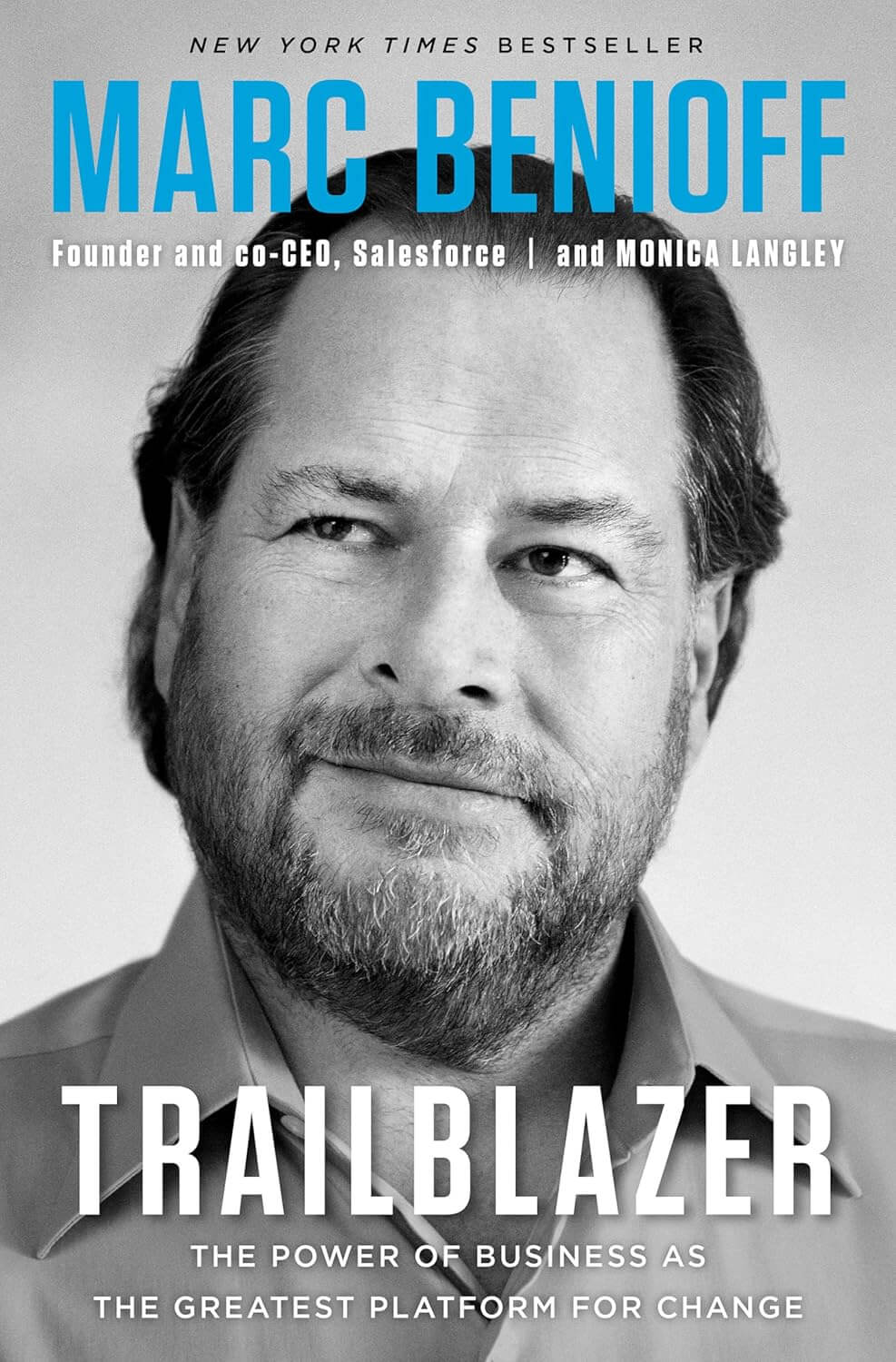
Trailblazer Book Summary
This Trailblazer Book Summary covers the key ideas, lessons, and takeaways in about 20 minutes.
Equally important, the book asserts that leadership is a personal practice. Principles only matter when leaders are willing to act on them, absorb criticism, and accept complexity. By embedding values into systems, incentives, and daily decisions, organizations can build trust, resilience, and relevance—qualities that sustain success over the long term.
Helps with these goals
Want the complete 20-minute summary?
- Full structured summary
- Video Summary
- Podcast Summary
- Audio summary
- Key takeaways
- Exercises
- Quiz
- Highlights and notes
- Ask the book with AI
What is in the Trailblazer book summary?
Below is a preview of Sumizeit’s expert-written summary of Trailblazer by Marc Benioff. The full summary covers the book’s key ideas in text, audio, and video.
In Trailblazer, Marc Benioff presents a sweeping argument that the dominant model of modern capitalism has reached an inflection point. For much of the last century, corporations were primarily evaluated by one metric: how efficiently they maximized financial returns for shareholders. This approach delivered extraordinary economic growth, but Benioff contends it also produced widening inequality, environmental degradation, eroded trust in institutions, and a sense that corporations had become detached from the societies they profit from.
Rather than framing these outcomes as unfortunate side effects, Benioff treats them as signals that the system itself needs redesigning. He argues that business is now one of the most powerful forces shaping human life—often more influential than governments—and therefore must accept moral responsibility for its impact. The book positions this moment as an opportunity rather than a crisis: a chance for companies to become engines of social progress while remaining financially successful.
Benioff does not write as a distant theorist. His claims are grounded in the lived experience of building Salesforce, one of the world’s most influential enterprise software firms. He presents Salesforce not as a flawless model, but as a living experiment—one that demonstrates how ethical commitments, when embedded into everyday decision-making, can coexist with scale, innovation, and profitability.
From Profit-First to Principle-First Thinking
At the heart of Benioff’s philosophy is a rejection of the idea that profit should be the supreme objective of a corporation. He proposes an alternative orientation in which values come first, and financial success follows as a consequence of trust, loyalty, and long-term thinking.
This approach differs from traditional “corporate social responsibility” programs, which often operate as side initiatives disconnected from core business strategy. Benioff argues that ethical behavior cannot be a marketing layer added after the fact. Instead, principles must guide hiring decisions, product development, partnerships, political engagement, and even which customers a company chooses to serve.
He frames this as a shift from shareholder-centric capitalism to a broader, stakeholder-centered worldview. In this model, companies owe duties not only to investors, but also to employees, customers, communities, and the planet. What makes Benioff’s argument distinctive is his insistence that principles are not abstract ideals—they are practical tools for decision-making. When leaders face ambiguity, values provide a compass that prevents short-term gains from undermining long-term legitimacy.
Why Ethics and Performance Reinforce Each Other
A central claim in Trailblazer is that principled leadership is not merely morally desirable—it is strategically advantageous. Benioff draws on internal data, external research, and lived experience to argue that values-driven companies are better positioned to thrive in volatile markets.
Customers, he notes, increasingly expect brands to stand for something beyond convenience or price. Purchasing decisions are influenced by how companies treat workers, handle data, and respond to social issues. While cost still matters, trust has become a differentiator—especially in industries where switching providers is easy.
Employees are another critical constituency. Benioff emphasizes that people want their work to feel meaningful.
Want the complete 20-minute summary?
- Full structured summary
- Video Summary
- Podcast Summary
- Audio summary
- Key takeaways
- Exercises
- Quiz
- Highlights and notes
- Ask the book with AI
Who should read Trailblazer?
Trailblazer is essential for business leaders, entrepreneurs, and executives who want to build companies that generate both profit and positive social impact. It's also valuable for employees, investors, and consumers who increasingly expect corporations to demonstrate values beyond shareholder returns. Anyone questioning whether capitalism can be reformed to address inequality, environmental damage, and institutional erosion will find Benioff's perspective compelling and grounded in real-world experience.
Why does Trailblazer matter?
As technology companies wield unprecedented influence over society, Trailblazer addresses an urgent question: can business become a force for good without sacrificing success? The book arrives at a critical moment when customers demand ethical brands, employees seek meaningful work, and regulators scrutinize corporate power. Marc Benioff argues that values-driven leadership isn't a liability—it's a competitive advantage that builds resilience, trust, and long-term viability in an increasingly complex world.
What are the key themes in Trailblazer?
- From shareholder capitalism to stakeholder capitalism
- Ethics as strategic advantage, not moral burden
- Technology innovation requires ethical guardrails
- Trust as a measurable and defensible business asset
- Service and human dignity as business foundations
- Systemic equality requires data and accountability
- Corporate responsibility in political and social issues
What are the key lessons from the Trailblazer book summary?
Profit follows principle, not the reverse
When companies prioritize values in decision-making, financial success follows as a natural consequence of customer loyalty, employee engagement, and reduced reputational risk rather than pursuing profit as the ultimate goal.
Values must be embedded in systems, not marketing
Ethical behavior cannot be bolted on as a PR initiative; it must guide hiring, product development, partnerships, and customer selection from the foundation upward to have lasting impact.
Customers increasingly purchase based on corporate values
Trust and brand values have become key differentiators in markets where price and convenience are commoditized, influencing purchasing decisions alongside traditional metrics.
Employee meaning drives performance and retention
Staff are more engaged, creative, and loyal when they believe their employer contributes positively to society, making values-driven mission statements crucial for talent attraction and retention.
Reputational crises are more expensive than ethical investment
Long-term investors recognize that values-driven approaches reduce regulatory risk, internal disengagement, and scandal costs—stabilizing growth and building resilience better than short-term optimization.
Technology without ethics amplifies inequality and risk
Artificial intelligence, automation, and data systems can concentrate power and erode privacy unless leaders embed responsibility into innovation itself to ensure progress serves human well-being.
Service to customers reveals innovation opportunities
Understanding real problems faced by customers provides the direction for product development and business strategy, aligning profit motive with genuine human need.
Open innovation accelerates progress beyond closed systems
Ecosystems that invite external developers and partners to build solutions democratize problem-solving and generate innovation faster than any single company could achieve alone.
Education and skill development reduce inequality structurally
Investing in workforce training and digital literacy removes barriers to opportunity more effectively than charity, enabling participation in the modern economy at scale.
Pay equity requires data, not just intention
Systemic disparities in compensation and advancement cannot be corrected through goodwill alone; comprehensive audits, standardized pathways, and accountability measures are necessary.
Transparency about ethical dilemmas builds trust
Leaders who publicly acknowledge conflicts between stakeholder interests and engage openly with dissent demonstrate principle-driven leadership more credibly than those offering easy answers.
Diversity and inclusion require dedicated resources and roles
Moving beyond representation to meaningful inclusion requires sustained investment through targeted recruitment, employee communities, and accountability structures that track progress over time.
Corporate neutrality is an illusion masking values
Business decisions inevitably reflect underlying values whether acknowledged or not; transparency about those values is more honest than claiming detachment from social and political issues.
CEOs have responsibility beyond shareholders
Executive power carries duties not only to investors but to employees, customers, communities, and the planet, requiring leaders to engage with social and political challenges openly.
Leadership is stewardship, not domination
Effective executives view themselves as custodians responsible for organizational impact on society rather than as owners maximizing personal authority and returns.
Community practices strengthen organizational culture
Rituals like volunteer time and mindfulness spaces reinforce shared mission, belonging, and reflection—translating abstract values into lived experience that shapes how employees approach work.
Ethical leadership invites criticism rather than suppressing it
Creating structures to evaluate ethical risks and incorporating feedback from skeptics demonstrates commitment to improvement more effectively than enforcing ideological consensus.
Long-term viability requires alignment across stakeholders
Companies that balance obligations to employees, customers, communities, investors, and the environment build resilience and legitimacy that sustain success through disruption and change.
Principled leadership does not eliminate trade-offs
Values-driven decision-making doesn't guarantee universal approval or resolve all conflicts; it provides a compass for navigating complexity while accepting responsibility for difficult choices.
Capitalism's future depends on moral evolution
The current economic model must transform from purely profit-maximizing to values-integrated if it is to address inequality, environmental damage, and institutional erosion while remaining viable.
Want the complete 20-minute summary?
- Full structured summary
- Video Summary
- Podcast Summary
- Audio summary
- Key takeaways
- Exercises
- Quiz
- Highlights and notes
- Ask the book with AI
How can you apply ideas from Trailblazer?
- Conduct comprehensive pay audits and implement standardized promotion criteria to measure and close equity gaps systematically
- Define company values explicitly and embed them into hiring decisions, product development, and vendor partnerships rather than treating ethics as a separate initiative
- Create internal structures to evaluate ethical risks before launching products or entering partnerships, and disclose decisions publicly when appropriate
- Allocate dedicated resources including paid volunteer time for employees to contribute to community causes and reinforce organizational mission
- Build transparency into corporate communication—sharing operational challenges, disagreements, and feedback mechanisms across hierarchies to foster trust
- Develop skill-training programs and educational partnerships that address workforce gaps in your industry and reduce economic barriers for underrepresented communities
- Establish open innovation platforms or ecosystems that invite customers and external developers to build solutions, accelerating progress beyond internal capability
What common mistakes do readers make with Trailblazer?
- Treating corporate social responsibility as a marketing layer disconnected from core business strategy rather than embedding values into foundational decisions
- Assuming ethical leadership guarantees universal approval or eliminates all trade-offs, leading to disillusionment when difficult choices are required
- Failing to measure and publicly report on diversity, equity, and inclusion progress, allowing initiatives to remain abstract without accountability
- Pursuing neutrality on social and political issues as if it were possible, when business decisions inevitably reflect and influence societal values
Sumizeit Exercises Apply what you've learned
Turn ideas from Trailblazer into action with a short guided reflection: identify the biggest takeaway, connect it to your life, and commit to one step you can take in the next 24 hours.
What is the expert analysis of Trailblazer?
Overview
Trailblazer is authored by Marc Benioff, a pioneering technology entrepreneur and philanthropist best known for founding Salesforce. The book is significant for its timely and ambitious critique of shareholder-centric capitalism and its call for a principled reimagining of corporate purpose. Benioff leverages his extensive experience leading one of the world’s most influential cloud computing companies to advocate for a model of business that integrates ethical responsibility with financial success. This work contributes meaningfully to contemporary debates on capitalism’s evolution in the face of social, environmental, and technological challenges.
Core Thesis
At the heart of Trailblazer is the argument that the traditional profit-first model of capitalism is no longer sustainable or desirable. Benioff proposes a shift toward a principle-first, stakeholder-centered approach where corporations prioritize values such as trust, equality, and social responsibility. He contends that embedding ethics into the core of business strategy not only addresses systemic societal issues—like inequality and environmental harm—but also enhances long-term corporate performance. Leadership, in this framework, is a stewardship that balances economic success with moral accountability, transforming companies into engines of social progress.
Strengths
- Integration of Theory and Practice: Benioff’s arguments are grounded in the lived reality of building Salesforce, providing concrete examples of how values-driven leadership can coexist with innovation and profitability.
- Holistic Stakeholder Focus: The book transcends traditional corporate social responsibility by embedding ethics into all facets of business operations, from hiring to product development and political engagement.
- Timely Engagement with Technology: Benioff thoughtfully situates his thesis within the context of emerging technologies like AI, emphasizing the need for ethical guardrails amid rapid innovation.
- Emphasis on Measurable Progress: The candid discussion of Salesforce’s equity challenges and the use of data-driven accountability mechanisms lend credibility and nuance to the advocacy for inclusion.
- Leadership as a Personal and Organizational Practice: The focus on leadership as an ongoing, reflective journey enriches the discourse on executive responsibility in the modern era.
Critiques & Counterarguments
- Potential Idealism and Scalability Concerns: While Salesforce serves as a compelling case study, the replication of its values-driven model across diverse industries and smaller firms may be more complex than acknowledged, raising questions about scalability and universal applicability.
- Evidence Base and Selective Examples: Benioff’s reliance on internal data and Salesforce’s successes may underrepresent cases where ethical commitments conflict with competitive pressures or shareholder demands, limiting the generalizability of his claims.
- Oversimplification of Capitalism’s Structural Issues: The book focuses largely on corporate leadership and culture but less on systemic economic factors, regulatory frameworks, or global inequalities that also shape corporate behavior and societal outcomes.
- Competing Schools of Thought: Critics from classical economic perspectives might argue that prioritizing stakeholder interests dilutes accountability and efficiency, potentially undermining innovation and growth.
- Real-World Contradictions: Despite Salesforce’s efforts, corporate scandals and ethical lapses remain pervasive in the tech industry, suggesting that principled leadership alone may be insufficient without broader institutional reforms and enforceable standards.
Who Should Read This
Trailblazer is essential reading for business leaders, entrepreneurs, and executives seeking to navigate the evolving demands of capitalism in the 21st century. It offers valuable insights for policymakers and scholars interested in corporate governance, ethics, and sustainable innovation. Additionally, socially conscious investors and professionals in technology and organizational development will find Benioff’s integration of ethical imperatives with strategic business practices both inspiring and practical. The book is particularly suited for readers who appreciate a nuanced, experience-based perspective on how values can be operationalized within complex, high-growth enterprises.
Frequently asked questions about the Trailblazer book summary
What is Trailblazer about?
Trailblazer by Marc Benioff argues that modern capitalism has reached an inflection point and must evolve from profit-maximizing to values-driven. The book presents Benioff's thesis that businesses, as powerful shapers of society, carry moral responsibility for their impact and that ethical leadership is not only morally imperative but also strategically advantageous. Drawing on his experience building Salesforce, Benioff demonstrates how companies can align economic success with positive social and environmental contribution.
Who should read Trailblazer?
Trailblazer is essential for CEOs, business leaders, and entrepreneurs seeking to build values-driven organizations that generate both profit and positive impact. It's also valuable for employees who want their work to feel meaningful, investors who recognize that ethical practices reduce risk, and anyone questioning whether capitalism can address inequality and institutional erosion. Consumers and stakeholders interested in corporate accountability will find practical insights into how values shape business decisions.
What are the main takeaways from Trailblazer?
The core messages are that profit follows principle rather than the reverse, that ethical behavior must be embedded in organizational systems rather than bolted on as marketing, and that trust has become a critical competitive advantage. Benioff argues that customers, employees, and long-term investors increasingly expect companies to demonstrate values beyond shareholder returns, making values-driven leadership strategically superior. Finally, the book emphasizes that capitalism's future depends on its ability to align economic success with moral responsibility and address inequality, environmental damage, and institutional erosion.
How does Benioff define stakeholder capitalism?
Stakeholder capitalism shifts from viewing corporations as accountable primarily to shareholders alone to recognizing duties to employees, customers, communities, and the planet. In this model, values guide decisions across hiring, product development, and partnerships, and companies measure success not only by financial returns but by lasting impact on society. Benioff argues this approach is not charity but strategic, as it builds trust, resilience, and long-term viability.
Why does Benioff argue ethics are a competitive advantage?
Benioff contends that customers increasingly choose brands based on values, employees perform better when work feels meaningful, and reputational crises are more expensive than ethical investment. Trust reduces regulatory risk and internal disengagement while stabilizing growth; long-term investors recognize these qualities as essential for resilience. By embedding principles into systems and decisions, companies build competitive advantages that sustain success through disruption.
What does Benioff say about technology and responsibility?
Benioff warns that artificial intelligence, automation, and data systems can amplify inequality and concentrate power without ethical guardrails, destabilizing democracy and eroding privacy. He argues that innovation must be guided by responsibility from inception, ensuring progress enhances human dignity and environmental health. Salesforce's approach prioritizes transparency, data protection, and human oversight as essential for responsible technology deployment.
How does Benioff address Salesforce's own shortcomings?
Benioff is candid about Salesforce's early failures in pay equity and underrepresentation, describing these discoveries as catalysts for structural change rather than dismissing criticism. The company conducted comprehensive pay audits, adjusted compensation, and implemented standardized promotion pathways to reduce bias. Benioff emphasizes that meaningful inclusion requires data, accountability, and sustained investment rather than good intentions alone, and acknowledges that progress has been uneven.
What role does service play in Benioff's business philosophy?
Service—the idea that businesses exist to solve real problems for real people—is foundational to Benioff's framework. Salesforce's success came from addressing inefficiencies in customer relationship management, and service expanded beyond products to include education, community-building, and crisis support. Benioff argues that understanding customer challenges reveals innovation opportunities and aligns profit motive with genuine human need, creating loyalty and resilience.
About Sumizeit
Sumizeit is a profitable Scomy LLC company based in Miami, Florida. It has been helping readers learn from nonfiction books for 7 years with expert-written summaries in text, audio, podcast, and video.
Want the complete 20-minute summary?
- Full structured summary
- Video Summary
- Podcast Summary
- Audio summary
- Key takeaways
- Exercises
- Quiz
- Highlights and notes
- Ask the book with AI
Here's why readers love Sumizeit
Join thousands of learners getting smarter every day
"Great experience. Detailed summaries. Loved the gamification feature. Makes learning fun. Good customer service. I recommend Sumizeit to anyone. You'll learn a lot."
"I always felt busy but still wanting to keep up with the book discussion in my friend group. This was a great supplement to help me keep reading the books I find fun while keeping up with important books."
"I love this website. Instead of scrolling social media, I find myself learning a lot. I use it everyday. I recommend this app for anyone who is too busy and wants to get up to speed with their favorite books."
Trailblazer Book Summary PDF
Looking for a Trailblazer Book Summary PDF you can save and revisit offline? Our Trailblazer Book Summary PDF captures the book’s core ideas in a clean, printable format — the key frameworks, takeaways, and structure without the fluff. Download the Trailblazer Book Summary PDF when you want a reference you can annotate, share with your team, or review on the go. Get your Trailblazer Book Summary PDF from the download page below.
Download Trailblazer Book Summary PDFPeople also liked these summaries
Readers who explored Trailblazer often enjoyed these titles next.




Want the complete 20-minute summary?
- Full structured summary
- Video Summary
- Podcast Summary
- Audio summary
- Key takeaways
- Exercises
- Quiz
- Highlights and notes
- Ask the book with AI
Featured Book Titles
Popular Book Summaries at sumizeit, leading book summary app