


As an Amazon Associate, Sumizeit earns from qualifying purchases.
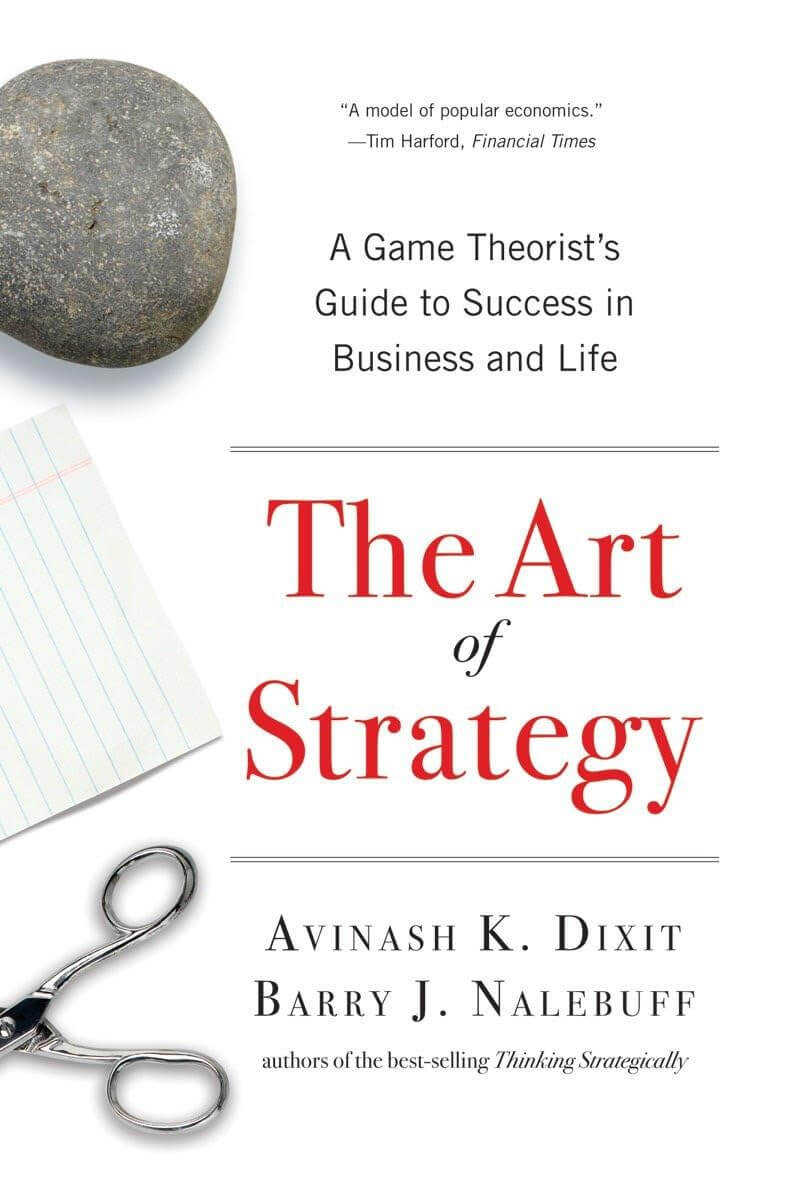
The Art of Strategy Book Summary
This The Art of Strategy Book Summary covers the key ideas, lessons, and takeaways in about 20 minutes.
The book’s central lesson is that many failures—price wars, environmental collapse, destructive rivalries—are not caused by ignorance or malice, but by misaligned incentives. By redesigning games through rules, commitments, information, and institutions, individuals and societies can escape self-defeating patterns and create more stable, mutually beneficial outcomes.
Ultimately, strategy is not about manipulation or dominance. It is about clarity: seeing the structure beneath surface chaos, understanding how choices interact, and acting with foresight rather than impulse. Those who master this way of thinking gain not just tactical advantage, but a deeper understanding of how the world works.
Helps with these goals
Want the complete 20-minute summary?
- Full structured summary
- Video Summary
- Podcast Summary
- Audio summary
- Key takeaways
- Exercises
- Quiz
- Highlights and notes
- Ask the book with AI
What is in the The Art of Strategy book summary?
Below is a preview of Sumizeit’s expert-written summary of The Art of Strategy by Avinash K. Dixit. The full summary covers the book’s key ideas in text, audio, and video.
The Art of Strategy presents strategy not as a collection of clever tricks, but as a disciplined way of interpreting situations where outcomes depend on the choices of multiple actors. Avinash K. Dixit and Barry J. Nalebuff argue that most conflicts, negotiations, competitions, and collaborations—whether in business, politics, or daily life—are best understood as strategic interactions. In these interactions, your success hinges not only on what you want, but on what others want, what they believe you will do, and what they think you believe they will do.
Rather than treating decisions as isolated calculations, the book reframes them as interconnected moves in a broader system. Every choice you make shapes the incentives and expectations of others, just as their choices constrain and redirect yours. Strategy, in this sense, is less about prediction and more about structured reasoning: identifying incentives, anticipating responses, and selecting actions that perform well across a range of possible reactions.
The authors emphasize that strategy is unavoidable. Even choosing not to think strategically is itself a strategic move—one that hands the advantage to others who do. Whether you are setting prices, negotiating a salary, choosing when to cooperate or defect, or deciding how firmly to commit to a position, you are already inside a game. The question is not whether you are playing, but whether you understand the rules well enough to play intelligently.
Games and Strategic Interdependence
At the core of the book is the concept of strategic interdependence. A situation qualifies as a “game” whenever each participant’s outcome depends on the actions of others. This definition expands the idea of games far beyond board games or sports, encompassing markets, elections, arms races, workplace dynamics, and even family decisions.
In these environments, no player controls outcomes alone. Your best move depends on what others do, and their best move depends on what they expect you to do. This mutual dependence creates a feedback loop of expectations and reactions. Strategic thinking requires stepping outside your own perspective and mentally occupying the vantage points of everyone else involved.
The authors stress that rationality in games does not imply cold calculation devoid of emotion. Real players are influenced by fear, pride, fairness, revenge, generosity, and reputation. Strategic reasoning must therefore account for psychological factors as well as material payoffs. Ignoring emotions can be just as costly as ignoring incentives.
Human Motivation and Context
One of the book’s most important insights is that people do not pursue self-interest in a simple or uniform way. While self-interest is a useful baseline assumption, it is not a complete model of human behavior. People care about fairness, social approval, moral identity, and long-term relationships, and these concerns often override immediate material gain.
Context matters enormously. When decisions threaten basic security—such as income, safety, or survival—behavior tends to skew toward narrow self-protection. In contrast, when interactions involve social standing, shared identity, or moral purpose, people are more likely to act cooperatively or even altruistically.
Strategic thinkers therefore must ask not only “What…
Want the complete 20-minute summary?
- Full structured summary
- Video Summary
- Podcast Summary
- Audio summary
- Key takeaways
- Exercises
- Quiz
- Highlights and notes
- Ask the book with AI
Who should read The Art of Strategy?
The Art of Strategy is for anyone navigating competitive or collaborative situations—business leaders, negotiators, policymakers, and individuals seeking to understand how their choices interact with others' incentives. Whether you're setting prices, managing teams, resolving conflicts, or planning your career, this book teaches you to think systematically about interdependence rather than in isolation.
Why does The Art of Strategy matter?
In a world of interconnected decisions and competing interests, most people rely on intuition or isolated analysis, leaving them vulnerable to predictable failures like price wars, environmental collapse, and destructive rivalries. The Art of Strategy by Avinash K. Dixit and Barry J. Nalebuff reveals that these breakdowns stem not from ignorance but from misaligned incentives—and shows how rigorous strategic thinking can reshape outcomes. By understanding the structure beneath surface chaos, you gain foresight rather than merely reacting to surprise.
What are the key themes in The Art of Strategy?
- Strategic interdependence: outcomes depend on what others choose and what they expect you to choose
- Zero-sum versus non-zero-sum interactions: distinguishing competition from cooperation
- Sequential versus simultaneous games: how visibility of moves changes strategy
- The prisoner's dilemma: how rational individual choices produce collectively worse outcomes
- Equilibrium and mutual expectations: why inefficient arrangements persist
- Commitment and the power of limiting options: how constraints create advantage
- Information, signaling, and credibility: why actions speak louder than words
- Institutional design: how rules, enforcement, and transparency support cooperation
What are the key lessons from the The Art of Strategy book summary?
Strategy is unavoidable in any situation with multiple decision-makers
Even choosing not to think strategically is itself a strategic move that hands advantage to those who do. You are always inside a game; the question is whether you understand the rules well enough to play intelligently.
Human motivation extends far beyond narrow self-interest
People care about fairness, social approval, moral identity, and relationships, which often override immediate material gain. Strategic thinkers must identify which motivations are salient in each situation, not just assume pure profit-seeking.
Context determines which motivations will drive behavior
When decisions threaten basic security, people tend toward self-protection. In social or moral contexts, people are more likely to cooperate. Understanding the stakes shapes your predictions and strategic design.
Backward reasoning maps out unintended consequences in sequential games
By imagining how others will react to each choice, you can eliminate paths leading to unfavorable outcomes. Starting with the desired end and reasoning backward forces clarity about trade-offs before they materialize.
Dominant strategies can trap you in collectively worse outcomes
A strategy that outperforms alternatives regardless of what others do may still produce inferior results for everyone. The prisoner's dilemma shows why individually rational defection can lead to mutual harm.
Equilibria are self-reinforcing even when unfair or inefficient
Stable outcomes arise when players' expectations align, but these need not be fair or optimal—they are simply self-perpetuating. Changing them requires coordinated shifts in belief, which are difficult without communication or leadership.
Focal points help coordinate choices when multiple equilibria exist
When several stable outcomes are possible, people gravitate toward options that feel natural, obvious, or symbolically significant. These culturally salient reference points break coordination deadlocks.
Shared resources collapse under open access without institutional support
When individual incentives favor overuse and enforcement is absent, common resources are depleted even though restraint would benefit all. Cooperation requires rules, monitoring, transparency, and credible sanctions.
Randomness prevents exploitation in adversarial contexts
Predictability is a weakness when opponents can anticipate and exploit your actions. Random inspections, patrols, or decisions increase compliance and prevent systematic advantage-taking.
Actions are stronger signals of credibility than words
Those with superior information can mislead through selective disclosure, but costly, observable actions are harder to fake. Focus on what people do and what it would cost them to be dishonest.
Voluntary constraints can strengthen your negotiating position
By making certain actions impossible or expensive, you change others' expectations and force adjustment. Public commitments and irreversible investments signal resolve and deter challenges.
Commitment requires matching resolve to circumstances
While inflexibility can create advantage, it also leaves you vulnerable if conditions change. Strategic commitment demands careful judgment about when rigidity gains leverage and when adaptability is more valuable.
Apparent irrationality can shift outcomes if it is credible
If others believe you may act in ways defying convention, they may avoid pushing you too far. However, empty threats damage reputation; only commit to actions you are genuinely willing to take.
Strategic credibility is a long-term asset built through consistency
Threats, commitments, and signals only work if you follow through reliably. Each fulfilled promise strengthens your credibility for future interactions; each broken promise weakens it permanently.
Many real-world failures stem from misaligned incentives, not malice
Price wars, environmental collapse, and destructive rivalries persist because systems reward defection and punish cooperation. Redesigning incentives through rules, institutions, and information can escape these traps.
Personal habits and relationships are strategic games with your future self
By designing environments that constrain temptation or reward desired behavior, you align short-term actions with long-term goals. Self-governance works best when you change the game, not just rely on willpower.
Information transparency transforms temptation into accountability
When participants can observe usage patterns and compliance, trust increases and enforcement costs fall. Visibility alone often deters opportunism more cheaply than active punishment.
Distinguishing zero-sum from non-zero-sum elements prevents costly mistakes
Most real interactions blend competition and cooperation. Treating non-zero-sum situations as purely competitive creates needless conflict; assuming cooperation where incentives are opposed leaves you vulnerable.
Simultaneous games require probabilistic reasoning rather than direct observation
When players act without knowing others' choices, you cannot wait to see what they do. Success depends on reasoning about what they likely will do based on incentives and expectations.
Strategy is clarity about structure, not cleverness or manipulation
True strategic intelligence lies in seeing the system beneath surface chaos, understanding how choices interact, and acting with foresight. Mastering this way of thinking reveals how the world actually works.
Want the complete 20-minute summary?
- Full structured summary
- Video Summary
- Podcast Summary
- Audio summary
- Key takeaways
- Exercises
- Quiz
- Highlights and notes
- Ask the book with AI
How can you apply ideas from The Art of Strategy?
- Use backward reasoning to map negotiation outcomes before making offers, anticipating counteroffers and identifying which concessions matter most to each party.
- Design pricing strategies by analyzing competitors' incentives, recognizing when price wars emerge from dominant-strategy dynamics rather than rational competition.
- Build institutional rules (monitoring, transparency, penalties) to align individual incentives with team or organizational goals in environments prone to free-riding.
- Make credible commitments in high-stakes situations by visibly constraining your options, signaling resolve in labor negotiations, conflict deterrence, or partnership agreements.
- Reshape personal habits and relationships by modifying your environment rather than relying on willpower—removing temptations, building accountability, and aligning short-term rewards with long-term goals.
- Evaluate information asymmetries by focusing on costly, hard-to-fake signals (warranties, guarantees, irreversible investments) rather than claims or promises.
- Coordinate teams around focal points—salient, culturally obvious choices—when multiple equilibria exist and communication is limited.
What common mistakes do readers make with The Art of Strategy?
- Assuming everyone is purely self-interested and profit-driven, ignoring that fairness, reputation, moral identity, and relationships often override material incentives.
- Blindly following dominant strategies without considering whether the entire system produces worse outcomes for all participants.
- Treating all interactions as zero-sum competition, missing opportunities to create value collaboratively or failing to recognize where rivalry is unavoidable.
- Making irreversible commitments without accounting for how circumstances might change, leaving yourself inflexible when adaptability would be more valuable.
- Relying on empty threats or promises that you cannot credibly enforce, damaging your reputation and inviting future defection by others.
Sumizeit Exercises Apply what you've learned
Turn ideas from The Art of Strategy into action with a short guided reflection: identify the biggest takeaway, connect it to your life, and commit to one step you can take in the next 24 hours.
What is the expert analysis of The Art of Strategy?
Overview
The Art of Strategy, authored by Avinash K. Dixit and Barry J. Nalebuff, stands as a seminal work in the field of strategic thinking, bridging rigorous economic theory and practical application. Dixit, a renowned economist with deep expertise in game theory, and Nalebuff, a strategist known for translating complex concepts into actionable insights, jointly craft a text that transcends traditional boundaries of business, politics, and everyday decision-making. Their collaboration yields a comprehensive exploration of strategy as a disciplined framework for understanding interdependent choices, making this book significant not only for scholars but also for practitioners seeking clarity in complex social interactions.
Core Thesis
The central argument of The Art of Strategy is that strategic thinking is essential for navigating any situation where outcomes depend on the actions and expectations of multiple actors. Rather than viewing decisions as isolated or purely competitive maneuvers, Dixit and Nalebuff reconceptualize them as moves within a dynamic system of incentives, beliefs, and potential reactions. Success arises from anticipating others’ responses, understanding the interplay of motivations beyond narrow self-interest, and designing strategies that remain robust amid uncertainty. The authors emphasize that strategy is unavoidable—choosing not to strategize is itself a strategic choice that cedes advantage.
Strengths
- Interdisciplinary Integration: The book masterfully synthesizes economic theory, psychology, and real-world examples, offering a nuanced view of human motivation that extends beyond simplistic rational actor models.
- Clarity and Accessibility: Complex concepts such as backward induction, equilibrium, and strategic stability are explained with lucid prose and relatable scenarios, making advanced game theory accessible to a broad audience.
- Comprehensive Scope: Covering zero-sum and non-zero-sum games, sequential and simultaneous moves, and institutional design, the text provides a versatile toolkit applicable across domains—from business negotiations to environmental policy.
- Practical Relevance: By emphasizing psychological factors, commitment devices, and the strategic use of randomness, the book equips readers with actionable insights that resonate beyond theoretical abstraction.
- Balanced View on Rationality: The acknowledgment that emotions and social norms influence strategic behavior enriches the traditional game-theoretic framework and aligns it more closely with observed human behavior.
Critiques & Counterarguments
- Potential Overreliance on Rationality: Although the authors incorporate psychological elements, the framework remains largely grounded in rational choice theory. Behavioral economics and recent findings on cognitive biases suggest that many decisions deviate systematically from rational strategic calculation, which the book only partially addresses.
- Complexity vs. Practicality: The backward reasoning and equilibrium concepts, while theoretically elegant, can become unwieldy in highly complex or large-scale real-world scenarios where information is incomplete or players are irrational, limiting direct applicability.
- Institutional Design Challenges: The book advocates for rules and enforcement mechanisms to sustain cooperation, yet it underestimates the difficulty of creating and maintaining such institutions in heterogeneous societies with conflicting interests and power asymmetries.
- Competing Schools of Thought: Alternative approaches such as evolutionary game theory emphasize adaptation and emergent behavior over deliberate strategic calculation, challenging the primacy of foresight and equilibrium concepts emphasized here.
- Empirical Contradictions: Real-world phenomena such as persistent cooperation in large anonymous groups or the breakdown of supposedly stable equilibria in financial markets suggest that factors like trust, culture, and irrational exuberance can override the strategic logic proposed.
Who Should Read This
The Art of Strategy is ideally suited for readers who seek a rigorous yet accessible introduction to strategic thinking grounded in economic theory but enriched by insights from psychology and social science. Business leaders, negotiators, policymakers, and academics will find its frameworks invaluable for understanding and influencing complex interactions. Additionally, intellectually curious individuals interested in the mechanics behind everyday decisions, from personal relationships to market competition, will appreciate the book’s clarity and depth. It is less suited for those seeking purely behavioral or descriptive accounts of decision-making divorced from formal strategic analysis.
Frequently asked questions about the The Art of Strategy book summary
What is The Art of Strategy about?
The Art of Strategy by Avinash K. Dixit and Barry J. Nalebuff teaches strategic thinking as a disciplined way of interpreting situations where outcomes depend on the choices of multiple actors. Rather than treating decisions in isolation, it reframes them as interconnected moves in a broader system where success depends on understanding others' incentives, expectations, and likely responses. The book covers everything from business and politics to personal habits and relationships, showing how to anticipate consequences and redesign systems to escape self-defeating patterns.
Who should read The Art of Strategy?
The Art of Strategy is for business leaders, negotiators, policymakers, and anyone navigating competitive or collaborative situations where their success depends on others' choices. It applies to career planning, salary negotiations, team management, conflict resolution, environmental policy, and even personal habit formation. Whether you're setting prices, designing institutions, or managing relationships, the book teaches you to think systematically about how choices interact rather than in isolation.
What are the main takeaways from The Art of Strategy?
The main takeaways include: understanding strategic interdependence is essential to success; many real-world failures stem from misaligned incentives rather than ignorance or malice; outcomes can be reshaped through rules, commitments, information, and institutional design; equilibria are self-reinforcing even when inefficient, making coordination difficult; and strategic intelligence lies in seeing structure beneath chaos and acting with foresight. The book shows that success comes from anticipating responses, recognizing where interests align or conflict, and choosing actions that remain effective across uncertainty.
What is the prisoner's dilemma and why does it matter?
The prisoner's dilemma is a situation where individually rational choices produce collectively worse outcomes. Each participant has an incentive to act selfishly, yet when all do so, everyone ends up worse off than if they had all cooperated. It appears in price wars, arms races, environmental degradation, and workplace competition, revealing why trust, enforcement, and repeated interaction matter. The dilemma shows that misaligned incentives, not malice or ignorance, cause many real-world failures.
How can I use commitment to strengthen my position?
You can voluntarily limit your options through public promises, irreversible investments, or visible constraints, which signal resolve and force others to adjust their behavior. A commitment device makes certain actions impossible or expensive, changing others' expectations and often leading them to concede rather than test your resolve. However, commitment is risky: if circumstances change, inflexibility becomes costly, so you must carefully judge when rigidity creates advantage and when adaptability is more valuable.
What is the difference between zero-sum and non-zero-sum situations?
In zero-sum situations, one person's gain is exactly another's loss, with a fixed total to be divided—like competitive sports or winner-take-all contests. Non-zero-sum situations allow for mutual gain or mutual loss, such as trade, collaboration, and partnerships where parties can create value together. Most real-world interactions blend both: cooperation can expand the pie while competition determines how it is divided. Recognizing which elements are zero-sum prevents treating cooperative opportunities as pure competition.
How can institutions support cooperation on shared resources?
Institutions can sustain cooperation by clearly defining membership, permissible actions, and consequences for violations. Effective systems balance enforcement (even modest penalties applied consistently) with information transparency, allowing participants to observe usage patterns and compliance. Clear rules, credible enforcement, and visibility transform private temptation into public accountability, reducing incentives to cheat and reassuring others that they can also comply without being exploited.
Why do inefficient or unfair outcomes persist?
Inefficient or unfair outcomes persist because they are equilibria—self-reinforcing patterns where each person's strategy makes sense given what others are doing. Changing them requires coordinated shifts in expectations, which are difficult to achieve without communication, leadership, or new information. Even when all parties would prefer a different outcome, the mutual expectation trap keeps them locked in place. Understanding this explains why outdated norms, harmful practices, and inefficient standards are so resistant to change.
About Sumizeit
Sumizeit is a profitable Scomy LLC company based in Miami, Florida. It has been helping readers learn from nonfiction books for 7 years with expert-written summaries in text, audio, podcast, and video.
Want the complete 20-minute summary?
- Full structured summary
- Video Summary
- Podcast Summary
- Audio summary
- Key takeaways
- Exercises
- Quiz
- Highlights and notes
- Ask the book with AI
Here's why readers love Sumizeit
Join thousands of learners getting smarter every day
"Great experience. Detailed summaries. Loved the gamification feature. Makes learning fun. Good customer service. I recommend Sumizeit to anyone. You'll learn a lot."
"I always felt busy but still wanting to keep up with the book discussion in my friend group. This was a great supplement to help me keep reading the books I find fun while keeping up with important books."
"I love this website. Instead of scrolling social media, I find myself learning a lot. I use it everyday. I recommend this app for anyone who is too busy and wants to get up to speed with their favorite books."
The Art of Strategy Book Summary PDF
Looking for a The Art of Strategy Book Summary PDF you can save and revisit offline? Our The Art of Strategy Book Summary PDF captures the book’s core ideas in a clean, printable format — the key frameworks, takeaways, and structure without the fluff. Download the The Art of Strategy Book Summary PDF when you want a reference you can annotate, share with your team, or review on the go. Get your The Art of Strategy Book Summary PDF from the download page below.
Download The Art of Strategy Book Summary PDFPeople also liked these summaries
Readers who explored The Art of Strategy often enjoyed these titles next.





Want the complete 20-minute summary?
- Full structured summary
- Video Summary
- Podcast Summary
- Audio summary
- Key takeaways
- Exercises
- Quiz
- Highlights and notes
- Ask the book with AI
Featured Book Titles
Popular Book Summaries at sumizeit, leading book summary app