


As an Amazon Associate, Sumizeit earns from qualifying purchases.
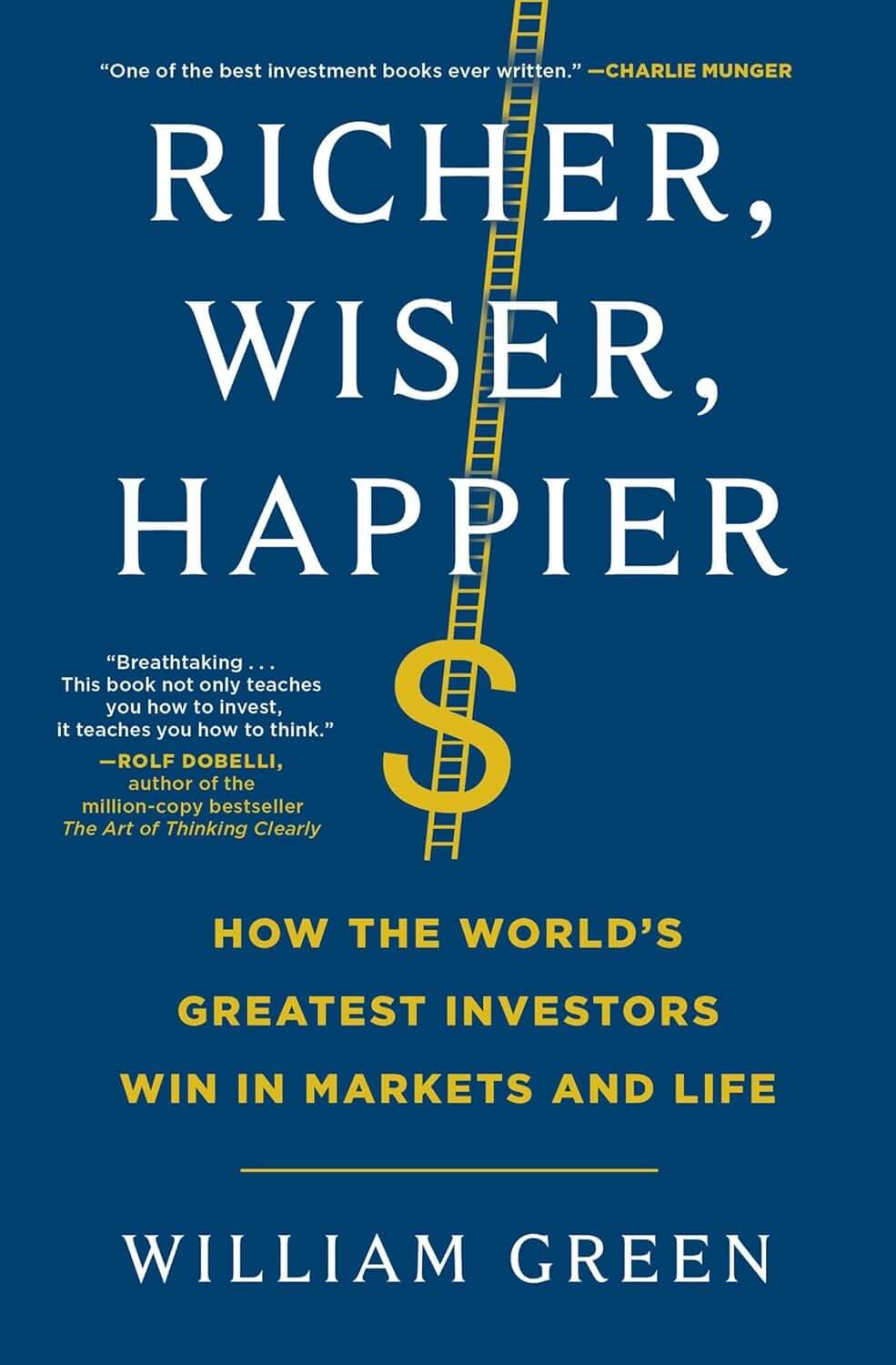
Richer, Wiser, Happier Book Summary
This Richer, Wiser, Happier Book Summary covers the key ideas, lessons, and takeaways in about 20 minutes.
Financial mastery and inner calm are not separate goals—they reinforce each other. Wealth grows fastest in environments of patience and clarity, while emotional stability improves when one is financially secure. The habits that build money—discipline, reflection, curiosity, integrity—also build a meaningful life. To become richer in resources, one must first become richer in wisdom. When wisdom deepens, happiness follows naturally.
Helps with these goals
Want the complete 20-minute summary?
- Full structured summary
- Video Summary
- Podcast Summary
- Audio summary
- Key takeaways
- Exercises
- Quiz
- Highlights and notes
- Ask the book with AI
What is in the Richer, Wiser, Happier book summary?
Below is a preview of Sumizeit’s expert-written summary of Richer, Wiser, Happier by William Green. The full summary covers the book’s key ideas in text, audio, and video.
William Green’s Richer, Wiser, Happier is less a book about stock markets and more a guide to building a life anchored in wisdom, resilience, and meaningful wealth. Instead of treating investing like a cold numerical pursuit, Green examines the world’s greatest investors as models of thought, behavior, and philosophy. Through years of interviews, conversations, and observations of icons such as Warren Buffett, Charlie Munger, Sir John Templeton, Mohnish Pabrai, and many others, Green uncovers an unexpected truth: people who accumulate extraordinary fortunes are not only skilled at finance—they are thinkers who cultivate their minds, manage decisions with clarity, and protect their well-being as carefully as they protect capital. Wealth, in this sense, becomes a byproduct of character development.
The book reveals three central pillars that define these exceptional investors:
They nurture learning throughout their lives.
They refine the way they think and choose.
They grow wealth slowly and guard it deliberately.
Green’s work blends financial strategy with personal growth, illustrating how the principles behind great investing also serve as tools for living a calmer, stronger, and more deliberate life. In the summary below, we will explore these concepts in depth.
The Investor’s Edge Begins in the Mind
World-class investors tend to view the mind as the ultimate asset. Money can be gained or lost; opportunities come and go. But thinking—disciplined, curious, structured thinking—is the engine that generates long-term results. Green notes that brilliant investors rarely assume they already know enough. They treat learning as oxygen, something required not only for financial survival but for personal evolution.
The highest performers do not passively consume information. They develop routines that transform knowledge into something usable. This approach involves three core habits: scheduled learning, broad intellectual exploration, and learning from those already ahead of us.
A Life Built Around Learning
Instead of hoping knowledge will appear by accident, elite investors carve space for it on purpose. Many dedicate part of each day to reading, study, reflection, and quiet thinking. Green points out that it’s not simply reading large amounts that strengthens the intellect—but reading deliberately. Taking notes, pausing to reflect, and applying insights to real problems turns information into understanding.
Structured learning time sharpens attention, deepens analytical ability, and trains the brain to see connections. When you routinely expose yourself to new ideas, patterns become easier to spot. Lessons compound just like capital in an account left to grow untouched.
Modern distractions make deep focus difficult, but that is exactly why it becomes a competitive advantage. When you give your full attention to a book, a compelling idea, or a problem you’re trying to solve, the mind processes information more efficiently. Instead of juggling multiple tasks, you allow the brain to immerse fully, which leads to insight rather than shallow familiarity.
Investors who commit to lifelong learning view education as fuel. Knowledge is not entertainment—it is a strategic resource.
Thinking Beyond Finance
Another striking trait among the wealthy investors Green studied is how broadly they read.
Want the complete 20-minute summary?
- Full structured summary
- Video Summary
- Podcast Summary
- Audio summary
- Key takeaways
- Exercises
- Quiz
- Highlights and notes
- Ask the book with AI
Who should read Richer, Wiser, Happier?
Richer, Wiser, Happier is for anyone seeking to improve their financial decision-making and overall life quality, regardless of current wealth level. It appeals equally to aspiring investors, seasoned professionals feeling stuck in their approach, and people who want to develop better thinking habits and emotional discipline. If you're interested in how the world's greatest investors think—not just what stocks they buy—this book offers a masterclass in applied wisdom.
Why does Richer, Wiser, Happier matter?
In an age of financial noise, algorithmic trading, and get-rich-quick schemes, William Green's exploration of timeless investing principles offers a counterintuitive truth: wealth accumulation is inseparable from personal development. The book matters because it reframes investing from a technical pursuit into a holistic journey about building character, managing emotions, and living deliberately. As markets grow more complex and distractions multiply, the mental disciplines Green explores—structured learning, rational decision-making, ethical consistency—have become rarer and therefore more valuable.
What are the key themes in Richer, Wiser, Happier?
- Lifelong learning as a competitive advantage
- Emotional discipline and rational decision-making
- Long-term thinking and compound growth
- Integrity and ethical behavior as wealth protection
- Accepting uncertainty while preparing for failure
- Physical and mental health as economic safeguards
- Values-driven decision-making
- The difference between skill and luck in outcomes
What are the key lessons from the Richer, Wiser, Happier book summary?
The Mind Is Your Ultimate Asset
Great investors prioritize disciplined, curious thinking above all else. Unlike money or opportunities, superior thinking compounds indefinitely and creates the conditions for long-term success.
Deliberate Learning Beats Passive Consumption
Reading is not enough; you must take notes, reflect, and apply insights to real problems. Intentional learning transforms information into usable understanding and sharpens your analytical abilities.
Intellectual Diversification Creates Better Decisions
Reading broadly across philosophy, psychology, history, and science provides more mental tools than specializing in one domain. Cross-pollination of ideas sparks creativity and helps you detect patterns others miss.
Deep Focus Is a Rare Competitive Edge
In a distracted world, the ability to give full attention to complex ideas or problems is increasingly valuable. Immersive thinking leads to genuine insight rather than shallow familiarity.
Learn From Those Already Ahead of You
Studying the decisions and philosophies of successful people accelerates growth far beyond trial-and-error learning. You don't need to reinvent what others have already perfected.
Acknowledge Luck to Make Better Decisions
Accepting that randomness plays a role in outcomes prevents arrogance and encourages caution. This humility leads to more measured, risk-aware decision-making.
Probability Over Perfection
Since outcomes are uncertain, focus on choosing options with the most favorable probability over time rather than seeking guaranteed success. This shifts mindset from perfectionism to realistic optimization.
Emotions Must Be Managed, Not Eliminated
Rationality doesn't eliminate emotion; it overrides it with structure. Great investors examine decisions logically, resisting fear-driven selling and greed-driven buying.
Cognitive Biases Distort Your Judgment
Confirmation bias and other mental shortcuts lead you to seek information supporting existing views while ignoring contradictory evidence. Active awareness and seeking opposing data strengthens decision quality.
Physical Health Directly Impacts Financial Decisions
Sleep, nutrition, and exercise are economic safeguards, not luxuries. A well-rested, nourished brain makes better choices and avoids costly impulsive thinking.
Values Serve as a Decision Filter
Knowing what you stand for—security, integrity, innovation—helps you choose investments and opportunities aligned with your principles. This creates sustainable confidence and reduces regret.
Ethical Behavior Is Strategic, Not Just Moral
Acting with integrity protects reputation and builds long-term trust, creating environments where compounding can work. Ethical behavior is the ultimate risk-management tool.
Reflect on Decisions to Expose Patterns
Analyzing past choices—separating skill from luck, flawed reasoning from uncontrollable circumstances—turns experience into actionable insight and prevents repetition of avoidable errors.
Visualize Failure to Build Resilience
Imagining worst-case scenarios and reverse-engineering how they might occur allows you to take preventive steps while risk is still hypothetical. This builds preparedness rather than fear.
Compounding Requires Patience, Not Bold Gambles
Extraordinary returns come from small advantages compounded over decades, not from constant trading or risky bets. Time is the investor's greatest ally.
Specialization or Diversification—Both Require Intention
Whether you focus deeply on one domain or spread investments widely, success requires deliberate strategy, not randomness. Balance is an art rather than a fixed formula.
Research Transforms Uncertainty Into Informed Risk
Understanding fundamentals—revenue, debt, leadership, competitive advantages—converts gambling into calculated decision-making. Knowledge reduces vulnerability to hype and market noise.
Transparency Is a Reliability Signal
Companies with clear communication, honest leadership, and straightforward reporting tend to operate more responsibly. Obscure language often hides problems.
A Safety Margin Protects Against Mistakes
Value investing—buying assets below intrinsic worth—creates cushion against price declines and increases upside potential. This margin reduces risk while improving returns.
Living Below Your Means Is Financial Armor
Spending discipline and accessible reserves allow you to remain calm during downturns and wait patiently for recovery. Frugality creates freedom, not deprivation.
Want the complete 20-minute summary?
- Full structured summary
- Video Summary
- Podcast Summary
- Audio summary
- Key takeaways
- Exercises
- Quiz
- Highlights and notes
- Ask the book with AI
How can you apply ideas from Richer, Wiser, Happier?
- Create a daily or weekly reading routine focused on diverse domains, taking notes and reflecting on how ideas apply to your decisions
- Identify one successful investor or mentor whose thinking aligns with yours, and systematically study their major decisions and philosophies
- Before making significant investments, write down your assumptions and then actively search for evidence that contradicts them
- Establish non-negotiable health habits—sleep schedule, exercise routine, nutrition standards—as foundational to decision quality
- Document your past financial decisions, rating each as driven by skill versus luck, and identify patterns in your judgment that need correction
- Conduct a values audit to clarify what principles matter most to you, then use this list to filter new opportunities
- Practice the pre-mortem technique by imagining a potential investment failing and listing all the ways it could happen, then address each risk
- Build a cash reserve and reduce debt to create emotional freedom during market volatility and financial stress
What common mistakes do readers make with Richer, Wiser, Happier?
- Confusing passive reading with active learning; consuming information without reflection, notes, or application leaves no lasting understanding
- Letting short-term market noise override your long-term thinking, causing you to sell during downturns or chase hot trends
- Making investment decisions while emotionally triggered, hungry, tired, or stressed, which invites impulsive choices you'll regret
- Building a portfolio without truly understanding the fundamentals of what you own, treating it as gambling rather than informed risk-taking
- Pursuing returns that conflict with your personal values, creating internal friction and unsustainable decision patterns
Sumizeit Exercises Apply what you've learned
Turn ideas from Richer, Wiser, Happier into action with a short guided reflection: identify the biggest takeaway, connect it to your life, and commit to one step you can take in the next 24 hours.
What is the expert analysis of Richer, Wiser, Happier?
Overview
Richer, Wiser, Happier is authored by William Green, a seasoned financial journalist with an extensive background writing for prestigious outlets such as Time, Fortune, Forbes, and The New Yorker. Green’s work transcends traditional investment manuals by weaving together finance, psychology, and philosophy to explore how the world’s most successful investors cultivate not only wealth but also wisdom and well-being. This book stands out as a significant contribution to the literature on investing and self-improvement because it reframes financial success as a holistic pursuit rooted in character development rather than mere technical prowess.
Core Thesis
At its core, Richer, Wiser, Happier argues that extraordinary financial success is inseparable from the cultivation of disciplined thinking, continuous learning, emotional regulation, ethical integrity, and deliberate decision-making. Green posits that wealth accumulation is a byproduct of personal growth and mental mastery. The book identifies three pillars that define exceptional investors: lifelong learning, refined decision-making processes, and cautious yet persistent wealth growth. Ultimately, it presents investing as a philosophy for living a calmer, more purposeful, and resilient life.
Strengths
- Interdisciplinary Approach: Green’s synthesis of investing with psychology, philosophy, and ethics enriches the traditional finance narrative, offering readers a multidimensional framework for understanding success.
- Rich Case Studies: The detailed profiles of iconic investors such as Warren Buffett, Charlie Munger, and John Templeton provide concrete examples that ground abstract principles in lived experience.
- Emphasis on Character and Mindset: The book’s focus on emotional stability, ethical behavior, and values as foundational to wealth-building challenges the often narrow, numbers-driven discourse in investment literature.
- Practical Wisdom: Green’s insights into habits like deliberate learning, reflection, and planning for failure offer actionable strategies that extend beyond investing into broader personal development.
- Balanced View of Risk and Uncertainty: The acceptance of randomness and the focus on probabilistic thinking provide a mature perspective often missing in investment advice, fostering humility and resilience.
Critiques & Counterarguments
- Potential Overemphasis on Elite Investors: By focusing predominantly on a small group of extraordinarily successful investors, the book risks survivorship bias, potentially overlooking the role of structural factors and luck in wealth accumulation.
- Limited Engagement with Behavioral Finance Contradictions: While the book discusses cognitive biases, it does not deeply engage with research showing how even disciplined investors can fall prey to systematic errors, nor does it address the challenges of consistently applying rationality under stress.
- Philosophical Idealism vs. Market Realities: The ethical and character-driven approach may be aspirational but could underestimate the competitive, sometimes ruthless nature of markets where moral compromises occasionally yield short-term gains.
- Oversimplification of Diversification Strategies: The discussion on specialization versus diversification, while insightful, could benefit from a more nuanced treatment of portfolio theory, including quantitative risk management and the evolving complexity of global markets.
- Neglect of Socioeconomic Context: The book largely treats investing as an individual endeavor, with limited consideration of systemic inequalities, access to capital, or macroeconomic forces that constrain or enable wealth-building.
Who Should Read This
Richer, Wiser, Happier is ideally suited for sophisticated readers who seek a deeper understanding of investing beyond technical analysis—those interested in the psychological and ethical dimensions of wealth. It appeals to investors, financial professionals, and thoughtful readers of self-improvement literature who value character development as integral to success. Additionally, anyone curious about how disciplined thinking and lifelong learning underpin not only financial returns but also personal fulfillment will find this book enriching. It is less appropriate for readers seeking quick financial tips or purely quantitative strategies.
Frequently asked questions about the Richer, Wiser, Happier book summary
What is Richer, Wiser, Happier about?
Richer, Wiser, Happier by William Green is a book that explores how the world's greatest investors think and live, revealing that financial success stems from cultivating the mind, managing emotions, and developing character. Rather than focusing on stock tips or market predictions, Green examines the habits and philosophies of legendary investors like Warren Buffett and Charlie Munger to show how discipline, continuous learning, ethical behavior, and long-term thinking create both wealth and fulfillment. The book argues that becoming financially successful and becoming a better person are deeply interconnected journeys.
Who should read Richer, Wiser, Happier?
This book is ideal for anyone interested in improving their financial thinking and decision-making, from novice investors to seasoned professionals seeking fresh perspective. It appeals to readers who want to understand the philosophical foundations of wealth-building rather than quick tips, and to anyone looking to develop greater discipline, emotional balance, and intentional living. Even if you have no interest in investing, the book's lessons about learning, decision-making, and living with purpose apply broadly to personal and professional success.
What are the main takeaways from Richer, Wiser, Happier?
The core takeaways are that investing success comes from lifelong learning, emotional discipline, rational decision-making, and ethical behavior rather than secret strategies or market predictions. William Green shows that great investors protect their mental and physical health, accept uncertainty while preparing for failure, and let compounding work over decades rather than seeking quick returns. The book's central insight is that financial mastery and personal development reinforce each other—to become richer in resources, you must first become richer in wisdom.
How does Richer, Wiser, Happier connect investing to happiness?
Green reveals that the greatest investors are often calm, fulfilled individuals because their wealth serves a deeper purpose beyond accumulation. Financial security provides freedom—freedom to think, learn, be generous, and work intentionally without constant fear. The book shows that the habits that build wealth—discipline, integrity, curiosity, emotional stability—also create meaning and peace. When you have financial security aligned with your values, the anxiety disappears and happiness naturally follows.
What role does learning play in Richer, Wiser, Happier?
Learning is presented as the foundation of everything else in the book. William Green emphasizes that great investors treat continuous learning as non-negotiable, reading broadly across many disciplines and reflecting deeply on what they learn. This habit of curiosity and intellectual exploration provides more mental tools for problem-solving, helps investors spot opportunities others miss, and maintains the mental sharpness required for good decision-making. Learning is framed not as entertainment but as a strategic resource that compounds like capital.
How does Richer, Wiser, Happier address risk and uncertainty?
Rather than pretending risk can be eliminated, the book teaches that accepting uncertainty and preparing for it creates resilience. William Green shows that legendary investors acknowledge luck's role while focusing on what they can control—research, discipline, and emotional stability. The book introduces techniques like pre-mortems (imagining failure and reverse-engineering its causes) and emphasizes building safety margins through diversification, fundamental research, and living below your means. This approach transforms uncertainty from something to fear into something to prepare for intelligently.
Can the lessons from Richer, Wiser, Happier apply beyond investing?
Absolutely. While the book uses investing as its framework, the underlying principles apply to any major life decision—career choices, relationships, health, personal development. The lessons about managing emotions, continuous learning, ethical decision-making, long-term thinking, and accepting uncertainty are universal. William Green's core message is really a philosophy for living deliberately and building a meaningful life, which investors happen to practice particularly well.
About Sumizeit
Sumizeit is a profitable Scomy LLC company based in Miami, Florida. It has been helping readers learn from nonfiction books for 7 years with expert-written summaries in text, audio, podcast, and video.
Want the complete 20-minute summary?
- Full structured summary
- Video Summary
- Podcast Summary
- Audio summary
- Key takeaways
- Exercises
- Quiz
- Highlights and notes
- Ask the book with AI
Here's why readers love Sumizeit
Join thousands of learners getting smarter every day
"Great experience. Detailed summaries. Loved the gamification feature. Makes learning fun. Good customer service. I recommend Sumizeit to anyone. You'll learn a lot."
"I always felt busy but still wanting to keep up with the book discussion in my friend group. This was a great supplement to help me keep reading the books I find fun while keeping up with important books."
"I love this website. Instead of scrolling social media, I find myself learning a lot. I use it everyday. I recommend this app for anyone who is too busy and wants to get up to speed with their favorite books."
Richer, Wiser, Happier Book Summary PDF
Looking for a Richer, Wiser, Happier Book Summary PDF you can save and revisit offline? Our Richer, Wiser, Happier Book Summary PDF captures the book’s core ideas in a clean, printable format — the key frameworks, takeaways, and structure without the fluff. Download the Richer, Wiser, Happier Book Summary PDF when you want a reference you can annotate, share with your team, or review on the go. Get your Richer, Wiser, Happier Book Summary PDF from the download page below.
Download Richer, Wiser, Happier Book Summary PDFPeople also liked these summaries
Readers who explored Richer, Wiser, Happier often enjoyed these titles next.



Want the complete 20-minute summary?
- Full structured summary
- Video Summary
- Podcast Summary
- Audio summary
- Key takeaways
- Exercises
- Quiz
- Highlights and notes
- Ask the book with AI
Featured Book Titles
Popular Book Summaries at sumizeit, leading book summary app
